New Mexico Nonresident OHV Permit Cost
New Mexico’s nonresident OHV permit may cost nothing if your home-state registration qualifies for reciprocity. Otherwise, visitors can choose between a short-term and longer-term permit, with a separate paved-road permit to consider. The key is identifying which rule applies to each machine before you ride, so you don’t pay for the wrong permit or mistake it for permission to use any road.
New Mexico nonresident OHV permit costs
The listed nonresident permit options are a 90-day permit for $18 and a two-year permit for $48. A separate paved-road permit is listed at $7. Because fees and eligibility can change, confirm the current amounts and requirements with the New Mexico agency responsible for OHV permits before purchasing.
| Permit option | Listed cost | Best suited to | Important distinction |
|---|---|---|---|
| 90-day nonresident OHV permit | $18 | A shorter visit or a limited riding season | Covers the eligible permit period, not every kind of road use |
| Two-year nonresident OHV permit | $48 | Visitors who expect to ride over a longer period or return | Check the permit’s start and expiration dates |
| Paved-road permit | $7 | A rider who separately qualifies for permitted paved-road use | Does not make every street or highway legal for an OHV |
The 90-day and two-year options are for nonresidents whose machines need a New Mexico OHV permit. They are not automatically required of every visitor. If your machine has a valid registration from a state whose OHV program New Mexico recognizes, you may not need to buy a New Mexico nonresident permit. That distinction can make the difference between paying for a permit and simply carrying proof of your home-state registration.
The $7 paved-road permit is a different item from the general nonresident OHV permit. Don’t assume it replaces the permit needed for off-highway riding, or that buying it gives you blanket permission to ride on public roads. Road access depends on New Mexico’s separate rules about eligible streets, local authorization, equipment and insurance. Check New Mexico’s $7 Paved Road Permit and New Mexico Paved Road Plate Requirements before treating a paved-road permit as part of your riding plan.
Fees are generally tied to the machine’s permit requirements, not a single group’s trip budget. If several ATVs or UTVs are travelling together, check what each one needs; don’t assume that one permit covers every vehicle. A rental machine may also have its own permit or registration status, so ask the rental provider what is already in place. New Mexico Rules for a Rented Machine covers that separate question.
Who needs to pay and how reciprocity works
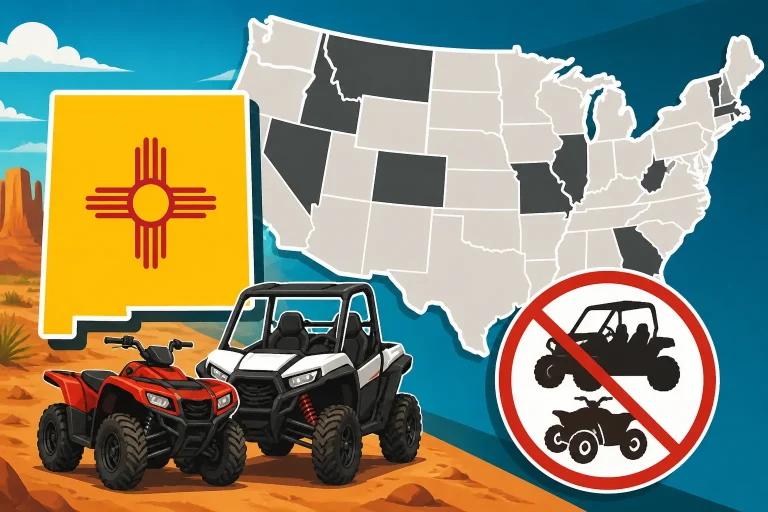
New Mexico’s nonresident permit requirement depends largely on whether the machine’s home state has an OHV registration or permit program that New Mexico recognizes. A valid out-of-state registration may satisfy the requirement for a visiting rider. If the machine comes from a state without a qualifying program, its operator may need to buy a New Mexico nonresident permit before riding where one is required.
This is why a visitor shouldn’t decide based only on where they live. The relevant question is what registration or permit the specific machine carries, and whether that credential qualifies under New Mexico’s reciprocity rules. For example, the reference information identifies Arizona, Colorado, Texas and Utah as states whose valid OHV registrations are honored. Still, verify the current rule and carry the registration document or other required proof with you. A machine’s home-state plate or decal may not, on its own, show the details an officer needs to confirm.
For a broader explanation, see New Mexico OHV Reciprocity Rules and Riding New Mexico With an Out-of-State Registration. If you want to check a specific neighboring state, the site also has focused pages on Does New Mexico Honor Arizona OHV Registration?, Does New Mexico Honor Colorado OHV Registration? and Does New Mexico Honor Texas Registration?.
Visitors from a state without an OHV program should pay particular attention to the permit rule. New Mexico’s permit options give those riders a way to meet its nonresident requirement, but they still need to select the right permit period and use it only for the machine and activities it covers. A two-year permit may make sense for repeat visits; a 90-day permit may suit a one-time trip. Neither option gives a rider permission to ignore trail closures, land-access rules or road restrictions.
A valid permit or registration is also not the same as permission to ride everywhere. A machine can be properly documented and still be barred from a particular road, trail, parcel or route. Public land agencies set their own route and access rules, and private and tribal lands have separate permission requirements. Before you leave the staging area, confirm both that the machine has the right paperwork and that your planned route is open to it.
For a quick eligibility check, use this order:
- Identify the state where the machine is registered or permitted.
- Confirm that the registration is current and applies to that machine.
- Check whether New Mexico recognizes that state’s OHV program.
- If it does not qualify, compare the nonresident permit periods and purchase the correct permit.
- Check whether your planned riding includes a paved-road segment requiring a separate permit or other authorization.
- Carry the required proof while riding.
This is a practical screening process, not a replacement for confirming the current requirements. A registration that has expired, belongs to another machine or doesn’t meet the state’s rules may not qualify for reciprocity.
Choosing between the 90-day and two-year permits
If you need a New Mexico nonresident OHV permit, choose based on when and how often you expect to ride, not just the first trip on your calendar. The 90-day permit is the shorter option. The two-year permit lasts longer and may be more convenient for someone planning several visits, but its value depends on your expected use and the current fee.
Before choosing, check how the permit period is counted. Don’t assume it starts on the date you first ride or ends at the end of a calendar year. Confirm the start date, expiration date and any instructions shown during purchase. The page Counting the Ninety Days on a Visitor Permit addresses the short-term option, while What Happens When a Two-Year Permit Runs Out explains the longer permit’s expiration issue.
A simple cost comparison can help, but only after you’ve confirmed that you actually need a New Mexico permit. If reciprocity applies, buying a permit may be unnecessary. If it doesn’t, compare the permit’s current price with the length of time you expect to ride. A short trip generally points toward the 90-day option; repeat trips or a longer stay may make the two-year option easier to manage. Don’t select a permit based on an old receipt or a price quoted for another kind of permit.
Use the official permit channel for the purchase and follow its directions for the machine information and proof required. Keep a copy of the confirmation and the permit details accessible while travelling. If the permit is issued as a decal or other physical credential, follow the instructions for displaying it. A receipt that shows you paid may not replace a required permit displayed on the vehicle.
If you are unsure whether your machine’s home-state registration qualifies, resolve that before buying. Have the registration document available and check the official guidance for your state of registration. If you cannot establish that the machine is covered by reciprocity, contact the permit provider or the relevant agency rather than guessing at the counter or trailhead. Do Visitors Need a New Mexico OHV Permit? is another useful starting point.
What the permit does and does not authorize
The nonresident permit addresses an OHV paperwork requirement. It does not turn an ATV or UTV into a street-legal vehicle, open a closed route, or grant access to land where riding is prohibited. Those are separate questions, and they can depend on the kind of road, who manages the land and what local rules apply.
In particular, a paved-road permit should not be treated as a general road pass. New Mexico restricts OHV use on many roads, and a local opening or other specific authorization may be needed for a particular route. State highways have their own restrictions. Before planning a route that uses pavement, check New Mexico’s Paved Street Opt-In and Why New Mexico State Highways Are Off Limits. Then confirm the road’s status with the relevant local or land-management authority.
The permit also does not replace any separate rider requirement. For example, young riders may have safety-training or supervision requirements, and road use may bring additional equipment, insurance and age rules. If a minor will ride, check New Mexico’s Safety Permit for Under-18 Riders. For paved-road travel, review Insurance New Mexico Requires on Pavement and the rules that apply to your particular machine and rider.
Finally, public-land access often depends on using designated, open routes. A valid permit does not authorize cross-country riding where it is not allowed, and it does not override seasonal closures, fire restrictions or land-management signs. Check current maps and closures for the area before setting out. If your trip crosses more than one type of land, such as federal, state, tribal or private land, verify access for each segment.
The most reliable way to plan the cost is to separate the questions: Does the machine qualify for reciprocity? If not, which nonresident permit period fits the trip? Is a paved-road permit or other road authorization needed? What additional rider and land-access rules apply? Answering those questions before departure helps avoid paying for the wrong credential and reduces the risk of reaching a route the machine cannot legally use.
Disclaimer
This article is for general informational purposes only and does not constitute professional advice. Laws, prices and regulations vary by location and change over time. Consult a qualified professional for guidance on your specific situation.