New Mexico Rules for a Rented Machine
Renting an ATV or UTV in New Mexico does not automatically make every road or trail legal to ride. The machine may need current registration or a nonresident permit, and the rules change with the land, route, rider’s age, and rental agreement. This guide explains what to confirm before pickup, what to carry, and how to avoid assuming the rental company’s permission covers your whole trip.
Start With the Machine’s Registration and Permit
Before you set off, find out what paperwork applies to the specific ATV or UTV you’re renting. A rental machine may already have the required New Mexico registration or permit, but do not assume that it does—or that a shop’s paperwork covers every kind of riding you have planned.
Ask the rental company to identify the machine’s current registration or permit and explain where it is valid. If the answer is unclear, ask to see the paperwork or the machine’s decal. You want to know that the identification belongs to that vehicle and is current, not just that the business generally rents machines for use in New Mexico.
The rules can differ depending on where the machine is registered and where you plan to ride. A New Mexico-registered rental machine is not the same thing as bringing a personally owned machine across the state line. For a visitor’s own vehicle, New Mexico’s recognition of another state’s registration and its nonresident permit requirements may matter. Read New Mexico’s Broad OHV Reciprocity and New Mexico’s Nonresident OHV Permit if you are bringing your own machine or need to understand how those rules work.
Questions to ask at pickup
Before signing and leaving the rental counter, ask:
- Is this machine currently registered or permitted for the riding area I’m using?
- Is the registration or permit attached to this specific machine?
- Where is the decal or other required identification displayed?
- What document should I carry while riding?
- Does the machine’s paperwork cover public-land riding, or only some areas?
- Are there separate rules for the route, forest, or town I’m heading to?
- If I take the machine to a different area, do I need an additional permit or permission?
A useful answer is specific: the staff member should be able to tell you what the machine’s status is and what riding it is approved for. “It’s a rental, so you’re fine” is not enough. The rental company may know its fleet well, but you are still responsible for following restrictions at your destination.
Registration is not a universal access pass
Registration or an OHV permit establishes only part of the picture. It does not automatically open every public road, trail, parcel, or town street to motorized use. A registered machine can still be prohibited from a closed route, a restricted land area, or a road that does not allow OHVs.
The same distinction applies to equipment and rider rules. A machine may have a current decal but still be unsuitable for a route because of its width, equipment, or the conditions on the ground. A rental contract may also limit where you can take it, even if a route is legally open to some OHVs.
Treat paperwork as one requirement among several:
- Confirm the machine’s registration or permit.
- Confirm that the route is open to the machine type.
- Confirm that each rider meets applicable age, supervision, and equipment rules.
- Follow the rental company’s limits and return instructions.
If you are unsure whether a rental machine has the required New Mexico documentation, stop and ask before riding. Sorting out an unclear decal or permit at the counter is much easier than trying to explain a paperwork problem during a roadside check.
Check Which Reciprocity and Visitor-Permit Rules Apply
New Mexico’s visitor rules matter most when you bring an out-of-state machine. They can also come up when a rental business uses machines registered somewhere other than New Mexico, or when the machine’s permit status is not obvious. The key is to confirm the status of the vehicle itself, not assume that a rental company’s location settles the question.
A valid registration from a state with an OHV registration program may be recognized under New Mexico’s reciprocity rules. A machine from a state without a comparable program may require a New Mexico nonresident permit for riding where that permit is required. There are details and exceptions, so check the current official requirements rather than relying on a broad statement about all out-of-state machines.
For a local rental, the practical question is simple: “What New Mexico registration or permit covers this machine?” If the shop says the machine is registered in another state, ask how it meets New Mexico’s requirements. If you are renting from a business near the riding area, the staff should be able to explain whether the paperwork is already handled or whether you need to take another step.
A rental agreement and a riding permit do different jobs
The rental agreement is a contract between you and the business. It may describe who can operate the machine, where it can go, how it must be returned, and who is responsible for damage or recovery. It does not, by itself, establish that the machine can legally ride on public land.
Likewise, an OHV registration or permit does not give you permission to use private property, tribal land, a closed road, or a route restricted to a particular vehicle type. You may need both the right machine documentation and permission to use the land or route.
If you are considering a rental because you are visiting New Mexico, ask the company whether the machine is prepared for the specific area on your itinerary. A machine permitted for one kind of riding may not satisfy a separate requirement at a different destination. You can also review New Mexico Rules for Riding Federal Land before choosing a route on federal property.
What to carry
Follow the rental business’s instructions about documents, and keep any paperwork accessible while riding. Depending on the machine and circumstances, that may include the rental agreement, registration or permit information, and any required proof of a rider’s safety course or permit.
A phone photograph may be useful as a backup, but do not assume it replaces a document or proof that must be carried in a particular form. Ask the rental company what it expects you to carry, and verify official requirements for the area you will ride.
If you are riding a borrowed machine rather than a commercial rental, be especially careful not to confuse the owner’s paperwork with your permission to ride. The registered owner may have a document, but you need to know that it applies to that vehicle, remains valid, and is acceptable for the location you plan to use.
Understand the Land and Route Before You Ride
New Mexico has a mix of federal, state, local, tribal, and private land. “Public land” is not one uniform riding area. A route can be open in one section and closed in another, and an OHV may be allowed on a designated route without being allowed to travel cross-country.
For a rented ATV or UTV, this matters even more because the rental business may have specific approved areas. A route that looks close on a map may cross a boundary, enter a closed area, or require permission that the rental contract does not provide. Ask which maps or route sources the shop recommends, then check current land-manager information before setting out.
Federal land has route-specific rules
On National Forest and Bureau of Land Management land, the fact that a road or trail exists does not necessarily mean it is open to motorized travel. Travel-management maps and signs identify routes that are open, restricted, or closed. Seasonal restrictions, maintenance, fire conditions, and other closures can change access.
Use the route information for the specific land unit, not a general recreation map alone. If a rental company gives you a GPS route, treat it as a starting point rather than an unconditional guarantee. Confirm that the route remains open and that it permits your vehicle type. See [New Mexico Rules for Riding BLM Land] and [New Mexico Rules for Riding a National Forest] for more on those settings.
Stay on the route unless the land manager clearly allows travel beyond it. Do not ride around a closed sign, bypass a gate, or follow tracks that appear to lead off-route. Other riders’ tire marks do not prove that a path is legal or open.
Private, tribal, and state trust land require separate care
A road that crosses private land is not automatically open just because it connects two public routes. A gate, fence, or unmarked boundary may signal that you are leaving an area where you have permission to ride. Do not assume that a rental company can grant access to property it does not control.
Tribal lands have their own rules and access requirements. A route shown on a map may still require permission, and rules can differ between tribal jurisdictions. Do not ride onto tribal land unless you have confirmed that access is allowed and obtained any required permission. The same caution applies to state trust land, which is not general-purpose public recreation land simply because it is state-owned.
When your plan includes a boundary or a road with uncertain status, ask the land manager or property owner before riding. [New Mexico Rules for Riding Tribal Land] explains why a route’s appearance on a map is not enough to establish access.
Town streets and paved roads are a separate question
A rental machine with an OHV decal is not automatically street legal. New Mexico has specific rules about when, where, and under what conditions an OHV may use paved roads. Some roads may be closed to OHVs, and a town may have its own restrictions. Rental companies may prohibit pavement use even where a limited legal option exists.
Do not take a machine onto a paved road simply because the rental shop is nearby or the route looks like the shortest way to a trail. Ask the business whether the machine is authorized for any paved-road use, which exact streets are allowed, and whether the route requires additional equipment, insurance, or paperwork. If the answer is not clear, trailer the machine to the riding area or choose an approved off-road route.
A street-use plate or authorization, where applicable, does not turn every road into an OHV route. For a broader explanation of the restrictions, see Street Legal ATVs in New Mexico: The Short Answer. If your planned ride involves any road, review the rules for that specific road and local jurisdiction first.
Check Rider Age, Supervision, and Safety-Permit Requirements
The rules for young riders are not the same as the rules for adults. A rental shop may set a minimum age to operate or ride as a passenger, and New Mexico may impose separate requirements for minors riding on public land. Meeting the company’s rental age is not proof that all legal requirements are satisfied.
Before booking, tell the rental company the ages of everyone who will ride or drive. Ask which riders may operate the machine, whether an adult must supervise, and what safety credentials or identification a minor needs. Do this before arriving: a machine reserved for an adult driver may not be usable by a teenager, and a minor may need more than a parent’s permission.
A company’s age policy is not the state’s only rule
A rental operator may choose stricter limits than the law requires. It might restrict who can drive a particular model, require the person signing the agreement to be an adult, or refuse to rent to a younger operator. Those are contract and safety rules. They do not replace state requirements that apply to minors on public land.
Ask the company to distinguish between:
- The minimum age to rent or sign the agreement
- The minimum age to operate a particular ATV or UTV
- The minimum age to ride as a passenger
- Any state safety-permit or course requirement
- Any supervision requirement for the riding area
Do not assume that a child who can legally ride a smaller machine can also drive a larger rental side-by-side. Vehicle size, passenger seating, the child’s ability to control the machine, and the rental contract can all matter.
Confirm whether a minor needs a safety permit
New Mexico has safety-permit requirements for certain riders under eighteen using OHVs on public land. The applicable rule can depend on the rider’s age, qualifications, and circumstances. An adult rider generally does not need that same youth safety permit, but that does not remove other responsibilities such as following route rules, wearing required protective gear, and supervising a young rider when required.
If a minor will operate the rental machine, confirm the current rule before the ride. Ask the rental company what proof it requires, then check the official requirements rather than relying solely on the shop’s answer. Read New Mexico’s Safety Permit for Under-18 Riders for a focused explanation of the youth requirement.
Keep any required proof with the rider or readily available as directed. If a minor completed an approved course, confirm that the completion record or permit is the form accepted for the ride. Do not leave the only proof at home or assume that a parent’s course record covers the child.
Choose a machine that fits the rider
Even when a young person meets the legal and rental requirements, the machine must be suitable for that rider. A UTV with a passenger seat is not a safe choice for a child who cannot sit correctly, reach the restraint system, or remain secured. An ATV should be appropriate for the rider’s size and experience rather than chosen simply because it is available.
Before leaving, make sure every occupant has a designated seat and uses the supplied restraint system as instructed. Do not carry extra passengers on a machine that lacks approved seating. If the rental company says a passenger is not allowed, do not try to work around that limit by holding a child on a lap or adding a makeshift seat.
For a family ride, it is often better to choose a route and machine that allow the least experienced rider to travel comfortably. Ask whether the business offers a beginner route, a guided ride, or a different vehicle size. Those options may be more practical than pushing an inexperienced rider onto a difficult trail.
Read the Rental Contract and Check the Machine at Pickup
The rental contract explains what the business expects from you and what you may be responsible for if something goes wrong. Read it before signing, especially the sections on approved routes, prohibited use, damage, recovery, fuel, late returns, and passengers. A short explanation at the counter is helpful, but the written agreement is the clearest record of the limits you accepted.
Some restrictions are more specific than state law. A company may prohibit riding on pavement, entering certain areas, crossing a particular boundary, or using the machine after dark. It may require you to follow a GPS route or stay within a designated riding zone. Those limits can apply even if a different rider could legally use a route in a privately owned machine.
Ask about the boundaries of the approved riding area
Have the employee point out the approved area on a map and identify any boundaries or restricted roads. Ask what to do if a trail is closed, a route is washed out, or the GPS sends you toward a gate. Confirm whether you can take the machine to a second riding area or whether the contract restricts it to one destination.
Pay particular attention to:
- Roads that are prohibited, including paved connectors
- Land boundaries and areas where permission is required
- Routes that are closed or too narrow for the machine
- Restrictions on night riding or riding after a certain time
- Whether another person can drive the machine
- What to do if the machine breaks down or becomes stuck
A route that appears manageable on a phone screen can be much more demanding in person. A narrow shelf road, steep climb, deep sand, or rocky descent may be unsuitable for a large or inexperienced rental group. If the shop discourages a route, ask why and choose a safer alternative.
Document the machine’s condition
Before leaving the lot, inspect the ATV or UTV with an employee. Check tires, wheels, lights, controls, seat belts, brakes, mirrors if fitted, and any visible damage. Make sure you know how to start and stop the machine, use its controls, engage four-wheel drive if applicable, and secure any doors or restraints.
Take clear photos or video of existing damage and point it out to staff before departure. Make sure the employee records it in the condition report. This can help avoid a dispute over whether a scratch, cracked lens, or damaged panel happened during your rental.
Ask where the registration or permit is displayed and whether it is easy to read. Do not remove, cover, alter, or relocate required decals. If a decal is missing or unreadable, ask the shop to resolve the issue before you ride.
If you are buying personal items for the trip, such as goggles or gloves, focus on fit and suitability rather than assuming any product will work. Amazon can be one place to compare options, but a product listing cannot confirm that the gear fits you correctly or meets the rules for your ride. Amazon listings can also vary in sizing and detail, so check the product specifications and allow time to try the item before the trip. If you cannot confirm that protective equipment is appropriate, ask the rental company what it supplies and what you need to bring.
Ask what happens during a breakdown or emergency
Before setting out, get the rental company’s contact number and instructions for a breakdown, injury, stuck vehicle, or route closure. Ask whether the machine has a tool kit, spare tire, first-aid supplies, or communication equipment, and what recovery services are included in the agreement. Do not assume that help can reach you quickly, especially in remote areas with poor cell coverage.
Tell someone who is not on the ride where you are going and when you expect to return. Carry enough water for the group, and do not depend entirely on phone navigation or mobile service. A rental business may provide a route device, but you should still understand where you are headed and what to do if the device fails.
Ride Within the Rules and Return the Machine as Agreed
Once you leave the rental lot, you remain responsible for how the machine is used. Follow traffic controls and route signs, stay on open roads or trails, and do not treat the vehicle’s capability as permission to climb, cross, or enter anywhere you choose.
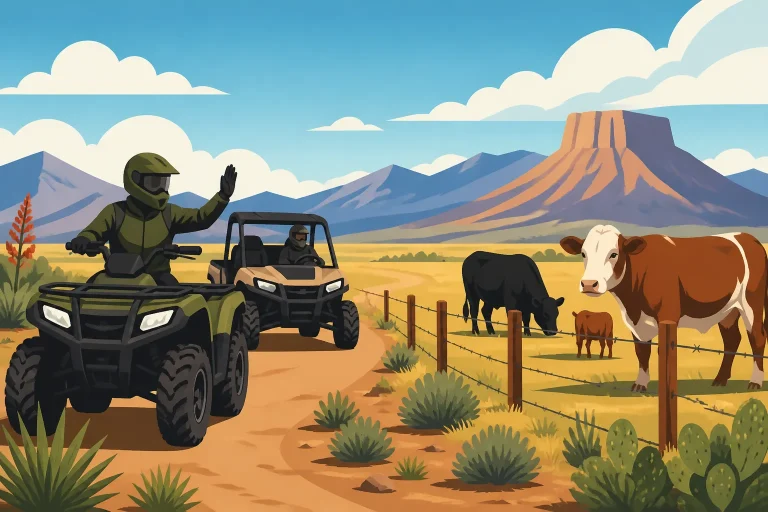
Stay alert for other trail users, including hikers, cyclists, livestock, and other motor vehicles. Slow down around people and animals, give them space, and avoid kicking up dust or startling stock. Close a gate behind you if you were permitted to pass through it and the land’s instructions call for it. If you find a closed gate or a restriction sign, do not go around it.
Do not assume the rental vehicle is road-ready
Many ATVs and UTVs are rented for off-road use only. A machine’s lights, mirrors, license plate, or safety features do not necessarily make it legal to ride on a public road. The rental company may also forbid road use even where a limited exception exists.
If a route requires pavement, ask the business for the exact legal route and the machine-specific requirements before you leave. Do not improvise a short road crossing or ride along a shoulder unless you have confirmed that the crossing is allowed and understand how it must be made. In many cases, transporting the rental to an approved trailhead is the safer choice.
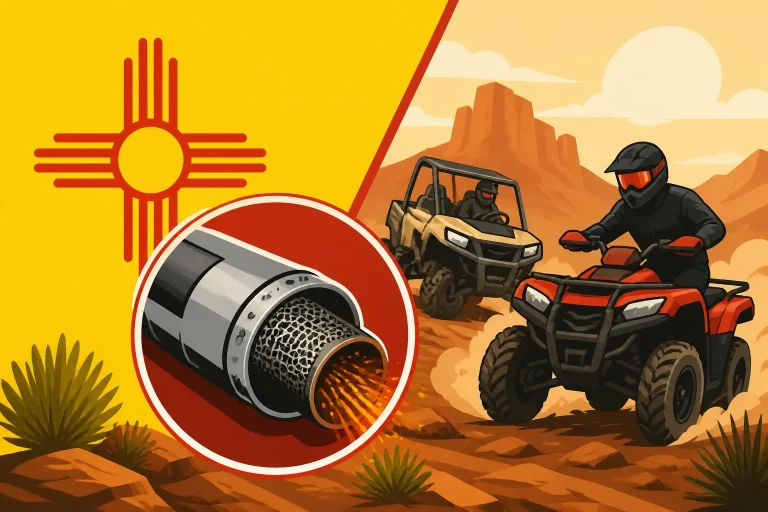
An OHV can also be subject to noise, lighting, spark-arrestor, helmet, and eye-protection rules depending on the rider and riding location. Ask what equipment is supplied and what you must provide. The rental shop’s helmet or goggle policy does not necessarily answer every legal requirement.
Respect weather and changing conditions
New Mexico’s conditions can change quickly. Heavy rain can turn a dry wash into a dangerous channel, while heat, dust, snow, and altitude can make an otherwise straightforward ride difficult. A route that was open when you picked up the machine may become unsafe or close during your rental.
If a storm is approaching, avoid low-lying washes and arroyos. If visibility deteriorates, slow down or stop in a safe location rather than continuing into dust. If snow, fire, flooding, or a closure blocks the planned route, contact the rental company and follow its re-routing instructions. Do not bypass barriers to stay on schedule.
Know how much fuel the machine has and where the next reliable fuel stop is. Rental businesses may have a specific return-fuel policy, and remote routes can leave little room for error. Carry water, dress for changing temperatures, and turn around early if the group is tired or the weather is worsening.
Return the machine and report problems promptly
Return the machine at the agreed time and follow the business’s instructions for fueling, cleaning, and parking. If you have a collision, mechanical issue, flat tire, or other damage, notify the rental company as soon as it is safe to do so. Do not wait until return to report a problem that could affect the next rider or require a recovery.
Before handing over the keys, walk around the machine with staff if possible. Point out any new damage and explain where and when it occurred. Keep a record of what you reported and follow the contract’s process for documenting the return.
If the planned ride changes because of a closure or weather, call the company rather than taking an unapproved alternate route. That can protect you, the machine, and the land—and may prevent a preventable dispute over recovery or damage responsibility.
A Pre-Ride Checklist for a New Mexico Rental
A few minutes of checking can prevent a day of confusion. Use this list before you leave the rental lot:
- Confirm the machine’s paperwork. Ask what registration or permit applies to that specific ATV or UTV and whether it covers your planned riding area.
- Confirm the route. Identify the open routes, boundaries, closures, and any restrictions on the machine’s size or type.
- Check the rental limits. Understand where you may go, who may drive, whether pavement is prohibited, and what to do if the route is blocked.
- Check rider requirements. Confirm age, supervision, passenger, and safety-permit rules for each person who will ride.
- Inspect the machine. Review controls and safety features, document existing damage, and ask about fuel and breakdown procedures.
- Carry required documents. Bring the paperwork and proof the business or official rules require, and keep the rental company’s contact details available.
- Prepare for conditions. Carry suitable protective gear, water, navigation, and a plan for weather or loss of cell service.
- Stay on open routes. Do not ride beyond a route, boundary, or permission that has been confirmed.
- Report problems quickly. Contact the rental company if the machine is damaged, stuck, or unable to continue safely.
- Return it as agreed. Follow the contract’s instructions for timing, fuel, cleaning, and reporting new damage.
If you are bringing your own vehicle rather than renting locally, the permit question may be different. Review New Mexico’s Broad OHV Reciprocity and New Mexico’s Nonresident OHV Permit and verify the current rules before traveling. If you are uncertain whether a specific trail is open, check with the relevant land manager and the rental company rather than relying on an old map or a previous visit.
Disclaimer
This article is for general informational purposes only and does not constitute professional advice. Laws, prices and regulations vary by location and change over time. Consult a qualified professional for guidance on your specific situation.