Which Neighboring States’ Registrations Are Always Honored
Planning a New Mexico ride with an ATV or UTV registered elsewhere? The key question is whether your home-state paperwork satisfies New Mexico’s nonresident permit requirement. Valid OHV registrations from qualifying states are generally recognized, but a title, vehicle plate, or registration from a state without an OHV program may not be enough. Here’s how to check before you travel.
How New Mexico Reciprocity Works
New Mexico generally recognizes a valid out-of-state OHV registration for a visiting rider. If your machine is properly registered in a state whose OHV program qualifies for reciprocity, you typically do not need to buy a separate New Mexico nonresident OHV permit just to ride there.
That recognition is about the machine’s OHV registration, not simply where it was bought or where you live. A vehicle title, a standard license plate, a bill of sale, or proof of insurance does not automatically take the place of OHV registration. The document needs to show that the machine is registered under the home state’s applicable off-highway program.
New Mexico’s reciprocity approach depends on whether a state has an OHV registration program. When a rider’s home state does not require OHV registration, there may be no registration for New Mexico to recognize. In that case, a nonresident permit may be required for riding in New Mexico.
A practical explanation is available in New Mexico OHV Reciprocity Rules. The broader overview in New Mexico’s Broad OHV Reciprocity can also help clarify how an out-of-state registration differs from a New Mexico visitor permit.
“Always honored” should be read as “recognized when the registration is valid and applies to the machine.” It does not mean that any document from a neighboring state will work in every situation. Check that the registration is current, belongs to the machine you brought, and is an OHV registration rather than a different kind of vehicle credential.
Registration is not the same as a title
A title establishes ownership or records a vehicle’s legal status under state rules. Registration is the credential that generally authorizes the machine under an OHV program. Some states may issue both; others may use different documents, decals, or registration systems.
If you have a title but no OHV registration, don’t assume that the title alone satisfies New Mexico’s reciprocity rules. Likewise, an automobile-style plate may not prove that a quad or side-by-side is registered as an OHV. If the paperwork is unclear, ask the agency responsible for OHV registration in your home state what document demonstrates current OHV registration.
Reciprocity does not grant every kind of access
Recognized registration does not make every road or trail open to your machine. New Mexico access rules still apply, including restrictions based on land ownership, route designation, vehicle type, local ordinances, and road-use requirements.
A valid registration also does not automatically authorize riding on paved streets. Street and roadway rules are separate from OHV registration reciprocity. For that distinction, see New Mexico Paved Road Plate Requirements and New Mexico Rules for Riding a County Road.
Neighboring-State Registrations to Check
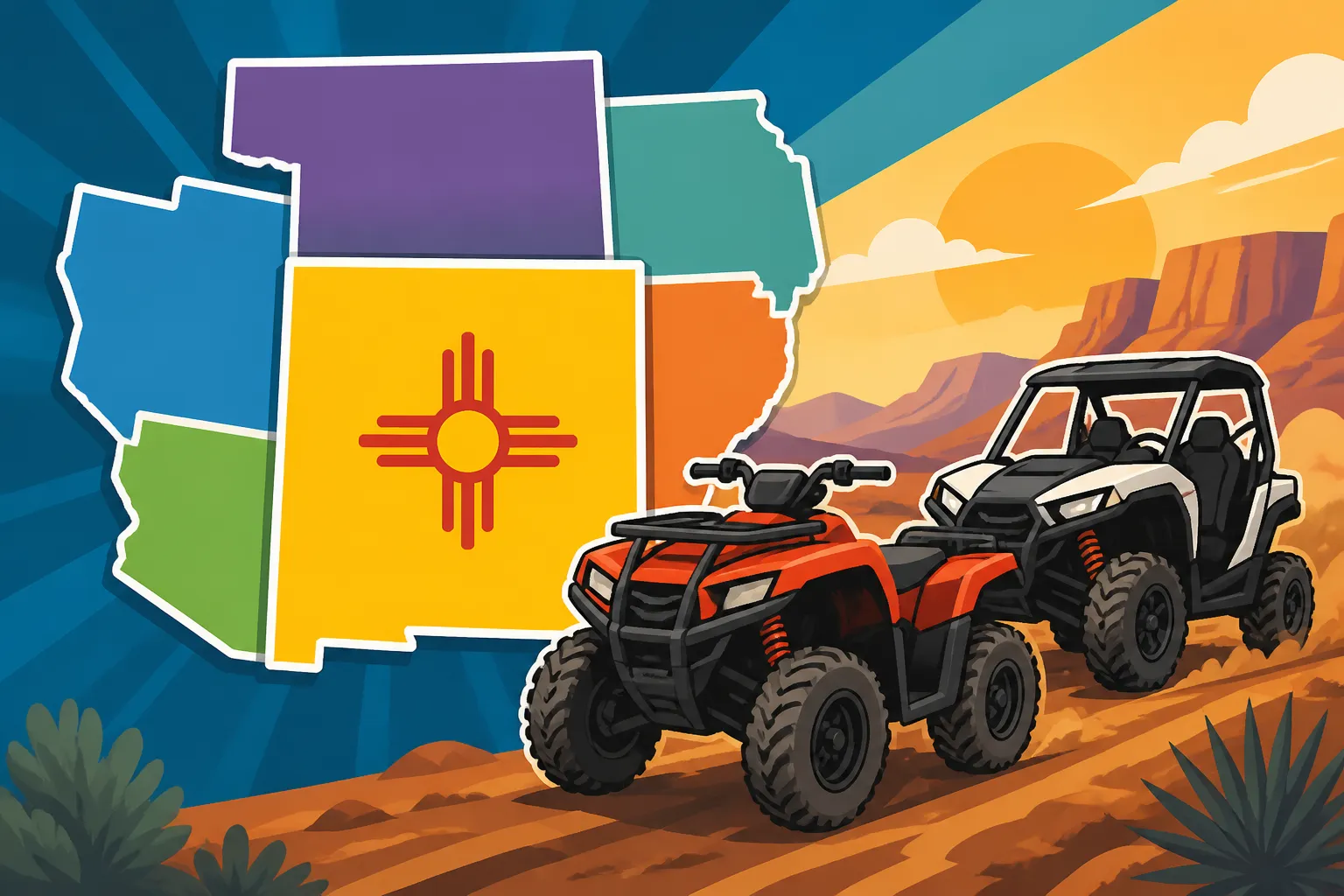
New Mexico riders commonly travel across state lines from Arizona, Colorado, Texas, and Oklahoma. The important distinction is not simply whether a state borders New Mexico. It is whether that state has an OHV registration program and whether your machine has current registration under it.
| Home state | What to check before traveling |
|---|---|
| Arizona | Confirm that the machine has current Arizona OHV registration and that you can show proof of it. |
| Colorado | Carry current OHV registration documentation for the machine, not just ownership paperwork. |
| Texas | Verify that the machine’s credential is the applicable OHV registration or decal, rather than assuming a title or ordinary plate is enough. |
| Oklahoma | Do not assume that a title or other vehicle document qualifies as an OHV registration. Confirm whether your machine has a current registration that New Mexico recognizes; if not, check whether a New Mexico nonresident permit is required. |
Arizona, Colorado, and Texas riders should still bring clear proof of current registration. A decal on the machine can be useful, but carrying the registration document or other official proof can make it easier to resolve questions if the decal is missing, damaged, or hard to read. New Mexico’s state-specific explanations for Does New Mexico Honor Arizona OHV Registration?, Does New Mexico Honor Colorado OHV Registration?, and Does New Mexico Honor Texas Registration? provide additional detail for those trips.
For Oklahoma riders, take an extra step instead of relying on assumptions based on proximity. A state may issue titles, require certain equipment, or regulate OHV use without providing the kind of registration that qualifies for reciprocity in New Mexico. If you cannot confirm that your paperwork is an OHV registration recognized by New Mexico, treat the permit question as unresolved until you check with the appropriate official program.
Utah is not a neighboring state, but riders may travel from there as well. If that applies to your trip, review Does New Mexico Honor Utah Registration? rather than using another state’s answer as a substitute.
The table is a starting point, not a replacement for checking a specific machine’s paperwork. Registration categories can differ within one state, and a credential that works for one type of OHV may not apply to another. When in doubt, confirm the credential’s name and status before setting out.
What to Carry and What to Do if You Do Not Qualify
A little paperwork preparation can prevent a confusing stop at a trailhead or a problem after you’ve hauled the machine into New Mexico. Before leaving home, match the documents to the exact ATV or UTV you plan to ride.
- Check the registration’s status. Make sure it has not expired, been canceled, or been replaced by a newer credential.
- Match the documents to the machine. Compare the VIN or other identifying information on the registration with the machine. If a decal is required by your home state, make sure it is displayed as directed.
- Carry proof that is easy to show. Bring the official registration document or another form of proof accepted by the relevant program. Do not rely on a receipt for a recent application if the registration has not yet been issued.
- Confirm the New Mexico requirement if the paperwork is uncertain. Ask whether your specific state credential qualifies for reciprocity. Avoid deciding based only on a seller’s statement or an online forum.
- Get a New Mexico nonresident permit when needed. If your home state does not have a qualifying OHV registration program, or your machine is not registered under one, check the permit requirement before riding.
New Mexico offers nonresident OHV permits for visitors who need them. Permit types, application methods, and current requirements can change, so confirm the available option and rules with the official program before buying. Do Visitors Need a New Mexico OHV Permit? explains the basic decision, while Where to Buy a New Mexico OHV Permit covers ways to obtain one.
Keep in mind that a permit and registration answer only part of the compliance question. Riders may also need to follow age-related safety requirements. For example, a minor may need a safety permit even when the machine has valid out-of-state registration. Check New Mexico OHV Safety Permit Requirements if a rider under 18 is joining the trip.
The machine must also be used where it is allowed. Public-land routes may have their own travel-management rules, and registration does not give permission to cross private, tribal, or restricted land. Review the applicable land manager’s route map and local restrictions before leaving the staging area.
Finally, don’t confuse a visitor permit with the paperwork needed for road use. Even if New Mexico recognizes your home-state OHV registration, that alone does not grant permission to ride on a paved road. Road access has separate legal and equipment requirements, and some roads remain closed to OHVs. Check the specific route and local rules rather than treating reciprocity as a road-use pass.
Disclaimer
This article is for general informational purposes only and does not constitute professional advice. Laws, prices and regulations vary by location and change over time. Consult a qualified professional for guidance on your specific situation.