New Mexico OHV Safety Permit Requirements
A New Mexico OHV safety permit is easy to confuse with vehicle registration or a visitor’s riding permit. The main question is usually simpler: does a young rider need safety training before riding, and what proof must they carry? Here’s how the under-18 requirement works, where supervision fits, and what to check before heading onto public land.
Who needs a New Mexico OHV safety permit
In general, an OHV operator under 18 must complete an approved safety course and have the required safety permit when operating on public land in New Mexico. This applies to young ATV and UTV riders as well as riders of other off-highway vehicles covered by the rules. Adults generally do not need this youth safety credential.
The requirement is about the person operating the machine. It is not satisfied just because the ATV or UTV is registered, someone else in the group has completed a course, or an adult is present. A parent or other supervising adult should make sure the young rider has met the requirement before the ride begins.
The exact age rules for riding and the safety permit requirement are related, but they are not the same question. A child may be too young to ride on certain public land even if they have completed training. Check New Mexico Safety Permit Age Rules and [New Mexico Minimum Age to Ride Public Land] when deciding whether a particular child can ride at all.
It also matters where the machine will be used. The safety requirement is relevant to riding on public land; it does not automatically grant permission to use a particular trail, road, or property. Public land may have its own route restrictions, seasonal closures, equipment rules, or access conditions. Private property is a different situation, but riders still need the landowner’s permission and should follow applicable safety requirements.
A practical starting point is to ask two separate questions:
- Is this rider old enough and otherwise allowed to operate this type of OHV in this location?
- Does the rider have the required safety training and proof for the ride?
A “yes” to one does not answer the other. For example, a youth rider may have completed the course but still be unable to use a particular route because of age, machine, or land-management restrictions. For rules that apply to younger riders, see [New Mexico Supervision Rules for Young Riders].
A driver’s license is not the same as a learner’s permit
Some riders assume any document allowing them to drive a vehicle also replaces OHV safety training. Don’t rely on that assumption without checking the precise rule and credential. A learner’s permit, a provisional license, a motorcycle credential, and a full driver’s license are not interchangeable documents.
If a teen believes a license exempts them from the safety permit requirement, confirm that the specific credential qualifies before riding. A motorcycle endorsement, in particular, should not be assumed to count as an OHV safety permit. The rules can depend on the type of license and the circumstances, so ask the appropriate state office if the answer is not clear.
What the safety permit is, and what it is not
The safety permit is proof tied to the rider’s training requirement. It is not the machine’s registration, title, insurance, or permission to ride every public trail. Keeping these documents separate in your mind prevents a common last-minute problem: arriving ready to ride with the vehicle paperwork in order but no proof of the young operator’s required course.
| Document or permission | What it relates to | What it does not do |
|---|---|---|
| OHV safety permit | A young operator’s safety training requirement | Register the machine or open a closed route |
| OHV registration or decal | The machine’s registration status | Prove the operator completed safety training |
| Nonresident OHV permit, when required | A visitor’s eligibility to ride in New Mexico under applicable rules | Replace a youth safety credential |
| Land or route authorization | Whether the rider may use a specific area or route | Substitute for registration or safety training |
| Driver’s license | Driving privileges under the rules that apply to that license | Automatically prove completion of an OHV course |
Visitors should pay special attention to the difference between safety training and a nonresident OHV permit. A visitor’s machine may meet New Mexico’s reciprocity rules, or the visitor may need a separate permit, depending on the home state and circumstances. That question is separate from whether a rider under 18 needs the safety credential. See Do Visitors Need a New Mexico OHV Permit? and New Mexico OHV Reciprocity Rules for the visitor side of the issue.
Likewise, having the safety permit does not make an unregistered machine legal to ride where registration is required. Registration and decal rules are a separate part of using an OHV in New Mexico. If you are sorting out a machine’s paperwork, start with Registering an OHV in New Mexico.
How to meet the training requirement
The central step is to complete a course accepted for the New Mexico OHV safety permit. Don’t assume that any online video, informal lesson, or safety course for a different activity qualifies. Check the state’s current OHV safety program instructions to confirm the course is approved and that the rider will receive the required proof after completing it.
A straightforward process is:
- Confirm that the rider needs the credential. Check the rider’s age, the type of machine, and where it will be used. If an exemption may apply, verify it rather than relying on an informal interpretation.
- Find an approved course. Use the current state program information to identify a course accepted for the New Mexico permit. See Where to Take a New Mexico OHV Safety Course.
- Complete the course as instructed. Make sure the rider finishes all required material and any assessment or other steps the program specifies.
- Obtain and check the permit or certificate. Confirm that the rider’s name and other details are correct, and find out whether the credential is available as a card, digital record, or both.
- Carry proof when riding. Do not leave the only copy at home if the rider is expected to show proof in the field. Review Carrying the Safety Permit on a New Mexico Ride.
- Recheck the rules for the ride location. Training does not replace route, land-access, equipment, or age restrictions.
Course arrangements and fees can change, so check the provider or official program for current details before enrolling. New Mexico OHV Safety Course Cost can help clarify what to look for, but use the current course information when budgeting and registering.
Parents can make the process easier by handling the course well before a planned trip. That leaves time to resolve a name or record problem, confirm that the credential was issued, and make sure the young rider knows where the proof is kept. Waiting until the night before a holiday weekend creates avoidable pressure, especially if the course or permit record needs follow-up.
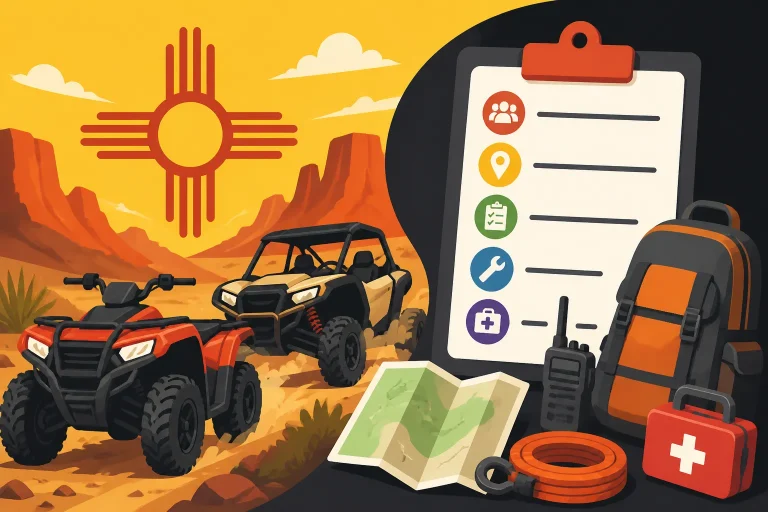
Training should also be treated as preparation, not a formality. A course can help riders understand basic operating decisions, but it does not replace hands-on instruction on the actual machine. Before the first ride, review controls, braking, turning, safe speed, passenger limits, protective gear, and what to do if the machine stops or the group becomes separated. Match the machine to the rider’s size and ability; a completed course does not make an oversized or unfamiliar vehicle suitable.
Supervision, proof, and common mistakes
Adult supervision is valuable, but it should not be treated as a substitute for a required safety permit. A parent riding nearby can help a young operator make safer choices, but the adult’s course record does not transfer to the child. Check Visual Supervision and What It Means for the separate question of what supervision requires.
Before leaving, make a simple document check for each young rider. Confirm that the rider has their own proof of course completion, that it is readable, and that the family knows how to retrieve a backup if the original is misplaced. A phone image may be useful as a backup, but do not assume it will be accepted in place of the required credential unless the current program says so.
Common mistakes include:
- Confusing the safety permit with vehicle registration. They serve different purposes and may both matter.
- Assuming an adult’s presence waives the training requirement. Supervision and course completion are separate issues.
- Treating a learner’s permit as a full driver’s license. Verify which credentials count for any claimed exception.
- Assuming a safety permit grants access everywhere. Land managers can restrict routes or close areas independently.
- Leaving proof behind. A young rider may be required to carry or produce their credential while operating.
- Applying the state requirement to every property in the same way. Public, private, tribal, and other land can have different access rules. For example, riding on BLM land brings route and travel-management requirements in addition to any rider credential; see [New Mexico Rules for Riding BLM Land].
It is also sensible to check the rules again when plans change. A family may begin on a permitted route and later consider a side road, a different parcel, or a trailhead reached through another jurisdiction. The youth’s safety permit does not answer whether that route is open, whether the machine is allowed, or whether additional permission is needed.
If an officer, ranger, or land manager asks for proof, having the credential organized and accessible can make the interaction straightforward. Keep the rider’s safety documentation with the trip paperwork, but do not rely on it to answer questions about the machine’s registration, visitor permits, insurance, or land access. Each requirement has its own purpose.
Disclaimer
This article is for general informational purposes only and does not constitute professional advice. Laws, prices and regulations vary by location and change over time. Consult a qualified professional for guidance on your specific situation.