New Mexico’s Safety Permit for Under-18 Riders
New Mexico’s Safety Permit for Under-18 Riders
A teenager may have permission to ride, a machine that fits, and an adult nearby, yet still be missing a required safety permit. In New Mexico, the permit is one part of the rules for minors riding off-highway vehicles on public land. Here’s what the requirement means, how to meet it, and why training does not replace age, supervision, or access rules.
What the safety permit requires
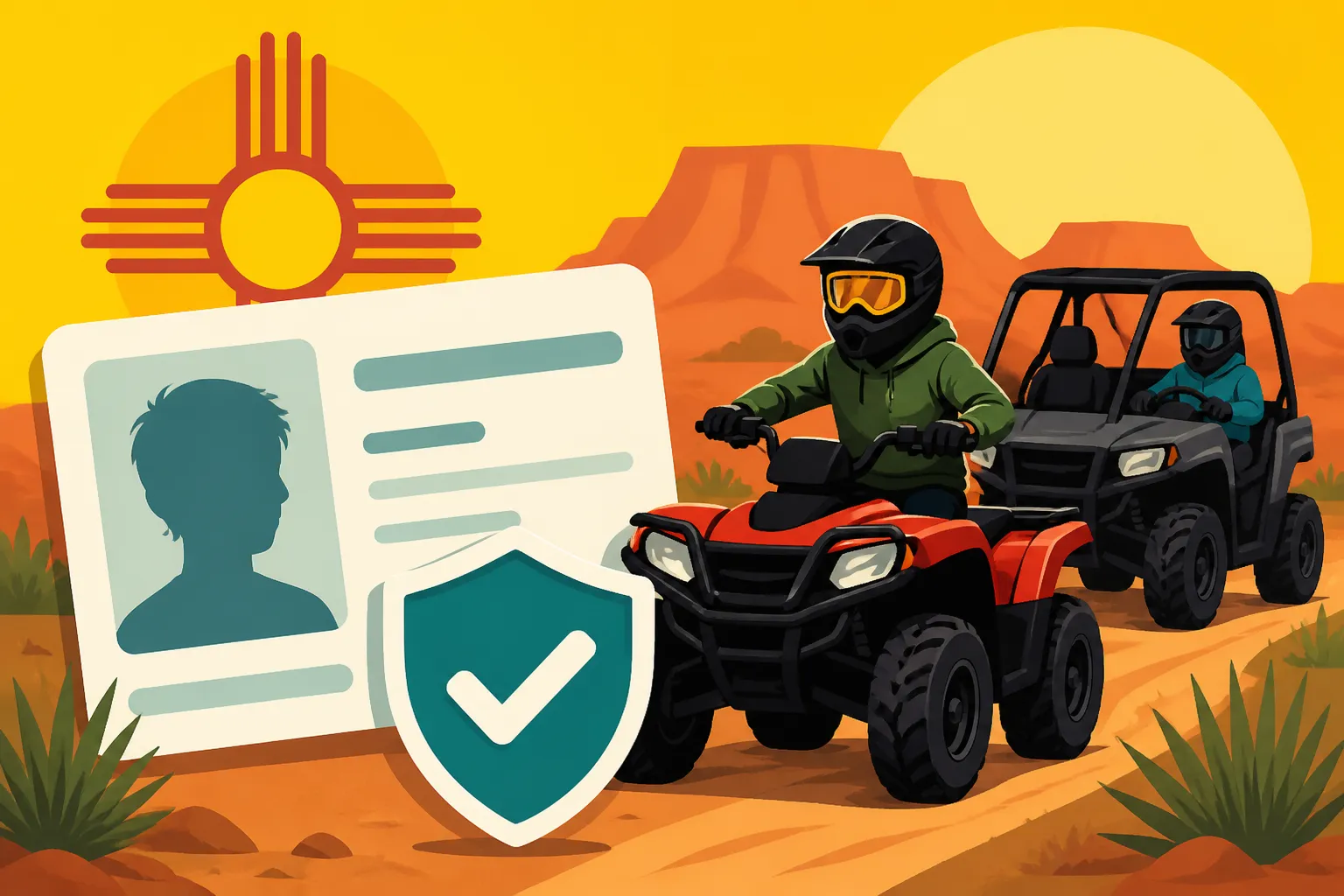
New Mexico requires riders under 18 to have an OHV safety permit when operating an off-highway vehicle on public land. The permit shows that the young rider has completed an approved safety course. It is a training credential—not vehicle registration, an operating license, or permission to ride anywhere.
The requirement applies to off-highway vehicles such as ATVs, dirt bikes, and side-by-sides when they are being operated in places covered by the state’s OHV rules. The key questions are the rider’s age, the type of machine, and where it will be used. A private-property ride may be treated differently from a ride on a public trail or road, but that does not make private-land riding automatically safe or unrestricted. Get the landowner’s permission and follow any other rules that apply.
The safety permit is also separate from registration and nonresident permits. A vehicle’s registration or decal establishes a different kind of compliance; it does not prove that a young operator has completed training. Likewise, a permit that allows a visitor’s machine to be used in New Mexico does not replace the rider’s under-18 safety requirement. For an overview of the rules that apply to young operators, see [New Mexico OHV Safety Permit Requirements] and New Mexico Safety Permit for a Minor.
| Requirement or document | What it addresses | What it does not replace |
|---|---|---|
| OHV safety permit | Required training for an under-18 rider on covered public land | Age eligibility, supervision, machine registration, or access permission |
| Vehicle registration or other required machine paperwork | The machine’s compliance and identification | The operator’s safety training |
| Nonresident permit, when required | A visitor’s permission to operate a machine in New Mexico | A minor rider’s safety permit or supervision requirements |
| Land or route permission | Whether that specific place or route is open to the rider | Training, registration, or equipment rules |
Think of the safety permit as one item in a larger checklist. A young rider can have a valid permit and still be too young for a particular machine, fail to meet supervision rules, or be on a closed route. Conversely, an adult’s experience does not transfer to a minor: the young operator needs to meet the requirements that apply to them.
The rules can also depend on the kind of riding and the land involved. Public land is not a single category with one universal access rule. A designated route, a managed trail area, a forest road, and land with separate permission requirements may each have additional limits. Before a ride, check both the safety-permit requirement and the rules for the exact place you plan to visit.
How a young rider gets the permit
The permit is earned by completing an approved OHV safety course. Do not assume that any riding class, school program, or online video qualifies. Use a course accepted for the New Mexico permit, then follow the course provider’s instructions for receiving and keeping proof of completion. The approved-course details are covered in Approved Courses for a New Mexico Permit.
A practical approach is to complete the course before the trip is close. That gives the rider time to finish the lessons, resolve any account or completion-record issue, and make sure the permit proof is accessible. Waiting until the night before a ride can leave a family unsure whether a course has been completed or whether the rider can show the required documentation.
A straightforward preparation sequence is:
- Confirm the rider’s age and riding situation. Check that the operator is covered by the under-18 requirement and identify whether the plan involves public land.
- Choose an approved course. Confirm that it qualifies for the New Mexico OHV safety permit rather than relying on a general safety class.
- Complete the training. Have the young rider take the course themselves and understand the material, rather than treating it as a parent’s paperwork task.
- Save the proof. Follow the course or permit instructions for obtaining the permit record or card.
- Carry it on the ride. Make sure the rider or supervising adult can produce the required proof if asked.
- Check the other rules separately. Verify age eligibility, supervision, machine paperwork, land access, and any route-specific restrictions.
The course is more useful when the rider can connect the material to the outing ahead. For a first trail ride, talk through how to stop safely, leave space between machines, handle blind corners, and respond if the group becomes separated. For a side-by-side trip, discuss seat belts, passenger limits, and keeping hands and feet inside the vehicle. For an ATV, cover balance, turning, braking, and why a machine designed for one rider should not be treated as a passenger vehicle.
An online course may be convenient, but convenience should not become a substitute for hands-on practice. A completion record does not show that a teenager can safely control a particular ATV or UTV. Start on suitable terrain at a manageable speed, with a machine appropriate for the rider, and build skill before attempting steep, narrow, fast, or crowded routes.
Keep the proof easy to produce
The permit must be available during the ride, not just stored at home or in an email account no one can open in the field. Follow the current instructions for what counts as proof and how it should be carried. A physical card may be easier to show where phone service is poor; an electronic record may be useful as a backup. Do not assume that a screenshot, a course confirmation email, or a photograph of a document is accepted unless the official instructions say so.
Before leaving, check that the rider’s name and course record are readable and that the family knows where the proof is. If the permit is lost, damaged, or unavailable, resolve the problem before heading out rather than relying on an officer or land manager to accept an explanation. See Carrying the Safety Permit on a New Mexico Ride for more on keeping proof available.
Parents and guardians can help with the logistics, but the rider should know what the permit is and where it is kept. That small step matters when a teen is riding with another family member, a club, or a group whose adult leader may not know where the paperwork is stored.
The permit does not set the rider’s age limits
A safety permit confirms course completion; it does not make every young person eligible to operate every machine. New Mexico has separate minimum-age and supervision rules. A permit cannot turn an undersized or inexperienced rider into an appropriate operator for a large, powerful machine, and it does not grant access to routes that are closed or restricted.
That distinction is important for families who see the course as a general “permission to ride” card. The permit addresses training. Other rules address who can operate a machine, who must supervise, and what kind of riding is allowed. Review [New Mexico Minimum Age to Ride Public Land] and [New Mexico Supervision Rules for Young Riders] before choosing a machine or setting out.
Supervision is not a vague promise that an adult is somewhere nearby. Rules for minors may require the adult to remain close enough to observe the rider directly. A parent waiting at a staging area while a young rider disappears around a ridge may not satisfy a visual-supervision requirement. Do not assume that a cell phone, radio, or periodic check-in counts as direct supervision.
The supervising adult should be able to see how the rider is doing and intervene if necessary. That can mean choosing a route with sightlines, keeping the group together, and selecting terrain where the adult can respond quickly. On a long or winding trail, an adult who cannot see the young rider may not be providing the required oversight, even if both are technically on the same ride.
The adult should also judge whether the young rider is ready for the conditions. Legal minimums are not a recommendation to ride at the edge of a person’s ability. Consider the machine’s size and power, the rider’s strength and experience, the trail surface, traffic, weather, and the ability to stop or turn safely. A rider who can manage a flat practice area may not yet be ready for deep sand, rocky climbs, steep descents, or narrow forest roads.
Licenses and age-specific exceptions need careful checking
Families sometimes ask whether a driver’s license, learner’s permit, or motorcycle endorsement removes the safety-permit requirement. These credentials are not interchangeable. A credential that relates to operating a different kind of vehicle does not automatically satisfy an OHV training rule, and an exception may depend on the rider’s age and the exact credential held.
Do not infer an exemption from a teen’s ability to drive a car on public roads or from experience riding a motorcycle. Check the specific New Mexico rule before treating a license or endorsement as a substitute. The questions addressed in New Mexico Permit Rules at Fifteen and Does an Adult Need a New Mexico Safety Permit? illustrate why age and credential details matter.
When an exception may apply, verify it through an official source and keep the supporting credential available. If the rule is unclear, the safer plan is to complete the approved course and carry the permit unless the appropriate authority confirms that the rider is exempt. Completing the course does not eliminate other requirements, but it can avoid an avoidable gap in training and proof.
What to check before a ride
A permit is most useful when it is part of a broader pre-ride check. The adult organizing the outing should confirm the rider’s paperwork, the machine’s condition, the route’s access status, and the group’s plan for supervision. This is especially important when the ride involves visitors, rented vehicles, unfamiliar public land, or a mix of ATVs and side-by-sides.
Use this checklist before loading:
- Permit: Has the under-18 rider completed an approved course, and can the required proof be shown?
- Age and machine fit: Is the rider legally eligible and physically capable of operating that specific machine?
- Supervision: Does the adult plan meet the applicable supervision rule throughout the ride, not only at the trailhead?
- Machine paperwork: Is the vehicle properly registered or otherwise documented for the intended use?
- Visitor requirements: If the machine is from out of state, does the rider or vehicle need a New Mexico nonresident permit?
- Route access: Is the route open to this type of machine, and is it legal for the group to use?
- Equipment: Are helmets and other required protective equipment available and correctly fitted?
- Conditions: Are weather, terrain, visibility, and the rider’s skill level suitable for the outing?
A ride on public land may involve route-specific travel rules in addition to state OHV requirements. A route that appears on a map may have seasonal restrictions, a closure, or machine-width limits. Follow posted signs and current land-manager information. Do not treat the absence of a gate or a warning sign as proof that a route is open.
Registration and visitor permits deserve their own check. New Mexico’s rules can distinguish between in-state and out-of-state machines, and the right answer may depend on the machine’s home-state status. A permit for a nonresident vehicle does not act as the minor’s safety permit. Likewise, the child’s safety permit does not make an unregistered machine legal to operate. For rental or borrowed vehicles, ask who is responsible for the machine’s required paperwork; New Mexico Rules for a Rented Machine is a useful related topic.
Equipment matters even when the paperwork is complete. Choose a properly fitted helmet and eye protection, and make sure the rider knows how to use the vehicle’s controls. Check brakes, tires, throttle return, lights, and any required safety equipment before leaving. The course can introduce safe practices, but a pre-ride inspection helps catch problems specific to the machine being used that day.
Plan the ride around the least experienced person, not the most capable adult. Set a pace the young rider can maintain, agree on stopping points, and make sure everyone knows what to do if the group separates. Avoid letting a teen ride ahead out of sight simply because the adult knows the route. If the terrain changes or the rider becomes tired, turn back or choose an easier route.
If the permit is missing or the rules are unclear
If a young rider arrives without the required proof, do not assume that a parent’s statement, an old course certificate, or a permit belonging to a sibling will be enough. The permit is tied to the individual rider. Pause before operating on public land and confirm what documentation is accepted. If the rider has not completed the required training, arrange for an approved course before the next outing.
If the permit was completed but cannot be found, contact the course or permit administrator for instructions on recovering the record or obtaining replacement proof. Keep a backup in a separate location when practical, but make sure the backup format is one the rules accept. A backup cannot help if it is inaccessible or unreadable in the field.
If a family is unsure whether a route counts as public land, whether a particular machine is covered, or whether a license creates an exception, do not base the decision on hearsay. Confirm the rule with the relevant official authority or land manager. The same caution applies when a ride crosses property boundaries: permission to enter one parcel does not necessarily authorize riding on adjoining land.
A violation can have consequences for the rider and, in some circumstances, the responsible adult. Penalties and enforcement can depend on the specific violation, so avoid relying on an old amount or an informal summary. The practical fix is to check the current requirement before riding and make sure all required permits and documents are available. See [New Mexico Fines for No Safety Permit] for the enforcement topic.
Parents can make the process easier by treating the permit as a continuing safety tool rather than a one-time hurdle. Ask the young rider to explain what they learned, talk through hazards on the planned route, and encourage them to speak up if they feel uncomfortable. A teenager who has permission to stop, slow down, or skip a difficult section is more likely to make a safer choice than one who feels pressured to keep up.
For clubs and group rides, make the check part of registration or the pre-ride briefing. Do not assume that every minor has completed the course because a parent is present. Confirm the adult who will supervise each young rider, set expectations for keeping visual contact, and have an alternate plan if a rider or supervisor needs to leave. For a large group, splitting into smaller supervised units may be safer and easier to manage.
The simplest rule for families is to keep the requirements separate in their minds: training permit, legal eligibility, supervision, vehicle paperwork, and land access. Check each one before the ride. That approach avoids the common mistake of treating a single card—or an adult’s presence—as permission to overlook the rest.
Frequently Asked Questions
Does every rider under 18 need a New Mexico OHV safety permit?
The requirement applies to under-18 riders operating OHVs in situations covered by New Mexico’s public-land rules. Check the official requirements for the rider, machine, and location before relying on an exemption.
Does the permit allow a teenager to ride any ATV or UTV?
No. It confirms safety-course completion. Separate age, supervision, machine-suitability, registration, and route-access rules still apply.
Can a parent carry the permit instead of the young rider?
Follow the current instructions for acceptable proof and carrying it. The key is that the rider’s permit must be available during the ride; do not assume an adult’s unsupported statement is enough.
Does an out-of-state vehicle permit replace the safety permit?
No. A vehicle permit and a rider’s safety permit address different requirements. A visitor should check both the machine’s permit status and the minor’s training and supervision obligations.
Disclaimer
This article is for general informational purposes only and does not constitute professional advice. Laws, prices and regulations vary by location and change over time. Consult a qualified professional for guidance on your specific situation.