Sixteen States on One List
A New Mexico ride can require more paperwork than you expect if your ATV or UTV is registered elsewhere. Riders from many states can rely on their home-state registration, but visitors from states without a qualifying OHV program may need a New Mexico permit. Here’s how the 16-state list affects your trip, what to carry, and what to check before you unload.
Why New Mexico Uses a 16-State List
New Mexico generally recognizes valid OHV registration from another state. That reciprocity keeps many visitors from having to register their machine twice just to ride in New Mexico. But recognition depends on the state where the machine is registered having an OHV registration program that New Mexico accepts.
The 16-state list identifies places whose riders may not be able to show that kind of registration. If your machine is registered in one of those states, you may need to buy a New Mexico nonresident OHV permit before riding on public land where the permit is required.
The list concerns the machine’s home-state registration program, not the rider’s citizenship, the state on a driver’s license, or the place where the ATV or UTV was bought. For example, a person who lives in a listed state but has a machine validly registered in a state whose registration New Mexico recognizes may be treated differently from a rider whose machine has no qualifying registration. If your situation involves a move, a borrowed machine, or a recently purchased OHV, confirm which documents apply before you travel.
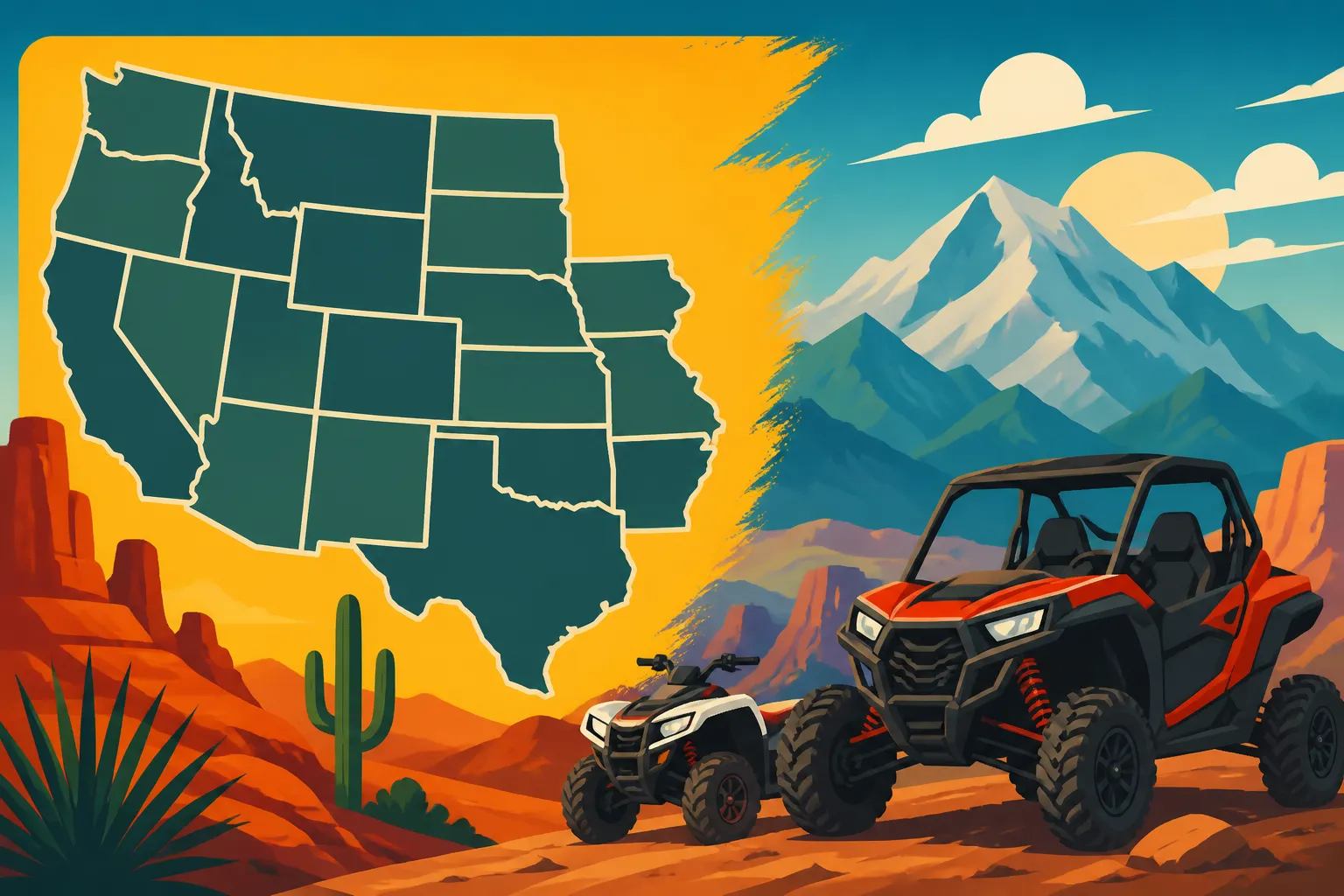
The 16 states on the list are:
- Alabama
- Alaska
- Connecticut
- Delaware
- Hawaii
- Illinois
- Indiana
- Kansas
- Kentucky
- Louisiana
- Maryland
- Mississippi
- Missouri
- New Jersey
- Tennessee
- West Virginia
State programs and New Mexico’s reciprocity rules can change. Treat the list as a prompt to check your status, rather than a substitute for checking the current rules with the state agency that administers OHV permits. For an overview of the permit categories and how they work, see New Mexico’s Nonresident OHV Permit and New Mexico OHV Reciprocity Rules.
A permit is also not a general pass to ride anywhere. You still have to follow the rules for the specific land or route, including restrictions on designated routes, private property, tribal land, and closed areas. A permit does not replace permission from a landowner or another required access authorization.
| Your machine’s situation | What to check before riding |
|---|---|
| Valid registration from a state New Mexico recognizes | Confirm it is current, applies to the machine, and that you can carry proof |
| Registration from one of the 16 listed states | Check whether a New Mexico nonresident permit is required |
| No registration paperwork or unclear status | Ask the permit agency what documents establish eligibility |
| Borrowed or rented machine | Confirm which registration or permit applies to that machine and who must carry proof |
| Riding on private, tribal, or restricted land | Get any separate permission or authorization required for that land |
What Riders From the Listed States Should Do
Start with the paperwork for the machine, not only your own address. Find the registration card, decal, or other official document showing the machine’s status and the state that issued it. Check that the document is current and that the vehicle identification number or other identifying details match the ATV or UTV.
If the machine is from one of the 16 states and you cannot establish that New Mexico recognizes its registration, contact the New Mexico agency responsible for OHV permits before departure. Ask whether the machine needs a nonresident permit and what proof you must carry. Avoid assuming that a bill of sale, title, insurance card, or registration from another vehicle is a substitute. Those documents serve different purposes.
If a permit is required, purchase the correct type for your trip and machine. New Mexico offers permit options for nonresident riders, but the available term, current cost, and purchase process should be confirmed with the official source. Do not rely on an old receipt or a screenshot of a payment page as proof that the permit is valid for the vehicle you brought.
Before you head out:
- Confirm the home-state status. Check whether the machine has valid OHV registration and which state issued it.
- Check New Mexico’s current reciprocity list. If the machine is registered in a listed state, ask whether you need a New Mexico permit.
- Match the permit to the vehicle. Make sure the permit or registration applies to the machine you plan to ride.
- Carry proof. Keep the required registration or permit documentation with you and make it easy to show during a roadside check.
- Check the riding area separately. Confirm that the route is open to your type of machine and that you have any other required land access authorization.
These steps are especially important if you own more than one machine. A permit or registration for one ATV does not automatically cover a second quad or a side-by-side. If you are transporting a family’s machines together, check the requirements for each one rather than assuming one document covers the group.
The same care applies to a borrowed machine. Ask the owner for the registration documents and confirm whether a permit must be associated with the machine, the rider, or both. If you rent, ask the rental company what paperwork is supplied and what you need to carry. A rental contract is not necessarily proof of OHV registration or a permit. Whose Permit Counts on a Borrowed Machine explains why it is worth sorting out that distinction before you ride.
If you are still trying to register an out-of-state machine rather than obtain a visitor permit, the process may be different. See Registering an Out-of-State Machine in New Mexico. A nonresident permit and a New Mexico registration are not interchangeable terms, so explain your circumstances clearly when asking the agency for help.
What Reciprocity Does Not Cover
Reciprocity addresses whether New Mexico accepts another state’s OHV registration for its permit requirement. It does not make every road, trail, or public-land route open to OHVs.
The land manager’s rules still matter. On federal land, riders generally need to stay on routes open to their vehicle type and follow posted closures. A route that appears on a map may be closed, seasonally restricted, or too narrow for a particular UTV. Check the current travel-management information for the specific area before setting out. New Mexico Rules for Riding Federal Land and Designated Routes and Travel Management in New Mexico offer more detail.
Private land requires permission from the owner. Tribal lands have their own access rules, and a New Mexico OHV permit does not grant permission to ride there. State trust land also has separate access requirements. Do not treat a valid permit as a substitute for landowner consent, a trust-land authorization, or any other access permission. For example, Riding State Trust Land With a Permit covers the separate issue of access on trust land.
Reciprocity also does not erase safety or equipment rules. Riders may need to meet age-related requirements, follow passenger restrictions, carry required safety documentation, or use appropriate equipment. Those details can depend on where you ride and the age of the operator. Check the rules that apply to your trip, especially if a minor will ride or if your route includes a paved roadway. The permit is one part of being prepared, not a replacement for the rest.
A common mistake is to focus on the permit and overlook the machine’s eligibility for a particular route. A wide side-by-side may be prohibited on a narrow trail even when its paperwork is in order. Similarly, a road open to local traffic may not be open to an OHV. Verify both the vehicle rules and the route status.
How to Avoid a Last-Minute Permit Problem
Resolve the question before your trip, while you have time to contact the relevant agencies or correct missing paperwork. Keep digital copies of your documents as backup, but carry any physical proof the rules require. Make sure registration details are legible and that identifying information matches the vehicle.
When you contact the permit office, describe the situation precisely. Provide the machine type, the state where it is registered, whether the registration is current, and whether you are visiting temporarily or have moved to New Mexico. If a document is missing or the registration status is unusual, explain that rather than guessing which category applies. Ask what proof will be accepted and whether each machine needs its own permit.
If you are traveling with several riders, have each person check the documentation for the machine they will operate. One person’s valid paperwork does not necessarily cover a group’s vehicles. This is particularly easy to miss when a family transports a mix of registered ATVs, borrowed machines, and rented UTVs.
Use this short pre-trip check:
- Confirm the machine’s home-state registration status.
- Compare the state of registration with New Mexico’s current reciprocity information.
- Obtain any required New Mexico permit through an authorized channel.
- Carry the required proof for each machine.
- Check route access, seasonal closures, and landowner or land-manager requirements.
- Review any age, passenger, safety, or equipment rules relevant to the riders and route.
If your state is on the list, the practical takeaway is simple: do not assume your home paperwork will be enough. Verify the current reciprocity rule, get the appropriate permit if required, and check the riding area separately. That combination helps prevent a paperwork issue from becoming a wasted trip or a citation.
Disclaimer
This article is for general informational purposes only and does not constitute professional advice. Laws, prices and regulations vary by location and change over time. Consult a qualified professional for guidance on your specific situation.