Can a 15-Year-Old Driver Skip the Safety Permit?
A 15-year-old may be able to ride an off-highway vehicle in New Mexico without the state’s OHV safety permit, but age alone is not enough. The key question is whether the teen has a valid driver’s license or only an instruction permit. Here’s how to tell which applies—and what the exemption does not cover.
The short answer: a valid driver’s license may qualify
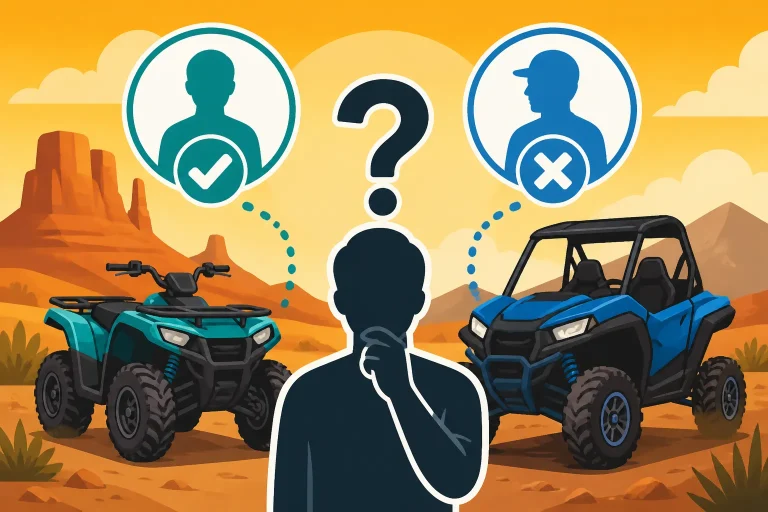
A 15-year-old with a valid driver’s license can generally use the license exception to New Mexico’s OHV safety-permit requirement for riders under 18. A learner’s or instruction permit is not the same as a driver’s license, so a teen who has only an instruction permit should not assume the exception applies.
That distinction matters because New Mexico’s regular driver licensing process and its OHV safety program are separate. A teen can be old enough to hold a particular driving credential without that credential automatically satisfying every rule for riding an ATV, UTV, dirt bike, or another off-highway vehicle.
The practical takeaway:
- Valid driver’s license: The teen may qualify to ride without the separate OHV safety permit, subject to other applicable rules.
- Instruction or learner’s permit only: Do not treat it as a substitute for the OHV safety permit. The teen should obtain the required safety permit or confirm with the relevant state agency that another exception applies.
- No license: The teen should plan to meet the under-18 safety-permit requirement before riding where it applies.
The exception is about the safety permit. It is not permission to ride anywhere, proof that the vehicle is registered, or a substitute for any permit required because of the rider’s residency or the place they plan to ride. For the broader age rules, see New Mexico Rules for a Rider Aged 15 and New Mexico’s Safety Permit for Under-18 Riders.
Because a mistaken assumption can lead to a citation or a turned-away ride, check the current state instructions before heading out. In particular, confirm the rule if the teen has a temporary, restricted, provisional, or out-of-state credential and its status is not clear.
What counts as a driver’s license for this purpose?
The important difference is between a credential that authorizes someone to drive and a credential that only lets them practice driving under specified conditions. A driver’s license may qualify for the safety-permit exception; an instruction permit generally should not be treated as one.
| The teen’s credential | What to assume about the OHV safety permit |
|---|---|
| A current, valid driver’s license | The teen may qualify for the driver’s-license exception. Confirm that the license is valid and that no special restriction changes the result. |
| An instruction or learner’s permit | Do not assume this satisfies the exception. Complete the OHV safety requirement or verify the teen’s eligibility with the state. |
| An expired, suspended, or otherwise invalid license | Do not rely on it as a valid driver’s license. Resolve the credential issue before riding. |
| A license issued by another state | It may qualify if it is current and valid, but confirm that the state accepts that credential for this exception. |
| A temporary or provisional credential | Check its exact status and terms. The label and restrictions matter; do not guess based on age alone. |
A permit to learn to drive is not simply a younger version of a full license. It usually comes with conditions about who may supervise the teen and when or how the teen may drive. Those conditions belong to the road-driving credential; they do not automatically satisfy a separate OHV safety requirement.
Check the credential, not just the teen’s age
A teen may be 15 and have a license, or be 15 and still have only an instruction permit. The birthday itself does not settle the question. Look at the actual credential and check whether it is current, valid, and recognized for this purpose.
If the teen’s credential has a restriction, temporary status, or unusual wording, do not try to interpret it from memory. Ask the state office responsible for OHV safety requirements. A quick confirmation before the trip is safer than discovering at a trailhead that the rider’s paperwork does not qualify.
The same caution applies to an out-of-state license. Do not assume that a credential issued elsewhere is automatically treated identically in every situation. The teen’s home-state driving rules, the credential’s current status, and New Mexico’s OHV requirements are separate questions.
Don’t confuse an OHV safety permit with a driver’s license
An OHV safety permit is evidence that a rider has met the relevant safety requirement. A driver’s license is a credential for driving on roads under the applicable licensing rules. When a driver’s license qualifies for the OHV safety-permit exception, it is serving a limited purpose: it may remove the need for that separate OHV permit.
It does not convert an ATV or UTV into a street-legal vehicle, waive registration or permit requirements, or override land-use rules. For a wider explanation of the youth requirement and how it fits with other rules, see New Mexico Safety Permit for a Minor and [New Mexico OHV Safety Permit Requirements].
What the exception does—and does not—let a teen do
A valid driver’s license may address one question: whether the teen needs a separate New Mexico OHV safety permit. It does not settle every question about the ride. Before setting off, consider the rider, the machine, the land, and the paperwork separately.
It does not replace vehicle registration or a visitor permit
The safety permit is about the rider. Registration and nonresident OHV permits concern whether the machine may be operated under the relevant requirements. A teen with a valid driver’s license may still be riding a machine whose registration or permit is not in order.
New Mexico’s requirements can differ depending on whether the machine is registered in New Mexico or comes from another state, and whether that state’s program is recognized. Check the rules for the vehicle rather than assuming the rider’s license covers it. Riding New Mexico With an Out-of-State Registration explains why an out-of-state registration and the teen’s safety-permit status need to be considered separately. More generally, Any Valid OHV Registration Counts in New Mexico can help with the reciprocity question.
If you are unsure which paperwork applies, identify the machine’s home state and registration status before travel. Do not rely only on the fact that the teen holds a driver’s license or that an adult in the group has a permit.
It does not make public land or a route open to OHVs
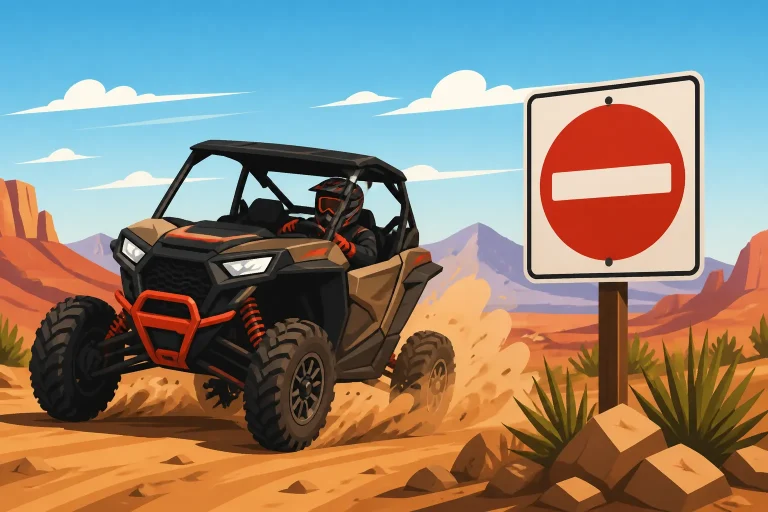
A rider may meet the personal credential requirement and still be prohibited from riding a particular road or trail. Public-land access depends on the location and its rules. A marked route may be open to some vehicles but not others; a nearby road may be closed to OHVs altogether.
Check the land manager’s current maps, signs, and restrictions for the exact route. A trailhead map is useful, but it does not replace posted closures or the land manager’s travel rules. The same principle applies to private and tribal land: public access should never be assumed just because a road looks rideable or connects to an open area.
A driver’s license also does not make an ATV or UTV street legal. Road use has separate rules, and the requirements can vary depending on whether the route is a highway, county road, or local street. Start with Street Legal ATVs in New Mexico: The Short Answer if the planned trip includes pavement, and check the specific route rules before riding there.
It does not waive other age, equipment, or supervision rules
Do not interpret the safety-permit exception as a blanket exemption for minors. Age-related requirements can apply to matters other than the safety permit, including helmets, passengers, equipment, and supervision in circumstances covered by state rules or land-manager requirements.
A 15-year-old should ride a machine suited to their size and ability, follow its passenger limits, and use required safety equipment. A driver’s license does not prove that the teen has experience on a particular machine or terrain. An ATV, a side-by-side, and a dirt bike handle differently, and a teen who is comfortable driving a car may still need practice with throttle control, braking, body position, and rough ground.
If the rider is younger than 15, or if a younger child is part of the group, do not apply the 15-year-old license exception to them. Check the age-specific requirements for each rider. The broader provisions are covered in [New Mexico Minimum Age to Ride Public Land] and [New Mexico Supervision Rules for Young Riders].
It does not establish insurance coverage
A driver’s license does not confirm that a policy covers the machine, the rider, the land, or the planned activity. Insurance is a separate issue, and coverage can depend on the policy terms and where the vehicle is being used.
If the machine belongs to someone else, is rented, or is covered under a household policy, check who is permitted to operate it and what exclusions apply. Ask the insurer or rental provider about the actual trip rather than inferring coverage from the teen’s license. If pavement is involved, check the separate financial-responsibility requirements for road use as well.
A pre-ride checklist for a 15-year-old
A few checks can prevent the most common mix-ups. Work through them in order, especially when the ride involves a rented machine, another state’s registration, or public land.
- Confirm the credential. Check the teen’s actual license. Make sure it is current and valid, and identify whether it is a driver’s license, an instruction permit, or another restricted credential.
- Verify the safety-permit exception. If the credential is provisional, temporary, restricted, or issued outside New Mexico, confirm that it qualifies. If there is any uncertainty, ask the state office responsible for OHV safety requirements before riding.
- Check the vehicle’s paperwork. Confirm that the machine has the registration, decal, or nonresident permit required for its circumstances. Do not treat the teen’s license as vehicle paperwork.
- Confirm the route is open to that machine. Check the land manager’s current route information and obey signs at the trailhead. A permit or license does not grant access to a closed route.
- Review rules beyond the safety permit. Check age-related restrictions, helmet and eye-protection rules, passenger limits, equipment requirements, and any applicable supervision rule.
- Make sure the teen can handle the machine. Match the vehicle to the rider’s size and ability. Practice on suitable ground before attempting steep, rocky, sandy, or unfamiliar terrain.
- Carry the necessary proof. Keep the driver’s license and applicable vehicle documents available during the ride. If the teen relies on an exception, having clear proof of the qualifying credential can help resolve questions during a stop.
The permit question is easy to focus on because it has a simple yes-or-no shape. In practice, the legal ride depends on several separate checks. A teenager can satisfy the rider-credential requirement and still be missing vehicle paperwork or planning to ride somewhere that does not allow that machine.
If the teen does not qualify for the exception
If the 15-year-old has only an instruction permit, or you cannot confirm that their credential qualifies, the straightforward option is to complete the OHV safety requirement before the ride. Follow the state’s current instructions for the approved course and permit process, then make sure the teen has access to the required proof.
This is also a sensible choice when the teen is new to riding. The course is not merely a substitute for a license-based exception; it is intended to teach safety practices relevant to operating an OHV. A driver’s license does not necessarily cover how to ride on uneven ground, handle a rollover risk, recognize route closures, or make decisions in a group.
For details on keeping proof with the rider, see Carrying the Safety Permit on a New Mexico Ride. If an adult in the group is unsure whether they need a safety permit, that is a separate question; Does an Adult Need a New Mexico Safety Permit? addresses the adult requirement.
Frequently Asked Questions
Does being 15 automatically exempt a rider from the OHV safety permit?
No. The relevant issue is whether the teen has a qualifying, valid driver’s license. Being 15 by itself does not establish that the safety-permit exception applies.
Does an instruction permit count as a driver’s license?
Do not assume so. An instruction permit generally allows a person to practice driving under conditions; it is not the same as a valid driver’s license for this exception. Confirm the teen’s credential with the state if its status is unclear.
Does a valid license let a 15-year-old ride any ATV or UTV?
No. The license exception concerns the OHV safety permit only. The rider must still meet other applicable requirements, and the vehicle must be properly documented and allowed on the planned route.
Should a teen carry the license while riding?
Yes. If the teen relies on a driver’s-license exception, carry the current license and keep the machine’s required registration or permit documents available too. A license does not replace those vehicle documents.
Disclaimer
This article is for general informational purposes only and does not constitute professional advice. Laws, prices and regulations vary by location and change over time. Consult a qualified professional for guidance on your specific situation.