Can a 13-Year-Old With a Motorcycle License Ride?
A 13-year-old may be old enough to ride an off-highway vehicle in New Mexico, but a motorcycle license does not make every ride legal. The key is whether the credential is a valid license or only a learner’s permit, and whether the rider meets separate rules for supervision, protective gear, passengers, registration and the land being used.
The short answer: a valid motorcycle license can matter
New Mexico requires many riders under 18 to complete an approved OHV safety course and carry proof of the resulting safety permit. A valid driver’s license can provide an exception to that requirement, and a motorcycle license may qualify. The important distinction is that the rider must hold an actual, current license—not simply have completed a motorcycle course or be waiting for an endorsement.
For a 13-year-old, check the document itself. Does it show a valid motorcycle license or endorsement? Is it restricted or provisional? Is it a learner’s permit? Those details matter because the word “license” is often used loosely to describe credentials that do not give the same privileges.
| Credential held by the 13-year-old | What to assume before riding |
|---|---|
| Valid motorcycle license | It may satisfy the license-based exception to the youth OHV safety-permit requirement. Confirm that the specific credential qualifies. |
| Motorcycle learner’s permit | Do not assume it counts as a full license or provides the same exception. |
| Motorcycle safety-course completion card | Useful evidence of training, but not necessarily a substitute for the OHV safety permit or a motorcycle license. |
| OHV safety permit | Shows completion of the OHV training requirement, but does not replace vehicle registration or land-access rules. |
| No applicable license or safety permit | Complete the required OHV safety training and obtain the required proof before riding where it applies. |
The safest practical answer is: a 13-year-old with a valid motorcycle license may qualify for the license-based exception, but the license does not replace every other OHV requirement. If the credential is a learner’s permit, or if the family is unsure whether the license qualifies, confirm the rule with the state OHV safety program before heading out.
The safety permit question is only one part of the decision. A license does not automatically authorize a child to ride every machine, on every route, or without an adult nearby. Age-related supervision rules, helmet requirements, passenger restrictions and land-manager rules still need to be checked. For a broader overview of the credential, see [New Mexico OHV Safety Permit Requirements].
License, learner’s permit and safety permit are different things
These documents can sound interchangeable, especially when a young rider has taken more than one course. They are not necessarily interchangeable. Treat each as proof of a different thing unless the state confirms that one credential satisfies a particular legal requirement.
A motorcycle license is a motor-vehicle credential. It generally indicates that the rider has met the requirements for the motorcycle privilege shown on the license. A learner’s permit is a restricted credential, often with conditions that limit when or how the holder may operate. An OHV safety permit is tied to off-highway vehicle safety training. A course card may prove that a class was completed, but it may not be the document the rider must carry.
That distinction matters for a 13-year-old because the legal effect depends on the exact credential—not the rider’s skill, the fact that they passed a class, or the family’s understanding of what the instructor called the document. If the state’s OHV rule provides an exception for a valid driver’s license, ask whether the specific motorcycle credential meets that definition. Do not infer that a learner’s permit qualifies just because it is issued by a motor-vehicle agency.
If the rider does not have a qualifying license, the straightforward route is to complete an approved OHV safety course and carry the required proof. Course details, approved providers and permit procedures can change, so use the state’s current OHV safety information rather than relying on an old course card or advice from another rider. See Where to Take a New Mexico OHV Safety Course and New Mexico’s Safety Permit for Under-18 Riders for related details.
It also helps to separate the safety credential from the vehicle’s paperwork:
- The rider’s license or safety permit concerns the person operating the vehicle.
- Registration or a nonresident OHV permit concerns the machine’s eligibility to be used.
- Permission, route designations and closures concern where the machine can go.
- Helmet, passenger and supervision rules concern how the ride is conducted.
One document cannot generally stand in for all four categories. A motorcycle license does not register an ATV, authorize travel on a closed forest road, or provide permission to cross private or tribal land. Likewise, a registered machine does not establish that a young rider has completed required training.
When there is any doubt about the credential, have the rider and a parent or guardian check the document and ask the relevant state office a specific question: “Does this exact license count for the under-18 OHV safety-permit exception?” That is more useful than asking generally whether “a motorcycle license” is enough. For guidance on carrying proof while riding, see Carrying the Safety Permit on a New Mexico Ride.
What a motorcycle license does not settle for a 13-year-old
Even when a license satisfies a safety-permit exception, it does not mean every other youth rule disappears. A 13-year-old remains a minor, and some requirements are based on age rather than on whether the rider has a license.
Before riding, check each of these separately.
Supervision
Do not assume that the license automatically answers whether an adult must supervise the rider. Supervision rules can be separate from the training requirement, and the law may distinguish between riders who have a qualifying license and those who do not. Confirm whether the license affects supervision for the particular route and riding situation.
If supervision is required, “nearby” may not be enough. A rule that calls for visual supervision generally means the adult must be able to see the rider, not merely be at the same staging area or reachable by phone. Forest terrain, ridgelines, trees and distance can quickly break line of sight. Read [New Mexico Supervision Rules for Young Riders] and Visual Supervision and What It Means before deciding how a group will ride.
Even where a license allows a teen to ride without the same supervision condition, adult oversight is still a sensible choice for a first ride, unfamiliar terrain or a group with mixed experience. A license shows that a credential was issued; it does not guarantee that a young rider knows the route, can handle a machine’s weight or can respond safely to changing conditions.
Helmet and eye protection
A motorcycle license does not waive age-based protective-gear rules. Make sure the rider has a properly fitted helmet when required and suitable eye protection. A helmet that is too loose or too large can shift during a fall, while goggles that do not fit comfortably may be left behind once the ride starts.
For a family outing, check the requirements for the exact activity. Rules may differ depending on whether the machine is being operated off road or on an authorized paved road. A helmet and eye protection are also practical protection from dust, branches, stones and wind, even where a particular rule does not apply. See New Mexico Helmet Law for Riders Under 18 and New Mexico Eye Protection Requirement.
Passengers
A 13-year-old’s license does not automatically authorize carrying a passenger. Check the rules for young operators and the design of the machine. Some vehicles have a passenger seat and restraints; others are intended for one rider. A passenger should never be added to a machine that is not designed for one, and a child operator should not assume that a second seat makes a passenger lawful.
A passenger can change the balance and handling of an ATV or UTV. It can also make it harder for a young operator to control the vehicle on a slope, in loose sand or when turning. Review New Mexico Passenger Rules for Young Riders and New Mexico Rules for Carrying a Passenger before taking someone along.
Machine size and the rider’s ability
A license is not a statement that a particular ATV or UTV is the right size for a 13-year-old. The rider should be able to reach the controls, operate the brakes and throttle smoothly, and keep control of the machine through turns and uneven ground. A large, powerful vehicle may be difficult to manage even for a teen who rides motorcycles confidently.
For a UTV, consider seat fit, restraints, visibility and whether the young driver can operate the controls without stretching or being obstructed by a passenger. For an ATV, consider the machine’s weight and whether the rider can control it when stopping, turning or moving slowly over uneven ground. A parent’s permission does not replace an age or equipment restriction that applies under law or a land manager’s rules.
A 13-year-old who is new to off-road riding should start on an appropriate machine and familiar, permitted terrain. The goal is not to prove that the rider can keep up with adults. It is to give the rider enough time and space to control the machine, follow instructions and stop safely.
The machine and the route need their own checks
A motorcycle license relates to the rider. The ATV or UTV may still need a separate registration, permit or proof of eligibility before it can be used. This is especially important when the machine is borrowed, rented, newly purchased or registered in another state.
For a New Mexico resident, check that the machine has the required New Mexico registration and display. For a visitor, check whether the home-state registration is recognized or whether a New Mexico nonresident permit is required. A permit or registration associated with one machine should not be assumed to cover another. Start with New Mexico OHV Reciprocity Rules and New Mexico’s Nonresident OHV Permit.
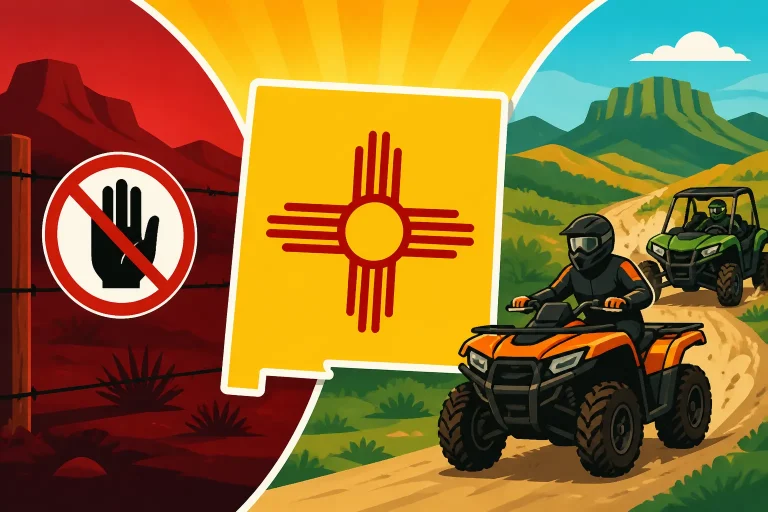
The route itself matters just as much. A valid credential and properly documented machine do not give permission to ride anywhere that looks like a trail. Public-land riding is generally limited by the land manager’s designated roads and routes, closures and other posted conditions. Private property requires the owner’s permission. Tribal lands have their own access rules; public roads or open-looking tracks should not be treated as permission to enter.
Before leaving, identify the land manager for the intended route. A forest road, BLM route, county road and trail through private land may each have different rules. Check maps and current closure information, and do not ride around a barrier or past a closed-route sign because a track appears on a phone map. See [New Mexico Rules for Riding a National Forest], [New Mexico Rules for Riding BLM Land] and [New Mexico Rules for Riding a Designated Route].
A simple pre-ride check helps prevent a credential question from becoming only one small part of a larger compliance problem:
- Confirm that the rider’s motorcycle license is valid and determine whether it qualifies for the OHV safety-permit exception.
- If it does not clearly qualify, complete the required OHV safety course and obtain the correct permit or proof.
- Check that the machine has the required registration or nonresident permit.
- Confirm the route is open to that kind of vehicle and that access is allowed.
- Check supervision, helmet, eye-protection and passenger requirements for the rider’s age and the type of ride.
- Carry the relevant documents and follow any posted instructions at the trailhead.
This checklist is useful for borrowed and rented machines too. Do not assume a rental company’s paperwork covers the rider’s training requirement, or that a parent’s registration covers a second machine. Ask the owner or rental provider what documentation applies to the machine, then verify the rider’s separate requirements. More detail is available in New Mexico Rules for a Rented Machine.
A practical way to confirm the answer before the ride
When the rider is 13, a small difference in wording can change the answer. Start by checking the exact name and status of the credential. If it says “learner’s permit,” do not treat it as a full motorcycle license. If it is a course-completion card, do not assume it is an OHV safety permit. If the license is restricted, confirm whether those restrictions affect the OHV exception.
Next, ask the state OHV safety program or the relevant motor-vehicle office about the specific document. Give the issuing jurisdiction, credential type, motorcycle endorsement status and expiration status. If the ride is on federal land, also check the land manager’s current requirements; state compliance does not eliminate route-specific federal rules.
Keep proof accessible during the ride. A parent may hold copies, but the rider should know what the required document is and how to show it if asked. A clear photo can be useful as a backup, but do not rely on a phone image if the rule requires the original or a particular form of proof. Confirm what is accepted.
Finally, make the decision based on the whole ride rather than the license alone. A 13-year-old who meets the credential rule still needs a suitable machine, lawful access, required safety equipment and a plan for staying within the permitted route. If one of those pieces is unclear, postpone the ride until it is resolved. That is easier than trying to settle a disputed rule at a trailhead or during a roadside check.
Frequently Asked Questions
Can a 13-year-old ride an ATV in New Mexico with a motorcycle license?
A valid motorcycle license may qualify the rider for the license-based exception to the under-18 OHV safety-permit requirement. Confirm that the specific license qualifies and check all other age, supervision, machine and route rules.
Does a motorcycle learner’s permit count?
Do not assume it does. A learner’s permit can have different legal status and restrictions from a full motorcycle license. Confirm with the state OHV safety program before riding.
Does the motorcycle license replace ATV registration?
No. The license is a credential for the rider. The ATV or UTV must separately meet applicable registration or nonresident-permit requirements.
Can a licensed 13-year-old ride without an adult?
That depends on the applicable supervision rule and whether the credential qualifies for any exception. Check the current rule before the ride; do not assume that a safety-permit exception automatically removes a separate supervision requirement.
Disclaimer
This article is for general informational purposes only and does not constitute professional advice. Laws, prices and regulations vary by location and change over time. Consult a qualified professional for guidance on your specific situation.