Does New Mexico Honor Colorado OHV Registration?
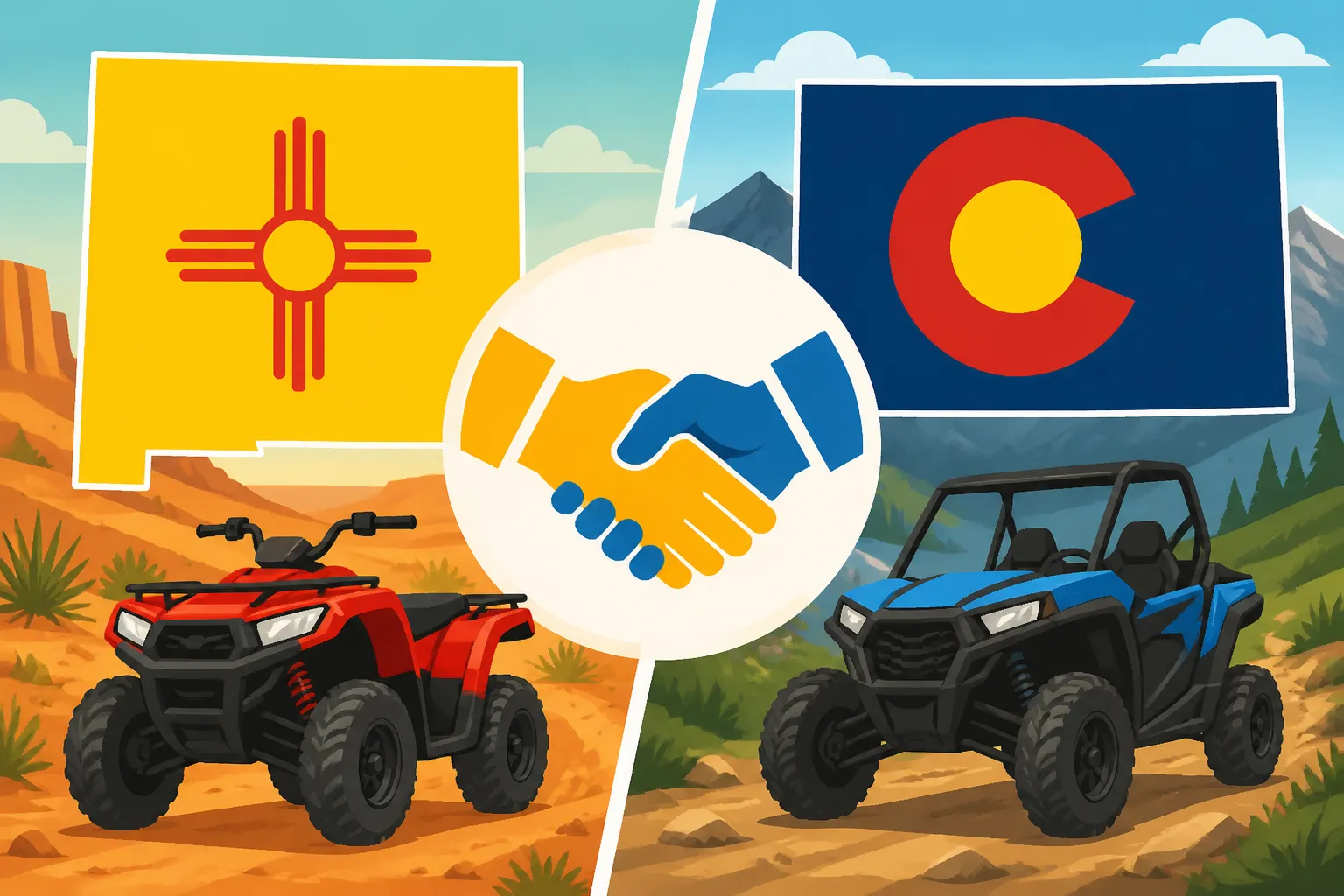
If you’re bringing a Colorado ATV or UTV into New Mexico, it can be hard to tell whether your home-state registration is enough or you need another permit. In general, New Mexico recognizes valid Colorado OHV registration. That recognition covers the state’s registration requirement, not every rule for riding on roads, trails, or public land.
Does New Mexico accept valid Colorado OHV registration?
Generally, yes. A Colorado OHV registration that is current and applies to the machine can satisfy New Mexico’s OHV registration requirement for a visiting rider. That means you usually do not need to buy a separate New Mexico nonresident OHV permit just because you plan to ride in New Mexico.
This is part of New Mexico’s reciprocity approach: the state recognizes valid OHV registration from states that have an OHV registration program. Colorado is one of those states. The practical distinction is that you need proof of actual OHV registration, not simply proof that you live in Colorado or own the machine there. For more on the general rule, see New Mexico OHV Reciprocity Rules and Any Valid OHV Registration Counts in New Mexico.
A Colorado OHV registration is also different from an ordinary motor-vehicle registration or license plate. A plate that makes a vehicle road-legal in Colorado may not, by itself, be the same thing as OHV registration. If your machine has both, keep the OHV registration proof available along with any road-vehicle documents that apply.
| What you have | What it generally means in New Mexico |
|---|---|
| Current Colorado OHV registration for the machine | Usually satisfies New Mexico’s OHV registration requirement for a visitor |
| Colorado residency, but no current OHV registration | Does not by itself establish that the machine meets New Mexico’s registration requirement |
| A road-vehicle plate only | May not be equivalent to OHV registration; check how the vehicle is classified and registered |
| A New Mexico nonresident OHV permit | May be an alternative when a visitor cannot rely on qualifying out-of-state registration |
| A Colorado OHV registration plus plans to ride a paved street | Registration alone does not authorize paved-road riding |
The word “generally” matters. Reciprocity depends on the registration being valid, applying to the machine you’re riding, and meeting the relevant requirements. If the registration has expired, belongs to a different machine, or is not an OHV registration, don’t assume it will count. Check the current New Mexico rules before traveling if anything about your paperwork is unclear.
A useful starting point is Riding New Mexico With an Out-of-State Registration. If your machine is not registered in Colorado, or your documentation is incomplete, compare the alternative options in New Mexico’s Nonresident OHV Permit. New Mexico’s nonresident permit rules are intended for visitors who cannot rely on a qualifying home-state registration; they are not automatically an extra charge for every out-of-state rider.
What proof to carry and how to prepare
Before leaving Colorado, check that the registration is current and that the machine’s identifying details match the paperwork. A discrepancy between the vehicle identification number, registration document, and machine can slow down a roadside check or leave you unsure whether the registration applies.
Use this preparation process:
- Confirm the document is OHV registration. Look for the state registration record or decal information tied to the off-highway vehicle. Don’t assume a title, bill of sale, insurance card, or ordinary plate is a substitute.
- Check that it is current. Review the expiration information and renew it through the appropriate Colorado process if needed.
- Match the machine. Compare the VIN or other identifying information on the registration with the machine. If the machine was recently bought, transferred, or replaced, confirm the registration reflects the correct vehicle.
- Bring accessible proof. Keep the official registration information where you can produce it during a ride. A clear paper copy or official electronic record is more useful than relying on memory or a seller’s verbal assurance. If you plan to rely on a digital document, confirm that it will be accepted and accessible where you ride.
- Keep other required documents separate. Registration does not replace documents that may be needed for ownership, insurance, a rental, or a special land-access permit.
If you recently bought a quad or side-by-side, make sure its registration is not still associated with the previous owner or a different machine. Registration and ownership paperwork do different jobs. A bill of sale can help document a transaction, but it is not automatically proof of current OHV registration. The details matter particularly when you are Registering an Out-of-State Machine in New Mexico or sorting out a purchase before a trip.
Also check the machine’s registration display requirements. New Mexico may require an OHV to display the applicable decal in a prescribed location, and the location depends on the vehicle type. A Colorado registration decal does not necessarily remove the need to follow New Mexico’s display rules. See Where New Mexico Decals Mount by Vehicle Type for the relevant placement details.
If you cannot show that your Colorado registration is valid and belongs to the machine, contact the appropriate state office before riding. Buying a New Mexico permit may be an option in some situations, but it is better to determine what paperwork you need before arriving at a trailhead. The nonresident permit process is separate from Colorado registration; Why Nonresident Permits Skip the MVD explains that distinction.
What Colorado registration does not authorize
Reciprocity is not a general pass to ride wherever you want. It addresses the registration requirement; it does not open closed roads, replace land-access permission, or make an ATV or UTV street-legal.
Paved-road riding is a separate question
A valid Colorado OHV registration does not, by itself, authorize riding on a paved street in New Mexico. Paved-road use has its own requirements, and it may be limited to roads that have been specifically opened for OHV travel. Other conditions can involve the vehicle’s equipment, insurance, the rider’s qualifications, and local rules.
Do not treat a brief paved connection between trails as automatically legal. New Mexico’s paved-road opt-in is distinct from ordinary OHV registration. Review New Mexico’s Paved Street Opt-In and New Mexico Paved Road Plate Requirements before planning a route that uses pavement. For insurance details, see New Mexico OHV Registration and Liability Insurance. Even if you have the correct registration, the route and the machine still need to qualify for the type of road use you intend.
Public-land rules still apply
A registered machine must still stay on routes open to OHVs. National forests and Bureau of Land Management areas can have designated-route systems, closures, seasonal limits, and other travel restrictions. A Colorado registration does not grant permission to ride off-route or enter an area closed to motorized use. Review New Mexico Rules for Riding Federal Land and check the land manager’s current maps and notices before setting out.
Access rules differ for other types of land, too. Tribal land, private property, and state trust land may require separate permission or permits. Do not assume a route is public simply because it appears on a map or connects two public roads. If your plans involve tribal roads, start with New Mexico Rules for Riding Tribal Land; for routes on trust land, see Riding State Trust Land With a Permit.
Youth and equipment requirements remain in force
A visiting rider may still need to meet New Mexico’s age-related safety rules. A home-state registration does not replace any safety permit, supervision, helmet, or passenger requirements that apply to a young rider. Check the rules for the rider’s age and machine before bringing a child on a ride. [New Mexico OHV Safety Permit Requirements] is a useful place to start.
Other operating requirements can apply regardless of where the machine is registered. Depending on where and how you ride, these may include lighting, sound, spark-arrester, helmet, and eye-protection rules. Registration establishes that the machine meets one administrative requirement; it does not certify that the machine or rider meets every operating rule.
Before heading out: a practical checklist
A little checking before you load the trailer can prevent a frustrating problem at the trailhead. Use this checklist for a Colorado-registered ATV or UTV:
- Registration: Verify that the Colorado OHV registration is current and applies to the exact machine.
- Proof: Carry official registration information in a form you can access during the ride.
- Display: Check the applicable decal-display rules for the vehicle type.
- Route: Confirm that each road or trail is open to OHVs; do not use registration as evidence that a route is open.
- Pavement: Treat paved-road use as a separate authorization question. Check local road eligibility and any additional requirements before riding on pavement.
- Riders: Review New Mexico rules that apply to minors, passengers, helmets, and safety permits.
- Land access: Confirm whether the route crosses federal, tribal, state trust, or private land and obtain any separate permission required.
- Changes: If the machine was recently sold, transferred, or modified, verify that its documents and registration still match.
If the Colorado registration is valid, the basic answer is straightforward: New Mexico generally honors it, so a visitor usually does not need a second nonresident OHV permit solely to meet New Mexico’s registration requirement. The important caveat is scope. Registration does not grant road access, replace safety rules, or override land-manager restrictions.
When paperwork is unusual, the machine’s classification is unclear, or a trip depends on a specific road, verify the details with the relevant official agency before riding. For broader context on permits and what they cover, see New Mexico OHV Permits Explained. Rules and procedures can change, and a quick confirmation is safer than relying on an old decal, an expired document, or an assumption based on another state’s rules.
Disclaimer
This article is for general informational purposes only and does not constitute professional advice. Laws, prices and regulations vary by location and change over time. Consult a qualified professional for guidance on your specific situation.