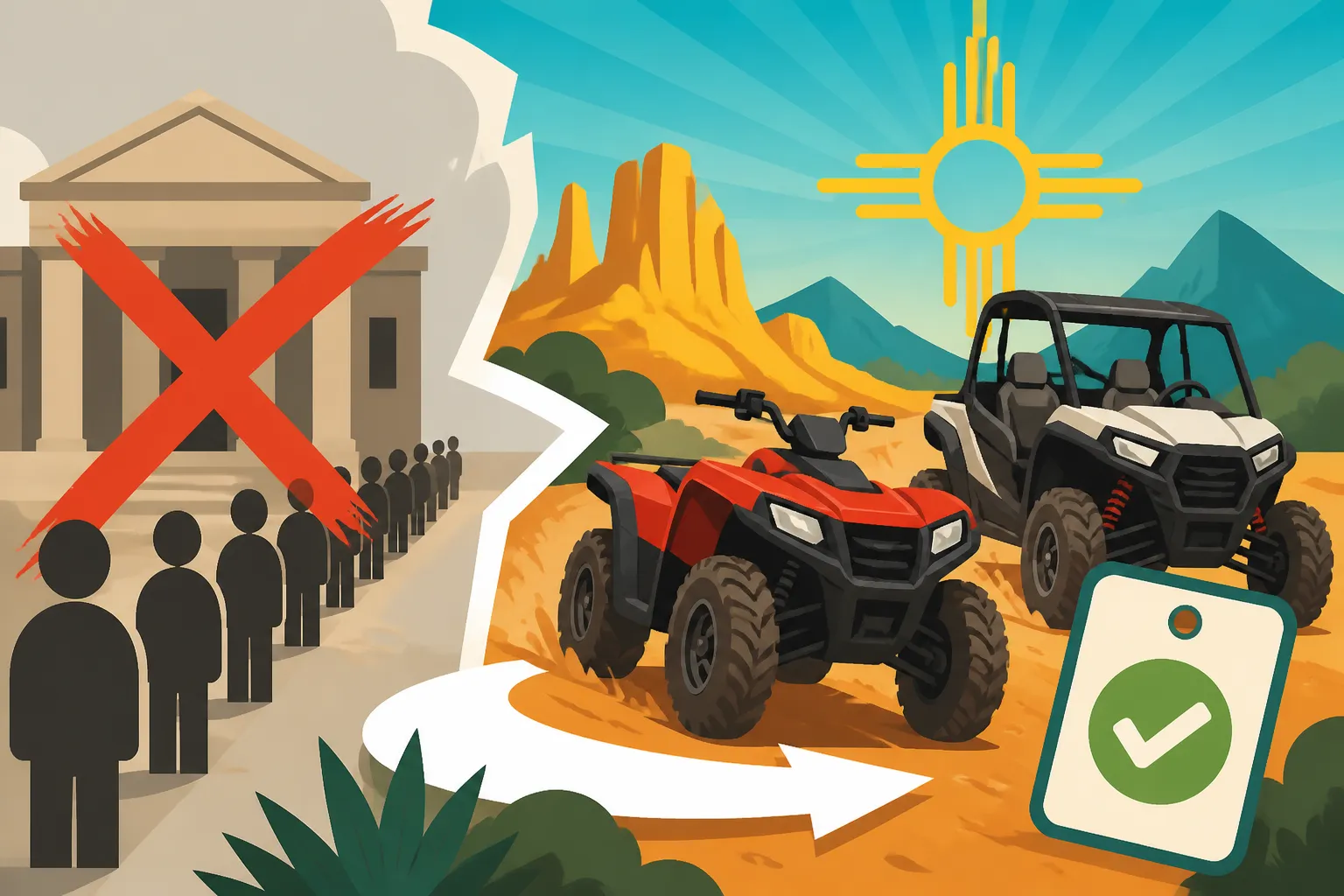
Why Nonresident Permits Skip the MVD
A New Mexico visitor can often ride without visiting a Motor Vehicle Division office, but that does not mean every out-of-state machine is automatically covered. The key is whether your home state has an OHV registration program New Mexico recognizes. This guide explains why some visitors need a separate permit, where to get it, and what it does—and does not—allow.
Why a visitor permit does not go through MVD
MVD and the nonresident OHV permit system serve different purposes. MVD handles matters such as vehicle titles, resident registration and certain plates. A nonresident permit is a separate authorization for eligible visitors to operate an OHV in New Mexico. It does not title the machine or convert it into a New Mexico-registered vehicle.
That distinction explains why a visitor generally does not need to take an ATV or UTV to an MVD office simply to obtain the permit. The permit system is designed to address whether a visitor has the required New Mexico OHV authorization—not to transfer ownership or create a New Mexico vehicle record.
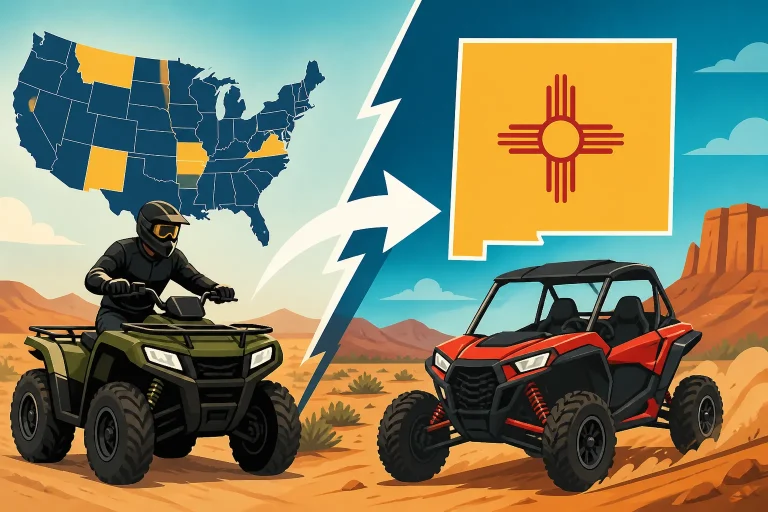
New Mexico’s reciprocity approach is also part of the reason. The state recognizes valid OHV registration from many other states. If your machine is properly registered in a state whose program New Mexico accepts, that registration may satisfy the state’s OHV permit requirement. If your home state has no comparable OHV registration program, you may need to purchase a New Mexico nonresident permit instead. For the details and exceptions, see New Mexico OHV Reciprocity Rules and Any Valid OHV Registration Counts in New Mexico.
| Your situation | Likely next step | Why MVD may not be involved |
|---|---|---|
| Your machine has valid OHV registration from a state New Mexico recognizes | Carry proof of that registration and check that it is current | New Mexico may accept the home-state registration for OHV purposes |
| Your home state has no OHV registration program that New Mexico recognizes | Check whether you must buy a New Mexico nonresident permit | The permit is issued through the OHV permit system rather than as a New Mexico vehicle registration |
| You are buying or titling a machine as a New Mexico resident | Check the applicable title and registration process | Ownership records and resident registration are MVD matters |
| You want to use a machine on paved roads | Check the separate paved-road rules, plate and equipment requirements | An OHV permit does not make a machine street legal |
The permit is therefore not a shortcut around a required title or registration. It is a separate route for visitors who do not have qualifying home-state OHV credentials. If you are unsure which category applies, start with Do Visitors Need a New Mexico OHV Permit? and Riding New Mexico With an Out-of-State Registration.
Think of the system as answering two different questions:
- Does New Mexico accept the machine’s existing OHV credentials?
- If not, does the rider need a New Mexico nonresident permit?
Neither answer determines whether a particular road or trail is open. Land access, route restrictions, safety requirements and local rules still apply.
Who may need the nonresident permit
The first thing to check is not where you bought the ATV or UTV. It is the status of its OHV registration in the state where it is registered. A vehicle purchased in one state might be registered in another, and riders in the same family may have machines with different paperwork.
A nonresident permit may be required when the machine is registered in a state that does not have an OHV registration program New Mexico recognizes. A registration card for a truck or trailer is not the same as OHV registration. Nor is a bill of sale, proof of insurance or a certificate of title automatically a substitute for valid OHV credentials.
New Mexico has a list of states whose systems do not provide the kind of registration used for reciprocity. Because the list and program requirements can change, check the current official information rather than relying on an old forum post or a friend’s experience. The explainer Which 16 States Have No OHV Program can help you understand the issue, but confirm that your particular state and document qualify before you travel.
A few practical examples:
- You live in a state with an OHV registration system and have a current registration for the machine. New Mexico may recognize it, so a separate nonresident permit may not be necessary. Carry the registration and confirm its status before riding.
- You live in a state without a recognized OHV registration system. You may need a New Mexico permit for the machine before using it in places where the state OHV permit requirement applies.
- You have a title but no OHV registration. A title proves or records ownership; it does not necessarily meet the OHV permit requirement.
- You rented or borrowed the machine. Ask the rental company or owner what credentials apply to that machine. Do not assume the registration or permit for another vehicle covers it.
- You have several machines. Check each machine separately. A document for one ATV does not automatically cover a second ATV or a side-by-side.
If you ride with a group, make this a paperwork check before loading the trailer. One rider may have qualifying registration while another needs a nonresident permit. It is easier to resolve the difference at home than at a trailhead.
What counts as proof
Carry a clear, current record of whichever credential applies: the accepted home-state registration or the New Mexico permit. Keep it accessible and make sure the identifying details match the machine you brought. If the machine’s VIN, registration number or owner information differs across documents, contact the issuer before your trip rather than trying to explain a mismatch during a stop.
A photo on a phone can be a useful backup, but it is not wise to assume that a screenshot replaces whatever proof or display method the rules require. Confirm the current instructions for carrying or displaying the permit. A waterproof document sleeve can keep paper proof readable after dust, rain or a wash; if you shop on Amazon for one, choose a size that fits the actual documents and keep the original paperwork available as required.
What the permit does and does not authorize
A nonresident OHV permit addresses the state’s OHV permit requirement for a qualifying visitor. It is not a universal pass to ride anywhere in New Mexico. A permit does not open a closed route, grant permission to cross private property, replace a land-use permit or override a local road restriction.
Before riding, identify who manages the ground and what routes are open. Federal land agencies use route designations and travel-management rules. State trust land has its own access requirements. Tribal lands and private property require their own permissions. Even a legal machine with valid paperwork must stay on routes where that kind of vehicle is allowed. See New Mexico Rules for Riding Federal Land for a broader overview of land-specific rules.
The permit also does not make an ATV or UTV street legal. New Mexico has separate rules for paved-road use, and access can depend on the type of road, local authorization, vehicle equipment, insurance and other conditions. A nonresident OHV permit is not a paved-road plate, insurance policy or road-use approval. If pavement is part of your plan, read New Mexico Paved Road Plate Requirements before assuming you can ride between a staging area and a trail.
The same separation applies to youth requirements. A minor may have an additional safety-permit obligation even when the machine’s registration or nonresident permit status is settled. Check the rules for the rider’s age, supervision and course requirements in New Mexico’s Safety Permit for Under-18 Riders. A parent’s permit or registration does not automatically satisfy a separate requirement for a young rider.
Keep these questions separate:
- Permit or registration: Does the machine have the OHV credential New Mexico requires?
- Land access: Is this exact route open to this type of machine?
- Road use: Is the road open to OHVs, and does the machine meet the applicable road requirements?
- Rider eligibility: Does the rider meet age, safety, supervision and protective-equipment rules?
- Other permissions: Does the route cross tribal, private or state trust land that needs separate permission?
Treating these as separate checks avoids a common mistake: seeing an OHV permit and assuming it covers every part of a ride. It does not. A route can be closed even when your paperwork is perfect, and an open trail can still have a separate age, equipment or land-access rule.
How to get the permit without an MVD visit
If your home-state credentials are not accepted and you need a New Mexico permit, use the current official purchase channel. The state has provided permit purchasing options outside MVD, including online and phone routes; availability and instructions should be confirmed before you rely on a particular method. The guides [Buying a New Mexico Permit Online] and Buying a New Mexico Permit by Phone explain the basic options.
A sensible process is:
- Confirm that you need the permit. Check New Mexico’s current reciprocity information and compare it with the actual registration for your machine.
- Identify each machine. Have the owner and machine details ready, including any identifying information requested during purchase.
- Use an official purchase channel. Verify that the site, phone service or authorized seller is actually connected to the New Mexico program. Do not assume an advertisement or general marketplace listing is valid.
- Follow the display and proof instructions. The permit may have specific placement or carrying directions. Read them before applying a sticker or putting paperwork away.
- Save your confirmation. Keep the receipt or confirmation with your travel documents, and check that the permit details are accurate.
- Review the rest of the ride requirements. Confirm the route, land-manager rules, rider requirements and any separate road-use conditions.
The permit is tied to the specific OHV and program rules, so do not guess about whether one permit covers multiple machines, whether it transfers with a sale, or whether an old permit remains valid after a change in ownership. Check the current instructions if your circumstances are unusual.
When packing, keep the credential somewhere that is easy to reach but protected from damage. A small waterproof pouch bought at an outdoor shop or through Amazon can keep a paper permit or registration from becoming unreadable in a dusty pack. Another Amazon option might be a simple organizer for the trailer’s registration and trip paperwork, but it is just storage—the item is not the permit and does not replace official proof.
If your trip includes both private trails and public land, do not assume the private operator’s waiver or reservation covers New Mexico’s public-land requirements. Ask the operator what documents they provide and what you must bring yourself. For a rented machine, clarify who is responsible for the permit and how you can verify that it is current. New Mexico Rules for a Rented Machine is a useful companion.
Avoiding common permit and reciprocity problems
Most problems are preventable with a few checks before departure. The trick is to confirm the paperwork for the machine you will ride, not just the rules you remember from a previous trip.
Do not confuse registration with title
A title concerns ownership; OHV registration or a permit concerns authorization under the applicable program. One document may not replace the other. If you bought a used machine and its paperwork is incomplete, resolve that before you travel. A bill of sale can help document a purchase, but do not assume it qualifies as current OHV registration. For background, see Titling an Off-Highway Vehicle in New Mexico.
Do not rely on another state’s road registration
A plate or registration for a passenger vehicle, motorcycle or trailer does not necessarily count as OHV registration for an ATV or UTV. Read the document and confirm what vehicle it covers. If your machine has an out-of-state OHV registration, check that the registration is active and that New Mexico accepts that state’s program.
Do not rely only on old advice
Reciprocity lists, purchase channels, display directions and program details can change. A past visit without a permit does not prove that the same arrangement applies to your next trip—or to a different machine. Check the current official program information shortly before travel, especially if you are coming from a state whose OHV rules are unfamiliar.
Do not assume a decal or permit is interchangeable with a plate
A nonresident OHV permit and a paved-road plate serve different purposes. A sticker for the OHV permit system does not automatically authorize pavement use. If you plan to cross or ride a public road, research that exact situation and the road’s jurisdiction. The distinction is covered in New Mexico OHV Plate Versus Sticker.
Keep documents legible and accessible
Dust, water and sun can damage paper or make a sticker difficult to read. Protect documents, but avoid covering or altering a decal in a way that conflicts with its placement instructions. A small pouch from Amazon may help keep registration papers dry, and a separate labeled folder can prevent paperwork for the tow vehicle from getting mixed up with the OHV’s documents.
At the same time, do not treat a phone photo as a guaranteed replacement for required original proof. Save a backup image in case a document is misplaced, but follow the official rules for what to carry or display. If a permit number or decal becomes unreadable, use the program’s official guidance rather than trying to recreate it yourself.
Check credentials for every rider and machine
Before leaving, match each machine to its own paperwork and each rider to the rules that apply to them. For a family trip, that may mean checking the adult’s registration, a youth rider’s safety permit, the rental company’s documents and the route’s access rules separately. A quick checklist can help:
- Is the machine’s home-state OHV registration valid and accepted?
- If not, has the correct New Mexico nonresident permit been obtained?
- Does the permit or registration clearly match the machine?
- Do you know the required display or proof method?
- Is the planned route open to your vehicle type?
- Are separate permissions needed for the land or road?
- Do age, supervision, helmet or safety-course rules apply to anyone in the group?
- Have you confirmed the current official requirements rather than relying on an old receipt or online discussion?
The practical answer to the title question is simple: nonresident permits skip MVD because they are not New Mexico titles or resident vehicle registrations. They belong to a separate OHV authorization process. That keeps a visitor’s permit task distinct from MVD’s vehicle-record work—but it still leaves the rider responsible for confirming reciprocity, carrying the right proof and following the rules for the route.
Disclaimer
This article is for general informational purposes only and does not constitute professional advice. Laws, prices and regulations vary by location and change over time. Consult a qualified professional for guidance on your specific situation.