New Mexico’s Broad OHV Reciprocity
A trip into New Mexico can turn confusing when your ATV or UTV is registered in another state: does that registration count, do you need a New Mexico permit, and will the same paperwork let you ride every trail? This guide explains how reciprocity works, what visitors should carry, where separate permissions still apply, and how to avoid a frustrating stop at the trailhead.
What New Mexico OHV reciprocity means
Reciprocity recognizes qualifying out-of-state registration
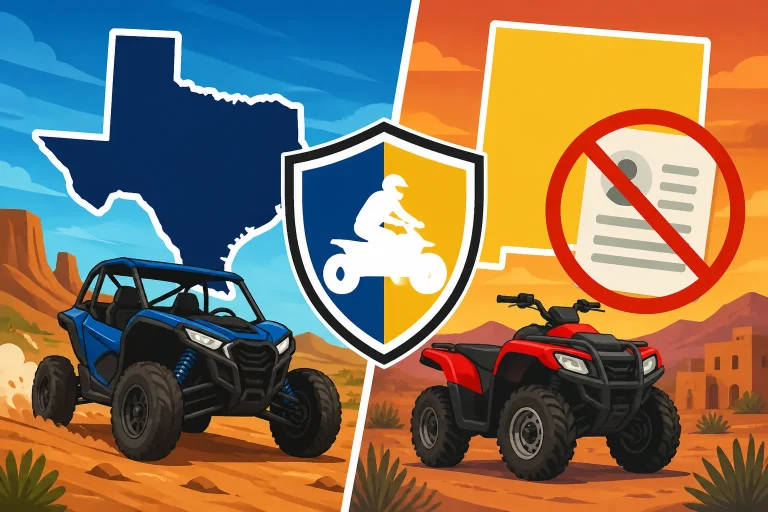
New Mexico generally recognizes a valid OHV registration from another state, so a visitor whose machine is properly registered at home usually does not need to buy a separate New Mexico nonresident OHV permit just to ride in the state. This is the practical meaning of broad reciprocity: a qualifying home-state registration can satisfy New Mexico’s registration or permit requirement for a visiting machine.
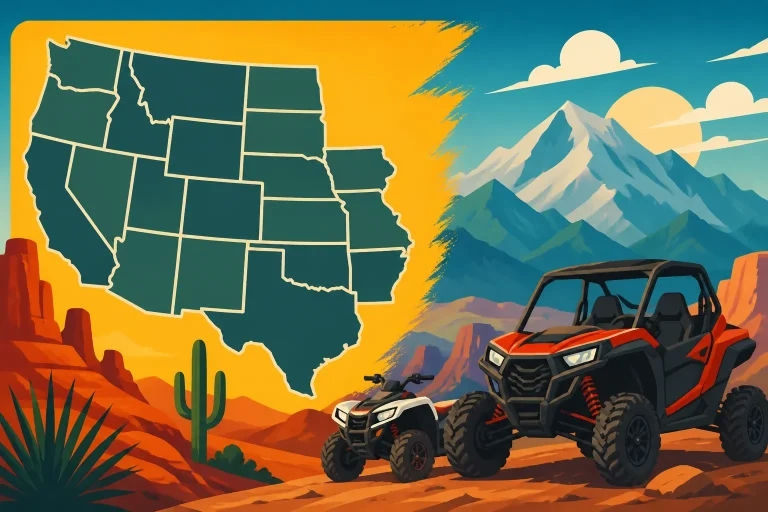
That can make planning simpler for riders traveling from Arizona, Colorado, Texas, or Utah. If your ATV or UTV is currently registered under your home state’s OHV program, you generally bring that proof with you rather than applying for a duplicate New Mexico permit. State-specific details are available in Why Arizona Riders Need No New Mexico Permit, Why Colorado Riders Need No New Mexico Permit, Why Texas Riders Need No New Mexico Permit, and Why Utah Riders Need No New Mexico Permit.
The key word is valid. An expired registration, a receipt that shows only a pending application, or paperwork for a different vehicle may not establish that the machine qualifies. Before leaving home, check the expiration date and confirm that the documents identify the machine you plan to bring. Reciprocity helps when your home-state registration is in order; it is not a way to fix registration problems after you cross the state line.
Reciprocity is not the same as permission to ride anywhere
A recognized registration answers a limited question: whether your out-of-state machine meets the relevant New Mexico registration or permit requirement. It does not automatically open every road, trail, parcel, or public-land route to motorized riding. The route must still be open to OHVs, and the rider must follow the rules that apply to that specific place.
That distinction matters around New Mexico because a vacation can include very different land types. A route on Bureau of Land Management land may have different access requirements from a road on a national forest, and state trust land has its own permission rules. A public road may be closed to OHVs even if the machine’s paperwork is impeccable. Check [New Mexico Rules for Riding Federal Land] before planning a ride on federal ground, and do not assume a road is open just because it appears on a general map.
Think of reciprocity as one item in a trip checklist, not a universal riding pass. A visitor can have valid registration and still need to change routes, obtain separate land access, meet equipment rules, or respect a closure. For a first trip, confirm three things independently: the machine’s registration status, the land manager’s access rules, and any special permit or safety requirements that apply to the rider.
Who qualifies for New Mexico reciprocity
Visitors with a current home-state OHV registration
If your state issues OHV registration for the machine you are bringing, start by confirming that the registration is current and that the vehicle details match. Keep the original registration document or an accepted official record available, along with any identifying information the state provides. The exact format can differ from one state to another, so do not assume that every state uses a windshield sticker or a paper card.
Riders from nearby states often find this straightforward. Someone trailering a registered quad from Colorado or a side-by-side from Texas can usually rely on the machine’s qualifying home-state registration rather than seeking duplicate New Mexico paperwork. That does not mean the two states’ laws are identical. Your home-state registration may satisfy the New Mexico registration requirement, while New Mexico’s riding rules still govern where and how you ride once you are here.
If you are uncertain whether your paperwork counts, compare your situation with New Mexico OHV Registration for a Nonresident and keep proof of your home-state status accessible. You can also review Proof of a Home-State Registration before packing. These checks are especially useful when you recently renewed, transferred ownership, or received a temporary document and have not yet received the usual decal or card.
Visitors from states without an OHV registration program
Some states do not operate an OHV registration program that New Mexico can recognize. For visitors coming from one of those states, New Mexico’s reciprocity rule cannot treat a nonexistent home-state registration as proof. The rider may need to obtain the applicable New Mexico nonresident OHV permit instead. The important distinction is not simply where you live, but whether your state has a qualifying program and whether your machine is covered by it.
Do not guess based on a neighboring state’s practice or a friend’s experience. Two riders who arrive in the same campground may have different requirements because their machines are registered in different states. Check the Sixteen States That Need a New Mexico Permit topic and the details in New Mexico’s Nonresident OHV Permit if your home state does not issue OHV registration.
A practical example: imagine a family driving from a state that registers road vehicles but has no separate OHV registration system. Their car’s plate does not necessarily serve as OHV registration for the quad on the trailer. They should establish what New Mexico requires for that machine before the trip, rather than discovering at a staging area that ordinary vehicle paperwork does not answer the OHV question.
Registration, permits, and other documents
Keep registration proof with the machine
A registration decal on the vehicle may be useful, but it is not a substitute for having evidence available if an officer, ranger, or land manager asks about the machine. Keep the home-state registration card or official document with your travel papers, and make sure you can match it to the ATV or UTV. That is particularly important when a household brings several similar machines on one trailer.
Before departure, check that the vehicle identification number on the paperwork corresponds with the machine. If a document lists an owner, registration number, or expiration date, make sure the information is legible and current. When paperwork is electronic, save an accessible copy on your phone and consider carrying a printed backup; a phone with a dead battery or no signal is not a dependable document folder.
A small waterproof sleeve can prevent a registration card from becoming damp, dusty, or torn during a desert ride. Amazon is one place riders may look for a simple document pouch, but the useful feature is protection and easy access, not a particular brand. Keep the pouch somewhere secure and avoid placing original documents where a spill, fuel leak, or loose cargo can damage them.
A permit is not the same thing as registration
People often use “permit,” “registration,” and “decal” as if they mean the same thing. In practice, the labels can refer to different paperwork, and requirements depend on whether the rider is a New Mexico resident, a nonresident with recognized registration, or a visitor whose state has no OHV program. A nonresident permit is not automatically required simply because the machine is from out of state.
Residents should not assume that a visitor’s reciprocity rule replaces New Mexico’s own registration requirements. If you live in New Mexico, have recently moved, or bought a machine here, use the resident registration guidance rather than relying on advice intended for out-of-state visitors. Start with Registering an OHV in New Mexico if you need to sort out the resident process.
Visitors can use New Mexico’s Nonresident OHV Permit to understand when a state permit may be needed. The most helpful question is: “What document proves this machine is covered under the rule that applies to me?” Answering that before travel helps prevent confusion between an out-of-state registration, a New Mexico permit, and any decal or plate associated with a different use.
Youth safety requirements are a separate question
A machine’s registration does not necessarily settle the requirements for the person operating it. New Mexico has separate safety rules for younger riders, including a safety-permit requirement in circumstances where an adult rider may not need one. A parent who sees that the ATV is registered should still check whether the teen needs a separate credential or must ride under particular supervision conditions.
This difference can catch families off guard. A parent may have taken care of registration months earlier, then assume the paperwork covers a teenager borrowing the quad during a weekend trip near Farmington or Ruidoso. It is better to confirm the rider’s age-related obligations before the trip, especially if more than one young person will take turns operating machines.
Review New Mexico’s Safety Permit for Under-18 Riders and the related safety requirements for the rider’s age and circumstances. Keep any required safety permit or proof of course completion with the rider’s trip documents. A waterproof document sleeve or a small zip pouch can help keep cards together; if you are shopping for one on Amazon, choose something that closes securely and can be found quickly in a gear bag.
How to check whether your home-state registration counts
Confirm that your state has a qualifying program
Start by identifying how your home state handles off-highway vehicles. Some states issue a dedicated OHV registration or permit; others may use a different system or may not have an equivalent program. Do not infer the answer from whether your ATV has a road plate, whether your neighbor’s machine carries a sticker, or whether the state requires registration for a different vehicle category.
Next, confirm that your particular machine is included. An ATV, UTV, dirt bike, youth machine, and a machine used only on private property may not always be treated identically under state rules. If your paperwork is for a different vehicle or a different type of use, it may not establish the status you need for a New Mexico trip.
When the answer is unclear, consult the official agency that issued your home-state paperwork and the New Mexico nonresident guidance. Keep notes about what you confirmed and save the relevant documents. That is more reliable than relying on a social-media post describing a different state, machine, or registration year.
Check dates, ownership, and vehicle details
A valid registration should be current for the dates you intend to ride. Look at the expiration date before packing, not after you have driven several hours toward the Sacramento Mountains or the dunes near Alamogordo. If the registration expires during a multi-day visit, ask the issuing agency whether renewal can be completed before departure and what proof is available while updated materials are on the way.
Ownership changes deserve special attention. If you recently bought a used ATV, the seller’s registration may not prove that the machine is registered to you or that the documents remain valid after the sale. Make sure the transfer has been completed as required in your home state and that the paperwork you carry identifies the machine accurately. New Mexico’s reciprocity does not resolve a title or ownership dispute from another state.
Compare the vehicle identification number on the machine with the number shown on the registration document. A typographical error, a smudged number, or paperwork for a similar-looking family machine can make a routine check harder. If something does not match, resolve it before the trip rather than hoping the difference will go unnoticed.
Make your proof easy to find during a roadside check
Carry registration proof somewhere secure but accessible. A rider who has to empty a dusty cargo box, remove a packed cooler, and dig through a trailer’s storage compartment just to locate one card is likely to find a roadside stop more stressful than it needs to be. Give each machine’s documents a consistent place and label them clearly.
For a group, put the paperwork for each vehicle together instead of carrying one loose stack for every ATV and UTV. This is helpful when a household has several machines with similar colors or when different adults are responsible for different riders. A simple checklist can record the machine, its identification number, registration expiration, and the person carrying its documents.
You can keep a digital backup as well as the original, but do not let the backup replace whatever official proof is required. Download documents before traveling, since service can be unreliable in remote areas. A modest waterproof sleeve or organizer bought through Amazon can be handy for keeping paper copies together, but avoid storing documents in a place that is exposed to heat, water, or fuel.
What reciprocity does not cover
Route access and land permissions still apply
New Mexico has a mix of public and private land, and a route that looks open on a map may have a closure, seasonal restriction, or land-access condition. Reciprocity does not grant permission to cross private property or ride on land where OHVs are prohibited. It also does not replace any special permit required for a separate land category.
State trust land is a common source of confusion because it may look like open desert or appear alongside other public land on a map. Access rules can differ, so do not treat a home-state registration as permission to ride there. Read The Permit You Need for New Mexico Trust Land before planning a route across trust land, and make sure you understand where the permitted area begins and ends.
Federal land managers also set route-specific rules. Some roads are open to motorized travel, while others are closed or designated for particular uses. Check official travel-management information and follow signs on the ground. For a broader overview of the distinction, see [New Mexico Rules for Riding Federal Land]. A valid registration can help satisfy one requirement while leaving the route-access question entirely unanswered.
Road-use rules are different from off-road registration
An OHV that is registered or covered by a visitor permit is not automatically legal for every paved street or highway. Road use may depend on the particular road, local rules, machine equipment, insurance, rider qualifications, and any applicable plate or authorization. A registration recognized for off-highway use should not be mistaken for permission to drive along a town street or state highway.
This matters on trips where a rider hopes to connect trails by using a short stretch of pavement. A brief shortcut through a town can still cross into a different set of rules. Before riding on pavement, check the specific New Mexico road-use requirements and local ordinances for the community or county involved. Do not assume a route is lawful simply because the machine has lights or a license plate from another state.
Plan a route that keeps the machine on roads and trails open to its use. If pavement is part of the plan, research the applicable requirements in advance and verify that the road itself allows the vehicle. A map app may show a connected road network without showing whether a particular segment is legally open to an OHV.
Safety, equipment, and rider rules still apply
Reciprocity does not exempt visiting riders from New Mexico’s operating rules. Age-related requirements, supervision, helmets or eye protection, equipment standards, and conduct rules may apply according to the rider, machine, and riding location. A visitor should not assume that compliance with a home-state rule automatically satisfies a different New Mexico requirement.
This is especially important for families. A teen who can operate a machine legally at home may face a separate safety-permit or supervision requirement in New Mexico. Similarly, an adult may need to follow rules about carrying a passenger, using a machine on a road, or riding after dark. Check the rules that apply to the situation rather than assuming one statewide age rule answers every question.
Before loading, inspect the machine as well as the paperwork. Check brakes, tires, lights where required, and any equipment relevant to the land or route. Carry protective gear and explain the plan to younger riders. The best use of reciprocity is to reduce duplicate paperwork—not to skip the ordinary preparation that helps keep a ride safe and lawful.
A practical trip-planning checklist for out-of-state riders
Before you leave home
Begin with the basics: confirm that the machine has current registration, determine whether your state’s program qualifies for reciprocity, and make sure the paperwork matches the vehicle. If your state has no qualifying OHV registration program, look into the New Mexico nonresident permit before departure. Do not wait until you reach a remote trailhead to investigate whether a permit can be purchased or displayed there.
Then check each rider separately. If a child or teenager will operate a machine, review the age-based safety requirements and have any necessary permit or course documentation ready. If an adult will ride a different machine, check that the adult’s machine has its own proof. A parent’s registration card does not automatically cover every vehicle on the trailer.
Finally, research the route and land access. Identify the land manager, check current route information, and look for seasonal or temporary closures. If the trip includes a town, paved-road segment, state trust land, or private boundary, verify the rules for that segment as well. A little paperwork and map checking at home can prevent an unplanned turnaround after a long drive.
At the staging area
Before unloading, check that the group has the right documents for the right machines. Confirm that every rider knows who is carrying the paperwork, where it is stored, and what to do if the group separates. Keep a list of the machine identification numbers and emergency contacts with the trip plan, but protect personal information and do not leave documents unattended.
Review the route with everyone before starting. Make sure the track follows routes that are open to OHVs and that the group understands where to stop, turn around, or avoid entering land with unclear access. A GPS line is not proof that a route is legal. Compare it with current official maps and signs, especially where a trail meets a road, a gate, or a land boundary.
It is also a good moment to check the machine and gear. Confirm that fuel, water, tools, first-aid supplies, and protective equipment are ready. If you carry paper maps and documents together, use separate sleeves or compartments so a wet map or spilled drink does not damage your registration proof.
If an officer or land manager asks for proof
Stay calm, stop safely, and follow instructions. Identify the machine and provide the registration or permit documentation that applies. If the documents are electronic, open the saved file rather than relying on a weak signal to retrieve it. If an officer asks about the route or land access, answer accurately and avoid guessing about a boundary you have not confirmed.
A mismatch or missing document is easier to address when you can clearly explain what you have and where it came from. Do not present another machine’s paperwork as if it belongs to the one being checked. If you discover that a registration is expired or a document does not match, ask what steps are appropriate and do not continue riding in a way that could create a further violation.
A roadside check can also reveal a planning mistake, such as assuming a trail was open or misunderstanding which permit applied. Treat the information as a reason to pause and confirm the route before continuing. New Mexico’s landscape can change quickly from open-looking desert to a marked boundary, a closed route, or a road with a different rule.
Common reciprocity mistakes and how to avoid them
Assuming every out-of-state document is enough
One of the most common mistakes is treating any state-issued document as OHV registration. A vehicle title, road registration, purchase receipt, or insurance card may be useful for other purposes, but it may not establish that the machine is covered by an OHV registration program. Identify what the document actually proves before relying on it.
Another mistake is confusing a state program with a dealer’s paperwork. A sales receipt can show when and where a machine was purchased, but it is not necessarily proof of current registration. If your home-state registration is being processed, ask the issuing agency what temporary document is recognized and whether it clearly identifies the machine.
Use New Mexico OHV Registration for a Nonresident and Proof of a Home-State Registration to check the distinction that applies to your visit. If the status remains unclear, resolve it before travel. A short call or official agency check at home is much easier than trying to interpret paperwork at a busy trailhead.
Believing reciprocity covers every machine in the group
A household may have an ATV registered in one state, a side-by-side titled in another, and a youth machine with different paperwork. Do not assume that one registration covers all the machines being transported. Verify every machine individually, including vehicles borrowed from friends or relatives.
Borrowed machines bring another layer of practical concern. The owner may have current registration, but the rider should still know where the proof is and confirm that the paperwork applies to the exact vehicle. If the machine is rented, ask the rental company what permits or registration documents are included and what riders must provide separately.
This is where a simple trip inventory helps. List every ATV and UTV, the state that issued its registration, the expiration date, and the person carrying its documents. A household that takes a few minutes to do this is less likely to leave a card in a different vehicle or discover that one machine’s registration expired last month.
Treating a map, decal, or old advice as final proof
A decal can be hard to read, damaged, or left over from a previous registration period. A map can show a line without showing a closure or access restriction. A friend’s advice may be accurate for a different state, machine, or land manager. Use these clues as prompts to verify information, not as substitutes for current official documents and route checks.
The same caution applies to online trip discussions. A rider might say that a road was open on a previous visit, but conditions and access rules can change. Confirm route status close to the trip and pay attention to posted signs. If a route is marked closed, do not rely on a GPS track or a past ride report to justify continuing.
Keep the paperwork organized and carry a reliable map or route plan. A phone mount or waterproof case purchased through Amazon may help keep a navigation device accessible, but the device itself does not establish legal access. Download maps in advance, carry a backup where practical, and make decisions based on official route information and signs on the ground.
Quick reference for New Mexico visitors
| Your situation | What to check | Practical next step |
|---|---|---|
| Your state issues OHV registration and your machine is currently registered | Whether the registration is valid and identifies the machine | Carry the registration proof and verify route access separately |
| You are coming from a state without a qualifying OHV registration program | Whether New Mexico requires a nonresident OHV permit for your machine | Review New Mexico’s Nonresident OHV Permit before traveling |
| Your machine was recently purchased or transferred | Whether ownership and registration paperwork are complete | Resolve mismatched or temporary paperwork with the issuing agency |
| A rider under 18 will operate a machine | Age-based safety permit, course, and supervision requirements | Review New Mexico’s Safety Permit for Under-18 Riders |
| Your route includes federal land | Open routes, closures, and land-manager requirements | Check [New Mexico Rules for Riding Federal Land] |
| Your route crosses state trust land | Separate access and permit requirements | Review The Permit You Need for New Mexico Trust Land |
| You plan to use pavement | Road-specific access, equipment, insurance, and rider rules | Confirm that the exact road and machine are authorized |
| Your group has several machines | Registration proof for each vehicle | Make a vehicle-by-vehicle document checklist |
New Mexico’s broad OHV reciprocity is useful because many visitors can ride with qualifying home-state registration instead of obtaining a duplicate state permit. But it only addresses one part of trip readiness. Confirm the paperwork for every machine, check separate requirements for young riders, and verify that the land and routes you plan to use are open to OHVs.
If you want a quick final check before loading the trailer, ask: Is every machine’s registration current? Does each document match the machine? Does my home state have a qualifying OHV program? Does any rider need a separate safety permit? Are the planned routes open, and do any land permissions or road rules apply? Answering those questions before departure makes it much easier to focus on the ride once you reach New Mexico.
Disclaimer
This article is for general informational purposes only and does not constitute professional advice. Laws, prices and regulations vary by location and change over time. Consult a qualified professional for guidance on your specific situation.