New Mexico’s $18 Ninety-Day Permit
If you’re visiting New Mexico with an ATV or UTV, the confusing part is figuring out whether your home-state registration is enough or whether you need a visitor permit. The $18 ninety-day permit is one option for certain nonresident riders, not a universal entry fee. Here’s how to tell whether it applies to your machine, when the shorter permit makes sense, and what to check before you ride.
What the ninety-day permit is for
New Mexico’s ninety-day permit is a short-term option for a nonresident whose off-highway vehicle does not qualify under the state’s registration reciprocity rules. It is intended for a machine being operated in New Mexico, rather than a permit for one person to use on every vehicle in a group.
The permit is commonly listed at $18. Fees and permit arrangements can change, so confirm the current amount, eligibility rules, and purchase process with the official New Mexico permit provider before you travel. For a broader overview of the visitor rules, see New Mexico’s Nonresident OHV Permit.
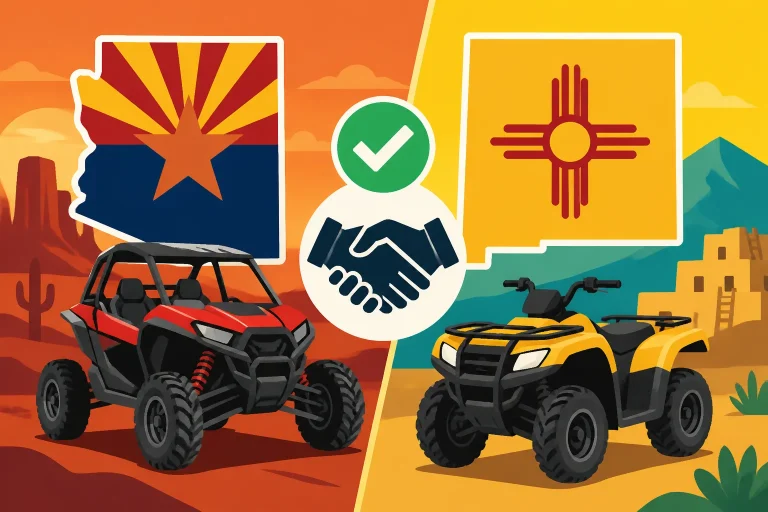
The key question is not simply, “Am I from out of state?” It is, “Does my machine have a valid registration or certificate from a state whose OHV program New Mexico recognizes?” A valid home-state registration may be enough. If your home state does not have a qualifying program, you may need to buy a New Mexico nonresident permit instead. New Mexico OHV Reciprocity Rules explains that distinction in more detail.
A permit is also not permission to ride anywhere. It addresses a New Mexico OHV requirement; it does not override land closures, route restrictions, private-property rules, or the requirements of a federal, tribal, or other land manager. Before setting out, check the rules for the specific place you plan to ride. For background, see New Mexico Rules for Riding Federal Land.
| Your situation | What to check | Likely next step |
|---|---|---|
| Your OHV has current registration from a state with a recognized OHV program | Whether the registration is valid for the machine and accepted under New Mexico reciprocity | Carry proof of registration; a separate visitor permit may not be needed |
| Your home state has no qualifying OHV registration program | Whether the New Mexico nonresident permit applies to your machine and planned riding | Compare the ninety-day permit with the longer-term option |
| Your registration is expired, missing, or for a different machine | Whether the document meets New Mexico’s reciprocity requirements | Resolve the paperwork issue or confirm whether a permit is required |
| You plan to ride on tribal, private, or state trust land | The landowner’s or land manager’s separate access rules | Get any required permission or access permit in addition to addressing OHV status |
| You will ride only on roads or surfaces where a different vehicle rule applies | Whether your planned use counts as OHV riding and what equipment or road-use requirements apply | Confirm the rules for that particular route before relying on an OHV permit |
The table is a starting point, not a substitute for checking your exact machine and documents. If you are unsure how New Mexico treats your home-state paperwork, ask the official permit provider before traveling rather than assuming that a license plate, bill of sale, or insurance card will stand in for OHV registration.
Who may need it and who may not
New Mexico generally uses reciprocity to recognize valid OHV registration from other states that have an established OHV registration program. That means many visitors can ride without buying the ninety-day permit, provided their vehicle has the qualifying document and they carry it with them.
That is different from having ordinary vehicle registration or a standard road plate. Some states issue a specific OHV registration, while others may not have an equivalent program. The precise document matters. Any Valid OHV Registration Counts in New Mexico is useful if you already have a state-issued registration and want to understand what proof to bring.
If your state does not have a qualifying OHV program, New Mexico may require you to purchase a nonresident permit before riding on applicable public lands. The state’s list of non-program states is a practical place to start: The Sixteen States That Need a New Mexico Permit. Check the current list directly, because program status and recognition details can change.
A few common situations deserve extra care:
- Your machine is registered in another state, but the paperwork is expired. Do not assume an expired document counts for reciprocity. Ask whether you need to renew the registration or obtain a New Mexico permit.
- You have a bill of sale but no registration. A purchase receipt may help establish ownership, but it is not necessarily a substitute for the required OHV registration or permit.
- The machine belongs to someone else. Confirm that its registration or permit is current and that you can carry proof while riding it. Do not assume that a permit associated with one machine covers another.
- You are borrowing or renting an OHV. Ask the owner or rental business what documentation applies to that specific vehicle and who is responsible for providing it. A rental agreement alone may not answer every permit question.
- You are a New Mexico resident. The visitor permit is not a replacement for the registration requirements that apply to residents. Start with Registering an OHV in New Mexico if the machine is based in the state.
- You are riding somewhere other than ordinary public OHV land. Tribal land, private land, and state trust land can have separate access rules. A New Mexico permit does not give you permission to enter land where you otherwise lack access.
When people ask, “Do visitors need a New Mexico OHV permit?” the useful answer is: some do, and some do not. It depends on the machine’s home-state status and where it will be ridden. Do Visitors Need a New Mexico OHV Permit? walks through the basic decision; for a state-by-state overview, New Mexico’s Broad OHV Reciprocity may also help.
When the $18 option makes sense
The ninety-day permit can suit a visitor who is eligible to use it and expects to ride in New Mexico for a limited period. It may be a reasonable choice for a seasonal trip, an extended visit, or a few riding outings spread across a stay that falls within the permit’s validity period.
It is not automatically the cheapest or simplest choice for every visitor. If your machine already has qualifying registration, buying a permit may be unnecessary. If you plan to ride for longer, compare the short-term permit with the longer-term option. The current two-year permit is commonly listed at $48, but confirm the current fee and terms before choosing; New Mexico’s $48 Two-Year Permit covers that alternative.
Think about the full trip, not just the number of days you expect to be on the trail. If you arrive near the start of a trip but might return for another ride later, check how the permit’s validity is counted and what date appears on the permit. Do not assume that “ninety days” means a calendar season, a fixed quarter, or a particular end-of-month date. Confirm the start and expiration rules when you purchase.
Before paying, work through these questions:
- Is your machine eligible for the visitor permit? Check your home-state registration status first. If you have a qualifying current registration, reciprocity may already cover you.
- Where will you ride? Identify the land manager and confirm that your intended trails or roads are open to your type of vehicle.
- How long will you need the permit? Compare the short-term and longer-term options using your actual travel dates, not a rough estimate.
- What proof must you carry? Confirm whether you need the permit itself, a receipt, a registration document, or more than one item.
- How should any permit decal or document be displayed? Follow the official instructions for your vehicle and permit. Don’t place a sticker based on a guess or attach it where it can be covered by mud, gear, or bodywork.
If you are traveling with several machines, check each one separately. A family might have a registered side-by-side and an unregistered youth ATV, for example. The first machine’s paperwork does not necessarily resolve the second machine’s status. The same applies to a group of friends transporting vehicles on one trailer: make a simple list of each vehicle, its registration or permit, and who is carrying the documents.
The purchase route is another detail worth checking. New Mexico permits may be available through official online or other authorized channels, but availability and instructions can change. Use Buying a New Mexico Permit Online or Buying a New Mexico Permit by Phone as a starting point, then confirm the current process with the official provider. Do not mistake a seller’s listing on a general marketplace for an official permit. Amazon may be useful for ordinary trip supplies, but it is not a substitute for an authorized permit channel.
How to prepare before riding
A permit solves only one part of trip preparation. Before loading the trailer, gather the documents and check the route conditions that apply to your ride.
Keep proof together
Carry the applicable registration or permit in a place where you can reach it without emptying a packed vehicle. A small waterproof document sleeve can help protect papers from dust and moisture. If you buy basic supplies through Amazon, look for a pouch that closes securely and can stay with the machine or rider; keep the original documents safe and use a copy only if the official rules allow it.
A clear photo on your phone can be a useful backup, but do not assume a digital image replaces required physical proof. Phone batteries run down, service can be unreliable in remote areas, and an officer or land manager may need to see the required document in the format specified by the rules. Carrying Proof on a Desert Ride has practical advice for keeping important documents accessible when you are away from town.
If the registration is in another person’s name, check that the vehicle is being used with permission and that the documents match the machine. The VIN or other identifying information should be legible. If something does not match, sort it out before the trip rather than trying to explain a paperwork problem at a trailhead.
Check the land rules separately
A permit does not open every road or trail. Public lands can have designated routes, seasonal closures, width limits, and vehicle-specific restrictions. Some roads are open to full-size vehicles but not OHVs; some trails are limited to certain machine types; and some areas may close because of weather, fire danger, maintenance, or wildlife concerns.
Use the current map or travel-management information for the area you plan to visit. Confirm that your route is open to your machine’s width and class, and check whether the rules differ between the road leading to the staging area and the riding area itself. A route that appears on a general map is not necessarily an authorized OHV route.
Do not assume that a road is open because it is unpaved, has tire tracks, or appears on a phone app. Closures and boundaries can be easy to miss in the field. If a route is marked closed, stay out and choose an open route. On tribal land or private property, get permission from the appropriate authority or owner. State trust land may require its own access authorization; an OHV permit does not replace it.
Make the paperwork easy to verify
Before departure, compare the machine’s identifying details with the registration or permit information. Bring the required documents and make sure the person who will be riding knows where they are stored. If there are several machines, keep each vehicle’s papers clearly associated with it rather than putting every document in a single envelope with no labels.
A compact checklist can prevent a last-minute scramble:
- Current qualifying home-state OHV registration, if relying on reciprocity
- New Mexico nonresident permit, if required
- Purchase or permit confirmation, if the official instructions say to keep it
- Machine details needed to match the paperwork, such as the VIN
- Any separate land-access authorization required for the riding area
- A backup copy or photo, where useful, without relying on it as the only proof
If your trip includes road use, check road rules independently. An OHV permit is not a street-legal conversion and does not authorize riding on a public road that is closed to OHVs. New Mexico has separate requirements for paved-road use and for the roads or crossings that may be used. See New Mexico Paved Road Plate Requirements before planning to ride on pavement.
Common mistakes and a practical decision
The most common mistake is buying the ninety-day permit simply because the rider is a nonresident. Visitors with qualifying current registration may fall under reciprocity instead. The opposite mistake is assuming that any state-issued plate, title, or insurance document automatically qualifies. Verify the document type, its validity, and whether New Mexico recognizes the home-state program.
Another frequent mistake is treating the permit as a person’s pass. The rules are tied to the OHV and its status, so check each machine individually. If you bring two ATVs and a UTV, do not assume that one registration or permit covers the whole trailer.
It is also easy to focus on the price and overlook timing. A short-term permit can be attractive for one visit, but the validity dates determine whether it covers the entire period you need. Confirm the start date and expiration date before purchase, especially if the trip is close to a return visit or spans several stages.
Finally, riders sometimes confuse three different things:
- Registration or reciprocity: whether the machine’s home-state paperwork is accepted.
- A New Mexico nonresident permit: a visitor requirement for a machine that does not qualify through reciprocity.
- Land access or road-use authorization: whether you are allowed to ride a particular route or property.
These are related but not interchangeable. Having one does not automatically satisfy the others.
A straightforward way to make your decision is to identify the machine’s home state, verify whether its current OHV registration qualifies for reciprocity, and then check the official permit options if it does not. If the ninety-day permit applies, compare its validity period with your travel dates and follow the provider’s instructions for carrying or displaying it. After that, confirm that every route you intend to ride is open to your vehicle and that any separate access permission is in place.
For riders without a qualifying home-state program, the ninety-day option may be a convenient fit for a limited visit. For riders with valid registration from a recognized program, a separate permit may not be needed. Either way, confirming the details before departure is easier than discovering a paperwork or access issue at the trailhead. Amazon can help with practical items such as a dust-resistant document pouch or a paper map, but use official sources for permit eligibility, purchase, and current instructions.
Disclaimer
This article is for general informational purposes only and does not constitute professional advice. Laws, prices and regulations vary by location and change over time. Consult a qualified professional for guidance on your specific situation.