Certifying a Rider Under Eighteen
New Mexico riders under eighteen face a requirement that is easy to confuse with machine registration: they need their own OHV safety permit. The key steps are to complete an approved course, keep proof of the permit available while riding, and check the separate age, supervision, and equipment rules that apply to the rider.
What certification means in New Mexico
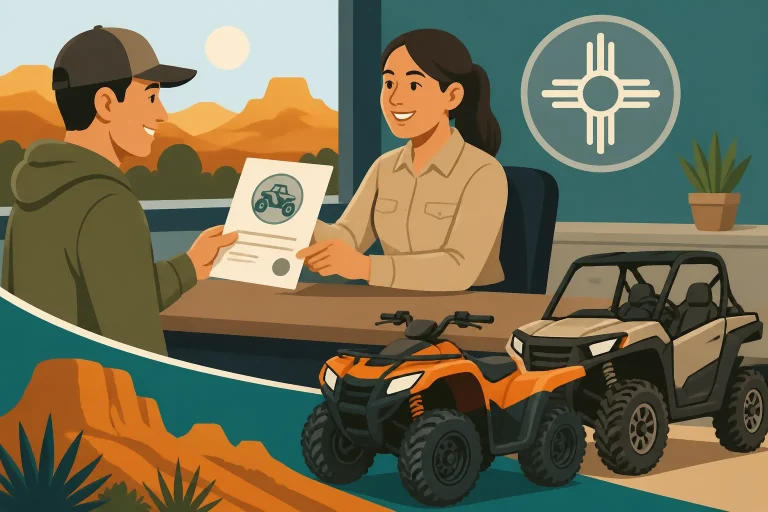
For an OHV rider under eighteen, certification means completing an approved safety course and obtaining the resulting safety permit. The permit is for the rider, not the ATV, UTV, or dirt bike. It does not replace the machine’s registration or any permit required for a nonresident machine.
| Requirement | Applies to | What it does |
|---|---|---|
| OHV safety course and safety permit | The qualifying under-18 rider | Shows that the rider completed the required safety training |
| Registration or other machine paperwork | The OHV | Establishes the machine’s required paperwork for the ride |
| Nonresident OHV permit, when required | A qualifying out-of-state machine | Covers a separate visitor or reciprocity requirement |
This distinction matters when a family shares one machine, borrows one, or rents one. The machine’s paperwork does not certify the young person operating it. Likewise, a rider’s safety permit does not register the vehicle. For more on the rider-specific requirement, see New Mexico’s Safety Permit for Under-18 Riders and New Mexico OHV Safety Permit Requirements.
The safety permit is part of New Mexico’s rules for young riders on public riding areas. It is not a general road license and does not give a rider permission to use every road or trail. Riders still need to follow the rules for the land they are on, including route restrictions, closures, and any applicable local requirements.
Certification also does not make every rider eligible to operate every type of machine. Age limits and supervision rules are separate questions. A safety card is one piece of readiness, not a substitute for checking whether a particular young person may legally operate that vehicle in that place. Review New Mexico Minimum Age to Ride Public Land alongside the permit requirement before planning a ride.
How to certify a rider under eighteen
The practical process is straightforward, but the family should use an approved course and make sure the rider finishes the steps needed to receive the permit.
- Check the current approved course options. Start with the official New Mexico OHV safety information and confirm which courses are recognized. Course formats and registration steps can change, so do not assume that any general ATV safety class qualifies. The current approved list is the right place to start; Approved Courses for a New Mexico Permit explains what to check.
- Enroll the rider in the course. Use the rider’s correct legal and contact information, and check any age or account requirements before beginning. If a parent or guardian needs to set up the registration, follow the course provider’s instructions rather than entering the adult as the student.
- Complete the required learning and assessment. The rider should work through the course material and any required test or practical component. Treat it as skills training, not just a form to get past. Topics commonly include protective gear, safe operation, terrain, other trail users, and how to avoid preventable crashes.
- Finish the provider’s permit steps. Course completion and having a permit in hand may not be the same step. Follow the provider’s directions to obtain the permit or proof of completion, and check that the rider’s name and details are correct.
- Save proof in a form that can be carried. Keep the permit accessible during rides. If the provider allows a printed copy or a digital record, check that it is readable and available when the phone has no signal or its battery is low.
A parent can help with enrollment, payment if applicable, and recordkeeping, but the young rider is the person who needs to complete the required training. A parent should not treat watching a video together or signing a waiver as a replacement for the rider’s own course completion.
Before choosing a class, verify that it is accepted for the New Mexico OHV safety permit. Some classes cover useful riding skills without meeting the state’s certification requirement. If a family already has an out-of-state safety card, check directly whether New Mexico recognizes it for this purpose instead of assuming that a course accepted elsewhere automatically qualifies.
The same caution applies to a driver’s license or motorcycle credential. A license may affect what a teen is allowed to operate under particular rules, but it should not be assumed to substitute for the OHV safety permit. Check the specific situation, especially for younger riders; Can a 13-Year-Old With a Motorcycle License Ride? covers why one credential does not automatically settle every age-related rule.
What the safety permit does and does not cover
The permit confirms completion of required safety training. It does not waive the other rules that can apply to the rider, the vehicle, or the place where the ride takes place.
First, certification is not permission to ride on a closed route or land where OHV use is not allowed. Public land may have designated routes, seasonal closures, or restrictions that apply even when a rider has the right paperwork. Private and tribal land may require permission. For federal ground, confirm the travel rules with the land manager; see [New Mexico Rules for Riding a National Forest] and New Mexico Rules for Riding BLM Land.
Second, the permit does not replace any required vehicle registration or visitor permit. A resident machine and a machine brought from another state may have different paperwork questions. Reciprocity may resolve a machine-permit requirement for some visitors, but it does not remove the under-eighteen rider’s separate safety obligation. For the visitor side of the issue, see New Mexico OHV Reciprocity Rules.
Third, certification does not cancel age-specific requirements. A young rider may still be subject to minimum-age, supervision, helmet, passenger, or other operating rules. The details can depend on the rider’s age, the machine, and the setting. Check those rules for the exact planned ride rather than relying on the course certificate alone.
Supervision deserves particular attention. If New Mexico requires an adult to supervise a rider in the relevant age group, simply having an adult somewhere at the trailhead may not meet the rule. Understand what supervision means in practice, including whether the adult must be able to see the young rider. Visual Supervision and What It Means and New Mexico Safety Permit for a Minor are useful related topics.
Parents should also verify passenger rules before allowing a young person to carry anyone. A machine that has a passenger seat is not, by itself, proof that a minor may carry a passenger under the applicable rules. The rider’s age and the type of machine can matter. For helmet and other protective-equipment requirements, check the rules that apply to that rider and route, and make sure the equipment fits properly.
Preparing for the first ride
Finishing the course is a good point to pause and check the whole plan. The rider, supervising adult, machine, and route all need to fit together.
Before leaving, confirm that:
- The young rider has completed the approved course and has the required safety permit.
- The permit proof is available on the ride, not just saved in an account that may be hard to access.
- The machine has the registration and any other paperwork it needs.
- Any nonresident permit question is resolved separately from the rider’s safety permit.
- The rider meets the age requirements for the machine and location.
- The required supervision is arranged and can be maintained during the ride.
- Required helmets and other protective gear fit and are in good condition.
- The intended route is open to that type of OHV and suitable for the rider’s skill level.
A beginner benefits from a route with room to stop, manageable terrain, and a clear way back to the staging area. Avoid making the first outing a test of whether a young rider can handle steep climbs, deep sand, traffic, or a long remote route. The course teaches important principles, but controlled practice with an appropriate adult is where a novice builds judgment and learns how a particular machine responds.
A short briefing before starting can prevent confusion once the group is moving. Agree on where to stop, how to signal a problem, what to do if riders become separated, and who has the permit and other documents. If the group includes several machines, set a pace the youngest or least experienced rider can manage rather than expecting that person to keep up.
Carry the permit in a way that protects it from dust, water, and loss. A phone image can be helpful as a backup if accepted, but do not assume a photo is always an adequate substitute for the required proof. Confirm what form the official rules or course provider accepts, and keep another copy somewhere secure.
If the rider loses the permit, cannot access the record, or has a name mismatch, resolve it before the next ride. Contact the course provider or the appropriate state office for replacement or correction instructions. Do not rely on a receipt for enrollment as proof that the course was completed or the permit issued.
Certification is most useful when treated as a starting point: the young rider learns the safety basics, and the adult checks that the specific ride is legal and appropriate. Keep the rider’s credential separate from the vehicle’s paperwork, verify age and supervision rules, and recheck land access before heading out.
Disclaimer
This article is for general informational purposes only and does not constitute professional advice. Laws, prices and regulations vary by location and change over time. Consult a qualified professional for guidance on your specific situation.