Does New Mexico Honor Utah Registration?
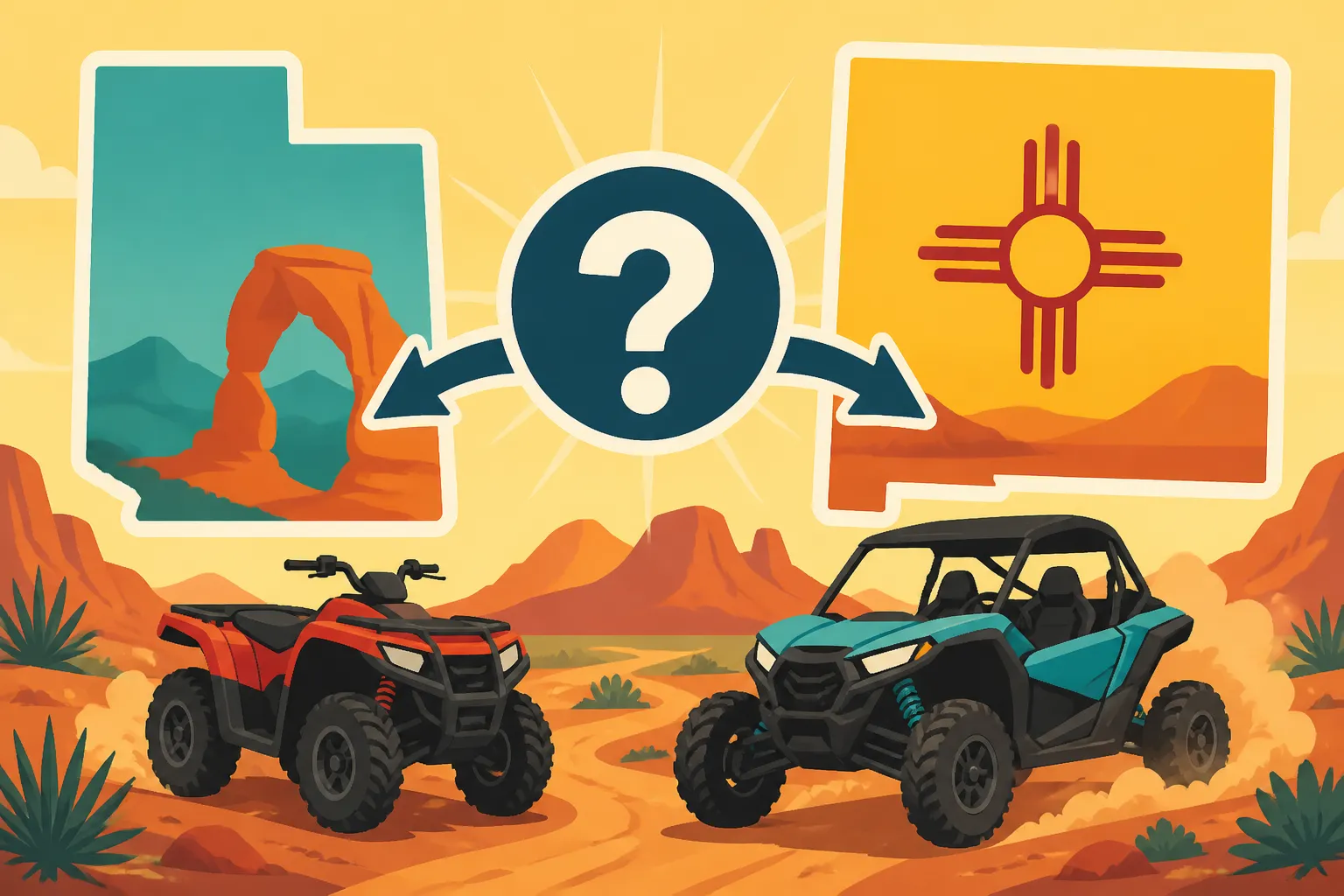
If you are bringing an ATV or UTV from Utah to ride in New Mexico, it is easy to wonder whether your home-state paperwork will count or whether you need to buy another permit. In general, New Mexico honors a current Utah off-highway vehicle registration. The important details are what kind of registration you have, what proof to carry, and which separate riding rules still apply.
Does New Mexico accept Utah OHV registration?
Yes. New Mexico generally recognizes a valid Utah OHV registration for a machine visiting from Utah. A Utah-registered ATV or UTV does not normally need a separate New Mexico nonresident OHV permit just because it crosses the state line. This is part of New Mexico’s reciprocity approach to out-of-state OHVs.
The key word is OHV registration. A title proves ownership, but it is not the same as registration. Nor should you assume that any Utah vehicle document or plate automatically serves as proof of OHV registration. The paperwork needs to apply to the off-highway machine you are bringing.
New Mexico’s permit requirement is particularly relevant to visitors whose home states do not have an OHV registration program that New Mexico recognizes. Those riders may need a New Mexico nonresident permit instead. For the broader rules and how they apply to visitors from other states, see New Mexico OHV Reciprocity Rules and Any Valid OHV Registration Counts in New Mexico.
| What you have | What it generally means in New Mexico |
|---|---|
| Current Utah OHV registration for the machine | Generally satisfies the visitor registration requirement through reciprocity |
| Utah title without current OHV registration | Does not, by itself, establish current OHV registration |
| New Mexico nonresident OHV permit | May be needed if the machine lacks qualifying registration from a state New Mexico recognizes |
| Utah registration plus a rider’s safety-permit requirement | Registration reciprocity does not waive separate rider requirements |
| Utah registration plus a desire to ride paved roads | Registration alone does not grant permission to use New Mexico roads |
This answer concerns a visitor riding a machine that is properly registered in Utah as an OHV. It is not a substitute for checking how Utah classifies your particular machine or whether its registration remains current. If your paperwork covers a street-legal vehicle rather than an OHV, or the machine is modified or registered in an unusual category, confirm how New Mexico treats it before relying on reciprocity.
For a closer look at what to carry and how registration is checked, see Riding New Mexico With an Out-of-State Registration.
What to carry and check before crossing the state line
Reciprocity is most useful when you can show that the machine qualifies. Before you leave Utah, check that the registration is current, belongs to the ATV or UTV you are transporting, and is being displayed as Utah requires. Bring the registration document or other official proof with you rather than relying only on a photograph or memory of the registration number.
It is also sensible to match the paperwork to the machine’s identifying information. Compare the vehicle identification number on the machine with the number shown on the registration documents. If there is a mismatch, a missing document, or a recent ownership change that has not been reflected in the records, resolve it before your trip where possible. A title, purchase receipt, or bill of sale can help establish ownership, but those documents do not necessarily replace current OHV registration.
A practical pre-trip check:
- Confirm that the Utah OHV registration is current for the dates of your ride.
- Check that the registration is for the machine you are taking, not another ATV or UTV in the household.
- Make sure required Utah decals, plates, or identifying marks are present and readable.
- Carry the registration proof where you can reach it during a roadside check.
- Keep ownership paperwork available if the machine was recently bought, inherited, or transferred.
- Check whether the person riding the machine has a separate New Mexico safety-permit requirement.
If the Utah registration has expired, do not assume that a title or a renewal application is enough to qualify. Ask the relevant Utah registration authority whether the registration is active, then confirm New Mexico’s current requirements if there is any uncertainty. New Mexico’s nonresident permit information is covered in New Mexico’s Nonresident OHV Permit and What a Rider From a Non-Program State Must Buy.
A visitor may be asked to show registration during a stop or at a managed riding area. Having the paperwork ready makes it easier to establish that the machine is covered by reciprocity. Registration does not guarantee access to every trail or road, however. Land managers can have their own route designations, closures, equipment rules, and access conditions.
What Utah registration does not cover
The main misunderstanding to avoid is treating registration reciprocity as a general riding pass. It addresses whether the machine needs an additional New Mexico nonresident OHV permit. It does not automatically satisfy every rider, vehicle, or land-use rule.
Rider safety requirements still apply
New Mexico has separate safety-permit rules for some riders under 18. A Utah registration for the ATV or UTV does not satisfy a safety requirement that applies to the person operating it. Check the rider’s age and circumstances before setting out; the rules are explained in New Mexico’s Safety Permit for Under-18 Riders.
Other age-related rules can also apply, including supervision and passenger restrictions. These are distinct from the machine’s registration status. A registered machine is not necessarily lawful for every rider to operate in every situation.
Trail and land rules still apply
A Utah registration does not open a closed route or grant permission to ride wherever a map shows open ground. On public land, follow the rules of the agency managing the area, including designated-route requirements and temporary closures. On private or tribal land, registration does not replace the permission needed to enter.
Before heading onto federal land, check the local route information and conditions. [New Mexico Rules for Riding a National Forest] and [New Mexico Rules for Riding BLM Land] explain why route access depends on the specific area and its rules. Conditions can change because of weather, fire restrictions, maintenance, or land-management decisions, so verify the route close to the day of your ride.
Registration alone does not authorize paved-road use
A valid Utah OHV registration does not, by itself, make an ATV or UTV legal to ride on New Mexico pavement. Road use has separate requirements and may be limited to particular roads or local opt-in areas. A machine’s Utah paperwork should not be treated as permission to travel on any New Mexico street or highway.
If paved-road access is part of your plan, check the requirements for the specific road and vehicle before riding there. New Mexico has separate plate and equipment rules, described in New Mexico Paved Road Plate Requirements. Even where local rules allow limited OHV use, requirements for insurance, equipment, rider qualifications, and road type may apply.
This distinction matters when planning a route from a staging area, campground, or rental location. A short paved connector can still be a road-use issue even if most of the ride is on legal trails. Do not rely on another state’s registration as a substitute for New Mexico’s separate road authorization.
How to handle a registration or permit question
If your paperwork is straightforward—a current Utah OHV registration for the machine you are riding—reciprocity should generally mean you do not need to buy a New Mexico nonresident permit. If your documents are incomplete or the machine’s classification is unclear, get an answer before you travel rather than relying on a general rule.
Start by checking the Utah registration record and the documents for the particular machine. If the registration is expired, belongs to a different vehicle, or is not clearly an OHV registration, ask the Utah authority responsible for OHV registration what status the machine has. Then confirm with New Mexico’s OHV permit information how that status affects the visitor permit requirement. For general information about the process, see Where to Buy a New Mexico OHV Permit.
There are a few situations where an extra check is especially worthwhile:
- A recent purchase: The seller’s registration may not yet reflect the new owner or may no longer be valid for your use.
- A machine with a complicated classification: A street-legal registration, an OHV registration, and a title serve different purposes.
- A missing or unreadable decal: Ask whether the registration remains verifiable and what proof you should carry.
- A borrowed machine: Confirm the machine is properly registered and that you have permission to use it.
- A planned paved-road segment: Check road eligibility separately; reciprocity for OHV registration does not settle that question.
When you plan a ride, treat registration as one part of the checklist. Verify the machine’s registration, the rider’s qualifications, the rules for the land you will enter, and any route-specific restrictions. That approach helps prevent a common mix-up: having valid Utah paperwork but assuming it also covers a safety permit, a closed trail, or paved-road use.
Disclaimer
This article is for general informational purposes only and does not constitute professional advice. Laws, prices and regulations vary by location and change over time. Consult a qualified professional for guidance on your specific situation.