New Mexico Rules for Riding a Closed Road
A road that looks rideable is not necessarily open to ATVs or UTVs. In New Mexico, a closure may apply to one vehicle type, one route, a season, or an entire area—and a registration or nonresident permit does not cancel it. Here’s how to read closure signs, check access before unloading, and choose what to do when a route is blocked.
What counts as a closed road in New Mexico
For riders, a closed road is any route where the responsible land manager or road authority does not allow your machine to travel. The closure may be temporary or permanent, and it may apply to motorized vehicles generally or only to certain uses. A road can look maintained and still be closed to OHVs; a track visible on a map does not prove that it is open.
The route’s location matters. A road on national forest or Bureau of Land Management land may be governed by that agency’s travel rules. A county road, town street, private road, or route across tribal or state trust land may have different access rules and a different authority responsible for posting or enforcing a closure. A public-land permit does not grant access across land where you do not otherwise have permission.
| What you encounter | What it may mean | What to do |
|---|---|---|
| A posted “Closed” or “Road Closed” sign | Motorized travel is prohibited for the stated route or period | Do not ride past it; look for the closure notice or an open alternative |
| A gate across the route | Access may be restricted, or the gate may serve a specific land-management purpose | Do not go around it; read nearby signs and confirm the route’s status |
| A seasonal or dated notice | The route may be closed during specified conditions or dates | Check whether the closure is currently in effect |
| A map route with no visible sign | The map may be outdated, or a closure may begin farther along | Check current land-manager information and obey signs on the ground |
| A route marked open for another vehicle type | Access may not extend to your ATV or UTV | Confirm that your machine is allowed before entering |
A closure can be announced through signs, agency notices, maps, or a combination of them. Reasons can include road damage, wet or snowy conditions, wildfire danger, habitat protection, maintenance, or a land-use restriction. The reason may not be obvious from the trailhead. Treat a closure notice as controlling even if the surface appears dry, passable, or unchanged.
A sign may also identify the exact segment affected. Read it carefully: a closure could begin at a junction rather than at the trailhead, apply only beyond a gate, or cover a group of roads in a defined area. If the wording or map is unclear, do not assume the least restrictive interpretation. Check with the agency or authority responsible for the road before riding it.
For background on land-manager route systems, see New Mexico Rules for Riding a Designated Route and Designated Routes and Travel Management in New Mexico. If you are planning a forest ride, [New Mexico Rules for Riding a National Forest] and New Mexico Rules for Riding a Forest Road can help you understand why access rules may differ from one road to another.
Why a permit or registration does not override a closure
An OHV registration, permit, decal, or proof of reciprocity is not a pass to ride every road. These credentials address whether your machine or rider meets a particular administrative requirement. They do not make a closed route open, give permission to cross private or restricted land, or replace the need to follow local travel rules.
That distinction is especially important for visitors. A valid home-state registration may be recognized for certain New Mexico riding requirements, while riders from some states may need a New Mexico permit. Either way, the credential does not authorize travel on a road that is signed closed. Review New Mexico OHV Permits Explained and New Mexico OHV Reciprocity Rules for the permit and reciprocity questions, then check the route itself separately.
The same principle applies when a closure has a narrow exception. A notice might allow access for a particular purpose, vehicle, resident, permit holder, or authorized worker. Do not assume that an exception applies to recreational ATV or UTV use. If the notice does not clearly cover your situation, confirm it with the authority that issued it.
The type of road matters too. Some roads are open only to certain kinds of traffic, or are open under conditions that do not include OHVs. A road’s appearance, an online map, or the fact that a full-size vehicle passed through does not establish that your machine is allowed. For federal land, use the applicable travel map and rules rather than relying on a general navigation app. New Mexico Rules for Riding BLM Land explains another common land-management setting where route access must be checked.
Do not treat a closure as optional because:
- The road is dry, firm, or easy to ride.
- There are tire tracks beyond the sign.
- Another rider says the route is usually open.
- The closure is not visible in a phone app.
- Your machine is registered or permitted.
- You see a gap beside a gate or a path around a barricade.
Going around a barrier can still mean entering a closed area. It may also damage the road edge, vegetation, or nearby land, and can make the situation worse for future riders. When a route is closed, the sensible response is to stop and find a legal alternative.
How to check a road’s status before riding
A little route checking before departure can prevent an expensive, frustrating change of plan. Start with the land manager or road authority responsible for the place you intend to ride. Use the current route map or closure notices, and look for updates about weather, maintenance, fire, seasonal access, and vehicle restrictions. A map downloaded months ago may not reflect a new closure.
Use this process when planning:
- Identify who manages the route. Determine whether it is on national forest, BLM, county, municipal, tribal, state trust, or private land. If the boundary is unclear, check before riding.
- Find the official route information. Look for the land manager’s current travel map, motor-vehicle-use information, closure notices, or direct contact details.
- Check the specific road and vehicle type. Confirm that the route is open to motorized travel and that your ATV or UTV is permitted there. Do not assume that an open road is open to every vehicle.
- Check for temporary conditions. Look for fire restrictions, storm damage, snow, maintenance work, or other notices that could close a route after a map was produced.
- Recheck before you unload. Conditions and access can change between planning and arrival. Review posted signs at the entrance and at junctions.
- Keep a legal alternate route in mind. If the route is closed, turn around and use an open route rather than improvising a detour.
A paper map or downloaded map can help when there is no reliable phone signal, but neither should replace current closure information. Keep the official map’s date in mind and watch for signs on the ground. If a closure notice conflicts with an older map or app, follow the current posted restriction while you confirm the details.
Closures can also apply to an area rather than to one named road. A fire-related restriction, for instance, may affect multiple routes or public access across a broader area. Before a ride during dry or windy conditions, check for area-wide notices as well as the status of your intended road. New Mexico Trail Closures to Check First is useful for building this check into trip planning.
If you cannot determine who manages a road or whether your machine is allowed, do not treat uncertainty as permission. Contact the relevant office or select a route whose status is clear. This is particularly important near land boundaries, where a road can pass from one jurisdiction to another without an obvious change in surface or scenery.
What to do when you reach a closure
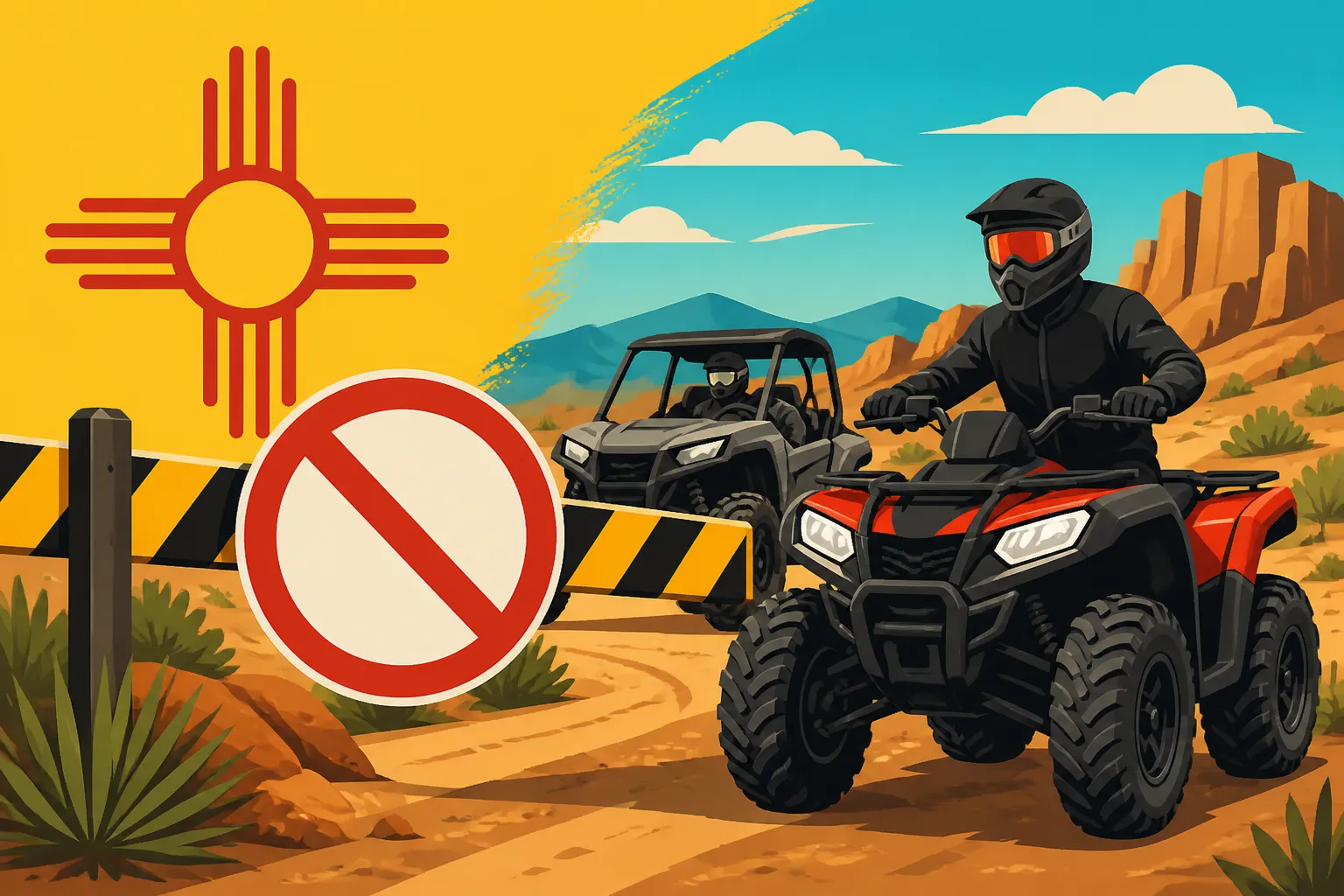
When you see a closure sign, gate, barricade, or other restriction, stop before entering the closed segment. Read the full notice, including any dates, vehicle limits, or alternate-route directions. Do not move a barrier, follow another rider around it, or continue because the route seems passable.
If the sign is damaged or hard to interpret, take note of the location and any route number or nearby landmark. If you have a safe place to stop, check current official information or contact the responsible land manager. Avoid blocking the road while you do this. If the closure still cannot be resolved, turn back and choose a route with clearly authorized access.
A gate is not an invitation to test whether it is locked. Some gates are used to manage access, livestock, or land boundaries, and a nearby sign may explain what riders must do. Follow the posted instructions. If access is allowed but the gate must be closed behind you, do so; if the notice says the road is closed, do not enter or bypass the gate.
When a road becomes impassable or unsafe during a ride, do not create a new path around the problem. Turning around on a suitable open area is usually the better choice. If a sudden hazard, injury, or emergency makes that impossible, prioritize safety and contact emergency services or the land manager as appropriate. An emergency does not make an unauthorized recreational detour acceptable.
After returning, report a missing, obscured, or confusing closure sign to the authority responsible for the road. Include the location and a clear description; avoid posting an unverified claim that a route is open. For practical trip planning, keep your permit and route information separate: New Mexico Rules for Riding a Closed Road concerns access on the route, while New Mexico Fines for No OHV Permit concerns a different requirement. Meeting one rule does not substitute for meeting the other.
The basic rule is straightforward: ride only where your machine is allowed, and stop when a current closure says not to proceed. Checking route status before a trip—and respecting signs even when a road looks inviting—helps protect access for everyone who rides legally.
Disclaimer
This article is for general informational purposes only and does not constitute professional advice. Laws, prices and regulations vary by location and change over time. Consult a qualified professional for guidance on your specific situation.