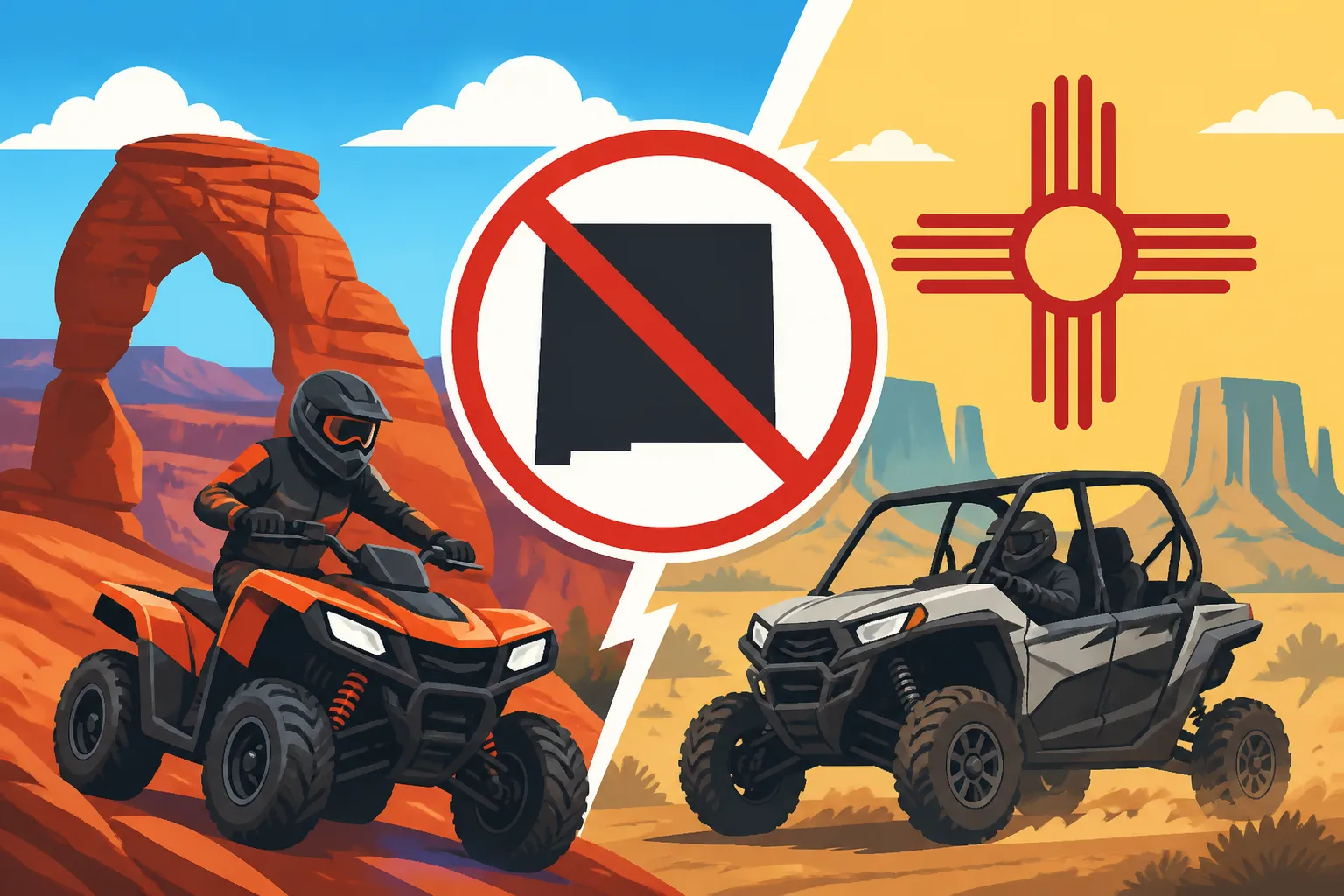
Why Utah Riders Need No New Mexico Permit
Utah riders often hear that New Mexico requires visitors to buy an OHV permit, then wonder whether they need one too. The key is reciprocity: a valid Utah OHV registration generally means no separate New Mexico nonresident permit is needed. That exemption covers the permit requirement, not every rule about where or how you may ride.
The short answer for Utah riders
If your ATV, UTV, or other off-highway vehicle has valid Utah OHV registration, you generally do not need to buy a separate New Mexico nonresident OHV permit just to ride in New Mexico. New Mexico recognizes valid out-of-state OHV registrations under its reciprocity rules. Utah has an OHV registration program, so a properly registered Utah machine can qualify.
The distinction is between a state registration and a New Mexico nonresident permit. The permit is meant for visitors whose home states do not provide an OHV registration or similar program that New Mexico recognizes. A Utah rider with valid OHV registration can generally rely on that home-state credential instead of buying the New Mexico permit. For the broader rule, see New Mexico OHV Reciprocity Rules and Any Valid OHV Registration Counts in New Mexico.
| Your situation | Is a New Mexico nonresident OHV permit generally needed? | What to check |
|---|---|---|
| Your machine has current Utah OHV registration | No | Carry proof of registration and display any required Utah identification |
| Your Utah registration has expired | Do not assume you are exempt | Renew it or confirm the correct New Mexico option before riding |
| Your machine has only a Utah road license plate | Not automatically clear | Confirm whether the paperwork establishes valid OHV registration |
| Your machine is not registered in Utah or another recognized state | You may need a New Mexico permit | Check the current nonresident permit rules |
| You are riding on land with separate access requirements | Reciprocity alone may not be enough | Check the land manager’s rules and any separate permit needs |
The important word is valid. An old registration card, an expired credential, or a registration belonging to a different machine may not establish that your vehicle qualifies. Make sure the identifying details match the ATV or UTV you are bringing, and carry the documentation with you rather than relying only on a memory of having registered it.
A lack of New Mexico permit does not mean New Mexico has approved the vehicle for every road or trail. It only answers one question: whether a visitor with qualifying Utah registration needs to purchase New Mexico’s nonresident OHV permit. You must still comply with applicable riding, safety, land-access, and equipment rules.
Visitors looking for a more general explanation of the permit requirement can read Do Visitors Need a New Mexico OHV Permit?. If you are bringing a machine with another state’s paperwork, Riding New Mexico With an Out-of-State Registration covers the related issue of what to carry and check.
How reciprocity works
Reciprocity is New Mexico’s way of recognizing qualifying OHV credentials issued by another state. Rather than requiring every visitor to buy a New Mexico permit, the state generally accepts a valid registration from a state that has its own OHV program. Utah’s registration program is why a Utah-registered machine can fall under this recognition.
This is not the same as saying every document from Utah automatically counts. The relevant credential needs to be a valid OHV registration for the machine. If you are unsure whether your paperwork is an OHV registration, a highway registration, a temporary document, or something else, check with the Utah authority that issued it and the official New Mexico OHV program before traveling.
A useful way to think about it is:
- New Mexico has a permit requirement for some nonresident machines. It applies when the visitor cannot rely on qualifying home-state OHV registration.
- New Mexico recognizes certain out-of-state registrations. A valid Utah OHV registration can satisfy the reciprocity condition.
- The recognition is tied to the machine’s status. Registration should be current and correspond to the vehicle you are riding.
- The exemption is limited to the nonresident permit. It does not replace other permissions, safety credentials, or riding requirements.
The state’s approach is intended to avoid making riders purchase duplicate credentials simply because they cross a state line. That convenience depends on having valid evidence of the home-state registration. Keep the registration paperwork accessible, and make sure the required Utah decal, plate, or other identifying display is still in place as required by Utah rules.
Do not treat a receipt for a renewal or an application as automatically equivalent to completed registration. If your Utah renewal is in process, check what temporary proof is accepted and whether it covers riding outside Utah. The safest course is to resolve any uncertainty before loading the machine or setting out for a ride.
New Mexico also has a different route for visitors from states without a qualifying OHV program. Those riders may need to purchase a New Mexico nonresident permit rather than rely on a home-state registration. See Riders From States Without Registration and New Mexico’s Nonresident OHV Permit for that contrasting situation. Utah riders generally do not fall into that category when their OHV registration is current.
When a Utah rider might still need to take action
Reciprocity is straightforward when the machine has current Utah OHV registration and the documentation clearly identifies it. Problems tend to arise when a rider assumes the exemption applies without checking the particular machine or paperwork.
The registration is expired or missing
If your Utah registration has expired, you should not assume New Mexico will treat it as valid for reciprocity. An expired credential may not meet the condition, even if the machine was registered in Utah in the past. Renew through the appropriate Utah process or confirm with New Mexico whether another option applies before riding.
The same caution applies if you cannot find the registration document. A visible decal may help identify the vehicle, but do not assume it will substitute for all proof that an officer, land manager, or other official may ask you to provide. Carry the available registration evidence and resolve missing-document issues before the trip.
The paperwork is for a different kind of registration
Some machines may have paperwork related to road use, while others have OHV registration documents. A Utah license plate or highway registration does not automatically settle whether the machine qualifies under New Mexico’s OHV reciprocity rule. If the vehicle is street legal, has multiple credentials, or was converted from one registration type to another, confirm which document applies.
This matters especially for side-by-sides and modified ATVs, where an owner may describe a machine as “registered” without knowing whether the credential is an OHV registration, a road registration, or both. Check the document itself rather than relying on the shorthand.
The registration belongs to another machine or owner
Registration is associated with a particular vehicle and its identifying information. If you are borrowing a friend’s machine, hauling a family member’s ATV, or riding a vehicle purchased shortly before the trip, check that the paperwork matches the machine and that it is current. A registration for another ATV in the trailer does not cover the one you are riding.
A recent purchase can create a gap between the seller’s paperwork and the new owner’s documents. Before traveling, confirm what the buyer needs to carry and whether the registration has been transferred or renewed as required. For a private sale, see New Mexico OHV Registration Transfer for related New Mexico transfer questions; for an out-of-state purchase, check the issuing state’s requirements as well.
You are relying on a rental or borrowed machine
If you rent or borrow an ATV or UTV, ask who is responsible for the machine’s registration and what proof you should carry. Do not assume the rental agreement alone proves the vehicle has valid Utah registration or that the machine’s registration is recognized in New Mexico. A rental company should be able to explain the machine’s registration status and any permit arrangements, but it is worth confirming before leaving the pickup location.
A nonresident permit question can also differ from who is responsible for the machine’s general compliance. The person operating it still needs to follow the applicable riding rules, even when the owner or rental company handles registration.
You are riding somewhere with an additional permit or access rule
A qualifying Utah registration does not grant permission to ride on every parcel of land. A land manager may require a separate access permit, restrict riding to designated routes, close an area temporarily, or prohibit OHVs entirely. Tribal lands and private property can have their own permission rules, too.
Before the trip, identify who manages the land you plan to ride and check its requirements. New Mexico’s statewide permit reciprocity is not a substitute for local access permission. More on federal-land rules is available in New Mexico Rules for Riding Federal Land and [New Mexico Rules for Riding BLM Land].
What Utah registration does not replace
A valid Utah OHV registration can remove the need for a separate New Mexico nonresident OHV permit, but riders should keep that conclusion narrow. It does not turn an ATV or UTV into a street-legal vehicle, open a closed route, or waive safety requirements.
Route and land-access rules still apply
New Mexico riding is shaped by the land manager and the road or trail designation. On federal land, a route may be open only to certain vehicle types or widths, or only during particular periods. A trail shown on an old map may have been closed or changed. Follow signs and current travel-management information rather than assuming that a visible track is open.
The same caution applies to state trust land, tribal land, private land, and county or municipal roads. Each can have separate rules. A state permit or registration does not convey permission to cross a ranch, enter tribal land, or ride beyond a designated route. Check [New Mexico Rules for Riding a Designated Route] before planning a route that leaves established public roads or trails.
Youth riders may have separate safety requirements
New Mexico has a safety-permit requirement for certain riders under 18 using OHVs on public land. A Utah registration for the machine does not automatically satisfy a rider-specific safety requirement. Parents and guardians should check the age rules, training requirements, supervision conditions, and documentation that apply to the young person who will operate the vehicle.
The vehicle’s registration and the rider’s safety credentials answer different questions: one concerns whether the machine has the required state credential; the other concerns whether a particular rider is permitted to operate it under the applicable rules. Review New Mexico’s Safety Permit for Under-18 Riders before bringing a young rider.
Equipment and operation rules remain in force
Riders still need to comply with applicable helmet, eye protection, lighting, noise, spark-arrester, passenger, and roadway rules. Which requirements apply can depend on the rider’s age, machine type, location, and whether the machine is being operated off-road or on a road where OHV use is allowed.
Do not infer that New Mexico’s nonresident permit exemption changes the machine’s equipment requirements. It does not. Check the relevant rules for the planned riding area and the type of vehicle. In particular, riding on a paved road has separate limits and should not be confused with ordinary trail use.
Registration is not a general access pass
A state registration is not a pass to ride wherever you see an open-looking trail. Land may be closed for seasonal conditions, fire danger, maintenance, wildlife, or other management reasons. A route may also be open to one class of vehicle but not another.
Before setting out, review current closure notices and official maps for the specific area. Carry a map or offline navigation option, and avoid crossing a boundary or gate unless you have permission. Reciprocity solves the New Mexico nonresident permit question; it does not replace responsible route planning.
A pre-trip checklist for Utah riders
A few checks before departure can prevent a permit misunderstanding from becoming a roadside problem or a wasted trip.
- Verify the Utah registration is current. Check the registration date and confirm that it belongs to the ATV or UTV you plan to ride.
- Confirm the credential is OHV registration. If the paperwork is for road use, a temporary registration, or a special status, verify whether it qualifies for New Mexico reciprocity.
- Carry proof. Bring registration evidence with the machine and keep it protected from water and damage. Make sure the identifying information is readable.
- Check the vehicle’s required display. Confirm that the Utah decal or other identification is displayed as required by Utah rules and has not become damaged or unreadable.
- Check rider-specific requirements. If anyone under 18 will operate an OHV, review New Mexico’s safety-permit and supervision rules before the ride.
- Identify the land manager. Confirm that your planned trails are open to your vehicle and that no separate access permit or permission is required.
- Review local riding rules. A county road, town street, forest route, BLM route, and private road may each have different restrictions.
- Recheck conditions before leaving. Closures, fire restrictions, and other access conditions can change. Use current official information, not only an old map or a route someone previously rode.
If you discover that the registration is expired or the credential does not clearly qualify, do not guess. Check the current official New Mexico permit instructions and, if needed, the Utah registration authority. The New Mexico permit options and application process are described in New Mexico’s Nonresident OHV Permit. For a quick comparison of the two systems, New Mexico’s Broad OHV Reciprocity explains why some visitors rely on their home-state credentials while others need a New Mexico permit.
Keep the conclusion simple: current Utah OHV registration generally means no separate New Mexico nonresident permit is needed. The rider still needs the right documents, must follow New Mexico’s rules, and must have permission to use the particular land and routes on the itinerary.
Frequently Asked Questions
Do Utah riders need to buy a New Mexico OHV permit?
Generally, no, if the machine has valid Utah OHV registration that New Mexico recognizes. Carry proof of registration and confirm that the document applies to the machine you are riding.
Does a Utah license plate automatically count as OHV registration?
Not necessarily. A road-use plate and an OHV registration may be different credentials. If you are unsure which paperwork the machine has, confirm with the issuing authority and New Mexico’s official OHV program.
Does reciprocity allow a Utah ATV on any New Mexico trail?
No. Reciprocity addresses the nonresident OHV permit requirement. Land access, route restrictions, closures, age-related safety rules, and equipment requirements still apply.
What if my Utah OHV registration is expired?
Do not assume an expired registration qualifies. Renew it or check the current New Mexico permit rules before riding.
Disclaimer
This article is for general informational purposes only and does not constitute professional advice. Laws, prices and regulations vary by location and change over time. Consult a qualified professional for guidance on your specific situation.