Where New Mexico Permit Money Goes
New Mexico’s OHV permit is easy to treat as one more cost before a ride. But where does the money go after you pay, and does it fund the trail you’re using? The answer involves a dedicated program, public budgets, and projects delivered by different land managers. Here’s how to understand the funding path, what it may support, and how to check what a particular project actually received.
The short answer: permit money supports an OHV program, not a personal trail account
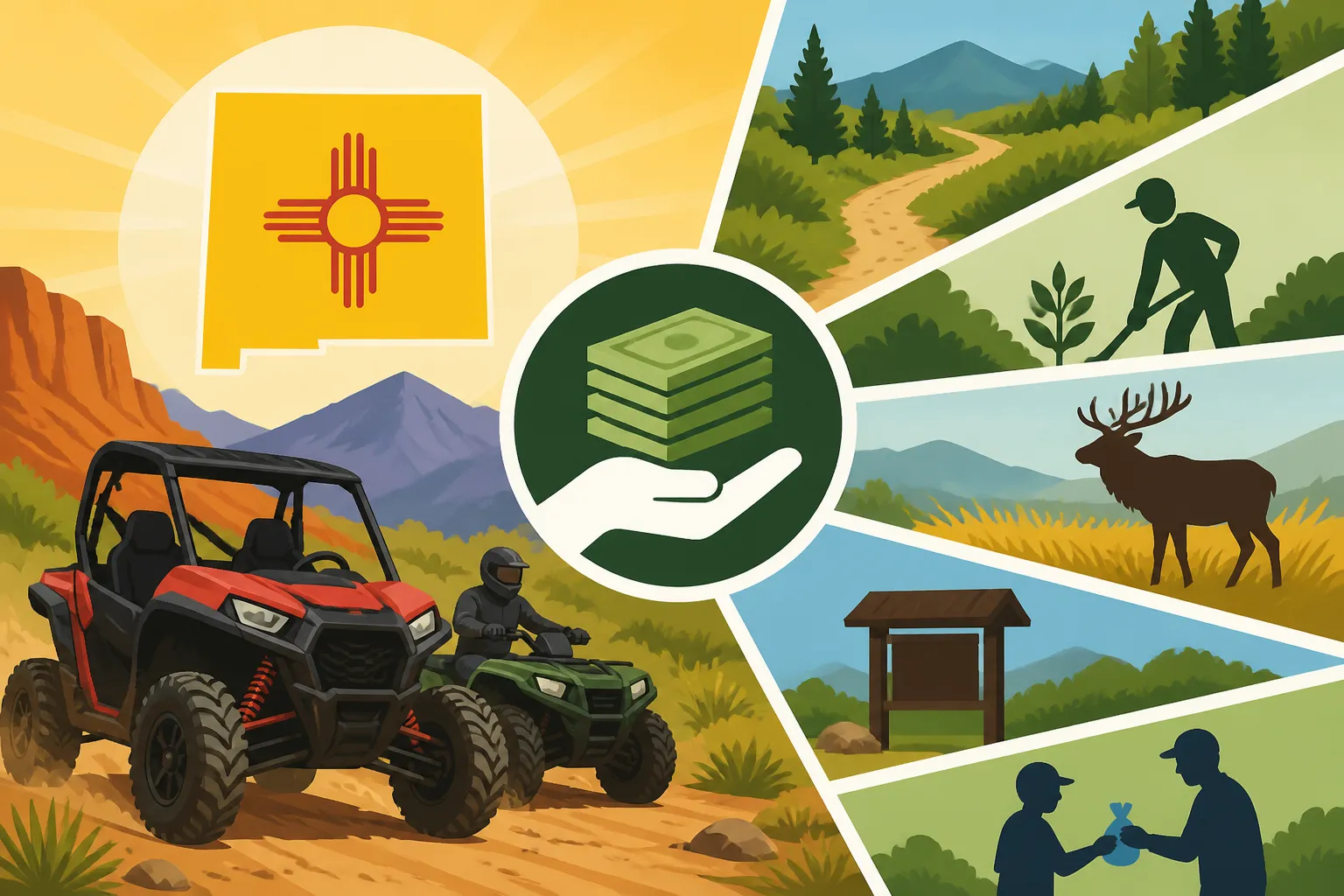
New Mexico’s off-highway vehicle program uses permit revenue to support public purposes connected with OHV use. That can include managing the program, educating riders, enforcing OHV rules, and supporting eligible projects such as trail planning, construction, maintenance, and related facilities.
That does not mean your payment is assigned to the trail where you ride, or that every dollar turns directly into trail work. Revenue is handled through public financial processes, and projects may be managed by public agencies, local governments, or other eligible partners. The work also depends on approvals, budgets, land access, environmental review, and the availability of staff and contractors.
The distinction matters because New Mexico has several kinds of OHV-related payments. A nonresident permit is not necessarily the same thing as a resident’s registration or a safety permit. The programs may serve related goals, but they are not interchangeable, and the money does not necessarily follow the same route.
| Payment or requirement | What it generally relates to | What not to assume |
|---|---|---|
| Nonresident OHV permit | Permission for certain visitors to operate on applicable public land in New Mexico | That the payment buys access to every public road or private property |
| Resident OHV registration | Registration requirements for qualifying machines | That a registration payment is identical to a visitor permit |
| Safety permit | A safety-course and age-related requirement for some young riders | That it replaces machine registration or a nonresident permit |
| Paved-road permit or related requirement | A separate condition for certain road-use situations | That it authorizes riding on any paved road |
| Project grant | Funding awarded for an approved purpose | That the grant is paid directly to riders or automatically goes to the nearest trail |
For the visitor permit rules and who may need one, see New Mexico OHV Permits Explained and New Mexico’s Broad OHV Reciprocity. Those details help answer a separate but important question: whether the payment you made was required for your machine and home-state status.
How a permit payment moves through the system
The exact accounting route depends on the type of payment and the governing program. In general, a rider pays through an approved channel, the payment is recorded and handled under the applicable public-fund rules, and spending occurs through authorized budgets or projects. A permit payment is not usually a direct donation to a trail crew or a payment to the land manager at the trailhead.
That’s why it is useful to separate three steps: collection, authorization, and delivery.
Collection
A permit may be obtained through the state program’s available purchase channels. The transaction creates a record that the required permit has been obtained. For current purchasing instructions and accepted methods, use the state’s official permit information rather than relying on an old receipt, a social-media post, or an outdated guide.
If you’re still deciding whether a permit applies to you, start with Buying a New Mexico Permit Online and confirm your situation against the current rules. Visitors from states with their own OHV programs may be treated differently from riders whose home state has no comparable program. A valid home-state registration can also affect what New Mexico requires. Don’t assume that a neighbor’s answer applies to your machine.
Authorization
Public money can be spent only through authorized processes. That may involve an agency’s operating budget, an approved grant, or another permitted funding mechanism. The existence of a permit fee does not, by itself, mean a local trail manager can immediately spend the revenue. A project may need an application, review, approval, matching resources, access agreements, or other steps before work can begin.
A useful way to think about it is that permit revenue helps maintain the capacity to manage OHV use and may support qualifying projects, while the public budgeting process decides what can be funded and when. The process can be less immediate than a rider expects: a fee paid today might contribute to a broader program rather than a specific repair this weekend.
Delivery
The organization that pays for or approves a project may not be the organization that does the work. For example, one entity may manage a funding program while a public land manager or local partner plans and carries out work on the ground.
That division can make projects hard to spot. A sign, trail repair, staging-area improvement, or education effort may be part of a larger project with several funding sources. Conversely, a trail that receives attention may have been funded through a land manager’s separate budget, a grant, volunteer labor, or another source rather than a particular permit payment.
For that reason, the careful answer to “Did my permit pay for this trail?” is usually: it may have contributed to the broader OHV program, but you need project records to confirm the funding for that specific work.
What permit revenue may help pay for
Funding connected with OHV programs can serve more than one purpose. The balance between activities depends on the program’s current authorities, priorities, approved budgets, and projects. It is safest to understand the following as examples of the kinds of work a program may support—not as a promise that every category receives money in every budget period.
Trail planning and maintenance
Before a trail is built or repaired, managers may need to identify where riding is allowed, assess impacts, plan a route, consult with affected parties, and determine how the route will be maintained. Funding may help with some of this planning, as well as with practical work such as drainage improvements, signs, barriers, or repairs to damaged surfaces.
The details depend heavily on who manages the land. A route on federal land may be subject to the land manager’s travel plan and site-specific rules. A county or local trail system may have different planning and maintenance arrangements. A permit does not grant permission to ride outside the designated network. Review New Mexico Rules for Riding Federal Land and the relevant land manager’s current route information before heading out.
Rider education and safety
Education can help riders understand registration and permit requirements, age-related rules, responsible riding practices, and the risks of riding in unfamiliar terrain. Programs may also help communicate why a route is closed, why a boundary matters, or what to do when conditions change.
Education benefits riders even when it does not produce a visible improvement on the ground. A trail sign is easy to point to; a class, a safety message, or clear public information can be less visible but still part of managing an OHV program. New riders and families should also review New Mexico’s OHV Safety Permit to understand the separate safety requirements that may apply to younger riders.
Enforcement and compliance
Rules only work if riders know what they are and agencies can respond to violations. Program resources may support the work associated with compliance, including public information, patrol-related functions, and coordination among responsible agencies. The precise funding arrangement varies, so don’t assume that every officer or enforcement activity is paid from one particular permit account.
Enforcement is not just about writing citations. It can help address unsafe road use, damage to closed routes, unauthorized access, and conflicts with other land users. A closed route may protect sensitive ground, avoid an unsafe crossing, or preserve a route that is open only during certain conditions. Check New Mexico Trail Closures to Check First before you ride; fees do not provide a right to ignore a closure.
Facilities and access management
Some eligible projects may involve facilities or access-related work that makes a designated riding area more manageable. Depending on the program and approvals, that could include signs, staging or parking improvements, information for riders, or other features associated with responsible OHV use.
Facilities can require ongoing care. A staging area that is built but not maintained may become unusable or cause problems for nearby residents and landowners. That is one reason funding decisions may consider long-term management rather than just construction. A project’s cost can include planning and maintenance needs, not just the visible installation.
Program administration
A permit program has operational work behind it. Staff may need to maintain records, answer questions, manage applications or purchases, coordinate with partners, communicate rules, and oversee funded projects. Some program resources may support this kind of administration where authorized.
It can be tempting to call anything other than trail construction “overhead.” But without a functioning system to collect funds, assess applications, track spending, and confirm that projects meet requirements, money can’t reliably reach the intended work. The important questions are whether spending is authorized, whether the program reports it clearly, and whether funded activities meet their stated purposes.
Why your permit does not pay for one particular trail
The most common misunderstanding is that a permit works like an admission ticket for a single riding area. In many cases, that is not how it works. The payment may support a statewide program, and the right to ride depends on separate rules for the land, route, vehicle, and rider.
A trail can be popular and still receive no direct project funding from a particular permit payment. It may be managed by an entity that uses a different budget, or it may not be eligible for the funding source you have in mind. The project may also be waiting for design, consultation, access approval, environmental review, or a partner contribution.
Permit coverage is not the same as land access
A permit requirement and a route’s open status answer different questions. The permit may satisfy one condition for operating an OHV, but it does not automatically open a road, trail, or parcel. Public land can have designated routes, seasonal closures, vehicle restrictions, and boundaries where motorized use is prohibited.
Federal land managers set and update rules for their own areas. On BLM ground, for example, riding may be limited to routes identified in the applicable travel-management information. On national forest land, route designations and seasonal conditions matter. Read [New Mexico Rules for Riding BLM Land] or [New Mexico Rules for Riding a National Forest] for the relevant distinctions, then confirm local conditions with the land manager.
Permit money also does not create a right to cross private or tribal land. Access may require express permission, even when a road appears to connect two public areas on a map.
A project’s location may not match where the permit was bought
A visitor might buy a permit before riding in one part of the state, while program decisions may support work elsewhere. A statewide funding approach can spread resources across areas and projects rather than assigning each purchase to the buyer’s preferred location.
That can be frustrating if the route you use needs work. But concentrating all resources where the most permits are purchased could leave less-used areas without support, even when they serve local riders or provide important connections. Allocation decisions can involve need, eligibility, safety, access, partner capacity, and the likelihood that a project can be completed and maintained.
Funding can be shared
A project may combine funding from several sources. A grant can be one part of the total, with a local agency, land manager, club, or other partner providing additional money, labor, materials, or equipment. The presence of a grant does not necessarily mean permit revenue paid the entire bill.
The reverse is also possible: a project may be associated with an OHV program but use other funds for some of its costs. This is why a project announcement alone may not provide the full financial picture. Look for an award notice, budget document, grant record, or project report that identifies the source and amount of support.
How to check what a particular project received
If you want a concrete answer about a trail, staging area, or sign, focus on the project rather than trying to trace an individual permit purchase. Public finance systems generally track program revenue and approved spending in aggregate; they do not normally earmark one rider’s payment for one repair.
Use this practical process:
- Identify the land manager. Determine whether the route is managed by a federal agency, the state, a county, a town, or another entity. A map, trailhead sign, or official land-management page can help, but confirm when boundaries are unclear.
- Describe the work precisely. Note the trail or facility name, the location, and what you saw: a repaired crossing, new sign, drainage work, or a staging-area improvement.
- Search for official project information. Check the relevant agency’s project pages, grant announcements, meeting materials, and public budget documents. A project title may differ from the name riders use for the trail.
- Look for the funding source and award record. Confirm whether the project received OHV-related support, who received it, what work was approved, and whether the listed amount is a grant, total project budget, or another figure.
- Ask the responsible office if the record is unclear. Keep the question specific: “Was this improvement funded through an OHV grant, and where can I find the award or project report?” A local land manager may know who administered the funding.
- Check the project’s status. An approved award is not proof that all work is complete. Projects can be delayed or revised, and a budgeted amount may not equal the final amount spent.
When comparing records, pay attention to the difference between an award, an approved budget, and actual expenditures. An award may be a maximum contribution or one portion of project costs. A budget is a plan. A spending report is more useful for understanding what was ultimately paid, though it may be posted later or under a broader accounting label.
If you cannot find a project record online, that does not necessarily mean there is no record. The project may be listed under a broader program, a different agency name, or a grant cycle. Ask the agency for the relevant public document or the office that administers the program.
What permit revenue does not automatically cover
It helps to be clear about what a permit is not. Paying for one does not automatically make the rest of a ride free, legal, or protected from additional costs.
It does not guarantee open access
An OHV permit cannot override a land closure, a route designation, a posted restriction, or a landowner’s decision to deny access. It also does not establish that a road is open to every vehicle type. Before a trip, check the route and land manager, especially after storms, fires, seasonal changes, or construction.
If you’re planning a first visit to an unfamiliar area, Where to Ride an ATV in New Mexico can help you understand the range of riding settings. Treat it as a starting point, not a substitute for current closure notices and route maps.
It does not replace registration, insurance, or safety requirements
Visitors sometimes confuse a permit with a machine’s home-state registration or other obligations. A permit may be required in addition to other documents, depending on the rider, machine, land, and intended use. New Mexico also has separate requirements for certain pavement use and for some young riders.
Likewise, buying a permit does not mean your machine is ready for every type of riding. Equipment requirements, age limits, supervision, helmet rules, and restrictions on passengers can apply independently. Check the rules for your planned activity rather than treating the permit as an all-purpose authorization.
It does not pay your personal riding costs
Your machine, fuel, food, transport, protective gear, and repairs remain your responsibility unless a particular program expressly provides something different. A permit program may fund public information or eligible public projects; it is not a personal allowance for parts, fuel, or emergency recovery.
That distinction is useful when planning a ride budget. A map or replacement strap you purchase from a local shop or Amazon is your own purchase, not a cost that the permit program reimburses. If you use Amazon to compare gear, check that the item fits your machine and riding conditions; a low-cost item is not necessarily appropriate equipment.
Similarly, a broken component on a ride is not automatically covered because you paid a permit fee. Carry basic supplies suitable for your route, and know how you will contact help if you become stranded. If you buy consumables through Amazon, keep them separate in your planning from permit-related fees and public trail funding.
It does not guarantee a visible return on every ride
Some benefits are indirect: a program may support planning, safety communication, coordination, or enforcement rather than a feature you can point to during a short trip. Other benefits may take time to appear. A trail project can require approvals and partnership work before construction starts.
That does not mean riders should stop asking how funds are used. It means the most useful questions are specific: What work was authorized? Who received the funds? What deliverables were expected? Was the work completed? How is the route maintained afterward?
How riders can support responsible spending and better trails
Riders have a legitimate interest in knowing whether permit revenue serves its intended purpose. You don’t need to be an accountant to ask useful questions or help improve the system.
Read the rules before paying
First confirm that you need the particular permit. Requirements can depend on your state of residence, whether that state has an OHV program, whether your machine is already registered, and where you plan to ride. Start with New Mexico’s Nonresident OHV Permit and New Mexico’s Broad OHV Reciprocity, then follow the official guidance for your machine and home-state documents.
This avoids two opposite problems: riding without a required permit and buying something that does not apply to your circumstances. Keep the purchase confirmation or permit proof accessible while riding, and make sure the machine’s identifying information is correct.
Report conditions through the right channel
A permit is not a maintenance request system, so tell the responsible land manager about a damaged sign, unsafe erosion, blocked access, or a route that appears to be used illegally. Include a location, route name or number, date, and a brief description. Photos can help if they are safe to take and do not require you to leave a designated route.
Report urgent hazards promptly, but avoid posting sensitive location details publicly if doing so could encourage trespass or damage. The responsible agency can tell you whether a site is scheduled for work or whether a closure is in effect.
Participate in public planning
Trail plans, grant priorities, and access decisions can involve public meetings or comment periods. If a route matters to you, learn the official process and contribute specific, constructive comments. Explain how you use the area, what safety or maintenance issue needs attention, and how a proposed change could affect riders and other land users.
Local clubs can sometimes coordinate volunteer work or provide input on projects. Volunteer effort is valuable, but it does not replace permission. Get approval before doing maintenance, moving signs, cutting brush, or altering a route. Well-intentioned work can create environmental damage or conflict with the land manager’s plan.
Judge outcomes by records and conditions together
Financial reporting tells you what was authorized and spent; a trail visit tells you what condition the route is in. Neither tells the whole story alone. A funded project can be delayed by weather or access issues, while a good-looking trail may have been maintained through a different source.
A fair assessment asks both questions: Was money handled as approved, and did the project deliver useful public work? If a route remains rough, that may signal a gap worth reporting, but it does not by itself prove that funds were misused. If a grant was awarded, that does not prove that every promised improvement has already been completed.
A practical way to think about the fee
The simplest useful model is this: your permit payment supports a broader OHV system, while access and trail conditions are managed through several agencies and funding decisions. Some resources may support trail-related projects; others may go toward program functions such as education, oversight, or coordination. A particular payment is not a direct contribution to the exact place you ride.
Before your next trip, confirm that your permit and registration status are right, check that the route is open to your machine, and review any local conditions. If you want to understand where funding went, look for the project record and ask the administering agency how the award was used. That gives you a more reliable answer than assuming that every dollar paid at the permit stage became a mile of trail.
Disclaimer
This article is for general informational purposes only and does not constitute professional advice. Laws, prices and regulations vary by location and change over time. Consult a qualified professional for guidance on your specific situation.