New Mexico’s Mandatory Financial Responsibility Act
Alright, fellow New Mexico adventurers! We all love the thrill of kicking up dust on our ATVs and UTVs across our beautiful landscapes, from the red sands near Artesia to the challenging trails of the Carson National Forest. But what happens when that dusty trail momentarily meets a paved county road or a short stretch of city street? It's easy to think "just a quick hop across!" but that brief moment on asphalt can actually plunge you into a whole new world of legal requirements, especially concerning New Mexico's Mandatory Financial Responsibility Act. This guide is here to shed light on exactly what that means for your off-highway vehicle when it touches pavement, helping you avoid unexpected trouble and ride with confidence.
Understanding the Mandatory Financial Responsibility Act in New Mexico
Let's face it, when you think about laws and regulations for your ATV or UTV, your mind probably jumps straight to decals, registration, or maybe helmet rules. The idea of insurance, beyond protecting your machine from damage, often feels like something reserved for your daily driver. But the truth is, the moment your off-highway vehicle enters a paved public road, even for a quick crossing or a short jaunt to link trails, it falls under the same umbrella of responsibility as any other motor vehicle in New Mexico.
What is Financial Responsibility?
At its core, "financial responsibility" is about proving you have the means to pay for damages or injuries you might cause if you're involved in an accident. Imagine you're riding your side-by-side down a county road, legally accessing a trailhead, and an unforeseen event leads to a fender bender with a passing car. Without financial responsibility, the burden of repairing that car or covering any medical bills for its occupants would fall entirely on you, potentially leading to devastating personal financial losses.
This isn't just about covering your own machine; it's about protecting others. The state wants to ensure that if you cause harm, you can be held accountable, and the injured parties aren't left holding the bag. It’s a fundamental principle of safe and responsible vehicle operation, whether you're in a pickup truck or a powerful UTV from a brand like SuperATV.
The Core Purpose of the MFRA for All Motorists
The Mandatory Financial Responsibility Act (MFRA) wasn't cooked up specifically to complicate the lives of OHV riders, though it certainly impacts us. This act is a broad stroke designed to protect everyone on New Mexico's public roads. Its primary purpose is to ensure that victims of motor vehicle accidents are compensated for their losses. It removes the potential for a situation where an at-fault driver or rider has no resources, leaving the innocent party with unreimbursed medical bills, property damage, and lost wages.
Think of it as a safety net for the community. By making financial responsibility mandatory, the state reduces the number of uninsured motorists and, consequently, the number of people who face financial ruin through no fault of their own. It reinforces the idea that using our shared public roadways is a privilege that comes with a serious obligation to operate safely and be prepared for the unexpected. While most of our OHV adventures keep us far from typical road traffic, that privilege and obligation kick in the instant our wheels touch public asphalt.
Why the MFRA Suddenly Matters for Your OHV on Paved Roads
You might be scratching your head, thinking, "My ATV is an off-highway vehicle! Why would car insurance laws apply?" It's a valid question, and it comes down to a crucial distinction the state makes about where you're riding and how your machine is classified in that moment. New Mexico is unique in how it approaches OHV access to paved roads, offering specific avenues for legal on-road use, and with those avenues come responsibilities.
The Distinction Between Off-Road and On-Road Use
For the vast majority of your OHV adventures on designated trails, private land, or unmaintained dirt roads, the MFRA doesn't directly apply in terms of requiring liability insurance. You're typically not interacting with conventional road traffic in the same way, and the risks are different. However, the game changes dramatically the second your OHV crosses the line from off-road terrain to a publicly maintained, paved surface.
New Mexico law provides specific ways for OHV riders to legally access paved county and municipal roads, and to cross state highways. This is often referred to as the "opt-in" provision for paved road use. [New Mexico's Paved Street Opt-In] The moment you choose to utilize these provisions, your machine, for that specific duration of on-road travel, is treated more like a conventional motor vehicle. This means you must meet certain equipment requirements (like lights, horn, and mirrors) and, critically, you must demonstrate financial responsibility. It's not about what your machine is, but about where you are riding it.
How New Mexico Law Defines "Public Roads" for OHVs
This is where many riders get caught off guard. When we talk about "public roads" for OHV purposes, it's not just the big, busy state highways that often have specific prohibitions. [Why New Mexico State Highways Are Off Limits] The definition extends to any county road or city street that has been explicitly opened for OHV use by local ordinance or resolution. These are usually paved, but can sometimes include maintained dirt roads that still fall under the jurisdiction of county or city government.
Even a short, perpendicular crossing of a state highway to get from one trail section to another counts as on-road use and triggers the MFRA. It’s important to remember that local jurisdictions have the power to open their roads to OHVs, but they don't necessarily have to. So, while riding on designated trails might not require this proof, transitioning to those open county roads absolutely does. Always check local ordinances before venturing out, and assume the MFRA applies whenever you're on a paved public road. [New Mexico Rules for Riding a County Road] The goal is to ensure that if something goes wrong on that shared surface, you're covered, and so are any other road users.
What Kind of Insurance or Proof Meets MFRA Requirements for OHVs
Okay, so you understand that hitting the pavement means you need financial responsibility. But what exactly does that look like for an ATV or UTV? It's not as complex as you might think, but there are specific minimums you need to be aware of to ensure you're fully compliant with New Mexico law.
The Minimum Coverage Mandated by New Mexico
When we talk about financial responsibility for vehicles, we're almost always talking about liability insurance. This type of insurance covers the costs associated with damages or injuries you inflict on other people or their property in an accident where you are at fault. It does not cover your own injuries or damage to your own ATV or UTV.
In New Mexico, the minimum liability coverage mandated by the MFRA is typically expressed in "split limits," meaning specific dollar amounts for different types of damages. While these figures can change, they generally include:
- Bodily Injury Liability (per person): A minimum amount to cover medical expenses, lost wages, and pain and suffering for one person injured in an accident you cause.
- Bodily Injury Liability (per accident): A higher minimum amount to cover total bodily injury expenses if multiple people are injured in a single accident you cause.
- Property Damage Liability: A minimum amount to cover damage to another person's property, such as their vehicle, fence, or other possessions, in an accident you cause.
It's crucial to check with the New Mexico Motor Vehicle Division (MVD) or a reputable insurance provider for the exact current minimums. While these minimums fulfill the legal requirement, many experienced riders, especially those with customized machines, will tell you that higher coverage limits are a wise investment. An accident can quickly exceed minimums, leaving you personally on the hook for the rest. [New Mexico ATV Insurance Requirement]
Acceptable Forms of Financial Responsibility Beyond Standard Insurance
For most OHV riders, the easiest and most practical way to meet the MFRA is through a standard liability insurance policy specifically for your ATV or UTV. However, the law does technically allow for other forms of financial responsibility, though they are far less common for individual riders.
These alternative methods typically include:
- Cash Deposit: Depositing a significant sum of cash (equal to the minimum liability limits) with the State Treasurer. This is rarely a practical option for individuals due to the amount required.
- Surety Bond: Obtaining a bond from a surety company that guarantees payment up to the required limits if you are found liable for an accident. Again, this is not a common route for private OHV owners.
- Self-Insurance: Reserved for large organizations or entities with many vehicles and significant financial assets, allowing them to demonstrate they can cover claims themselves. This absolutely does not apply to individual riders.
For all intents and purposes, you should plan on obtaining a dedicated OHV liability insurance policy. It's the most straightforward, cost-effective, and widely accepted method. Don't assume your auto policy covers your OHV on paved roads; many specifically exclude off-highway vehicles, and you'll likely need a separate policy or an endorsement.
| Requirement Type | Off-Road Riding (Public Lands/Trails) | Paved Public Road Use (Opt-In) |
|---|---|---|
| Financial Responsibility | Not generally required by law (but recommended) | MANDATORY (New Mexico MFRA applies) |
| Minimum Liability | N/A (unless personal choice) | Required by New Mexico Law (e.g., $25k/$50k/$10k) |
| Proof Required | Not typically | Must be carried (physical or digital) |
| Equipment Rules | Basic safety gear | Specific street-legal equipment (lights, mirrors, etc.) |
| Registration/Decal | Required (yellow or green) | Required (green for paved road use) |
Note: Specific minimum liability amounts can vary. Always confirm current figures with the New Mexico MVD or your insurance provider.
Practicalities of Proving Financial Responsibility for OHV Riders
Having the right insurance is one thing; being able to prove it when you need to is another. It’s not enough to simply have a policy; you need to carry verifiable proof with you every time you venture onto a paved public road with your OHV. Ignoring this step can lead to immediate complications during a routine stop or, worse, after an incident.
Carrying Your Proof On-Road
Think of your OHV insurance card like your driver's license or vehicle registration – it's a document you must have accessible when operating on public roads. If a law enforcement officer pulls you over while you're legally traversing a county road or crossing a state highway on your UTV, one of the first things they'll ask for, after your driver's license and OHV registration, is proof of financial responsibility. [What a New Mexico Officer Checks Roadside]
This proof can be in a physical format, like a printed insurance card or a copy of your policy declarations page. Many insurance companies also offer digital proof through their mobile apps, which is generally acceptable. Just make sure your phone is charged and readable! The key is that the proof clearly shows the policy is current, covers the specific OHV you're riding, and meets New Mexico's minimum liability requirements. Fumbling around or admitting you don't have it could instantly turn a minor stop into a much bigger problem. Make it a habit to always stash that card in a waterproof pouch in your glove box or saddlebag. [Carrying an Insurance Card on Pavement]
Getting an OHV Insurance Policy
So, you need an OHV insurance policy. How do you go about getting one? It's relatively straightforward. Many major insurance carriers that offer auto or home insurance also provide specialized policies for ATVs, UTVs, and other recreational vehicles. It's worth checking with your current provider first, as they might offer discounts for bundling policies.
When you're shopping around, be sure to:
- Specify "on-road" or "street legal" coverage: While all OHV policies offer some liability, you need to ensure the policy explicitly covers you for those moments when you're on paved public roads, not just off-road. Explain your intended use to the agent.
- Understand your coverage limits: As mentioned, meeting the state minimums is the legal baseline. But consider your assets and potential risks. If you own a high-value UTV, or have a custom build, you might want higher liability limits to protect yourself more fully.
- Ask about other coverage: Beyond liability, you might want to consider collision (for damage to your machine in an accident), comprehensive (for theft, fire, vandalism), and uninsured/underinsured motorist coverage (to protect you if someone else without adequate insurance hits you).
- Compare quotes: Don't just go with the first quote. Different companies have different pricing structures, so compare rates and coverage from a few reputable providers.
Equipping your UTV for paved road adventures, whether it's adding proper mirrors, turn signals, or a horn, is a smart move. Companies like SuperATV offer a fantastic range of accessories that not only make your machine more capable off-road but also help meet the necessary equipment requirements for paved road use, contributing to a safer, more responsible riding experience overall. While SuperATV doesn't sell insurance, outfitting your machine with their quality safety gear like mirrors or turn signals can demonstrate a commitment to safe road practices, which can sometimes be a factor in your overall insurability or simply reflects good stewardship on the road.
The Steep Consequences of Not Complying with New Mexico's MFRA
Ignoring the financial responsibility requirement for your OHV when it's on paved roads isn't just a minor oversight; it can lead to some severe and costly repercussions. New Mexico takes its MFRA seriously, and the penalties reflect the state's commitment to ensuring everyone on public roadways is covered.
Fines, Penalties, and Machine Impoundment
If you're caught operating your OHV on a paved public road without proof of financial responsibility, the immediate consequences can be quite harsh. For a first offense, you could be facing substantial fines. These aren't just a slap on the wrist; they can easily run into hundreds of dollars. But it doesn't stop there. The MVD can also suspend your OHV registration and possibly your driver's license (even if you weren't operating your personal vehicle).
Perhaps the most inconvenient and immediate penalty is the potential for your machine to be impounded. Imagine being miles from home, enjoying a ride, only to have your prized ATV or UTV towed away because you forgot a piece of paper. Not only will you have to pay the hefty fine, but you'll also be responsible for towing and storage fees, which can quickly add up, especially if your machine is impounded over a weekend. This can turn a fun day out into a financial nightmare. [New Mexico Fines for an Unregistered OHV] Subsequent offenses will only lead to even steeper fines, longer suspensions, and potentially more prolonged impoundment periods.
The Legal and Financial Fallout of an At-Fault Accident
While fines and impoundment are bad, they pale in comparison to the financial and legal fallout if you're involved in an at-fault accident on a public road without insurance. Remember, liability insurance exists to cover the damages you cause to others. Without it, you are personally responsible for every single penny.
This means if you damage another vehicle, injure a person, or cause any other property damage, the costs come directly out of your pocket. We're talking about potentially tens of thousands of dollars for vehicle repairs, medical bills, lost wages, and pain and suffering. If you can't pay, the injured party can sue you, and a judgment against you could lead to wage garnishments, liens on your property (like your home or other vehicles), and even bankruptcy. The emotional stress of facing such a lawsuit, combined with the financial devastation, can be life-altering. Protecting yourself and your assets with proper liability insurance is not just a legal requirement; it's a crucial layer of personal financial protection.
Navigating the Paved Road Legally and Safely
Riding your OHV on paved public roads in New Mexico, even for short distances, comes with a specific set of rules and responsibilities that go beyond just having insurance. To truly ride legally and safely, you need to be aware of the required equipment and the riding practices that keep you, and everyone else, out of harm's way.
Essential Equipment for Paved Road Use
When your ATV or UTV hits the asphalt, it's no longer just an off-road toy. It momentarily becomes a road vehicle, and New Mexico law expects it to be equipped accordingly. Meeting these requirements is not just about avoiding a ticket; it's about ensuring visibility and control in an environment where speed and traffic patterns are different from the trails.
Generally, you'll need to ensure your OHV has:
- Headlights and Taillights: Operational lights are crucial, especially if visibility is low or you're riding near dawn or dusk. Your headlight needs to illuminate at least 150 feet ahead, and your taillight must be visible from 200 feet behind.
- Brake Lights: Clearly visible when you apply the brakes.
- Horn: An audible warning device.
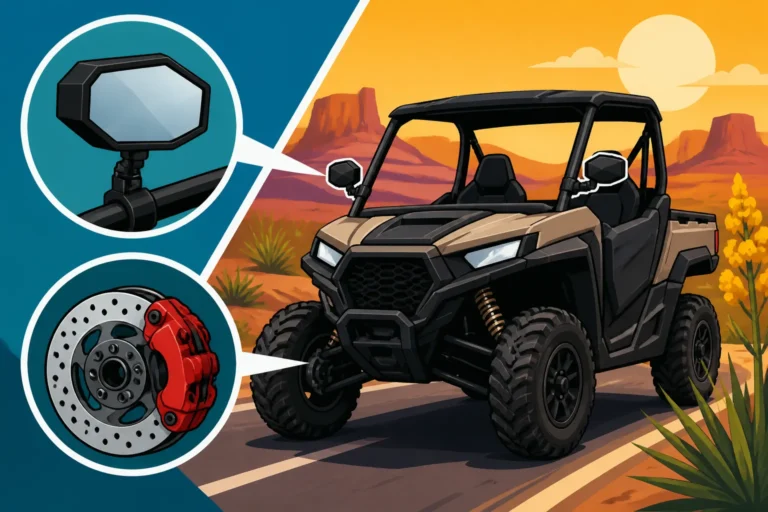
- Mirrors: At least one rearview mirror, typically on the left side, providing a clear view of traffic behind you.
- Spark Arrester: While usually required for off-road use on public lands, it's a good general practice for all operation to prevent fires.
- Muffler: To keep noise levels within legal limits (usually 96 decibels).
Many riders choose to upgrade their machines with aftermarket accessories to meet these requirements. Companies like SuperATV offer a wide array of street-legal kits, mirrors, turn signals, and lighting solutions that can help transform your off-road beast into a compliant, road-ready machine, enhancing both safety and legality. This kind of preparation ensures you're not caught off guard by a roadside inspection. [New Mexico Equipment Rules for Road Use] You'll also need to display the proper decal for paved road use, which is typically the green "on and off-highway" decal. [New Mexico Green Decal Requirements]
Riding Practices and Legal Responsibilities
Beyond the equipment, how you ride on paved roads is paramount. This isn't the free-for-all of a wide-open desert. You are sharing the road with cars, trucks, and possibly cyclists and pedestrians, all of whom have different expectations.
- Driver's License: You absolutely must possess a valid driver's license to operate an OHV on a public paved road in New Mexico. This is not optional. [A Driver's License on a New Mexico Paved Road]
- Helmet and Eye Protection: While helmet laws vary for off-road use, eye protection is generally required on pavement for all riders, and helmets are mandatory for riders under 18. [New Mexico Eye Protection Requirement] Always prioritize safety gear.
- Traffic Laws: All standard traffic laws apply to OHVs on paved roads. This means obeying speed limits, stopping at stop signs and red lights, using turn signals, and yielding the right of way. No wheelies, no reckless driving, and certainly no drinking and riding.
- Crossing Highways: New Mexico allows OHVs to cross state highways at a 90-degree angle, as perpendicularly as possible, after coming to a complete stop and yielding to all traffic. You cannot ride along a state highway. [Crossing a Highway on an ATV in New Mexico]
- Passenger Rules: Be aware of passenger restrictions, especially for younger riders. New Mexico has specific rules regarding who can carry a passenger and the age of that passenger, particularly for those under 18.
By understanding and adhering to these rules, you're not only protecting yourself from fines and accidents but also ensuring that OHV access to our beautiful state's paved roads remains a privilege for all of us to enjoy. It's about being a responsible member of the riding community.
Disclaimer
This article is for general informational purposes only and does not constitute professional advice. Laws, prices and regulations vary by location and change over time. Consult a qualified professional for guidance on your specific situation.