Freeways New Mexico Riders May Not Cross
There’s nothing quite like the freedom of exploring New Mexico’s vast landscapes on your ATV or UTV, but the dream can quickly turn into a headache when you start wondering where you can actually ride. One of the biggest points of confusion for many riders is navigating the state's roadways and, more specifically, figuring out which ones are absolutely off-limits. This guide will clarify the strict rules regarding freeways and interstates, helping you understand where you can and cannot take your off-highway vehicle in the Land of Enchantment.
Understanding New Mexico's General OHV Road Rules
New Mexico offers some unique opportunities for OHV riders to use public roads, a privilege not found in many other states. However, this isn't a free-for-all. There are very specific rules and requirements you need to meet to legally operate your ATV or UTV on any paved or unpaved public road. Ignoring these can lead to serious fines or even legal trouble, which nobody wants when they're trying to enjoy a beautiful day out.
New Mexico's Paved Street Opt-In
The concept of "street legal" for an ATV or UTV in New Mexico isn't about transforming your machine into a car. Instead, it's about meeting a specific set of criteria that allows you to "opt-in" to using certain paved public roads. This isn't a blanket permission slip for all roads, but rather a carefully defined allowance for specific county and municipal streets. Many rural counties and smaller towns have passed ordinances or resolutions that open their local roads to OHV traffic, often as a way to connect trails or allow riders access to local businesses. These local ordinances are crucial, and you absolutely must check them before riding, as they can vary greatly from one community to the next. What's allowed in Sierra County might be strictly forbidden in a town just a few miles away. The goal is to provide a sensible way for riders to access trail systems or move between destinations without having to trailer their machines for every short distance, but always within clearly defined boundaries. [New Mexico's Paved Street Opt-In] explains this concept in more detail.
The Green Decal and Paved Road Plate
To legally operate your OHV on any designated paved public road in New Mexico, you'll need more than just good intentions. The state requires a specific combination of registration and identification that signals your machine is ready for mixed use. First and foremost, you need a New Mexico OHV registration, which comes with either a yellow or a green decal. For paved road use, the green decal is absolutely essential, as it signifies that your machine is insured and meets specific road-use criteria. But that's not all; you also need a special paved road plate issued by the Motor Vehicle Division (MVD). This plate is distinct from the regular OHV decal and carries its own set of requirements. Think of it as a second layer of verification, proving your machine is not just registered for off-highway use, but also specifically equipped and authorized for on-highway sections. Without both the green decal and the paved road plate, you’re not considered street-legal in New Mexico, even if you’re just trying to cross a paved road. You can learn more about [New Mexico's Green On and Off-Highway Decal].
Equipment Rules for Road Use
Just getting the right decal and plate isn't enough; your ATV or UTV itself needs to be equipped for road safety. New Mexico has specific requirements for what your off-highway vehicle must have to be considered road-ready. This isn't just about passing a visual check; it’s about ensuring your machine is safe for you and for other drivers on the road. Essential items include headlights and taillights that meet specific visibility standards, brake lights, and a horn. You’ll also need at least one mirror, securely mounted to provide a clear view to the rear, and a muffler system that keeps your machine within the state's noise limits. Some riders also opt for additional safety features like turn signals, even if not explicitly mandated for all road types, simply because it makes communicating intentions much clearer to other drivers. These equipment requirements are designed to bring OHVs closer to the safety standards of traditional vehicles when sharing public roads, reducing the risk of accidents. For a full breakdown, check out [New Mexico Equipment Rules for Road Use]. Many riders turn to aftermarket suppliers like SuperATV for these upgrades, ensuring their machines meet legal standards while enhancing performance and safety.
The Strict Prohibition on Freeways and Interstates
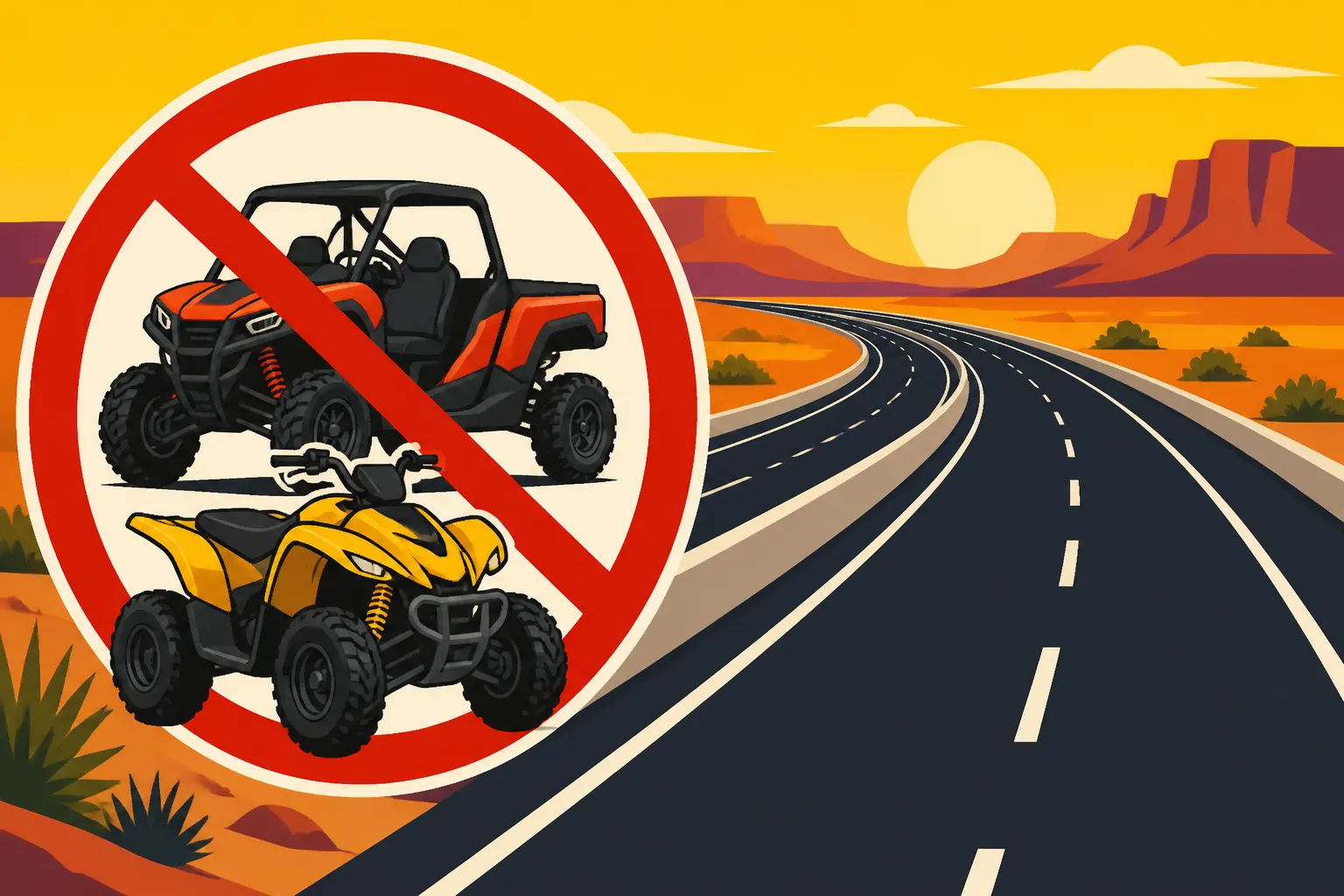
Now, let's get to the heart of the matter: freeways and interstates. While New Mexico is relatively permissive with OHV use on some public roads, there is a very clear and absolute line drawn when it comes to high-speed, controlled-access highways. These major arteries of transportation are unequivocally off-limits for ATVs and UTVs, no exceptions for simply having a green decal or paved road plate. This isn't just a suggestion; it's a hard rule that's enforced for public safety and the smooth flow of traffic.
Specific Freeway Examples in New Mexico
Across the state, any road designated as an interstate highway (like I-10, I-25, or I-40) is strictly off-limits. These are high-speed thoroughfares designed for passenger cars and commercial trucks, and OHVs simply do not belong on them. Imagine trying to keep pace with traffic moving at 75 miles per hour on a UTV designed for trails. It’s a recipe for disaster. This prohibition extends to all parts of these roadways, including the main travel lanes, shoulders, and exit/entrance ramps. Whether you're in the southern part of the state near Las Cruces and El Paso, up through Albuquerque and Santa Fe, or cutting across the eastern plains, any road with that "I-" designation means "no OHVs." It’s important to familiarize yourself with these specific routes and plan your rides to avoid them entirely. Even if you're just looking for a shortcut or trying to connect two trail systems, the interstate is never the answer for an OHV.
Interstate Crossings: The "Perpendicular Crossing Rule" Exception
Here’s where a little nuance comes in, but it's vital to understand the difference between riding on a freeway and crossing one. While riding on the main lanes of an interstate is forbidden, New Mexico law does allow for a very specific type of crossing. If you are on an otherwise legal road (like an open county road) that happens to intersect an interstate, you are generally permitted to cross it. However, this isn’t a leisurely drive. The law specifies that any crossing must be made "as close to a perpendicular angle as possible." This means no meandering, no stopping, and no cruising parallel to the highway. You must come to a complete stop, check for traffic, and proceed directly across to the other side of the intersecting road. This allowance is purely for transit – to get from one side of a legally open road to the other – and not an opportunity to "sample" the interstate pavement. It’s a momentary maneuver, executed with extreme caution. Always remember to prioritize safety during these crossings, as other vehicles will likely be moving at high speeds. [New Mexico Rules for Crossing a Highway] delves deeper into these specific requirements.
On-Ramps, Off-Ramps, and Medians
Even if you understand that the main lanes are off-limits, it’s critical to remember that this prohibition extends to all ancillary parts of the freeway system. On-ramps and off-ramps are integral components of the interstate; they are not separate, permissible roadways for OHV use. Attempting to use a ramp, even for a short distance, puts you directly into the flow of high-speed traffic and is illegal. Similarly, the medians and shoulders of interstates are not places for OHVs. These areas are for emergency use, vehicle breakdowns, or specific maintenance activities, not for trail riding or staging. The entire "right-of-way" of a freeway, from fence line to fence line, is generally considered off-limits for OHV operation, unless you're making a legal, perpendicular crossing on an intersecting public road. The intent of the law is to keep slower-moving, less protected OHVs completely separated from the hazards of interstate traffic. Disregarding these rules isn’t just breaking the law; it’s putting yourself and others in immense danger.
Why Freeways Are Off-Limits to OHVs
The rules against OHV use on freeways aren't arbitrary; they're rooted in common sense, safety concerns, and the fundamental design of these transportation systems. Understanding the "why" behind the regulation can help reinforce the importance of adherence and discourage any temptation to bend the rules.
High-Speed Traffic and Safety Concerns
The most obvious reason freeways are off-limits is the sheer danger posed by mixing slow-moving, open-air OHVs with high-speed car and truck traffic. Interstates are designed for vehicles capable of maintaining speeds of 70-80+ mph, with drivers expecting consistent flow and predictable maneuvers. ATVs and UTVs, even modified ones, are typically much slower, have a different turning radius, and offer far less protection in a collision. The speed differential alone creates an incredibly dangerous situation, drastically increasing the risk of rear-end collisions or high-speed side impacts. Furthermore, OHVs have a smaller profile, making them less visible to drivers of larger vehicles, especially trucks. A split-second misjudgment or an unexpected maneuver from an OHV could lead to catastrophic consequences for everyone involved. Safety is paramount, and the state's clear prohibition is a direct measure to prevent avoidable tragedies.
Legal Liability and Insurance Implications
Beyond the immediate physical dangers, riding an OHV on a freeway carries significant legal and financial risks. Operating any vehicle illegally immediately complicates insurance coverage. If you were to be involved in an accident on a forbidden roadway, your OHV insurance policy, even if it covers on-road use on approved roads, might be entirely voided. This would leave you personally liable for damages, injuries, and legal fees, which could quickly amount to hundreds of thousands of dollars. The financial fallout of an accident under such circumstances could be life-altering. Furthermore, you would almost certainly face severe citations for illegal operation, potentially reckless driving charges, and other legal penalties that go far beyond a simple traffic ticket. [New Mexico OHV Registration and Liability Insurance] details the requirements for legal operation. Even if you have comprehensive coverage for your machine, including parts from a company like SuperATV, it won't protect you if you're riding in a prohibited area. The legal system views operating a vehicle where it's explicitly forbidden as a serious offense, and the consequences reflect that severity.
Designation for Motor Vehicles Only
From a purely legal and infrastructural standpoint, freeways are designated exclusively for "motor vehicles" as defined by specific statutes, which generally do not include OHVs. These roads are built to specific engineering standards for certain types of traffic and speeds, and they are maintained accordingly. OHVs, by their very nature and design, don't fit into this classification for freeway use. The signage, lane markings, and traffic flow patterns are all predicated on standard automotive traffic. Allowing OHVs would disrupt this entire system, creating confusion and hazards. It's a fundamental distinction in how different types of vehicles are legally allowed to operate on different types of roads, designed to ensure order and safety within the transportation network.
Navigating Around Forbidden Roadways
So, if freeways are out, how do you get where you need to go without breaking the law or endangering yourself? The answer lies in careful planning, understanding your alternatives, and utilizing the resources available to OHV riders in New Mexico. There are plenty of incredible places to ride, and with a little preparation, you can enjoy them safely and legally.
Utilizing County and Forest Roads
New Mexico boasts an extensive network of county roads and forest roads that are often open to OHV use, either by default or through specific ordinances. These are your bread and butter for connecting trails, accessing remote areas, or simply enjoying a scenic drive. County roads, particularly in rural areas, can range from well-maintained gravel paths to rough dirt tracks, and many are designated for OHV use. Similarly, the vast lands managed by the U.S. Forest Service and Bureau of Land Management (BLM) offer countless miles of roads and designated trails where OHVs are welcome. Always check with the local county sheriff's office, Forest Service district, or BLM field office for current regulations, restrictions, and maps. These roads provide a fantastic alternative to freeways, allowing you to immerse yourself in New Mexico’s natural beauty at a more appropriate pace for your machine. Just remember that even on these roads, you must obey all traffic laws, speed limits, and respect private property. For more on this, read [New Mexico Rules for Riding a County Road] and [New Mexico Rules for Riding a Forest Road].
Trailer Transport and Staging Areas
For longer distances, or when connecting areas separated by prohibited roadways, trailering your OHV is the safest and most legal option. New Mexico has numerous designated staging areas and trailheads specifically set up for OHV users. These areas typically offer parking for trucks and trailers, access points to trails, and often amenities like restrooms. By trailering your machine, you completely avoid the legal and safety risks of riding on forbidden roads. It might take a bit more time and effort to load and unload, but the peace of mind knowing you're operating within the law and keeping yourself safe is invaluable. Plus, it allows you to access a wider variety of riding areas without being limited by connecting roads. When loading up your UTV, you might consider heavy-duty ramps or a robust winch from a company like SuperATV to make the process smoother and safer. For tips on transporting your machine, see [New Mexico Rules for Towing With a UTV].
Planning Routes to Avoid Freeways
Effective route planning is key to a successful and legal OHV adventure in New Mexico. Don't rely solely on general navigation apps designed for cars; these will often suggest freeway routes. Instead, use specialized OHV maps, topographic maps, or GPS devices/apps that specifically show legal OHV trails and roads. Many federal land agencies provide free maps online or at their offices that clearly delineate open routes. Look for routes that utilize county roads, forest roads, and designated trails, and actively identify and avoid all interstate highways. It's a good practice to plot out your route in advance, noting any potential crossing points or areas where roads might become less OHV-friendly. Having a paper map as a backup to your GPS is always a smart move, especially in remote areas where cell service can be spotty. The goal is to create a seamless, legal journey from your starting point to your destination, all while bypassing any forbidden roadways. Consider these trips as part of [New Mexico Rules for Riding to a Trailhead].
Consequences of Riding on Forbidden Roadways
It's tempting to think you might get away with a quick hop onto the interstate, especially if it seems like a shortcut. But the reality is that law enforcement in New Mexico takes these violations seriously. The consequences can range from expensive to severe, impacting your wallet, your vehicle, and even your freedom to ride in the future. It’s simply not worth the risk.
Fines and Penalties for Violations
Riding an OHV on a freeway or other prohibited road in New Mexico will almost certainly result in a citation, and these aren't minor parking tickets. Fines for illegal OHV operation can be substantial, often starting in the hundreds of dollars for a first offense. These fines are designed to be a significant deterrent, reflecting the seriousness of the safety hazard created. Depending on the specific circumstances, such as whether you were seen driving recklessly, putting others at risk, or causing an obstruction, additional charges might be added, increasing the financial penalty. Plus, you might face court fees and other administrative costs, piling onto the initial fine. It's a quick way to turn an enjoyable outing into a very expensive lesson. [New Mexico Fines for Illegal Road Riding] outlines the various penalties you could face.
Vehicle Impoundment and Other Enforcement Actions
In more serious cases, or if you're a repeat offender, law enforcement has the authority to impound your ATV or UTV. This means your machine could be towed away at your expense, and you would then be responsible for impound fees, daily storage fees, and any other charges associated with retrieving it. This can quickly add up to hundreds or even thousands of dollars, far exceeding the initial fine. In some situations, especially if other laws were broken (like reckless driving or operating under the influence), your OHV might even be subject to forfeiture. Beyond impoundment, you could face driver's license points, mandatory court appearances, or even community service, depending on the severity of the violation and local judicial practices. These actions are meant to ensure compliance and discourage dangerous behaviors on public roads.
Impact on Future Riding Privileges
A history of illegal OHV operation can have long-lasting effects on your ability to enjoy riding in New Mexico. Repeated violations could lead to suspensions of your OHV registration or permits, effectively banning you from legally riding on public land or designated roads. If the violation involved a driver's license (even if not strictly required for off-road operation), it could impact your driving record and insurance rates for your primary vehicle. Furthermore, having a record of these offenses can make it difficult to obtain future permits or even participate in organized riding events that require a clean record. The state wants to ensure that its trails and roads are safe for everyone, and those who consistently flout the rules may find their riding privileges revoked. The best way to ensure you can continue to enjoy New Mexico's fantastic riding opportunities is to always ride responsibly and legally.
| Road Type | OHV Use (New Mexico) | Requirements |
|---|---|---|
| Freeways/Interstates | Strictly Forbidden (except for perpendicular crossings on intersecting roads) | None (crossing requires legal road use, extreme caution) |
| State Highways | Generally Forbidden (unless specifically opened by local ordinance, which is rare) | Green Decal, Paved Road Plate, OHV Equipment, Check Local Ordinances |
| County Roads | Often Allowed (check local county ordinances/resolutions) | Green Decal, Paved Road Plate, OHV Equipment (if paved); Yellow/Green Decal (if unpaved) |
| City/Town Streets | Sometimes Allowed (check specific municipal ordinances) | Green Decal, Paved Road Plate, OHV Equipment |
| Forest Roads | Generally Allowed (check Forest Service maps for designated routes/restrictions) | Green or Yellow Decal (state registration), Spark Arrester |
| BLM Roads/Trails | Generally Allowed (check BLM travel management plans for designated routes/restrictions) | Green or Yellow Decal (state registration), Spark Arrester |
| Private Land | Allowed with Owner's Permission | Permission from owner; state registration recommended but not always legally mandated |
Disclaimer
This article is for general informational purposes only and does not constitute professional advice. Laws, prices and regulations vary by location and change over time. Consult a qualified professional for guidance on your specific situation.