A Driver’s License on a New Mexico Paved Road
It's a common question that pops up in every riding group, a real head-scratcher for many of us who just want to enjoy our machines: Do you actually need a driver's license to ride your ATV or UTV on a paved road in New Mexico? The answer isn't always as simple as a yes or no, especially with the unique ways New Mexico allows off-highway vehicles (OHVs) onto certain public roads. This guide will dive deep into New Mexico's regulations, clearing up the confusion so you can hit the pavement legally and confidently, whether you're just crossing a highway or planning a cruise through an open county road.
The Basics: Driver's License Versus OHV Registration
Many riders get caught up thinking that if their ATV or UTV is registered with the state, that's all they need for any type of public use. While registration is absolutely crucial for any off-highway vehicle venturing onto public lands in New Mexico, it's a separate beast entirely from the requirements for operating a motor vehicle on a paved public roadway. This distinction is where a lot of the confusion and frustration arises for riders who are used to simply showing their OHV decal out on the trails.
Understanding the Off-Highway Vehicle Definition
In New Mexico, an ATV or UTV is primarily defined as an off-highway vehicle, designed and intended for off-road use. This definition dictates how it's registered through the Motor Vehicle Division (MVD) and the types of trails and lands it can access. When you're out on a dirt trail, a sand dune, or a designated off-highway recreation area, the primary requirement is your current OHV registration and decal. This signals to authorities that your machine is recognized by the state and that you've paid the necessary fees that often go towards trail maintenance and development.
However, the moment your tires touch asphalt or concrete on a public road, the rules begin to shift. The state's interest in public safety on shared roadways brings a different set of expectations for the operator. It's no longer just about regulating a recreational vehicle on an adventure trail; it's about integrating it into a flow of traffic that includes cars, trucks, and motorcycles, all governed by established road rules.
Why a Driver's License Is Necessary on Pavement
Here's the critical point: when you operate an ATV or UTV on a paved public roadway in New Mexico, it immediately falls under the same general umbrella as any other motor vehicle regarding operator licensing. This means you absolutely must possess a valid driver's license. It's not just a recommendation; it's a legal requirement. The state wants to ensure that anyone operating a vehicle on its paved roads has demonstrated a basic level of knowledge of traffic laws and has proven their capability to safely control a vehicle.
Imagine the chaos if just anyone, regardless of their driving experience or knowledge of road signs, could take to the streets on an OHV. It would be a nightmare for public safety. Your driver's license signifies that you've passed tests and understand the rules of the road, which are entirely different from navigating a washboard trail. This includes knowing how to interpret traffic signals, yield to pedestrians, merge safely, and generally operate predictably among other drivers. This isn't just about New Mexico; it's a common approach in states that allow OHVs on any paved public roads.
New Mexico's Opt-In for Paved Road Use
New Mexico has a progressive "opt-in" law that allows counties and municipalities to open their paved roads to OHVs, but this privilege comes with specific responsibilities, including the mandatory driver's license. It’s not a free-for-all, and understanding the nuances of these local ordinances is key to a legal ride. This law was a big step for riders, recognizing the need for access, especially in rural communities, but it was carefully crafted to maintain public safety.
The New Mexico Paved Road Plate
Before you even think about hitting a New Mexico paved road, you need to ensure your machine is properly equipped and permitted. Beyond your standard off-highway registration, any ATV or UTV that will be ridden on designated paved roads must also display a specific [New Mexico's Paved Road Plate]. This plate is your official declaration that your machine is set up for limited paved road use and has met additional equipment requirements. It's crucial to understand that this isn't just a fancy sticker; it’s a distinct requirement that sets your paved-road-ready machine apart from one that only sees dirt.
The paved road plate is tied to an application process that verifies your machine has the necessary safety features for road use, things like mirrors, a horn, and proper lighting. This ensures that when your machine is sharing the road with cars, it can be seen, heard, and communicate its intentions just like any other vehicle. It's all about making OHVs predictable and visible to other drivers, which dramatically reduces the risk of accidents.
Equipment Rules for Paved Road Use
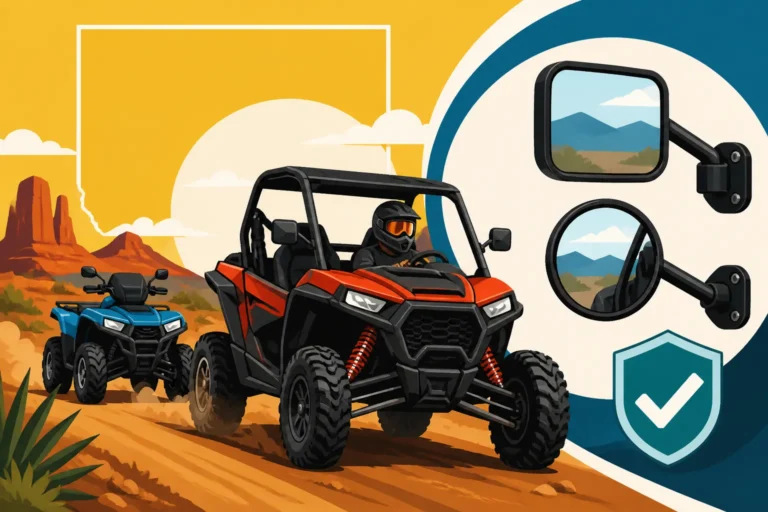
Operating an OHV on a New Mexico paved road isn't just about having a license and the right plate; it's also about having the right equipment. New Mexico law requires specific items to make your ATV or UTV street-legal on opened roads. This includes headlights that emit a white light visible from at least 150 feet to the front, and taillights that display a red light visible from at least 200 feet to the rear. Additionally, you'll need at least one rear-view mirror, proper braking capabilities, and a horn capable of being heard from 200 feet away.
Many riders, especially those who primarily hit the trails, might find their stock machines lacking some of these features. This is where upgrading comes into play. Aftermarket companies like SuperATV offer a wide range of products designed specifically to get your ATV or UTV up to snuff for street legality. From turn signal kits to side mirrors and even DOT-approved tires, you can find everything you need to transform your off-road beast into a paved-road cruiser. Ensuring all these components are correctly installed and functional is not just a matter of compliance, but a vital aspect of your safety and the safety of others on the road.
Essential Requirements Beyond the License
While a driver's license is paramount for operating an OHV on paved roads, it's just one piece of the puzzle. New Mexico has other crucial requirements that riders often overlook, leading to potential fines and serious safety risks. These are designed to protect you, your passengers, and other motorists sharing the road. Ignoring them could turn a pleasant ride into a very expensive and regrettable experience.
Mandatory Insurance Coverage
Just like any other vehicle on New Mexico's paved roads, your ATV or UTV must have valid liability insurance if you plan to ride it on public streets. This isn't optional; it's part of [New Mexico's Mandatory Financial Responsibility Act]. This law ensures that if you are involved in an accident, there is financial protection for damages or injuries you might cause to others. Many riders carry insurance for their OHVs for off-road damage, but often this doesn't extend to liability coverage on public roads.
It's absolutely critical to check with your insurance provider to confirm your policy covers paved road use. Don't assume your existing off-road policy automatically includes this. If you're pulled over and cannot provide proof of insurance for paved road use, you could face significant penalties, regardless of whether you have a driver's license. A quick call to your insurer can save you a lot of headache and expense down the road, and it's a non-negotiable step before venturing onto any asphalt.
Helmet and Eye Protection Rules
New Mexico has specific helmet laws that apply to OHV riders, especially when operating on public roadways. While adults are generally not required to wear a helmet when riding off-road, the rules change significantly on pavement. For riders under the age of 18, a helmet is always required, whether on or off-road. But even for adult riders, if you're hitting the paved streets, it's highly recommended, and often required depending on the local ordinance or specific circumstances, to wear a helmet. [New Mexico Helmet Law for ATV Riders] details these nuances.
Beyond helmets, eye protection is another non-negotiable item for paved road use. New Mexico law states that all OHV operators and passengers must wear eye protection when riding on public roads, regardless of age. This could be goggles, a face shield, or safety glasses. Wind, dust, and debris on paved roads can be just as hazardous as on dirt trails, potentially impairing your vision and leading to accidents. Prioritizing safety gear isn't just about avoiding fines; it's about protecting yourself and ensuring you can react to changing road conditions.
| Requirement | Off-Road Only | Paved Road Use (Opt-In) |
|---|---|---|
| OHV Registration | Required (Decal) | Required (Decal) |
| Paved Road Plate | Not Required | Required |
| Driver's License | Not Required | Required |
| Liability Insurance | Optional (Recommended) | Required |
| Headlights | Recommended | Required (Visible 150 ft) |
| Taillights | Recommended | Required (Visible 200 ft) |
| Brake Lights | Recommended | Required |
| Rear-View Mirror | Optional | Required (At least one) |
| Horn | Optional | Required (Audible 200 ft) |
| Spark Arrester | Required on public land | Required on public land |
| Helmet (Adult) | Optional | Recommended (often required locally) |
| Helmet (Under 18) | Required | Required |
| Eye Protection | Recommended | Required |
| Muffler | Required | Required (Sound limit applies) |
Special Considerations for Young Riders
The rules for young riders in New Mexico are particularly stringent when it comes to OHVs, and these regulations become even more critical when paved roads are involved. Parents and guardians need to be acutely aware of these limitations, as violations can result in penalties not just for the minor, but also for the supervising adult. It's a heavy responsibility, but it's all designed to keep our youth safe while enjoying the sport.
Minimum Age and Supervision Rules
In New Mexico, a driver's license is generally not issued to individuals under a certain age, which directly impacts a minor's ability to operate an OHV on a paved public road. Since a driver's license is required for paved road use, by default, a minor who hasn't reached the age to obtain a valid driver's license cannot legally operate an OHV on these roads. [New Mexico Rules for Riders Under 18] clearly outline the restrictions. Even if a county has opted in to allow OHVs on its paved roads, the driver's license requirement stands, effectively barring most minors from taking that privilege.
For off-road riding, minors can operate OHVs under specific supervision rules and age limits, often requiring a safety permit. However, this off-road allowance does not translate to paved road privileges. The state makes a clear distinction here because of the increased hazards and complexities of interacting with conventional traffic on asphalt. Parents, it's vital to educate your children about these rules and strictly enforce them to prevent dangerous situations and legal repercussions.
Passenger Restrictions for Young Riders
Another crucial rule pertains to carrying passengers, especially for younger riders. In New Mexico, an OHV operator under the age of 18 is generally prohibited from carrying passengers. This rule is in place whether the riding is off-road or on designated paved roads. The rationale is simple: a young, less experienced operator has enough responsibility just controlling their machine, let alone managing the added dynamics and risks of carrying another person.
This restriction underscores the state's cautious approach to young OHV operators. Adding a passenger, especially on a paved road where speeds might be higher and traffic more complex, significantly amplifies the risk. Always ensure that if a minor is operating an OHV, they are doing so alone, and if you're on a paved road, that they meet all other requirements, including holding a valid driver's license. Safety for our youth is always paramount, and these rules are designed with their well-being in mind.
Common Misconceptions and Local Ordinances
The landscape of OHV laws can feel like a labyrinth, especially with state-level requirements interweaving with county and city ordinances. It’s easy to misunderstand or misinterpret what’s allowed, leading to honest mistakes that can still result in fines or worse. Clearing up these common misconceptions is vital for every rider venturing into New Mexico’s diverse terrain.
The Myth of "Paved Road Adjacent" Riding
One common misconception is that if you're just traveling a short distance on a paved road to connect to another trail, or if the paved road runs "adjacent" to public lands, the driver's license requirement might not apply. This is absolutely not true. The moment your wheels touch a paved public road, even for a few yards to cross a highway or connect trails, you are subject to the same rules as if you were driving a car, including the need for a valid driver's license. [New Mexico Rules for Crossing a Highway] makes this very clear. There's no "almost street legal" status; you either are, or you aren't, and the license is a core part of "being."
Many riders find this frustrating, especially in areas where trail systems are bisected by short stretches of asphalt. It forces them to trailer their machines for what feels like a trivial distance or risk a citation. However, the law sees no distinction between a short crossing and a long cruise on a paved road. It's about ensuring competent operators on any shared public thoroughfare. Always err on the side of caution and assume that if you're on pavement, your driver's license needs to be in your wallet.
Local Control Over Paved Road Access
While state law sets the framework, individual counties and municipalities have the final say on whether to open their paved roads to OHVs. This means that a road that's legal for OHVs in one county might be completely off-limits just across the county line, even if all your paperwork and equipment are in order. [New Mexico Rules for Riding a County Road] highlights this local control. This patchwork of rules can be incredibly confusing, and it's a huge source of frustration for riders trying to navigate unfamiliar areas.
Before you plan a ride that involves any paved roads, always, always check the local ordinances for that specific area. Many counties and towns have their ordinances published online. A quick search for "OHV ordinance [county name] New Mexico" can often save you from a nasty surprise. For example, while Sierra County has opened nearly all its county roads, a town within Sierra County might have its own rules for city streets. Don't rely on word-of-mouth; verify the information yourself to ensure a legal and enjoyable ride.
Preparing for Your Paved Road Ride
Embarking on a ride that includes paved roads requires more than just knowing the rules; it demands thoughtful preparation. From equipping your machine to ensuring you have all your documentation, a little foresight can make the difference between a smooth journey and an unfortunate encounter with law enforcement. It’s about building confidence and ensuring safety for everyone on the road.
Documentation to Carry
When you're out on any paved public road in New Mexico on your ATV or UTV, you absolutely must carry specific documentation. This isn't just about showing your driver's license when asked; it's about proving that your machine is legally allowed on that road and that you're operating it responsibly. The basic documents you should always have with you include your valid driver's license, your OHV registration and proof of a valid [New Mexico's Green On and Off-Highway Decal], and proof of liability insurance that covers paved road use.
It's a good practice to keep these documents in a waterproof bag or container, especially given the unpredictable weather conditions in New Mexico. Consider carrying a photocopy of your title or registration as well, just in case. Some riders even take photos of their documents on their phones, though physical copies are always preferred by law enforcement. Being able to quickly and clearly present all required documentation shows that you're a responsible rider and can help smooth over any roadside stops.
Pre-Ride Machine Check for Paved Roads
Before you even turn the key or press the start button, a thorough pre-ride inspection of your OHV is critical, particularly when you're planning to hit paved roads. Beyond your usual checks for tire pressure and fluid levels, focus on the specific components required for street legality. Check that your headlights, taillights, and brake lights are all fully functional and clean. Test your horn and ensure it's loud enough to be heard. Verify that your mirrors are clean, properly adjusted, and securely mounted, offering a clear view of traffic behind you.
This is also a great time to inspect any aftermarket parts you've added for street legality. Are your SuperATV turn signals working correctly? Is your license plate bracket secure and illuminated if riding at night? Even small issues like a loose mirror or a dim taillight can draw unwanted attention from law enforcement and potentially compromise your safety. A few minutes spent on a pre-ride check can prevent bigger problems down the road and ensure your machine is truly ready for its paved adventure.
Disclaimer
This article is for general informational purposes only and does not constitute professional advice. Laws, prices and regulations vary by location and change over time. Consult a qualified professional for guidance on your specific situation.