New Mexico Mirror Requirements for Road Use
It’s a common scenario for many of us who love hitting the trails in New Mexico: one minute you’re navigating rocky arroyos, and the next you need to cross a paved county road or even drive a short distance down a city street to get to the next trailhead. The moment your tires touch that asphalt, the rules of the game change significantly. One of the most frequently asked questions I hear from fellow riders, right after "Can I even do that?", is "What about mirrors?" It’s a point of confusion for many, and frankly, the regulations can feel like a tangled mess. This guide is here to untangle New Mexico's specific mirror requirements for off-highway vehicles (OHVs) when you venture onto a paved public road, making sure you stay safe and legal.
Why Mirrors Are More Than Just an Accessory for Road Use
Let's be honest, when you're tearing up a dirt trail, the last thing on your mind might be a rearview mirror. Off-road, situational awareness often comes from looking over your shoulder, listening to your engine, and trusting your gut. But the moment you transition to a paved street, whether it's just a quick crossing or a longer jaunt to connect trails, that mindset has to shift. The stakes are higher, the speeds are different, and the other vehicles you encounter are much, much larger and less forgiving.
The Legal Imperative: What New Mexico Law Demands
New Mexico law doesn't just suggest you have mirrors for road use; it requires them. This isn't some arbitrary rule dreamt up by bureaucrats to annoy us; it's a fundamental safety measure. When you opt to use your off-highway vehicle on a paved public street, you're essentially stepping into the realm of conventional traffic laws. This "opt-in" carries with it a responsibility to equip your machine as if it were any other street-legal vehicle, at least for the duration of its time on asphalt. Without proper mirrors, you're not only putting yourself at risk but also risking a citation and a fine from law enforcement who are simply trying to ensure everyone's safety on the roads. It’s part of the comprehensive effort to make sure that when OHVs are sharing the road with cars and trucks, they can do so as safely as possible. Think of it as part of the pact you make when choosing to ride legally on a paved surface.
Safety First: Eliminating Blind Spots and Enhancing Situational Awareness
Imagine this: you've just come off a fantastic trail, and you need to turn right onto a paved county road to reach the next section of public land. You glance over your shoulder, but your helmet or the roll cage of your UTV creates a significant blind spot. A car, moving much faster than you expected, could be approaching rapidly from behind. Without a mirror, that car is invisible until it's right on top of you. It’s a heart-stopping moment that no one wants to experience.
Mirrors provide that critical glance backward, giving you precious seconds to assess traffic conditions without having to take your eyes entirely off the road ahead. They are your extra set of eyes, crucial for everything from checking if a vehicle is passing you, to making a lane change (if you're on a multi-lane road, which is rare for OHVs but still possible in certain contexts), or simply maintaining awareness of your surroundings. On a dusty trail, a lack of mirrors might be an inconvenience; on a paved road, it can be a genuine hazard. The objective here is to give you the best chance of seeing what’s coming, allowing you to react safely and predictably in traffic. It's about minimizing the surprises that can quickly turn a fun ride into a dangerous situation.
New Mexico's Specific Mirror Requirements for Paved Road Use
Navigating the specifics of New Mexico's mirror laws can feel a bit like trying to find a single, unmarked trail in a vast wilderness. It’s not always immediately clear whether you need a single rearview mirror, a pair of side mirrors, or both. The good news is, the state simplifies it quite a bit for OHV operators on paved roads.
Rearview Mirror or Side Mirrors? The New Mexico Distinction
New Mexico law for street-legal vehicles generally requires either an interior rearview mirror or two exterior side mirrors. For off-highway vehicles, particularly ATVs and UTVs, the interior rearview mirror isn't always practical or even possible due to their open-air design or the position of the rider. Think about a typical ATV – there's no "interior" space to mount a traditional rearview mirror.
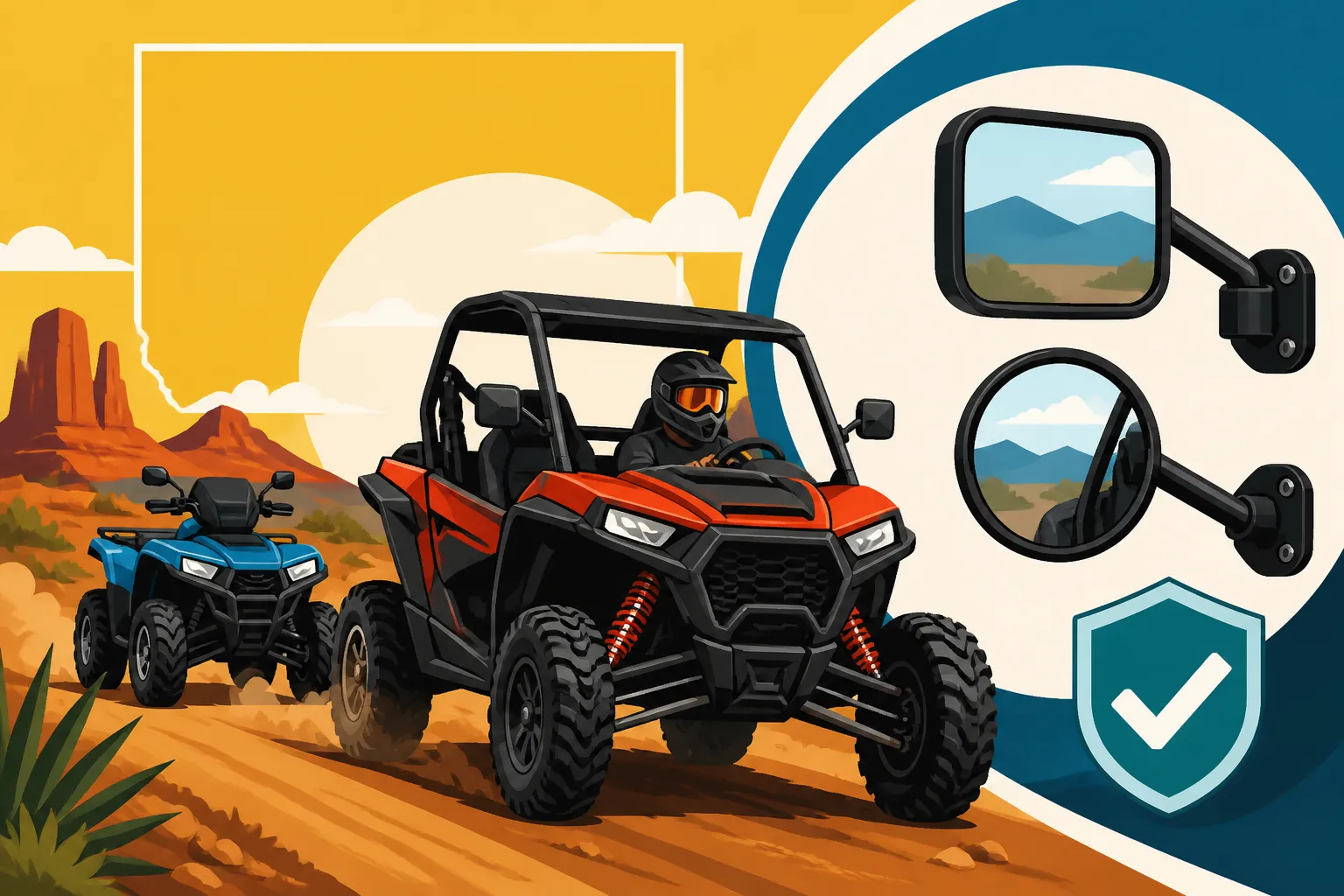
This means that for most OHV riders looking to hit the pavement, the requirement effectively translates to two exterior side mirrors. These mirrors must be mounted on the left and right sides of your machine, providing a clear and unobstructed view of the roadway behind you for a significant distance. This setup helps to cover the blind spots that a single rearview mirror might miss on a wider vehicle like a UTV, or simply provides the necessary rearward visibility for an ATV rider whose body might obstruct a center mirror. When you're transitioning from the trail to a paved road, it's this setup that ensures you're compliant and as safe as possible. You can explore [New Mexico Equipment Rules for Road Use] for a broader look at what else your machine might need.
Placement and Visibility Rules
It’s not enough to just have mirrors; they need to be properly placed and provide adequate visibility. The law typically states that mirrors must be positioned to allow the operator to view the highway for a certain distance to the rear. While exact measurements might not be specified down to the inch for OHVs, the spirit of the law is clear: you must be able to clearly see traffic approaching from behind and to the sides.
For UTVs, side mirrors are usually mounted on the roll cage or doors, giving a wide field of view. For ATVs, bar-end mirrors or handlebar-mounted mirrors are common solutions. The key is ensuring they don't vibrate excessively to obscure your view, aren't easily obstructed by your gear or body, and stay in place once adjusted. It's also critical that they remain clean and free of mud or dust, which can quickly accumulate during off-road segments and render them useless on pavement. Before you even pull onto that paved surface, take a moment to ensure your mirrors are properly adjusted for your riding position and cleaned so they offer maximum visibility. This attention to detail can make all the difference when you're sharing the road with faster-moving vehicles.
| Mirror Type | Requirement for Paved Road Use in NM | Key Consideration for OHVs |
|---|---|---|
| Interior Rearview Mirror | Optional, if two side mirrors are present | Not practical for most ATVs/UTVs; typically not the primary solution. |
| Two Exterior Side Mirrors | Required for paved road use | Essential for seeing blind spots, checking traffic, making turns; must be properly mounted and visible. |
| Single Side Mirror | Not compliant on its own | A single side mirror does not meet the legal requirement for rearward visibility. |
Choosing the Right Mirrors for Your Machine
So, you know you need mirrors. Now comes the task of actually choosing and installing them. This isn't a one-size-fits-all situation, as ATVs and UTVs have different mounting points and typical use cases. The good news is the aftermarket is full of solutions, so you shouldn't have trouble finding something that works for your specific machine and riding style.
Universal vs. Vehicle-Specific Options
When you start looking, you'll notice mirrors categorized as "universal fit" or "vehicle-specific."
Universal Fit Mirrors:
These are designed to adapt to a wide range of machines. For ATVs, universal handlebar-mounted mirrors are common. For UTVs, many clamp-on side mirrors use a versatile mounting bracket that can attach to various roll cage diameters.
- Pros: Often more affordable, widely available, and can sometimes be transferred between different machines if you upgrade in the future. Installation can be straightforward for basic models.
- Cons: "Universal" often means "compromise." They might not fit as snugly, look as integrated, or provide the optimal viewing angle without some tweaking. You might need additional shims or adapters to get a perfect fit, and they might be more prone to vibration on certain machines. For example, a rearview mirror designed to clamp to a UTV's roll bar might work, but it might not be perfectly centered or as sturdy as a vehicle-specific option.
Vehicle-Specific Mirrors:
These are engineered to perfectly match the make, model, and year of your ATV or UTV.
- Pros: Designed for optimal fit, aesthetics, and often superior stability, meaning less vibration. Installation is usually seamless as all mounting hardware is purpose-built. They integrate well with the machine's existing lines and structure.
- Cons: Typically more expensive. If you ever switch machines, they likely won't fit your new ride. Availability might be more limited for older or less common models.
Ultimately, the choice often comes down to budget and how much you value a perfect fit and integrated look. For many riders, a good quality universal set from a reputable brand like SuperATV can provide all the necessary functionality and durability without breaking the bank.
Durability and Off-Road Considerations
This is where the rubber meets the road—or, more accurately, where the mirror meets the tree branch! Our OHVs are built for rugged environments, and any accessory we add needs to be just as tough. It’s no good having mirrors for road legality if they shatter the first time you brush against some dense scrub on the trail.
Look for mirrors made with durable materials, like impact-resistant ABS plastic housings and shatter-resistant glass or polycarbonate lenses. Breakaway features are a huge plus, especially for side mirrors on UTVs. These mirrors are designed to fold in or pivot upon impact, rather than snapping off or breaking. This means if you misjudge a tight spot or a low-hanging branch, the mirror might just swing out of the way and can be easily repositioned, saving you from having to buy a replacement. Companies like SuperATV understand these demands and offer products specifically designed for the dual life of an OHV – ready for both the trail's challenges and the road's requirements.
Consider the mounting hardware as well. Sturdy clamps or bolts that can withstand constant vibration and occasional bumps are essential. Nobody wants to lose a mirror halfway through a ride, especially if you still have a paved section to navigate! Before you make a purchase, think about how and where you ride. If your trails are particularly tight and brushy, those breakaway mirrors become less of a luxury and more of a necessity.
Beyond the Mirrors: Other Road-Use Equipment
While mirrors are a critical component for safe and legal paved road use in New Mexico, they're just one piece of a larger puzzle. When you decide to take your OHV from dirt to asphalt, you're agreeing to equip your machine to a higher standard, much like any other vehicle on the road. It’s all about making your presence known, being able to communicate with other drivers, and having the necessary paperwork to back it all up.
Lights, Horns, and More
Beyond mirrors, there's a whole suite of equipment that New Mexico law expects your OHV to have for paved road use. This is where things can start to feel a bit more like outfitting a car, but for good reason:
- Headlights and Taillights: Your OHV must have at least one headlight that can illuminate objects at a certain distance, typically 150 feet, and at least one taillight visible from a certain distance, often 200 feet. If you plan to ride after dark or in low-visibility conditions on a paved road, these are absolutely non-negotiable. [New Mexico Headlight and Taillight Rules] covers these specifics.
- Brake Lights: A functioning brake light that illuminates when you apply the brakes is crucial for signaling your intentions to traffic behind you.
- Horn: A horn capable of emitting a sound audible under normal conditions for a significant distance (typically 200 feet) is required. This is for signaling other drivers of your presence or alerting them to potential hazards, much like a car horn. [New Mexico Sound Limit for ATVs] might touch on related noise regulations.
- Turn Signals: While not always explicitly required for all OHVs, integrated turn signals are a definite plus for communicating your intentions clearly on paved roads, especially when making turns or lane changes. Many aftermarket kits are available to add these.
- Muffler and Spark Arrester: While primarily for off-road use to prevent wildfires and manage noise, a proper muffler helps keep your OHV's sound levels within legal limits for both off-road and on-road operation.
Ensuring all these components are in working order before you even approach a paved road is key to avoiding trouble. A quick pre-ride check of all lights, the horn, and your mirrors can save you a lot of hassle and keep you safe.
Driver's License, Insurance, and Registration
No matter how well-equipped your machine is, you, the operator, also need to meet certain legal requirements to ride on paved public roads in New Mexico. This isn't just about your machine; it's about your legal standing as a driver:
- Driver's License: If you're operating an OHV on a paved public road, you generally need to possess a valid driver's license. This applies whether you’re crossing a highway or riding a county road. [New Mexico Driver's License Rules for OHVs] clarifies this important point. It’s a requirement that acknowledges you're now part of the standard flow of traffic.
- Liability Insurance: New Mexico's Mandatory Financial Responsibility Act requires that any vehicle operating on a public road, including OHVs that opt-in for paved road use, must carry minimum liability insurance. This protects you and other road users in case of an accident. It’s not just a suggestion; it’s the law. [New Mexico ATV Insurance Requirement] provides more details on what coverage you need.
- OHV Registration/Decal: Your off-highway vehicle must be properly registered with the New Mexico Motor Vehicle Division (MVD) and display the appropriate decal. While the yellow decal allows off-road use, if you're venturing onto paved roads, you might need to ensure your registration is up-to-date and, depending on the specific paved road use, have the correct additional permissions or decals. [Registering a UTV in New Mexico] is a great resource if you're still navigating the registration process. This confirms that your machine is recognized by the state for operation.
It’s easy to get caught up in the excitement of riding, but overlooking these crucial legal and equipment requirements can quickly turn a fun outing into a frustrating and expensive encounter with law enforcement. Always check the current regulations before you head out, and ride prepared for whatever the trail, or the road, throws your way. Being fully compliant means you can enjoy your ride with peace of mind.
Disclaimer
This article is for general informational purposes only and does not constitute professional advice. Laws, prices and regulations vary by location and change over time. Consult a qualified professional for guidance on your specific situation.