Why New Mexico Counties Open Only Their Own Streets
It can be incredibly frustrating to hit a perfectly good paved road on your ATV or UTV in New Mexico, only to wonder if you're suddenly breaking the law. Many riders assume that if some roads are open to off-highway vehicles, then all similar roads must be, leading to confusion and potential fines. This guide will meticulously break down why New Mexico's counties operate under specific, localized ordinances, explaining why their streets might be open while a state highway just a few feet away remains off-limits, helping you navigate the patchwork of regulations with confidence.
The Patchwork Quilt of New Mexico OHV Road Access
Riding off-highway vehicles in New Mexico offers incredible scenic diversity, from desert dunes to high mountain trails. However, when it comes to riding on paved roads, things can get complicated fast. Many riders get the impression that there's a single, statewide rule, but the reality is much more nuanced, especially when you consider county roads. It’s like trying to quilt with a hundred different patterns – each piece is unique.
Understanding New Mexico's "Opt-In" System for Paved Roads
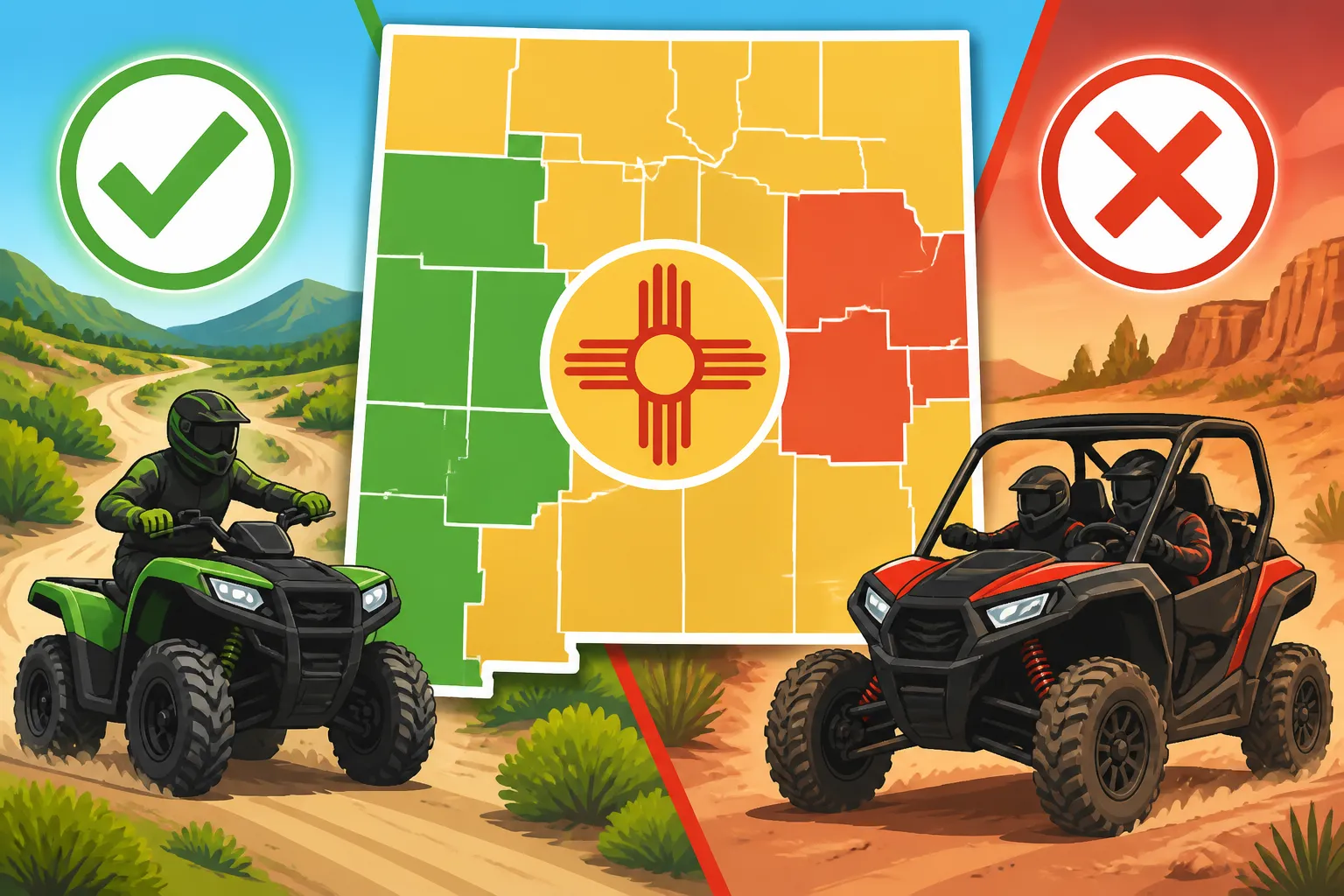
At its core, New Mexico law generally prohibits OHVs from operating on paved public roads. This isn't just some arbitrary rule; it's a foundational principle designed with safety and vehicle capabilities in mind. However, the state also wisely recognized that local communities have diverse needs and desires. This led to an "opt-in" system, which essentially means that while the default is "no," local governments (counties and municipalities) have the power to say "yes" to OHV access on the roads they control.
This system validates a common frustration: you might be riding perfectly legally on one stretch of asphalt, only to cross an invisible boundary into a jurisdiction that hasn't opted in, suddenly making you an scofflaw. It puts the onus on the rider to know the local rules, which can feel unfair when all you want to do is get from Point A to Point B. But from a governmental perspective, it allows for flexibility, letting communities decide what works best for their residents, local businesses, and specific traffic conditions.
The Fundamental Difference: State vs. Local Jurisdiction
The key to understanding this "patchwork quilt" is recognizing the different layers of governmental authority over roads. New Mexico's state highway system, which includes major arteries like U.S. Highways and designated New Mexico State Routes, falls under the jurisdiction of the New Mexico Department of Transportation. These are the roads that connect our cities and towns across vast distances, often carrying significant volumes of high-speed traffic. When it comes to OHVs, the state highway system generally remains off-limits for continuous travel, with very limited exceptions for [New Mexico's Perpendicular Crossing Rule].
In stark contrast, county roads are, as their name suggests, owned and maintained by the individual counties themselves. These roads often serve rural communities, connect smaller towns, provide access to ranches, or link up with public lands. Because these roads serve a different purpose and often see lower traffic volumes and speeds, counties are given the autonomy to decide whether to open them to OHVs. This distinction is crucial: a county commission opening its roads has absolutely no authority over a state highway that runs through its territory. So, even if you're in a county that has fully embraced OHV access, hitting a state highway will almost always mean you need to get off the pavement, or at least cross it safely and legally. Riders often feel frustrated by this disconnect, but it's a clear legal boundary that protects the integrity and safety of the state's main transportation network.
How Counties Exercise Their Authority
It might seem like a simple decision for a county to open its roads, but there's actually a significant process and a lot of factors that go into it. It's not just a flip of a switch; it involves careful consideration and community input. Understanding this process can help riders appreciate why some counties are more open to OHVs than others.
The Resolution Process for Opening County Roads
When a county decides to permit OHVs on its roads, it typically does so through a formal process involving a resolution or an ordinance. This isn't something that happens overnight or on a whim. Usually, it begins with local residents, businesses, or OHV clubs advocating for access, highlighting potential benefits like increased tourism, easier access to recreational areas, or practical transportation for agricultural purposes.
The county commission will then typically hold public meetings, inviting citizens to voice their opinions, both for and against the proposed changes. They'll hear from law enforcement about safety concerns, from local businesses about economic impacts, and from property owners about potential noise or dust issues. After gathering all this input, and often after several rounds of discussion and revisions, the commission will vote on a formal resolution. This document will specifically outline which roads are open, any restrictions (like speed limits or specific hours), and the types of OHVs permitted. This detailed and often lengthy process is precisely why you see such varied approaches across New Mexico – each county weighs its unique circumstances and community values differently. This is why [When a County Uses a Resolution to Open Roads] is a key step.
Factors Influencing a County's Decision
Several factors play a significant role in whether a county opts to open its roads to OHVs. Economic development is a huge one; many rural counties recognize the potential for increased tourism dollars from OHV enthusiasts who visit, stay in local hotels, eat at restaurants, and buy supplies. For these communities, allowing OHV access on county roads can be a direct pipeline to local businesses, encouraging riders to explore more of what the area has to offer.
Safety concerns are, of course, paramount. County officials must weigh the benefits against the potential risks to public safety. This involves looking at traffic volumes, road conditions, the presence of schools or residential areas, and the capacity of local law enforcement to monitor compliance. Counties with high traffic or narrow, winding roads might be more hesitant than those with wide-open, lightly used routes. Local culture and existing land use also come into play; a county with a strong agricultural base might view OHVs as essential farm implements, making access a practical necessity, whereas a more urbanized county might see them primarily as recreational vehicles with associated noise and safety concerns. This complex interplay of factors is why you can find yourself in a county like Sierra, which has largely embraced OHV access on its county roads, right next to another county that maintains a much stricter stance.
The Practical Implications for Riders
Navigating New Mexico's varied road rules for OHVs can feel like deciphering an ancient map. One minute you're legally cruising, the next you might be facing a citation. This section dives into what these localized decisions truly mean for you on the ground and how you can stay on the right side of the law.
What "County Roads Only" Really Means on the Ground
When a county opens its roads to OHVs, it's fantastic news for riders looking to connect trails, access remote areas, or simply enjoy a scenic drive. However, the phrase "county roads only" carries a significant practical weight that often catches riders off guard. It means precisely that: only the roads designated as county roads by that specific county are open. The moment your tires touch a state highway (identified by a US or NM route number), a city street (unless the city has also opted in, which is a separate, equally complex process), or federal land roads with their own rules, you might be in violation.
Imagine you're riding a beautiful gravel county road near Truth or Consequences, enjoying the views. You come to a crossroads, and one of the options is a paved road marked "NM-152." Even if the county has opened all its roads, NM-152 is a state highway, and your recreational OHV generally cannot travel on it, except to cross it at a ninety-degree angle when safe. This creates a real challenge for riders who might want to use paved roads to link different trail systems or simply to reach a gas station. It demands constant vigilance and a clear understanding of road signage. The frustration is real when you feel hemmed in by invisible lines, but knowing these distinctions is crucial to avoid [New Mexico Fines for an OHV Violation].
Navigating the Rules: Researching Before You Ride
Given the fragmented nature of OHV road access, your best defense against inadvertently breaking the law is proactive research. You simply cannot assume that because one county has open roads, its neighbor will too. Before you even trailer your machine to a new area, take the time to investigate the local ordinances.
Start by checking the official website of the county you plan to ride in. Many counties will publish their OHV ordinances or resolutions online. If you can't find it there, a call to the county clerk's office, the local sheriff's department, or even a regional tourism office can often yield the necessary information. Online mapping tools can also be invaluable for identifying state highways versus county roads, helping you plan routes that stick to legal territory. Look for resources that explain [New Mexico Rules for Riding a County Road] or [New Mexico Rules for Riding a City Street] in specific areas. It’s also wise to inquire about any temporary closures or restrictions, as fire danger or road construction can change access rules quickly. A little homework upfront can save you a lot of hassle and potential penalties down the trail.
Safety, Equipment, and Local Ordinances
Even when you're riding legally on a county road, there are still rules of the road – and of safety – that apply. New Mexico has specific requirements for OHVs operating on any paved surface, and local ordinances can add further layers of detail. It’s not just about where you can ride, but how you ride and what you ride.
Essential Gear and Insurance for Paved Road Use
When a county road is opened for OHV use, your machine isn't just an off-road vehicle anymore; it's sharing the pavement with cars and trucks. This shift in environment brings with it mandatory safety and equipment requirements that often mirror those for conventional vehicles. In New Mexico, if you're riding on a paved road, even a county one, you'll need to meet certain standards. This includes displaying a valid [New Mexico's Yellow and Green Decals], having adequate headlights and taillights for visibility, and often mirrors to see traffic behind you.
Furthermore, [New Mexico ATV Insurance Requirement] mandates that any OHV operating on a paved public road must carry liability insurance, just like a car. This is a critical point that many riders overlook, potentially leading to significant legal and financial consequences in the event of an accident. Making sure your UTV or ATV is equipped for paved road use means having the right mirrors and lights. Companies like SuperATV offer a wide range of accessories, from durable side mirrors to high-intensity LED light bars, to help you meet these requirements, ensuring you're visible and safe, whether you're cruising on a county road or just crossing a highway. Don't forget [New Mexico Helmet Law for ATV Riders] for those under 18, and eye protection for everyone on pavement. These aren't suggestions; they're legal obligations designed to protect you and others.
Specific County Examples and Their Unique Rules
New Mexico offers a fascinating case study in localized OHV governance, with several counties adopting different approaches. For instance, [Sierra County's Open County Roads] stands out as a beacon for many riders, having opened nearly all of its county roads to OHVs. This has created a robust network for exploring the Black Range, connecting small towns, and accessing vast stretches of public land. However, even in Sierra County, you still can't just jump on US-180 or NM-52.
In contrast, other counties, while perhaps not as widely open as Sierra, have specific ordinances in place. For example, [Eddy County Ordinance O-18-95] might designate certain roads in specific areas for OHV use, perhaps to connect residential areas to trailheads, or to allow access around particular oil and gas fields for local workers. Similarly, [Otero County's OHV Ordinance] might detail specific restrictions, such as speed limits lower than the posted car limit, or restrict OHV use to daylight hours only. For those riding in counties like Sierra, where many roads are open, ensuring your machine is properly equipped is key. Investing in robust turn signals or a good horn from a brand like SuperATV can make all the difference in navigating shared roads safely. These variations underscore the absolute necessity of checking the local rules for your specific destination. A general understanding isn't enough; you need the specifics to ensure a legal and enjoyable ride.
| Feature / County Approach | Sierra County (Example) | Eddy County (Example) | Urbanized County (Example) |
|---|---|---|---|
| Paved County Roads Open | Most county roads open | Select county roads open | Few to no county roads open |
| Resolution Type | Broad ordinance | Specific road list | Rarely, limited exceptions |
| Primary Driver | Tourism, rural access | Industry, some recreation | Public safety, traffic |
| Key Restrictions | State highways remain closed | Specific hours, speed limits | Total bans, crossing only |
| Rider Experience | Generally positive, requires knowledge of state highways | Requires precise route planning, knowledge of specific open roads | Highly restrictive, mainly off-road |
| Local Economy Impact | Positive for OHV-related businesses | Mixed, depends on specific access | Minimal |
The "Why": Benefits and Challenges of Local Control
Understanding that counties open only their own streets is one thing, but understanding why this system exists and its inherent benefits and challenges offers a fuller picture. It's a balance between local autonomy and the need for some statewide consistency.
The Advantages for Local Communities and Riders
The primary advantage of this localized control is that it allows individual counties to tailor OHV regulations to their unique geographic, economic, and social landscapes. New Mexico is incredibly diverse, from the high desert mesas of the north to the ranchlands of the south and the mountainous regions in between. A one-size-fits-all approach from the state would inevitably be a poor fit for many areas. Instead, counties can foster specific types of recreation or support local industries more effectively. For example, a rural county that relies heavily on agricultural operations might prioritize OHV access for ranching and farming, allowing machines to be used practically to connect fields or check fences. Meanwhile, a county boasting extensive public lands might open its roads to connect trailheads and allow riders to reach more remote areas, boosting tourism and local businesses. This allows for a more direct relationship between riders and local government, where community input can genuinely shape policy. It encourages residents and visitors to engage with their county commissioners, making their voices heard about the recreational and economic value of OHV use. This localized approach allows for programs like [New Mexico's Paved Street Opt-In] to truly serve the needs of the community.
The Downsides: Confusion and Inconsistency
While local control has its benefits, it undeniably comes with significant challenges, especially for riders. The most prominent downside is the sheer confusion and inconsistency it creates. Imagine planning a multi-county riding trip only to discover that the rules change every time you cross a county line. What was legal and encouraged in Sierra County might be strictly prohibited just a few miles down the road in an adjacent county that hasn't opted in. This fragmented regulatory environment can lead to inadvertent violations, even for well-meaning riders who are trying their best to comply.
The lack of a unified statewide approach means riders must constantly be vigilant, checking maps, researching local ordinances, and looking for specific signage. This can be time-consuming and detract from the enjoyment of a ride. Furthermore, it places a heavy burden on riders to become amateur legal scholars of every county they might pass through. This inconsistency can be a barrier to entry for new riders and a source of perpetual frustration for experienced ones. Ultimately, while the system aims to serve local needs, it often complicates the overall riding experience, highlighting the importance of thorough preparation to avoid issues like [New Mexico Fines for No OHV Permit] or [New Mexico Fines for an Unregistered OHV].
Disclaimer
This article is for general informational purposes only and does not constitute professional advice. Laws, prices and regulations vary by location and change over time. Consult a qualified professional for guidance on your specific situation.