New Mexico Rules for Riding a City Street
There's a special thrill that comes with owning an ATV or UTV in New Mexico. The wide-open spaces call to you, promising adventure on dusty trails and rugged terrain. But what happens when that trail ends and you need to navigate through a town, or perhaps even ride down a city street to get to your favorite coffee shop or back to your lodging? This can be a huge headache for many riders who just want to understand the rules without getting a ticket. This guide is here to untangle the complexities of riding your off-highway vehicle (OHV) on city streets in the Land of Enchantment, explaining what's allowed, what's definitely not, and what you need to do to stay on the right side of the law.
The Reality of City Street Riding in New Mexico
It's a common misconception that if a county opens its roads to OHVs, then all the towns and cities within that county are automatically open too. Oh, how we wish it were that simple! The truth is, riding your ATV or UTV on city streets in New Mexico isn't a given; it's a privilege that comes with specific conditions and local regulations. The state law provides a framework, but it's the individual municipalities that hold the ultimate power to decide if, and how, OHVs can operate within their city limits.
Why City Streets Are Different from County Roads
Imagine a vast, open county with miles of unpaved roads perfect for exploring. A county commission might pass an ordinance opening all or most of those roads to OHVs, recognizing the recreational and economic benefits. This is fantastic news for riders! However, when you cross that invisible line into an incorporated city or town, you're entering a different jurisdiction entirely. Cities have their own governing bodies, their own concerns about traffic, pedestrian safety, noise, and infrastructure wear and tear.
These municipal governments have the authority to enact their own ordinances, which can be much stricter than county rules, or even prohibit OHV use entirely on their paved streets. This creates a patchwork of regulations across the state, making it crucial for riders to understand that a "street legal" OHV in one area might be completely illegal just a few miles down the road in the next town. It’s a frustrating reality for riders who travel across the state, trying to keep track of every local nuance.
The "Opt-In" System and Its Limitations
New Mexico law outlines an "opt-in" process for municipalities. This means that a city or town must actively pass an ordinance to allow OHVs on its paved streets. It's not an automatic right. This ordinance will specify which streets are open, if any, and often include limitations on things like hours of operation, speed limits, or even the types of OHVs permitted. For example, some towns might open certain collector streets but prohibit OHVs on their main thoroughfares or state highways that pass through town.
The "opt-in" system is designed to give local control, which makes sense from a governance perspective, but it places the burden squarely on the rider to do their homework. You can't just assume. If you're heading to a specific town and plan to use your OHV on its streets, you need to check that town's specific ordinances beforehand. This often means a quick call to the city clerk's office or checking the municipality's official website. It's not the most glamorous part of planning a ride, but it's absolutely essential to avoid a costly fine or, worse, having your machine impounded.
What Happens if a City Hasn't Opted In?
If a city or town has not passed an ordinance explicitly allowing OHVs on its paved streets, then the general state prohibition remains in effect. This means that riding your ATV or UTV on those city streets is illegal. The consequences for violating these rules can be significant. You could face fines, which vary by municipality but can be substantial. Beyond a simple citation, your vehicle could be impounded, leading to towing fees, storage fees, and the hassle of retrieving your machine.
Consider a scenario where you've been riding all day on wide-open BLM land and decide to head into the nearest town for gas and a burger. You see other vehicles on the road, so you assume it's okay. But if that town hasn't "opted in," you could be breaking the law the moment your tires hit the paved street. The fines for an unregistered or illegally operated OHV can really put a damper on your adventure, especially if you also don't have the necessary decals. [New Mexico Fines for an Unregistered OHV] can certainly be a wake-up call. It's a stark reminder that even in off-road friendly New Mexico, specific rules apply when asphalt enters the picture.
Navigating the Legal Requirements for City Street Use
Even if a city has opted in and opened its streets to OHVs, you can't just hop on and ride. There's a specific set of state-level requirements that your machine and you, as the operator, must meet. These aren't suggestions; they're legal mandates designed to ensure safety and accountability when an OHV shares the road with traditional vehicles.
The Mandatory Paved Road Plate and Green Decal
To legally operate your OHV on any public paved road in New Mexico—including city streets that have opted in—your machine must be properly registered for that purpose. This means you need a specific paved road plate, along with the correct decal. While New Mexico used to have a separate sticker program, the law has evolved. Now, for any paved road use, you'll need an actual license plate for your OHV.
Alongside this, your machine must display the current New Mexico green on- and off-highway decal. This decal signifies that your OHV is registered for both off-road and paved road use, differentiating it from machines only registered for off-road trails, which would bear a yellow decal. The green decal is your visual proof that your machine is compliant for road use, alongside the plate. Understanding [New Mexico's Green On and Off-Highway Decal] is key here, as it's the mark of a properly equipped machine for paved surfaces. Without both the plate and the decal, even if the city's streets are open, you're not legal.
Insurance, Driver's License, and Age Requirements
Riding on city streets means you're sharing the road with cars, trucks, and motorcycles. Because of this, the state of New Mexico requires you to have adequate liability insurance for your OHV, just as you would for any other motor vehicle on public roads. This isn't optional; it's a legal necessity to protect yourself and others in case of an accident. Make sure your insurance card is always with you when riding on pavement. For more details on what's required, check out [New Mexico ATV Insurance Requirement].
Furthermore, to operate an OHV on a paved public road in an "opted-in" city, you must possess a valid driver's license. This means a standard automobile driver's license, not just an OHV safety permit. The state wants to ensure that anyone operating a vehicle on its paved roads has demonstrated a basic understanding of traffic laws and safe driving practices. This is a critical point, especially for younger riders.
Regarding age, New Mexico has specific rules for minors. While a driver's license covers the operator requirement for adults, riders under the age of 18 have additional stipulations. For example, a rider under 18 generally cannot carry a passenger on a public paved road. There are also minimum age requirements for operating OHVs in general, regardless of whether it's on a street or trail. It’s always best to verify [New Mexico Driver's License Rules for OHVs] to ensure every member of your riding party meets the legal criteria.
Essential Equipment for City Road Use
Your OHV might be a beast on the trail, but for city street use, it needs to be equipped more like a traditional motor vehicle. New Mexico law specifies certain equipment requirements for OHVs operating on paved roads. These typically include:
- Headlights and Taillights: You'll need at least one headlight that illuminates objects at 150 feet and at least one taillight visible from 200 feet. This isn't just for night riding; it's a safety measure for visibility at all times, especially in traffic. Many stock OHV lights are sufficient, but if you've done any custom work or bought an older machine, double-check their effectiveness.
- Brakes: Your OHV must have fully functioning brakes, capable of stopping the machine safely. This might seem obvious, but proper maintenance is key.
- Mirrors: You'll need at least one rear-view mirror to see traffic behind you. Many aftermarket mirrors attach easily to roll cages or handlebars.
- Muffler and Spark Arrester: While important off-road, on city streets, noise becomes even more of a concern. Your exhaust system must be equipped with a muffler that keeps sound levels below 96 decibels. It also needs a spark arrester, especially if you're transitioning from public lands that require them.
- Horn: A working horn is necessary to alert other drivers or pedestrians to your presence.
These requirements ensure that your OHV can safely integrate with regular traffic. If you're looking to upgrade or add any of these components to meet street legal standards, companies like SuperATV offer a wide range of accessories, from mirrors and turn signal kits to DOT-approved tires, that can help you get your machine compliant. It's about making sure your machine is not just capable, but also safe and visible for city environments. [New Mexico Equipment Rules for Road Use] provides a thorough breakdown of what's expected.
Practical Advice for Riding in Opened City Streets
So, you've done your homework, found a city that welcomes OHVs on its streets, and your machine is fully compliant with all the state-mandated equipment, registration, and insurance. Fantastic! But the journey isn't over yet. Riding an OHV on city streets presents a unique set of challenges and demands a different mindset than tearing up a dirt trail.
Understanding Local Ordinances and Signage
Even when a city has "opted in," it rarely means all streets are open all the time. Local ordinances can be quite specific. They might designate certain streets as OHV-friendly while prohibiting them on others, particularly busy main arteries or state highways that pass through town. There could be time restrictions, like a curfew after dark or specific hours of operation. Some towns might even limit the types of OHVs allowed, permitting UTVs but not ATVs, for instance.
Take a town like Red River, for example. They have a specific ordinance, [Red River Ordinance 2000-5], which allows certain side-by-sides (ROVs) on designated town streets during specific hours, but generally bans traditional ATVs from those same streets. This is a prime example of how local rules can be nuanced. Always look for signage when entering a town. Often, cities that allow OHVs will have clear signs indicating designated routes or restrictions. If you don't see any signs, proceed with extreme caution and assume OHV use is restricted until you can verify otherwise. When in doubt, it's always better to park and walk or trailer your machine.
Safe Riding Practices on Paved Surfaces
Riding an OHV on pavement is fundamentally different from riding off-road. The traction is different, the turning radius feels different, and the presence of other vehicles, pedestrians, and cyclists adds layers of complexity. Here are some critical safety tips:
- Respect Speed Limits: City speed limits are there for a reason. OHVs often have a higher center of gravity and are not designed for high-speed cornering on asphalt. Slow down, especially on turns and when approaching intersections.
- Watch for Traffic: Always be hyper-aware of your surroundings. Use your mirrors frequently, signal your turns clearly, and be prepared for sudden stops or changes in traffic flow. Remember, many drivers of traditional vehicles aren't expecting to see an OHV on city streets.
- Maintain Proper Following Distance: Give yourself plenty of space between your OHV and the vehicle in front of you. OHV brakes can behave differently on pavement than on dirt.
- Tire Pressure Matters: While you might air down your tires for maximum traction on trails, for paved road use, ensure your tires are inflated to the manufacturer's recommended pressure for street driving. This will improve handling and tire longevity. You can find robust, DOT-approved tires from brands like SuperATV that are designed for both on- and off-road use, giving you the best of both worlds.
- Wear Safety Gear: Even if a helmet isn't strictly required for adults on pavement by state law (though [New Mexico Helmet Law for ATV Riders] outlines rules for minors), it's always a good idea. Eye protection is generally a must to shield against dust, debris, and glare.
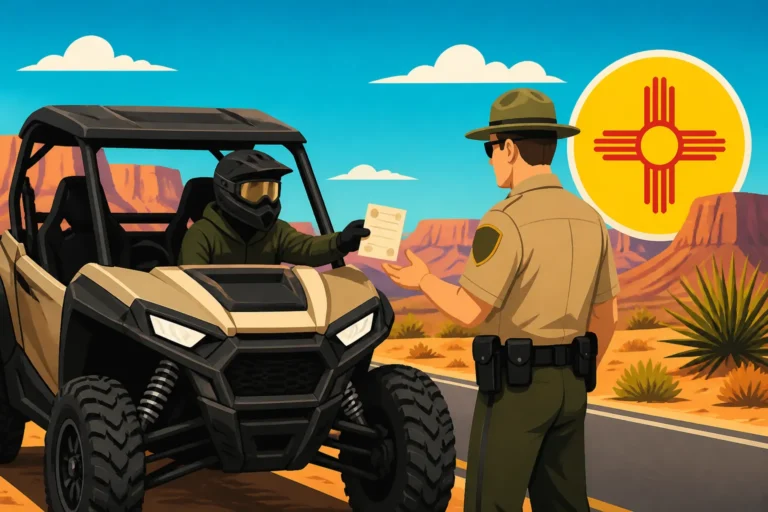
What to Do in Case of a Roadside Stop
No one wants to be pulled over, but if it happens, knowing how to react can make a big difference. Law enforcement officers are just doing their job, and a calm, cooperative attitude is always best.
- Pull Over Safely: As soon as you can, find a safe spot to pull your OHV over to the side of the road. Use your signals.
- Remain Calm and Respectful: Keep your hands visible, ideally on the steering wheel or handlebars. Avoid any sudden movements.
- Provide Documentation: The officer will likely ask for your driver's license, proof of insurance, and your OHV registration. Have these readily accessible. This is where your diligent preparation with your paved road plate and green decal pays off. If you're a nonresident, you'll also need your valid OHV permit.
- Answer Questions Truthfully: If asked where you're coming from or going, answer honestly. If you're unsure about a specific rule, it's okay to say so, but avoid arguing.
- Know Your Rights: While cooperating, you also have rights. If you feel a search is unwarranted, you can politely state that you do not consent to a search.
The best way to handle a roadside stop is to prevent it by being fully compliant with all state and local laws. Always make sure your registration is current, your insurance is valid, and all your required equipment is in working order. Being prepared allows you to ride with confidence and peace of mind on those New Mexico city streets that welcome your OHV.
| Requirement Area | Off-Road (Trails, BLM, Forest Roads) | City Street (Opted-In Municipalities) |
|---|---|---|
| Registration/Decal | New Mexico OHV Registration (Yellow or Green Decal) | New Mexico OHV Paved Road Plate & Green Decal (mandatory) |
| Local Authority | State/Federal land management rules, county ordinances for county roads | Specific City Ordinance (Opt-In Required) |
| Driver's License | Not always required for adults off-road | Required (standard auto driver's license) |
| Insurance | Not generally required for off-road (though highly recommended) | Required (liability insurance) |
| Headlights | Required for night riding | Required (functional, visible 150 ft) |
| Taillights | Required for night riding | Required (functional, visible 200 ft) |
| Mirrors | Not typically required | Required (at least one rear-view) |
| Brakes | Required | Required (functional) |
| Horn | Not typically required | Required |
| Muffler/Sound | Required, spark arrester for public lands | Required (below 96 dB), spark arrester |
| Helmet | Required for under 18 | Required for under 18 (recommended for all) |
| Eye Protection | Recommended for all | Required for all on pavement |
| Passenger Rules | Varies by age/machine | Stricter rules for minors, often no minor passengers on pavement |
Disclaimer
This article is for general informational purposes only and does not constitute professional advice. Laws, prices and regulations vary by location and change over time. Consult a qualified professional for guidance on your specific situation.