How a Motorcycle Endorsement Changes the Rules for Teens
A teen’s motorcycle endorsement can affect whether they need a separate New Mexico OHV safety permit, but it does not make every ATV or UTV rule disappear. The key is knowing what the endorsement covers, what documents the rider still needs, and which age-based restrictions continue to apply. Sorting that out before a ride can prevent a confusing roadside stop.
What the motorcycle endorsement changes
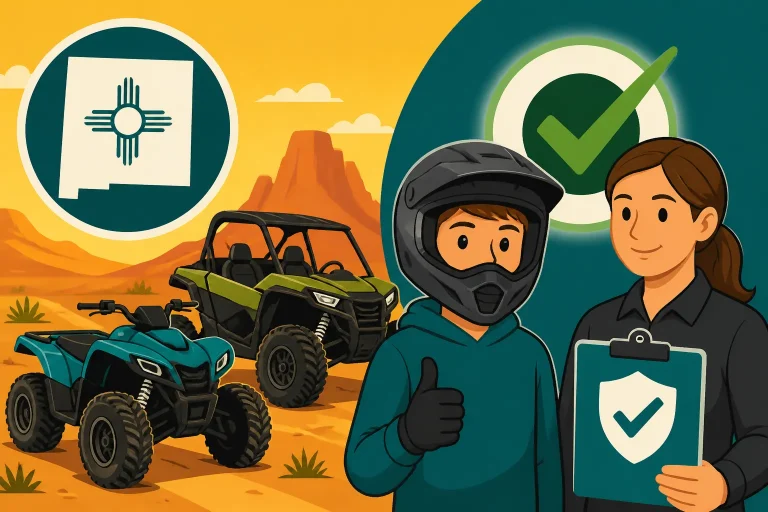
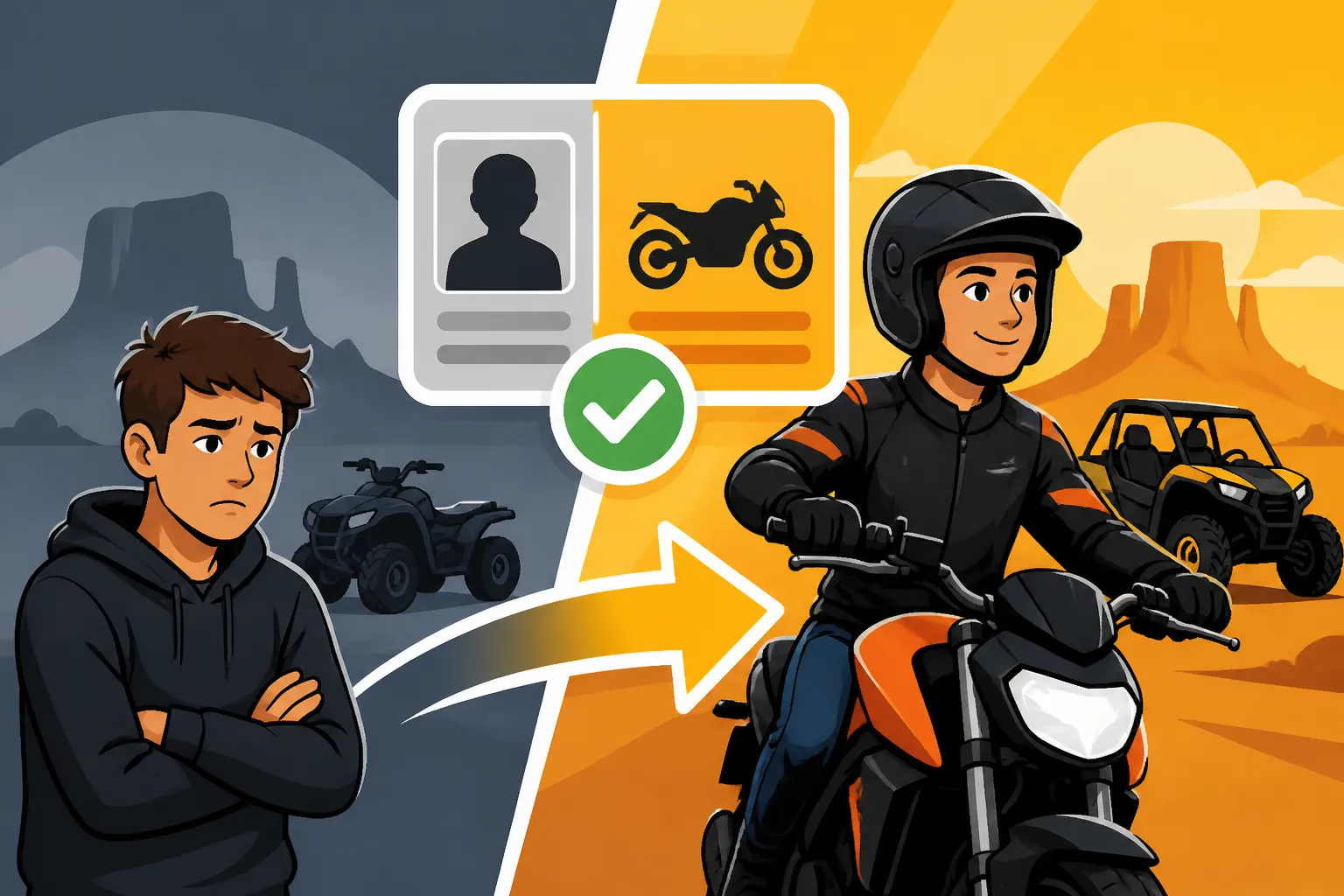
New Mexico generally requires an OHV safety permit for riders under 18. A teen who holds a valid driver’s license with a motorcycle endorsement may qualify for an exception to that separate safety-permit requirement. The endorsement matters because it is more than a standard driver’s license: it indicates motorcycle authorization on the license.
That distinction is important. A regular driver’s license, learner’s permit or provisional license should not be treated as equivalent to a motorcycle endorsement. If the teen does not have the endorsement, the safer assumption is that they need to meet the under-18 OHV safety-permit requirement. Review New Mexico’s Safety Permit for Under-18 Riders and New Mexico OHV Safety Permit Requirements for the general rule and the steps for meeting it.
The endorsement exception is about the rider’s safety-permit requirement. It does not register the ATV or UTV, supply a nonresident OHV permit, grant access to a trail or authorize road use. Those are separate questions, and a teen may need to satisfy several requirements at once.
| Document or qualification | What it generally addresses | Does a motorcycle endorsement replace it? |
|---|---|---|
| Motorcycle endorsement on a valid driver’s license | May qualify a teen for an exception to the separate OHV safety-permit requirement | It is the qualifying credential for that exception |
| OHV safety permit | Rider’s OHV safety requirement when no exception applies | May not be needed if the teen qualifies for the endorsement exception |
| OHV registration or nonresident permit | The machine’s legal status for riding where required | No |
| Land access permission or route authorization | Whether and where the machine may be ridden | No |
| Road-use requirements | Whether a particular roadway is open to that type of OHV and rider | No |
The endorsement is not a general “all clear.” It does not turn an off-highway machine into a street-legal vehicle, and it does not mean the teen can ride any route or public land without checking the rules. Think of it as one part of the rider’s paperwork, not a substitute for the machine’s paperwork or the land manager’s requirements.
Endorsement versus motorcycle experience
A teen may have considerable experience riding a dirt bike, or may have completed a motorcycle course, without holding a motorcycle endorsement on a valid license. Experience and course completion can be valuable, but they are not automatically the same as the credential named in an exemption.
Likewise, an endorsement on a license should be current and easy to verify. If the teen has a temporary document, a restricted license or paperwork that does not clearly show the endorsement, confirm with the appropriate New Mexico authority before relying on the exception. A course card or an application receipt may not prove that the license itself carries the required endorsement.
For details about younger riders and the endorsement question, see Can a 13-Year-Old With a Motorcycle License Ride? and Can a 15-Year-Old Driver Skip the Safety Permit?. Those questions turn on the rider’s exact age and credential, not simply on whether the teen has ridden before.
What the endorsement does not replace
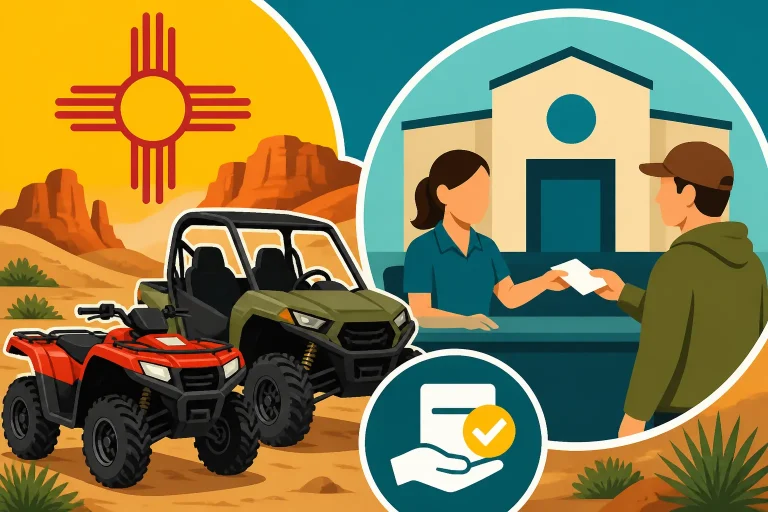
A motorcycle endorsement does not cover the machine. New Mexico’s rider-focused safety requirement and the machine’s registration or permit are separate. If the ATV or UTV needs New Mexico registration, a valid out-of-state registration or a nonresident OHV permit for the planned ride, the teen still needs the applicable proof for that machine.
This is particularly easy to overlook when the machine belongs to a parent, is borrowed from a friend or is rented. The rider’s endorsement does not automatically make the machine’s paperwork current. Before leaving, check what document applies to the vehicle and whether it is accepted for the place you plan to ride. For visitors, New Mexico OHV Reciprocity Rules explains why an out-of-state registration may count in some cases, while a rider from a state without an accepted OHV program may need a New Mexico permit.
The endorsement also does not grant land access. Public land can have route restrictions, seasonal closures and equipment requirements. Private property requires permission from the owner, and some land has its own access rules. A teen with every required rider document can still be riding somewhere they are not allowed to go.
It does not make an ATV or UTV street legal, either. An endorsement is not a paved-road permit or permission to use a city street, county road or highway. Road access depends on the specific road, the type of machine and the applicable equipment and insurance requirements. Even a short connection between two trails can have its own restrictions. See Street Legal ATVs in New Mexico: The Short Answer before planning a route that includes pavement.
Age rules still matter
An endorsement should not be read as a blanket exemption from every rule for minors. New Mexico has age-related requirements for OHV riders, and the rules can address supervision, helmets, passengers and where a young person may operate a machine. A motorcycle endorsement does not, by itself, prove that a teen meets every age-based condition.
This matters especially when a younger teen rides without a parent nearby, when a group plans to carry passengers, or when an adult assumes the endorsement allows the rider to operate independently. Check the specific rules for the teen’s age and riding situation. New Mexico Supervision Rules for Young Riders and New Mexico Rules for a Rider Under 13 address situations where the rider’s age changes what is allowed.
Do not infer an exception from one rule and apply it to another. A credential that may remove the need for a separate OHV safety permit does not necessarily remove supervision requirements, passenger limits or helmet rules. If the planned ride involves a minor, verify each issue separately rather than relying on the endorsement as a catch-all.
How to check whether the teen qualifies
Before a ride, confirm that the license actually meets the exception and that the teen has all other required documents. A quick check at home is easier than trying to resolve uncertainty at a trailhead.
- Check the rider’s age. Confirm which requirements apply to a rider under 18 and whether any additional restrictions depend on the teen’s specific age.
- Read the license itself. Look for a valid driver’s license with a motorcycle endorsement. Do not assume a standard license, learner’s permit or experience on a motorcycle is enough.
- Confirm the safety-permit status. If the teen does not clearly qualify for the endorsement exception, check the current New Mexico requirements and arrange the required safety training and permit before riding.
- Check the machine’s paperwork. Confirm whether the ATV or UTV needs New Mexico registration, an accepted out-of-state registration or a nonresident permit for that trip.
- Check the route and land rules. Make sure the route is open to that machine and rider, and confirm access permission where it is required.
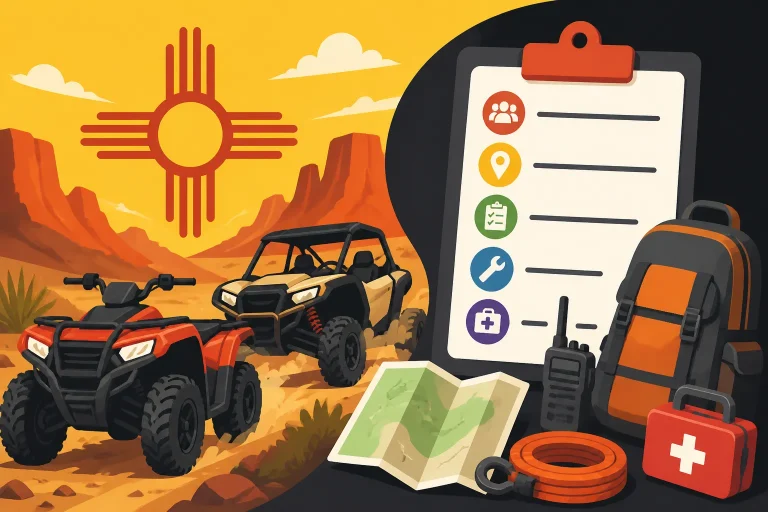
- Pack proof. Carry the teen’s license, machine paperwork and any required permit or safety document. If relying on an exception, having the endorsement visible on the license makes it easier to explain the basis for that decision.
For teens who do need the safety permit, do not leave the proof at home. The rider may need to show it during a check. Carrying the Safety Permit on a New Mexico Ride covers the practical question of what to bring.
A parent or trip organizer can also confirm the rule before departure, especially if a teen’s license status recently changed. If the endorsement has been added but the physical license has not arrived, ask whether the temporary documentation is sufficient rather than assuming it is. Keep the answer and the relevant paperwork together with the machine documents.
Common mistakes to avoid
The most common mix-up is treating “has a driver’s license” as the same thing as “has a motorcycle endorsement.” They are not interchangeable for this issue. A teen with an ordinary license should not assume the OHV safety-permit exception applies.
Another mistake is treating the endorsement as the machine’s permit. The license belongs to the rider; registration or a nonresident permit relates to the machine. If a family brings two machines, they should check the paperwork for each one rather than assuming the teen’s license covers both.
A third mistake is confusing permission to ride an OHV with permission to ride on pavement. Motorcycle licensing does not automatically authorize an ATV or UTV to use a public road. A route that briefly crosses a road may still be subject to separate rules, and a road that is open to one type of OHV may not be open to another.
Finally, do not assume a teen’s endorsement cancels age-based safety protections. Check the helmet, supervision and passenger rules that apply to the rider and the ride. If an adult is unsure whether the exception applies, the practical choice is to verify it with the relevant state authority before riding or ensure the teen has completed the OHV safety requirement.
The useful takeaway is narrow but important: a valid motorcycle endorsement may change whether a teen needs a separate New Mexico OHV safety permit. It does not replace the machine’s registration or permit, settle land access, authorize road riding or erase other rules for minors. Treat each requirement as its own check, and carry documents that make the answer clear.
Disclaimer
This article is for general informational purposes only and does not constitute professional advice. Laws, prices and regulations vary by location and change over time. Consult a qualified professional for guidance on your specific situation.