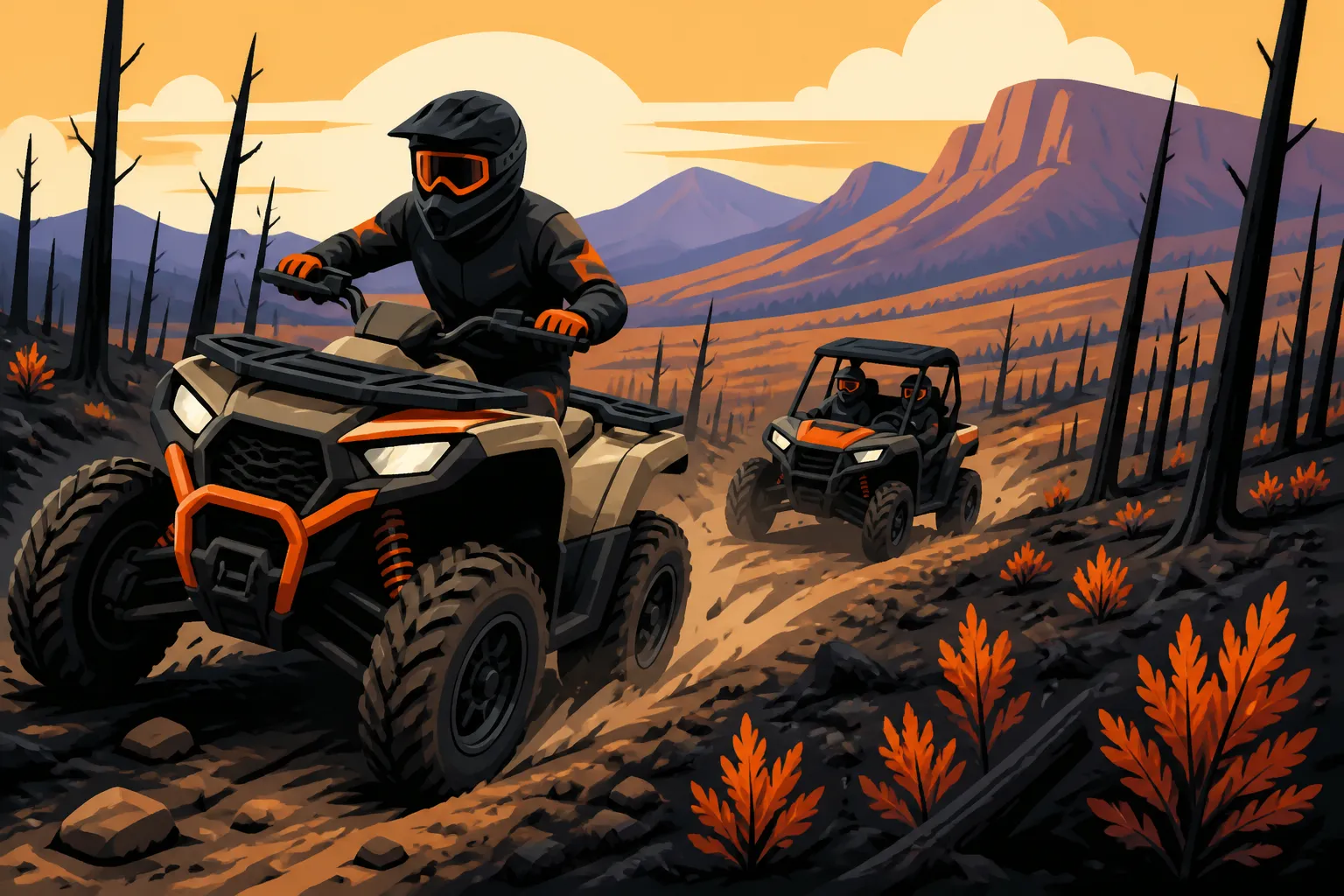
Riding a Burn Scar After a Fire
A trail that looks dry and rideable after a New Mexico wildfire can hide loose ash, weakened soil, falling trees, unstable slopes, and a closure boundary that is easy to miss. Riding a burn scar takes more than checking the weather or following a familiar track. This guide explains how to check access, read the terrain, and decide when to turn around.
Check whether the burn area is open
Confirm access before you leave
A burn scar is not automatically open or closed to ATV and UTV use. Restrictions may apply to a whole forest, a specific road or trail, or only part of a burned area. The responsible land manager may close routes during emergency response, rehabilitation, flooding, or hazardous-tree removal. A familiar trail on an older map does not prove that it is open today.
Start with the agency responsible for the land you plan to ride. In New Mexico, that may mean checking with the relevant national forest, Bureau of Land Management office, or other land manager. Look for current closure orders and maps, and make sure the order covers the exact area and route you intend to use. If the closure language is unclear, call the managing office before driving to the trailhead. The basics in New Mexico Trail Closures to Check First and [New Mexico Rules for Riding a Closed Road] are worth reviewing before a trip.
Mapping apps can help you understand where a trail appears to go, but an app’s route line is not permission to ride. I use onX Offroad as a planning aid to orient myself and compare a proposed route with surrounding terrain. I still check the land manager’s official closure information separately, because restrictions can change faster than a map layer.
Look beyond the trailhead sign
A closure may begin well away from the place where you unload. Access roads, connector trails, and staging areas can have separate rules, and a route might cross between different land jurisdictions. A trail that starts on public land could reach private, tribal, or state trust land where separate permission or permits apply. Do not assume that an open trail sign at one entrance settles the rules for every segment.
Before setting out, identify the route’s entry and exit points, nearby roads, and any alternative turnarounds. Compare that plan with current agency notices and signs at the trailhead. If a sign on the ground conflicts with an older map or your planned route, respect the sign and stop to clarify access. For a broader look at land-specific requirements, see Riding BLM Land in New Mexico and New Mexico Rules for Riding a Forest Road.
Understand what fire changes on the ground
Expect unstable soil and sudden washouts
Fire can remove vegetation and ground cover that would normally slow rainwater and help hold soil in place. Afterward, runoff may move faster and carry more sediment into gullies, washes, and low spots. A route that seems firm during a dry morning can become slick, deeply rutted, or washed out after a storm. Even modest rain can create problems on slopes where the soil has been exposed.
Treat fresh-looking channels and damaged trail edges as warning signs, not invitations to test the machine. Avoid riding through flowing water, across new washouts, or along a bank that has begun to crumble. Do not try to climb around a blocked or damaged section: the bypass can widen the disturbance, cross sensitive ground, or put you on an unauthorized route. If the trail no longer looks safe or clearly defined, turn around.
Monsoon weather makes this judgment especially important in New Mexico. Storms can develop quickly, and runoff may reach a wash even if rain is falling somewhere else. Before riding, consider the forecast across the whole drainage and the route back to your trailer, not just the sky above the staging area. New Mexico Riding in Summer Monsoon and Riding a Wash on State Trust Land offer useful background on why dry-looking channels and storm timing deserve caution.
Watch for hazards that are hard to see
Burned trees can be weakened even when they remain standing. Wind, vibration, and changing weather may bring down limbs or whole trunks, including beside roads that still look passable. Ash and loose debris can also hide rocks, holes, damaged culverts, and sharp branches. In shaded areas, a surface that seems dry may conceal soft mud or eroded ground.
Give unstable trees and steep slopes a wide berth. Do not park beneath dead branches, and avoid stopping where the ground above you could slide or shed debris. If you encounter a blocked route, do not squeeze through a narrow gap between a fallen tree and a slope; the obstacle may be concealing additional damage. Turn back or use an officially open alternative rather than creating a new line around it.
A simple comparison can help you decide what to do when conditions are uncertain:
| What you notice | Why it matters | Safer response |
|---|---|---|
| Fresh washout or deep rut | The trail surface may be undermined or unstable | Turn around rather than crossing or widening it |
| Standing water or flowing runoff | Water can hide holes and move loose soil | Do not ride through; wait or leave by a safe route |
| Leaning or burned trees beside the route | A tree or limb may fall without much warning | Keep distance and avoid stopping nearby |
| Unclear trail edge or missing markers | You may be entering a closed or unauthorized area | Stop, check the map and signs, and retreat if uncertain |
| New closure sign or barrier | Access may have changed since you planned the trip | Follow the restriction and check with the land manager |
Plan a lower-impact ride
Stay on established, open routes
The temptation to go around mud, a fallen tree, or a rough section is understandable—especially when you have driven a long way to ride. But repeated detours can turn a narrow trail into a wide scar, damage recovering soil, and make it harder for land managers to restore the area. In a burned landscape, the ground may be more vulnerable to tire disturbance than it appears.
Stay on routes that are both established and currently open. Do not create a bypass around a gate, closure, or damaged trail, and do not ride over rehabilitation markers, protective fencing, or planted areas. If a route is blocked, backtrack to a known junction instead of choosing an unmarked line across the hillside. New Mexico Trail Etiquette on Shared Ground is a helpful reminder that responsible riding includes leaving a route in a condition others can use without expanding its footprint.
If you are using onX Offroad to follow a planned track, treat the screen as a navigation aid rather than an instruction to continue at all costs. Compare your location with posted signs and visible trail conditions. Download the map information you need before losing cell service, and bring another way to navigate, such as a paper map or a GPS device. A phone battery failure or a confusing map boundary should never leave you feeling compelled to continue into uncertain terrain.
Choose timing and group size carefully
A route can be open but still be a poor choice for the day. Recent rain, forecast storms, high winds, or changing access notices can make a post-fire ride riskier. If the ground is wet and easily marked by tires, wait for better conditions. If wind is moving branches or pushing dust across exposed terrain, consider postponing the ride rather than pressing on.
Keep the group small enough that riders can communicate clearly and avoid bunching up near hazards. Agree on a turnaround rule before leaving: any rider can call a stop when the route appears unsafe, unclear, or closed. Share the planned route and expected return time with someone who is not on the ride. Carry water, basic recovery equipment, and a way to contact help that does not depend entirely on cellular coverage.
Before moving out, check that your vehicle and trailer are parked in a safe, legal staging area and that you are not blocking access for emergency or land-management crews. Pack out all trash, and leave gates as you found them unless posted instructions say otherwise. The aim is to enjoy the ride without making recovery work harder or adding damage to a landscape that is already trying to heal.
Know when to turn back
Use clear stop conditions
It is easy to second-guess a cautious decision when the trail looks almost passable. Agreeing in advance on specific reasons to turn around helps remove that pressure. A new closure sign, an unmarked route, a washout, unstable trees, active runoff, or a trail surface that is breaking apart are all sensible stop conditions. So is losing confidence in where the legal route continues.
A useful rule is to stop before the obstacle, not after you have committed to crossing it. Take a moment to check your location, compare the route with official information, and look for a safe way back. If there is no clearly open, stable path forward, retrace your route. Do not follow tire tracks just because another rider has passed through; their presence does not establish that a route is legal or safe.
Leave room for the landscape to recover
Burned areas change as rain, wind, and vegetation reshape the ground. A route that was passable on one visit may be damaged on the next, while a formerly closed area may later reopen under new conditions. Check access again before each ride instead of relying on a trip report or a map saved from a previous season. New Mexico Fire Season and Trail Closures explains why fire-related restrictions can affect riding plans, while New Mexico Fire Restrictions That Close Trails provides related context on closures and public-land access.
When you leave a burn scar undamaged, you help protect the route for future riders and give land managers a better chance to restore the area. Ride only where access is clear, adapt to the ground in front of you, and turn back when the signs point to risk. That approach may shorten a planned loop, but it is far better than getting stranded, injuring someone, or widening damage that will take time to heal.
Disclaimer
This article is for general informational purposes only and does not constitute professional advice. Laws, prices and regulations vary by location and change over time. Consult a qualified professional for guidance on your specific situation.