Bringing a Dog on a Summer Desert Ride
A summer ride near Alamogordo or Farmington can turn dangerous for a dog faster than it looks: hot ground, engine heat, dust, and long stretches without shade all add up. This guide helps you decide whether to bring your dog, how to reduce the risks, and what to check before choosing a New Mexico trail.
Decide Whether Your Dog Should Come
An ATV is usually a poor place for a dog
An ATV is designed for a rider, not a four-legged passenger. A dog perched on the seat or squeezed between a rider and the handlebars can lose footing when the machine jolts, turns, or stops suddenly. Even a calm dog may react to engine noise or a passing vehicle. A leash attached to the ATV is not a safe fix: it can catch, pull the dog, or interfere with the rider.
The safest choice is often to leave your dog at home with a trusted caregiver. If that is not workable, consider a shorter, dog-friendly outing that does not involve riding, or ask your veterinarian whether your dog is fit for the heat and physical demands of the trip. Age, breed, weight, health conditions, and how well the dog handles noise and travel all matter. A young, energetic dog is not automatically a safe riding companion, and a dog that seems relaxed in a parked vehicle may panic once the engine starts.
Do not improvise a carrier or restraint for an ATV. If you are considering any setup, get advice from a veterinarian and the equipment maker, and do not ride unless the dog can be safely contained without affecting your control of the machine. For practical trip planning, [New Mexico Riding Areas Good for Kids] is a reminder to assess the needs of every passenger or companion, not just the route itself.
A UTV still needs a dog-specific safety plan
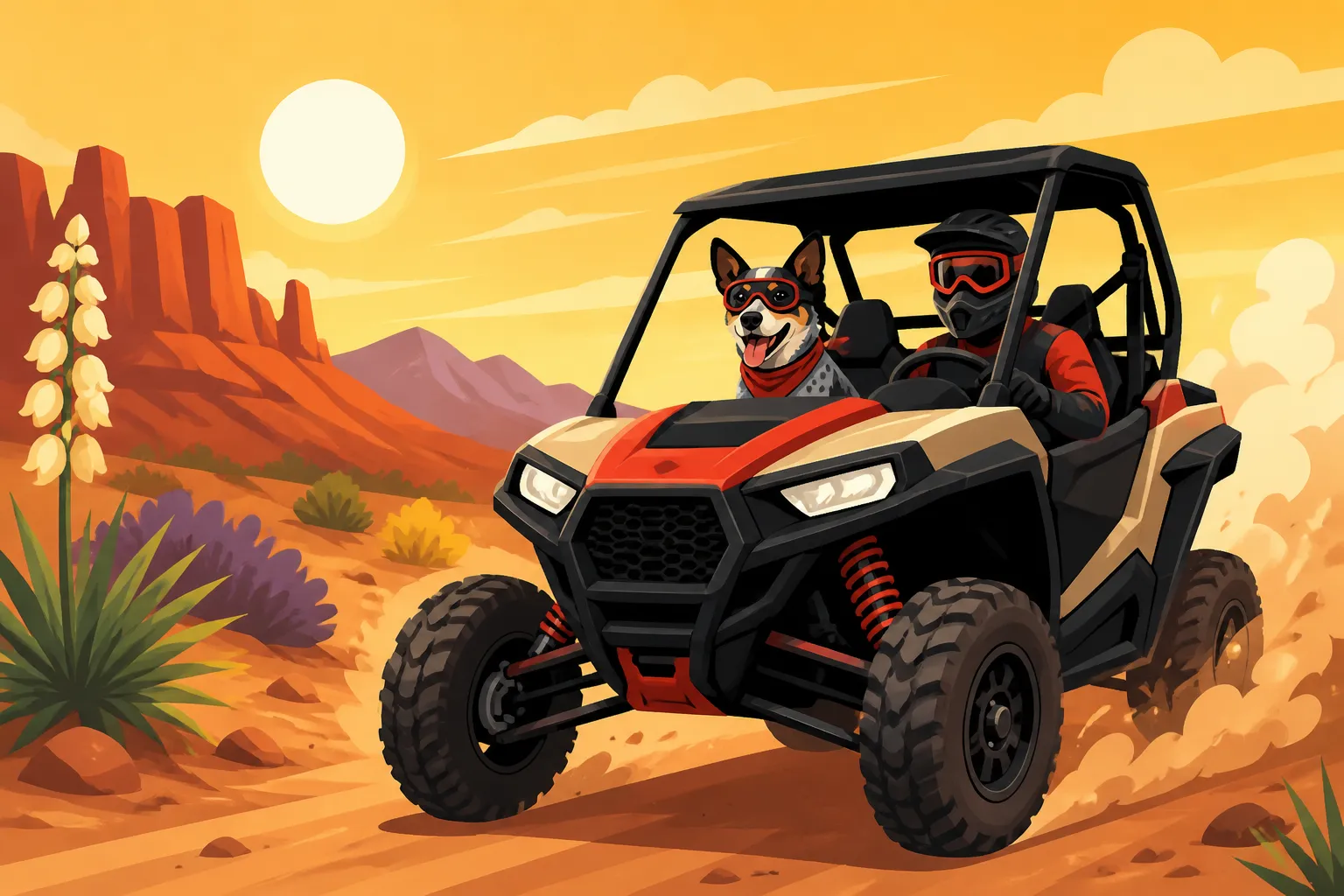
A side-by-side may offer more room than an ATV, but an open cab does not make it a safe space for a dog. A dog can fall out, jump toward wildlife, or move into the driver's footwell. Dust and flying debris can also irritate eyes and airways. A loose dog in the cab can distract the driver at exactly the moment precise steering is needed.
Use a secure, appropriately sized enclosure or restraint system designed for vehicle travel and suitable for the machine. It should be firmly attached to a structural point and keep the dog away from pedals, controls, and exposed edges. Never rely on a human seat belt looped around a dog's neck or abdomen, and never attach a tether to the outside of the machine. A dog should be able to sit or lie in a stable position without being able to reach the driver or jump out. If no safe arrangement is available, do not bring the dog on the ride.
Before you leave, let your dog explore the parked, switched-off UTV. Then try a brief, stationary engine-on session at a comfortable distance. If the dog trembles, pants heavily, tries to escape, or cannot settle, stop. Acclimation is not a guarantee of safety, but a dog that is already distressed before you move is giving you a clear reason to change plans.
Plan Around Heat, Water, and Trail Conditions
Choose the day and route with the dog in mind
New Mexico's summer heat can be especially unforgiving on exposed desert routes. A route that feels manageable to a rider in protective gear may be exhausting for a dog riding low in a warm cab. Shade can be scarce around places such as Red Sands in southern New Mexico, and a dog cannot tell you in words when it is becoming overheated. Plan for a short outing, start early, and be willing to turn around before the dog looks unwell.
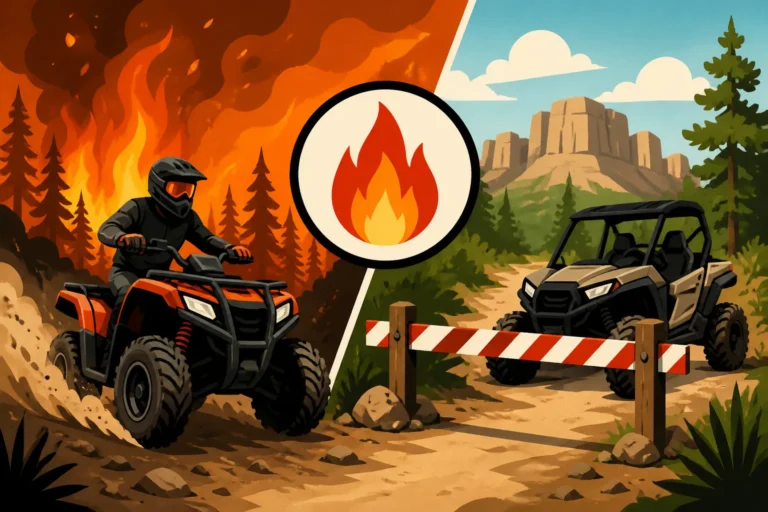
Check the forecast and the route conditions before setting out. Summer storms can bring lightning, sudden runoff, and flash flooding, including in washes that looked dry when you arrived. Read [New Mexico Riding in Summer Monsoon] and [Monsoon Afternoons and Flash Floods] before choosing a route during storm season. Avoid riding into an arroyo or low spot when rain is nearby, and do not assume a clear sky at the staging area means the whole route is safe.
Use a detailed map to understand distance, access points, and possible exits. onX Offroad can help you review route information and identify where a ride may become difficult to shorten. Still, a map is a planning tool, not confirmation that dogs are allowed on a particular parcel or that a road is open. Check the land manager's rules and local closures before you go. For a starting point on public-land riding, see [Red Sands OHV Area in Southern New Mexico] and [New Mexico Trail Closures to Check First].
Carry more water than you think you will need
Do not count on finding water at a staging area or along the route. Bring enough for the dog as well as the people in your group, and carry it in a container that is easy to access during breaks. Offer small, frequent drinks rather than waiting until the dog seems desperate. A collapsible bowl is useful, but it does not replace a dependable supply. Keep drinking water separate from fuel, cleaning products, and other chemicals.
Water is only one part of heat management. Plan shaded rest stops, but remember that a thin patch of shade may not cool a dog adequately. Never leave a dog unattended in a parked UTV, even with the windows or side openings unobstructed. A parked vehicle can heat up quickly, and a machine that has been running can have hot surfaces near where a dog might settle. If the route offers no reliable shade or a safe place to stop, choose another plan.
Dogs can overheat without having run a long distance. Watch for excessive panting, drooling, weakness, confusion, vomiting, or difficulty standing. If you see concerning signs, stop the ride, move the dog to a cooler shaded place, and seek veterinary help promptly. Do not make the dog continue because the group is close to the trailhead. [Carrying Water in the Southern Desert] and [New Mexico Riding Areas With No Water] are useful reminders to treat water access as a route-planning issue, not an afterthought.
Protect Paws, Eyes, and Breathing
Check the ground and the dog's condition often
Desert ground can be rough, sharp, and hot enough to injure paws. Even if your dog stays inside a UTV for most of the ride, it will need to get out for breaks. Check the surface before letting the dog walk on it. If you cannot comfortably keep your hand against the ground for several seconds, it may be too hot for paws. That simple check is not a precise safety test, but it can help you recognize when the surface is plainly uncomfortable.
Look for cuts, redness, limping, or repeated paw licking whenever you stop. Boots may help some dogs, but only if the dog has been introduced to them and they fit securely. Trying new boots for the first time at a remote trailhead can make a stressful day worse. Carry a basic pet first-aid kit, and know how you would get the dog back to the vehicle if it could not walk.
Plan regular breaks in safe, shaded places away from moving machines. Keep your dog close and under control around other riders, trailers, and wildlife. Do not let it wander into brush or rocks to cool off; snakes, cactus, and sharp debris can be difficult to spot in the desert. Read [Rattlesnakes at a Staging Area] and [New Mexico Trail Etiquette on Shared Ground] when considering how to manage a dog around other trail users and local hazards.
Reduce dust, noise, and flying debris
Dust is part of many OHV rides, and it can be uncomfortable for a dog even when the person driving feels protected. Leave space between vehicles, avoid following closely through a dust cloud, and stop if the dog's breathing or behavior changes. Do not assume that a dog sitting in a cab is protected from dust; an open-sided UTV can let plenty of fine material inside. If conditions are persistently dusty, shorten the ride or return to the staging area.
Eye protection and hearing protection made for people should not be treated as automatically suitable for dogs. Equipment that slips, blocks vision, or causes distress can create a new hazard. Ask your veterinarian about options for your particular dog, and test any protective gear at home before the trip. Pay attention to the noise level too. A dog that is shaking, hiding, or repeatedly trying to get out is not simply being stubborn; those behaviors may mean the environment is too intense.
onX Offroad may help you identify a route that avoids unnecessary backtracking or lets you plan a shorter loop, but no map can tell you how your dog is tolerating the ride. Check in at every stop. If the dog cannot settle, is struggling to breathe comfortably, or is showing signs of panic, end the ride rather than trying to push through.
Make a Practical Go or No-Go Decision
Use this checklist before loading up
A quick decision table can keep excitement from taking over the safety call. If you cannot answer the key questions confidently, make a different plan for your dog.
| Check | A safer plan looks like | Reconsider the ride if |
|---|---|---|
| Vehicle setup | Dog is secured in a suitable, stable enclosure or restraint | Dog would ride loose, on an ATV seat, or tethered outside |
| Weather | Conditions allow a short ride with shade and frequent stops | Heat, storms, or exposure make cooling and shelter uncertain |
| Water | You can carry enough water for the dog and group | You are relying on a tap or stream being available |
| Route | You have checked access rules, closures, and exit options | You do not know whether dogs are allowed or how to shorten the ride |
| Dog's response | Dog can settle around the parked machine and engine noise | Dog panics, tries to escape, or shows distress before departure |
| Paw and health needs | The dog is healthy enough for the outing and you can inspect its paws | The dog has mobility or health concerns you have not discussed with a veterinarian |
Use [New Mexico Trail Maps Worth Carrying] as a reminder to have route information available even when phone reception is poor. You can also use onX Offroad to plan around known access points and potential turnarounds, then verify the rules with the relevant land manager. A trail shown on a map is not an invitation to ride it, and it does not establish that dogs are permitted.
Pack for the dog, not just the machine
A dog-ready packing list should include drinking water, a bowl, a leash for stops, waste bags, a towel or cooling cloth, and basic first-aid supplies. Bring any medication the dog normally needs, along with your veterinarian's contact information and the location of an appropriate emergency clinic along your travel route. Keep the dog’s identification current and make sure it is wearing a secure collar or harness with contact details.
The group should agree in advance on what will happen if the dog becomes tired, overheated, or frightened. Decide who will stay with the dog and who can drive it back, and make sure there is a vehicle available if a UTV cannot safely continue. A ride that depends on everyone ignoring a problem until the planned finish is not a good dog-friendly plan.
Finally, check rules for the specific trail system, land parcel, and staging area. Access and pet requirements can differ between public lands, local riding areas, and private property. For general trip planning, [Camping at a New Mexico OHV Area] and [Where to Ride an ATV in New Mexico] can help you think through the whole outing, but confirm current site rules before arrival. If you cannot verify that the dog may go, or cannot provide a safe way to carry and protect it, leave the dog with a trusted caregiver and enjoy the ride without putting it at risk.
Disclaimer
This article is for general informational purposes only and does not constitute professional advice. Laws, prices and regulations vary by location and change over time. Consult a qualified professional for guidance on your specific situation.