Cattle on a Forest Road
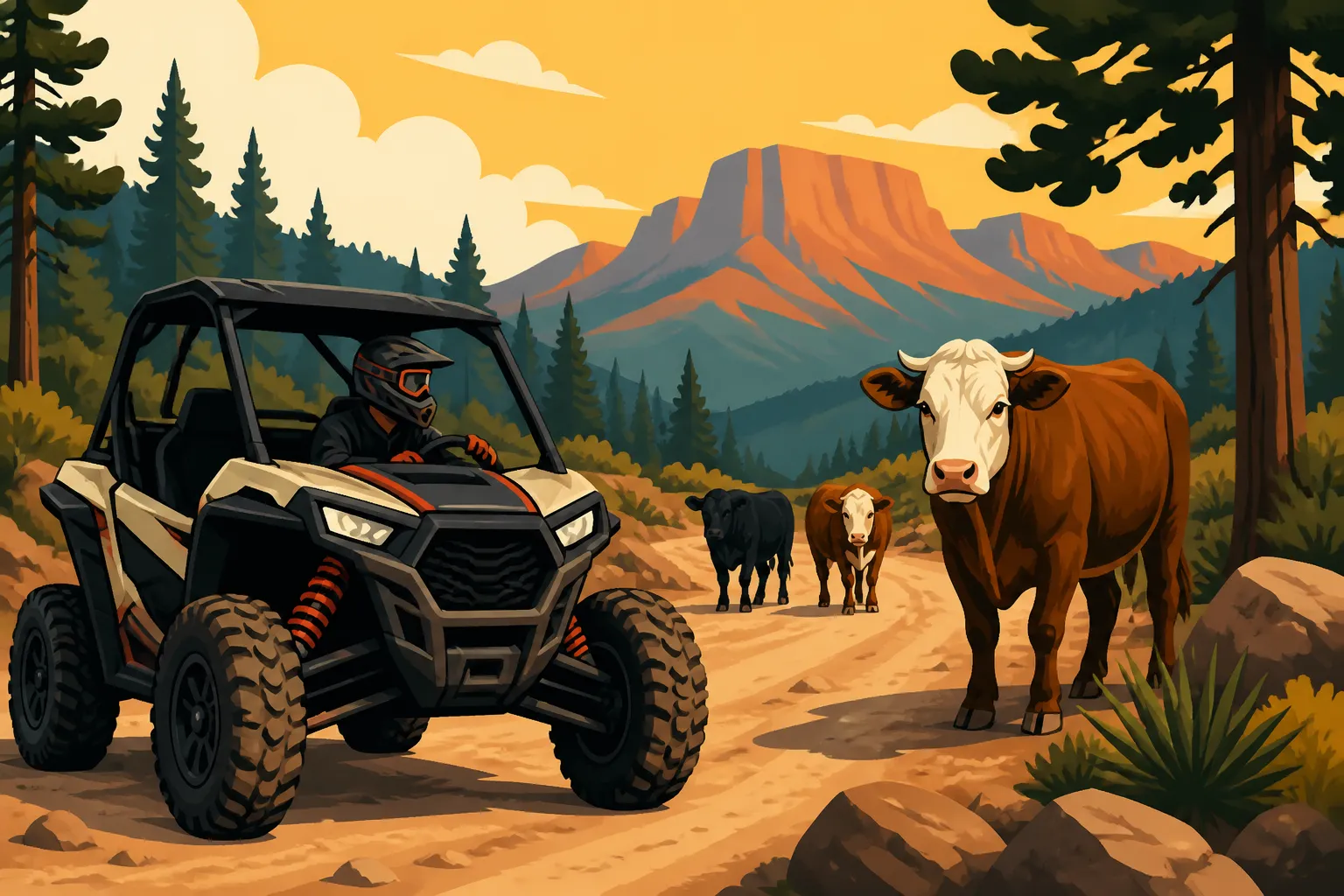
Cattle can appear around a bend on a New Mexico forest road with little warning, especially where public routes cross grazing allotments. A sudden stop, a revving engine, or a rider trying to squeeze past can turn a calm encounter into a stressful one. This guide explains how to approach livestock safely, pass without causing a stampede, and handle gates and cattle guards responsibly.
Why cattle are on New Mexico forest roads
Forest roads can cross working grazing allotments
A route through a national forest may also pass through land used for livestock grazing. In places such as the Carson, Lincoln, Gila, and Cibola National Forests, riders may encounter cattle near roads, trails, water sources, or shaded areas. A forest road can be open to motorized travel while still being part of a working landscape.
That overlap can catch visitors off guard. A road may look like a remote recreation route, but ranchers and permittees may use it to check livestock, move equipment, or reach range improvements. Cattle may gather on the road because it is easier to walk than rough ground, offers shade, or leads toward water. Their presence does not automatically mean the road is closed, but it does mean riders need to slow down and share space.
Access is not permission to ride anywhere nearby. Stay on the route that is open to your vehicle, and pay attention to signs, barriers, and travel-management information. For the broader rules that apply to national forest riding, see [New Mexico Rules for Riding a National Forest] and [New Mexico Rules for Riding a Designated Route].
Cattle may not react the way you expect
Cattle often move away from a machine, but they do not always choose the direction a rider expects. A group may bunch together, turn back toward the road, or drift toward a gate or fence. Calves can be especially unpredictable, and a cow with a calf may be more alert to a nearby vehicle than cattle grazing calmly in an open area.
The machine itself can make a difference. The noise and movement of an ATV or UTV may startle animals, particularly if riders accelerate suddenly, rev the engine, or approach from behind. Even a rider moving slowly can create pressure if the cattle are boxed in between a steep bank, a fence, and the vehicle.
It is worth treating any group of cattle as a potential hazard, not because they are always aggressive, but because their movement can be hard to read. Keep enough distance to give them a clear way to move, and be prepared to stop until the situation settles.
The route and the livestock operation both matter
A road may be public or designated for motorized use, while nearby land is privately owned, leased, or managed for grazing. Fences, signs, and gates may mark boundaries or control livestock movement. Do not treat an open-looking stretch of ground beside the road as an invitation to ride around a group.
A cattle guard is not a trail marker or a guarantee that the road continues beyond it. Its purpose is generally to discourage livestock from crossing while allowing vehicles to pass, but the surrounding access rules still matter. For more on interpreting these features, see What a Cattle Guard Marks on a Ranch Boundary and [New Mexico Rules for Riding a Grazing Allotment].
How to approach cattle on an ATV or UTV
Slow down before you reach the herd
If you spot cattle ahead, ease off the throttle well before reaching them. A slow approach gives the animals time to notice you without feeling suddenly crowded, and it gives you room to assess whether the road is blocked or whether there is a safe, legal way through.
Avoid quick throttle changes, sharp turns, or repeated engine revving. Those reactions can startle livestock and make the group move unpredictably. If you are riding with others, signal the group to slow down too. A rider who stops while the next machine continues at speed can leave the lead rider dealing with both the cattle and traffic approaching from behind.
On a dusty road, reduce speed even earlier. Dust can make it harder for you and other riders to see where the animals are moving. It can also obscure a bend or a vehicle coming from the opposite direction. The practical goal is simple: approach slowly enough that you can stop without swerving or skidding.
Stop and give the animals room
When cattle occupy the road, stop at a respectful distance and wait. Keep the engine quiet if you can do so safely, and avoid crowding the animals with the front of your machine. A UTV should not be used to push cattle down the road, and an ATV should not circle around them to make them move.
Give the herd time to choose its own direction. Often, the animals will gradually move off the route once they are no longer being pressured. If they do not move, or if the road is narrow and there is no clear, safe passage, waiting is usually better than trying to force a gap.
Do not split a group if you can avoid it. A calf separated from its mother can trigger more movement, and cattle may turn suddenly to rejoin one another. If the animals begin moving toward you, stay calm, avoid sudden acceleration, and give them room to pass. The right response is to create space, not to chase or block them.
Pass only when there is a clear, safe opening
If the herd moves off the road and leaves a clear passage, proceed slowly and smoothly. Leave as much space as practical, keep a steady pace, and do not stop beside or among the animals to take photos. If there is not enough room to pass without coming close to the cattle or riding off the designated route, wait.
A common mistake is to see one animal step aside and assume the whole group will follow. Check for calves, animals behind the first row, and cattle that may be partly hidden by brush or a bend. Make sure the route ahead is clear before moving forward.
If you are riding in a group, pass one machine at a time when the opening is limited. Leave enough room between vehicles that you are not creating a continuous wall of noise and motion. After passing, continue at a measured pace until the herd is well behind you.
| What you see | Safer response | Avoid |
|---|---|---|
| Cattle far ahead on the road | Slow early and assess the road | Accelerating to reach them before they move |
| A group blocking a narrow section | Stop at a distance and wait | Trying to squeeze between animals and a fence |
| Cattle moving toward your machine | Stay calm and make room if possible | Revving, swerving, or chasing them away |
| A gate near the herd | Check whether it is meant to be open or closed, and leave it as found unless signs or instructions say otherwise | Assuming an open gate means the route continues |
| Dust or limited visibility | Reduce speed and be prepared to stop | Following another machine too closely |
Gates, cattle guards, and route etiquette
Leave gates as you find them
Gates are part of livestock management, and riders should not guess why a gate is open or closed. If you encounter one, look for posted directions and follow them. When a gate is meant to be closed after passage, close it securely behind you. When signs or instructions indicate it should remain open, do not close it just because that seems tidier.
A gate can be easy to overlook when you are focused on a machine, a map, or the trail ahead. In a group, make sure the last rider knows whether the gate has been closed. It is also considerate to pause and let the group pass through without leaving a large gap that allows livestock to wander onto another route.
Never move a gate or barrier to gain access to a road that appears convenient. If the route is closed, or you cannot tell whether motorized travel is allowed, stop and check rather than assuming the barrier is only for cattle. These habits are covered in Gates on Grazing Allotments, Why You Close Every Gate Behind You, and New Mexico Trail Etiquette on Shared Ground.
Do not use a cattle guard as a shortcut
A cattle guard may be installed where a road crosses a fence line, but its presence does not settle whether a nearby track is open to OHVs. It also does not mean riders should travel along the fence, cut across a pasture, or follow cattle trails. Stay on the route you are authorized to use.
Approach a cattle guard slowly and squarely, especially if it is uneven, muddy, or difficult to see in low light. Do not stop on it to regroup. If a machine has trouble crossing, move to a safe place off the travel path before assisting, provided that doing so does not take you off the allowed route.
Cattle may stand near the guard, and they may not respond predictably to a machine approaching from behind. Give them time and space rather than trying to push through. When the road is narrow or the animals are crowded against a fence, wait for a clear opening or turn back if doing so is safer than proceeding.
Share the road with ranchers and other users
A ranch truck, trailer, or livestock vehicle may be coming from the other direction. On a one-lane forest road, slow down enough to stop where you can see ahead, and leave room for a larger vehicle to pass. If you meet someone moving livestock, follow their directions and avoid riding through the group.
Courtesy also matters when no one is immediately visible. Keep noise controlled, avoid spinning tires, and do not leave litter or damage roadside vegetation. Cattle may be grazing out of sight, and the sound of a machine can carry farther than expected in a quiet forest or valley.
For more practical guidance on riding around livestock and meeting traffic on narrow routes, see New Mexico Riding With Livestock Around, Riding a Grazing Allotment Politely, and Meeting a Truck on a One-Lane Road.
Plan for livestock before you set out
Check the route and travel information
Before riding, confirm that the road or trail is open to your type of machine and that motorized travel is allowed on the route you intend to use. A line on a general map may not tell you whether a road is closed, seasonally restricted, or outside the designated route network.
A navigation app can help you follow a planned route, but it should not replace posted signs or land-management information. Riders who use onX Offroad can review mapped routes before leaving and keep track of their planned route, but should still check local signs and official travel information at the trailhead. onX Offroad is most useful as one planning aid among several, rather than a reason to continue when a closure or restriction is posted.
Carry a map you can use if your phone loses service or its battery runs down. In remote parts of New Mexico, that backup can prevent a wrong turn onto a ranch road or an unmarked track. New Mexico Trail Maps Worth Carrying offers more context on planning for routes where connectivity may be limited.
Prepare for a delay instead of rushing
A cattle encounter can add time to a ride, particularly when animals occupy a narrow road or are slow to move. Build flexibility into your schedule, especially if you are heading to a trailhead, campsite, or meeting point. Rushing because you are behind can lead to the exact behavior that makes livestock encounters riskier.
Make sure everyone in the group understands the plan: slow down when cattle appear, stop if the road is blocked, and wait for a safe opening. Agree on hand signals or another way to alert riders behind you. If someone in the group is inexperienced, brief them before you reach the trail rather than trying to explain while cattle are already in the road.
Keep water and basic recovery supplies with you, and avoid leaving the group behind while one machine goes ahead to investigate. If you cannot determine whether a route is open or safe, turn around or seek reliable local guidance instead of exploring a track that may cross private land.
Know when to wait, turn around, or ask for help
Waiting is a sensible choice when cattle are calm but blocking the route. Turning around may be the safer option if the animals are agitated, the road is too narrow, or passing would require leaving the designated route. A route that is not practical to ride today may be fine on another visit.
If livestock appear injured, trapped, or in immediate danger, do not attempt to handle them yourself. Keep your distance and contact the appropriate land manager or local authority when you have a reliable way to do so. Riders should also avoid touching fences, gates, or livestock equipment; those features may be under tension or serve a purpose that is not obvious from the road.
A calm, patient response protects both the animals and your group. Slow down early, give cattle room, respect gates and route boundaries, and accept that sometimes the safest way forward is to wait.
Disclaimer
This article is for general informational purposes only and does not constitute professional advice. Laws, prices and regulations vary by location and change over time. Consult a qualified professional for guidance on your specific situation.