What a Cattle Guard Marks on a Ranch Boundary
We've all been there: cruising along a fantastic New Mexico dirt road on your ATV or UTV, the wide-open landscape stretching out before you, when suddenly, a series of metal grates appear in your path. This isn't just a quirky road feature; that cattle guard is often a silent but significant marker, telling you a lot about the land you're on and how you're expected to ride. This guide will help you understand exactly what those often-jarring grates mean for your off-highway vehicle adventures in the Land of Enchantment.
The Unspoken Language of the Range: What a Cattle Guard Tells You
Cattle guards are such a common sight in New Mexico's rural and ranching areas that it's easy to take them for granted. But for OHV riders, they're more than just a bumpy obstacle; they're an integral part of the landscape's communication system. Understanding their purpose and how to navigate them safely is key to responsible and enjoyable riding.
More Than Just a Grate: The Purpose of a Cattle Guard
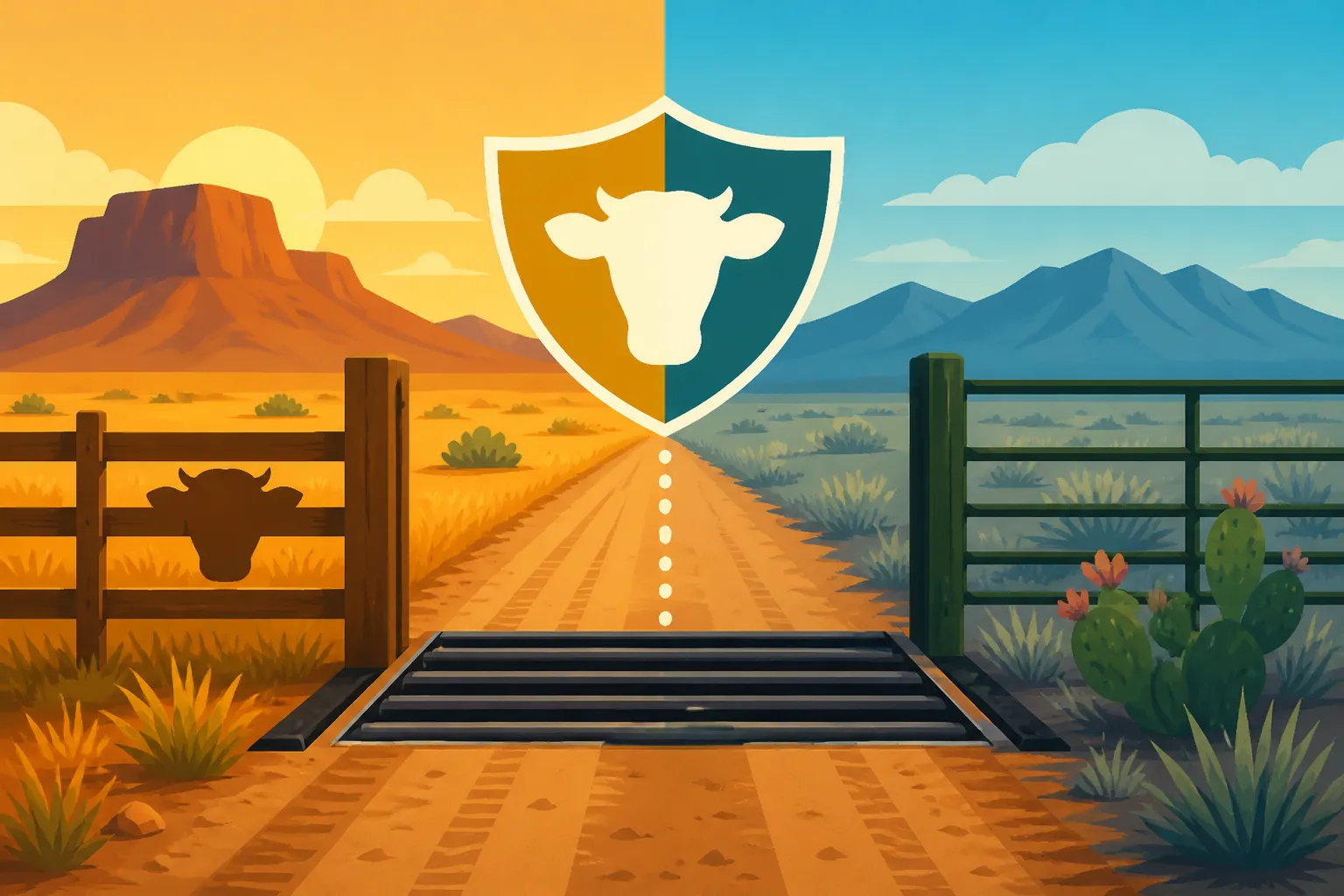
At its most basic, a cattle guard is an open grid of bars or pipes set into a roadway, designed to prevent livestock (like cattle, horses, and even sheep) from crossing a boundary while allowing vehicles to pass without the need for opening and closing a gate. Imagine having to hop off your side-by-side every quarter-mile to open a fence, drive through, and then close it behind you. It would be a nightmare for ranchers needing to move between pastures and for the public trying to access roads that traverse these properties. The cattle guard solves this by creating a barrier that animals instinctively avoid stepping on due to the unstable feel of the grates underfoot.
For us riders, though, these can be a bit intimidating. They can be rough, uneven, and sometimes downright jarring. It’s not uncommon for folks to worry about damaging their tires, suspension, or even losing control, especially if they hit one too fast. This is why paying attention and knowing what you're crossing is so important. When you see a cattle guard, it immediately signals that you are entering or leaving an area where livestock are present or could be present. This automatically brings [New Mexico Rules for Riding Near Livestock] into play, reminding you to be aware of your surroundings and the potential presence of animals. This simple structure helps maintain the integrity of grazing allotments and private pastures, ensuring that cattle stay where they're supposed to, benefiting both ranchers and the natural ecosystem.
Navigating Cattle Guards Safely on Your OHV
Crossing a cattle guard on an ATV or UTV isn't like driving over a speed bump. It requires a bit more finesse and attention. The key is usually to approach them slowly and deliberately. Hitting one at speed can lead to a very uncomfortable ride, or worse, potential damage to your machine or even yourself.
First, reduce your speed significantly as you approach. You want to be slow enough that you can easily assess the condition of the guard. Some are pristine and smooth, while others might have bent bars, wide gaps, or loose sections. A good rule of thumb is to almost crawl over them, letting your suspension do the work. If you're on a narrower ATV, you might be able to find a "sweet spot" where your tires ride mostly on the cross supports, but with a UTV, you'll likely be hitting the grates head-on. Try to keep your wheels straight as you go over, avoiding any sharp turns that could put undue stress on your tires or suspension components. It's also a good idea to shift your weight slightly back on an ATV, or be prepared for a bit of a jolt in a UTV, to absorb the impact.
After you've crossed, take a moment to check your tires for any foreign objects that might have been picked up, or for any visible damage. Regular checks of your suspension components are always a good idea when riding in areas with frequent cattle guards. For those who frequently tackle rough terrain, investing in heavy-duty components from brands like SuperATV can offer an extra layer of durability and peace of mind when you're repeatedly traversing these types of obstacles. Remember, prevention and careful riding are your best defense against unexpected issues when out on the trail.
Beyond the Fence Line: What a Cattle Guard Signifies for Public Access
Cattle guards aren't just about keeping cows in their place; they're also critical indicators of land ownership, access, and usage rights. Understanding what they signify can prevent accidental trespassing and ensure your ride stays legal and enjoyable.
Public Lands and Private Easements: Where You Can Go
One of the most common things a cattle guard marks is the transition between different types of land ownership, or access points to public lands that are surrounded by private property. In New Mexico, you'll frequently find cattle guards at the entrance to Bureau of Land Management (BLM) land, National Forests, or State Trust Land. This is because much of our public land is leased for grazing, and cattle guards allow ranchers to manage their herds while still providing public access for recreation.
For example, you might be riding a county road that suddenly transitions from privately owned ranch land to wide-open BLM territory. A cattle guard often marks this exact spot. It's a visual cue that while the land around the road might have been private up to that point, beyond the guard, you are likely entering public ground where OHV riding is permitted on designated routes. However, it's crucial to remember that "public land" doesn't always mean "open to all vehicles everywhere." You'll still need to stick to designated roads and trails, as outlined in guides like [Riding BLM Land in New Mexico] and [New Mexico Rules for Riding a Forest Road].
Sometimes, a cattle guard might be on private land but grants access to public land via an easement or right-of-way. This means the landowner has granted permission for the public to traverse a specific route across their property to reach another point. These easements are usually clearly marked with signs, but the cattle guard itself is often the physical transition point. Always look for accompanying signage to confirm your right to pass, and never assume that a cattle guard automatically means a route is public.
Understanding Land Ownership: The Invisible Lines
While a physical fence and cattle guard make a boundary obvious, the actual lines of land ownership can be far more complex and invisible to the naked eye. In New Mexico, with its vast stretches of ranchland, state trust land, and federal holdings, knowing whose land you're on is paramount. A cattle guard is a huge hint, but it's not the final word.
The presence of a cattle guard means someone is actively managing livestock, and that management is tied to specific land parcels. It could be private ranch land, a grazing allotment on federal land, or even state trust land. The key takeaway is that you should always be prepared to verify land status, especially if you plan to venture beyond the immediate road. Modern GPS apps and online mapping tools are invaluable for this. They allow you to overlay property lines onto satellite imagery, showing you exactly where you are in relation to private, state, and federal boundaries.
This diligence is essential because [New Mexico Rules for Riding Private Land] are strict, and accidental trespassing can lead to fines, confrontations, and a bad reputation for the OHV community. If you see a cattle guard and no clear public land signage, it's safest to assume you're on private property until you can confirm otherwise. Even if there's a cattle guard, if the land adjacent to the road is private, you must stay on the road itself. Never ride off-trail onto private property. Always respect "No Trespassing" signs, even if they appear next to a cattle guard that seems to indicate open access further down the road.
Rules of the Range: Etiquette and Legality at a Cattle Guard
Understanding the physical structure and its broader implications for land access is just one piece of the puzzle. There's also an unspoken code of conduct, a trail etiquette, that comes into play when encountering cattle guards, especially in New Mexico's ranching country.
The Expectation of Open Passage: Don't Stop, Don't Tarry
Cattle guards are designed for continuous flow. Unlike a traditional gate that requires you to stop, dismount (or exit your UTV), open, drive through, and then close, a cattle guard is meant to be traversed without interruption. The expectation is that you'll slow down, cross it safely, and continue on your way. You shouldn't stop on a cattle guard, park near one unnecessarily, or use it as a photo op for extended periods. Doing so can impede ranch operations, block others, or even startle livestock.
Now, what if you encounter a gate that is located right next to a cattle guard? This is a bit less common but does happen. Generally, if there's a cattle guard, it means vehicles are meant to use it, and the adjacent gate is often for heavier equipment, pedestrian access, or specific animal movement. Unless the cattle guard itself is completely impassable or clearly blocked, you should use the cattle guard. If you are ever faced with a gate, the golden rule of [New Mexico Rules for Opening a Gate] is to leave it as you found it. If it was closed, close it behind you. If it was open, leave it open. But again, with a cattle guard, the primary expectation is continuous passage for vehicles. If you must stop for an emergency, do so as far off the road and away from the cattle guard as safely possible.
Reading the Signs: What to Look For (and Why)
While the cattle guard itself is a strong indicator, it's the accompanying signage that provides the definitive word on land status and access rules. This is where your attentiveness truly pays off. You might see signs like "Entering BLM Land," "Carson National Forest," "State Trust Land — Permit Required," "Private Property — No Trespassing," or "Grazing Allotment — Keep Gates Closed." Each of these signs carries specific instructions or implications for your ride.
For instance, a cattle guard often marks the entry into a [New Mexico Rules for Riding a Grazing Allotment]. This doesn't mean you can't ride there, but it certainly means you need to be extra vigilant for cattle, horses, and even fencing that might be less visible. It also means adhering to good [New Mexico Trail Etiquette on Shared Ground], which includes things like giving livestock a wide berth and not spooking them. Understanding these subtle cues is part of being a responsible rider.
It's helpful to consider what the signs tell you in conjunction with the cattle guard itself.
| Signage Found Near Cattle Guard | What It Typically Means for OHV Riders |
|---|---|
| No Signage / Unmarked | Proceed with caution. Often implies public access on the road, but may border private land. Consult maps. |
| "Private Property" | Stay on the designated road. Do not venture off. |
| "BLM Land" | Public access on designated routes. Stick to marked trails/roads. |
| "National Forest" | Public access on designated routes. Check for seasonal closures. |
| "State Trust Land" | Recreational Access Permit Required. Often has specific rules. |
| "Grazing Allotment" | Expect livestock. Ride slowly, be prepared to stop. Close any gates you open. |
| "Entering Tribal Land" | Permit/Permission Required. Do not proceed without prior authorization. |
| "Wilderness Boundary" | No motorized vehicles. Turn around or find an alternate route. |
Paying attention to these details can make the difference between a fantastic day on the trails and an unwelcome encounter. Always carry good maps (digital or paper) that show land ownership, as this will be your ultimate guide in ambiguous situations. And when in doubt, it's always better to turn around than risk trespassing. Being informed helps everyone enjoy New Mexico's beautiful landscapes respectfully. It also contributes to positive relationships between riders, landowners, and land management agencies, ensuring continued access for future generations. For riders who explore vast landscapes, carrying a [New Mexico OHV Permits Explained] document is also a good idea, as some areas may require specific permits for entry.
Maintenance and Responsibility: Keeping the Gates (and Guards) Open
When we ride through New Mexico's stunning landscapes, we're sharing the trails and roads with a variety of users and landowners. This shared space means we also share a bit of responsibility, especially when it comes to infrastructure like cattle guards.
Who Maintains These Structures?
The maintenance of cattle guards typically falls to whoever owns or manages the land where they are located. On private ranches, the landowner is responsible. This means that the condition of private cattle guards can vary greatly depending on the rancher's resources and priorities. You might encounter brand new, well-maintained guards or older, more weathered ones that are a bit rougher around the edges.
On public lands, the responsibility lies with the managing agency. For instance, cattle guards on BLM roads or within National Forests are maintained by the Bureau of Land Management or the U.S. Forest Service, respectively. These agencies often have specific budgets and crews dedicated to maintaining infrastructure on their lands. However, given the vastness of these public lands and the constant wear and tear from vehicles, weather, and livestock, even agency-maintained cattle guards can sometimes be in need of repair.
Understanding who is responsible helps in two ways: first, it sets your expectation for the condition you might encounter. Second, it helps you know who to contact if you come across a significant issue. A well-maintained cattle guard means safer passage for you and better livestock control for the landowner or agency. It's a win-win, and recognizing the effort behind it can help us appreciate these crucial pieces of infrastructure even more. [New Mexico Riding Areas Open Year Round] often rely on accessible, well-maintained roads, which includes these guards.
Reporting Damage or Issues
While cattle guards are built to be robust, they aren't indestructible. Heavy traffic, oversized vehicles, errant livestock, and natural wear and tear can cause damage. Bent bars, missing sections, or loose grates can be dangerous not only for OHV riders but also for other vehicles, pedestrians, and livestock.
If you encounter a damaged or unsafe cattle guard, reporting it is a gesture of communal responsibility. For private land, it can be tricky if you don't know the landowner. In such cases, if it's on a public access road, you might consider reporting it to the local county road department, as they often have jurisdiction over [New Mexico Rules for Riding a County Road] that traverse private land. For public lands, contact the local field office for the BLM, Forest Service, or State Land Office. They appreciate knowing about infrastructure problems so they can address them. Providing a precise location (GPS coordinates are best!) and a brief description of the damage will be incredibly helpful.
Remember, taking the time to report an issue helps ensure the safety of other riders and maintains good relationships with landowners and land management agencies. It's part of being a responsible outdoor enthusiast and contributing to the upkeep of the trails and access routes we all enjoy. We are all stewards of the land, and a little effort can go a long way in preserving access and safety for everyone.
Disclaimer
This article is for general informational purposes only and does not constitute professional advice. Laws, prices and regulations vary by location and change over time. Consult a qualified professional for guidance on your specific situation.