New Mexico Trail Etiquette on Shared Ground
A ride can go sideways fast when a dusty ATV catches up to hikers, a UTV meets horses on a narrow road, or a rider opens a ranch gate and leaves it swinging. New Mexico’s trails are shared by many kinds of users, and good etiquette helps prevent conflict, protect land, and keep routes open. This guide explains how to ride considerately and what to check before you go.
Start With the Route, Not Just the Trailhead
Confirm that the route is open to your machine
New Mexico riding areas can include a mix of designated motorized routes, nonmotorized trails, private land, grazing allotments, and closures. A route visible on an app or map is not automatically open to OHVs. Before unloading, check the land manager’s current travel map, signs at the entrance, and any posted seasonal restrictions. If those sources disagree, follow the on-site closure signs and ask the managing agency for clarification rather than guessing.
This matters in places with extensive networks, such as Glade Run near Farmington and the Carson National Forest around Red River. A road that looks wide and well-used may still be closed to motorized travel, while a nearby route may be open only to certain vehicle types. Check width limits and machine restrictions too, especially if you ride a wide side-by-side. [Designated Routes and Travel Management in New Mexico] explains why route designation matters on public land.
A mapping app such as onX Offroad can help you plan and keep track of your position, but use it as one planning tool rather than as proof that a route is open. Compare the map with current agency information and signs when you arrive. This extra check can save you from riding into a closure, crossing onto private land, or reaching a route that your machine is not allowed to use.
Know who shares the ground
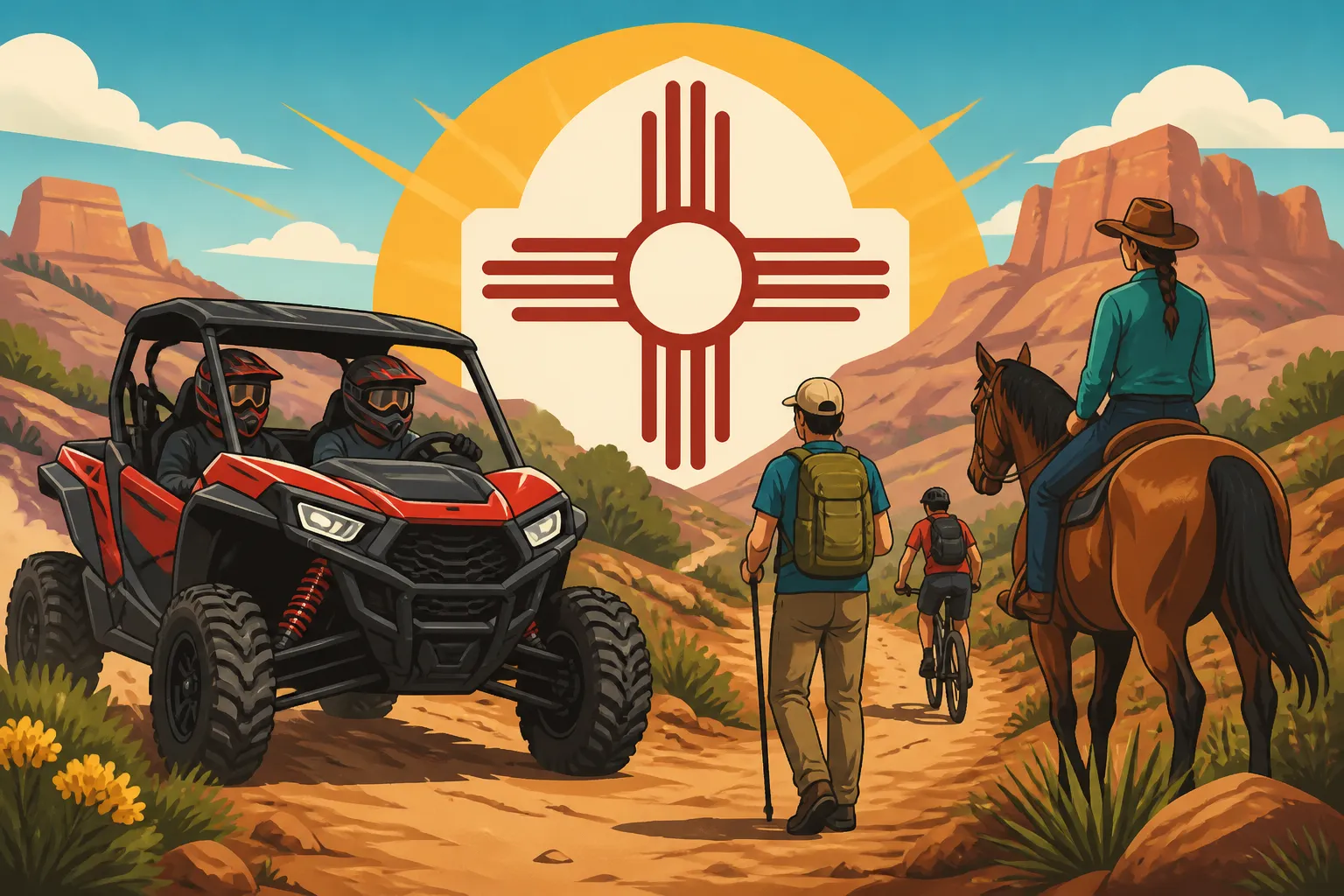
“Shared ground” can mean far more than two kinds of vehicles using the same trail. You might encounter hikers, mountain bikers, horseback riders, hunters, ranchers, campers, wildlife, or agency staff. A forest road near Red River may carry trucks and stock; an open riding area such as Red Sands may bring together several groups of motorized riders. Conditions and expected behavior vary by location, so pay attention to the people and signs around you.
Before a ride, talk through how your group will respond when the trail gets crowded. Agree to slow down near staging areas, stop when visibility is limited, and give other users room rather than trying to squeeze past. If you are leading a group, make sure the riders behind you know when you are stopping and why. A friendly wave or brief conversation can prevent a tense encounter from turning into an argument.
Respect for land boundaries is part of sharing the route, too. A trail can pass close to a ranch, a grazing allotment, or a sensitive area without giving riders permission to leave the designated route. Review [New Mexico Rules for Riding a Grazing Allotment] and [Tribal Land and Why Permission Differs] before a ride that may approach those areas. When permission is unclear, stay on the route you know is open.
Pass Other Trail Users Calmly and Safely
Slow down early and give people room
The considerate pass begins before you reach someone. Slow down while there is still plenty of distance, ease off the throttle, and avoid making a sudden approach that could startle a hiker, cyclist, or rider on horseback. On dusty routes, speed also affects how much debris and dust you send toward people behind you. If visibility is poor, wait until you can see enough of the trail to pass without forcing anyone toward the edge.
Choose a wide, stable spot where both parties can remain on firm ground. Don’t pass on a blind bend, near a drop-off, or where the trail narrows between rocks or vegetation. If a person is walking a dog, give the handler time to get the dog under control. If your machine is noisy, consider shutting off the engine while waiting, particularly when someone is close by or appears uneasy.
Communication should be simple and calm. A friendly greeting, a clear indication of which side you plan to use, and a moment to let the other person respond are usually better than revving or calling out at the last second. If there isn’t enough space to pass safely, wait. Losing a minute is far better than creating a collision or leaving the established trail to go around someone.
Give horses and livestock extra consideration
Horses can react unpredictably to engine noise, movement, and dust, even when a rider appears relaxed. When you see horseback riders, slow well before reaching them and ask how they would like you to proceed. Stop at a safe distance, keep your machine steady, and follow their directions. Some riders may ask you to turn off the engine; others may prefer that you stay in place while they guide their horse past.
Avoid sudden throttle changes, quick turns, or attempts to pass close behind a horse. Don’t assume a horse is comfortable with OHVs just because it has encountered them before. Let the horse and rider move through the narrow section before you continue. The same practical caution applies around cattle and other livestock: slow down, avoid chasing or crowding animals, and keep your group together so you don’t scatter them in different directions.
New Mexico’s working landscapes often put recreation routes near grazing areas. Close gates as you found them, and don’t take a shortcut around a gate or fence. If you find an open gate and can’t tell whether it should remain open, look for signs or ask the land manager rather than making an assumption. [Why You Close Every Gate Behind You] and [New Mexico Riding With Livestock Around] offer more detail on these everyday responsibilities.
Ride in a Way That Keeps the Trail Usable
Stay on the route and protect fragile ground
Riding off a designated route can widen the trail, damage vegetation, disturb wildlife, and create new tracks that other riders may mistake for an approved route. This is especially easy to do when avoiding a puddle, rock, or rut. If you can’t pass an obstacle without leaving the established route, slow down and choose a careful line through it when safe. Don’t create a bypass just because it looks easier.
Desert soils and vegetation can take a long time to recover from repeated disturbance. At Red Sands, for example, the landscape includes mesquite and dune terrain that can be affected by riders cutting new lines through the area. In forest country, riding around a muddy section can widen a narrow track and damage its edges. [New Mexico Trail Etiquette on Shared Ground] is one part of a broader Leave No Trace mindset: use open routes, avoid unnecessary disturbance, and carry out what you bring in.
A route-tracking tool such as onX Offroad may help you notice when you’re drifting away from your planned line, but stay alert to ground signs and posted boundaries. Apps can be helpful for orientation; they don’t replace route markers or land manager rules. If a route is blocked by a closure, downed tree, or damaged bridge, don’t ride around the obstruction unless the manager has identified an approved detour.
Manage dust, noise, and group size
Dust can make a ride miserable for people behind you and can obscure hazards for everyone. Leave space between machines, especially on dry roads, and reduce speed when you see another group ahead. If you’re riding in a convoy, don’t bunch up at a narrow section or accelerate hard just to catch the rider in front. Let dust settle before moving on when visibility has become poor.
Noise etiquette is just as practical. Keep your machine in good working order, avoid unnecessary revving at trailheads and campsites, and use a steady throttle rather than loud bursts of acceleration. A quieter approach is less startling to other users and wildlife, and it makes it easier for your group to hear instructions or notice a vehicle coming from another direction. Follow any posted sound limits and equipment requirements for the area.
Large groups need a little more planning than a pair of riders. Keep the group compact enough that it doesn’t block an intersection or staging area, but leave enough space between machines for safe stopping. If your group is long, allow other trail users to pass where there’s room rather than making them wait through a long line. On a popular route, consider splitting into smaller groups if doing so is allowed and can be done without losing track of one another.
| Situation | Considerate response | Avoid |
|---|---|---|
| Hiker or cyclist ahead | Slow early, give room, and pass only where the route is wide and visible | Accelerating past at close range |
| Horse or livestock nearby | Stop at a safe distance, ask what the rider needs, and follow their lead | Revving, crowding, or passing behind an animal |
| Dusty group ahead | Increase distance and reduce speed until visibility improves | Tailgating or accelerating through the dust |
| Blocked or closed route | Stop and use only an officially approved detour | Creating a new path around the obstruction |
| Gate across a route | Follow posted instructions and leave the gate as you found it | Leaving it open or closed without checking |
| Narrow trail encounter | Pause at a safe, stable spot and agree on who moves first | Forcing another user toward an unsafe edge |
Handle Common Encounters With Courtesy
Share narrow routes and intersections
When two groups meet on a narrow road, take a moment to read the situation instead of assuming the other person should move. Look for a stable place to stop, make eye contact if practical, and use a calm gesture to communicate. If one group is already committed to a steep or rocky section, it may be safer for the other group to wait at a wider spot. Don’t squeeze a machine past someone who has little room to maneuver.
At intersections, slow down and check every direction before crossing. A rider coming from a side route may not see your group, especially if dust, vegetation, or terrain blocks the view. Keep the intersection clear so others can pass, and avoid stopping where you block a signed route or access point. If your group is regrouping, move to a broad turnout rather than gathering in the middle of a junction.
There isn’t one universal right-of-way rule that settles every encounter on every New Mexico route. Posted signs, local rules, trail design, and the specific situation all matter. Use caution, communicate, and yield when it’s the safest choice. For roadway crossings, follow the applicable legal requirements rather than treating a road like an ordinary trail; [Crossing a Highway on an ATV in New Mexico] covers that separate situation.
Be thoughtful at trailheads and campsites
Trailheads can feel crowded before the ride even begins. Park and unload without blocking access lanes, gates, or another trailer’s turning space. Keep children and pets away from moving vehicles, and don’t start revving or testing a machine beside people who are preparing to leave. If a sign explains where to stage, park, or unload, follow it even if another spot looks more convenient.
At campsites, lower your speed and keep engine noise down, especially early in the morning and later in the day. Never use a campsite or parking area as a place to spin tires or practice tight turns. These spaces are often used by families, people walking between vehicles, and campers who may not expect an OHV to move through at speed. A slow, predictable ride is safer and less disruptive.
If you’re camping near a riding area, find out whether the campground and the trail network have separate rules. A nearby trail does not necessarily mean you can ride directly through a campsite or across an access road. Plan your route from camp to the trailhead in advance, and confirm that any connector is open to your vehicle. [Camping Near New Mexico Riding Areas] can help you think through the practical differences between staging at a trailhead and staying overnight nearby.
Prepare Your Group for a Better Ride
Brief riders before you start
A short pre-ride conversation can prevent common problems once helmets are on and engines are running. Tell everyone which routes you plan to use, where you’ll regroup, and what to do if the group gets separated. Set a pace that suits the least experienced rider rather than the fastest machine. Make sure each person knows that posted closures, private boundaries, and route markers take priority over the planned track.
Agree on a few simple signals, such as a raised hand for stopping or a clear point toward an obstacle. Riders should leave room to stop without hitting the machine ahead, and the last rider should know how to communicate if someone has fallen behind. If a rider is uncomfortable with a section, let the group pause and reassess instead of pressuring them to continue. That’s not holding everyone up; it’s basic group safety.
Check that riders understand the area’s rules before leaving the staging area. Visitors may need to confirm permit requirements, while younger riders may have additional safety requirements. Review [New Mexico's Nonresident OHV Permit] and [New Mexico's Safety Permit for Under-18 Riders] if they apply to your group. Carry any required documents and equipment, and make sure riders know where to find them.
Use maps and local information responsibly
Plan around the kind of ride your group can handle, not just the distance shown on a screen. A short route with steep, rocky, or exposed sections can be more demanding than a longer, smoother road. Consider the width of your machine, the skills of the least experienced rider, weather, fuel range, and where you can safely turn around. If a route description is unclear, contact the relevant land manager or local office before you go.
Use onX Offroad or another mapping resource to help orient yourself, then compare your planned route with current agency maps and signs. Download or carry information in a form you can access when cell coverage is weak. Don’t stop in the middle of a trail to study a screen; pull over in a safe, wide spot and keep the route clear. If your group changes plans, check that the alternative route is open to motorized use before following it.
Conditions can change after a storm, wildfire, or seasonal closure. A road that was passable on a previous trip may now be damaged, muddy, or restricted. Check for closures before departure and be prepared to turn around without trying to force a passage. [New Mexico Trail Closures to Check First] and [New Mexico Trail Maps Worth Carrying] are useful next reads for building a more reliable plan.
Disclaimer
This article is for general informational purposes only and does not constitute professional advice. Laws, prices and regulations vary by location and change over time. Consult a qualified professional for guidance on your specific situation.