New Mexico Rules for an Electric UTV on a Street
The dream of quietly cruising your electric UTV down a scenic New Mexico county road, feeling the breeze without the roar of an engine, is incredibly appealing. However, the reality often hits you like a sudden dust cloud: what are the actual rules for getting your electric side-by-side onto paved streets here? This guide is here to untangle the complexities and walk you through exactly what New Mexico law says about making your electric UTV street legal for those moments when the trail meets the town.
Understanding What an Electric UTV Is (and Isn't) in New Mexico's Eyes
Before we can even talk about streets, it's crucial to understand how New Mexico defines your electric UTV. You might think, "It's electric, so it's different," but the state's laws often lump all Off-Highway Vehicles (OHVs) together, regardless of their propulsion. This means your electric UTV will primarily be treated as any other UTV (or "Recreational Off-Highway Vehicle" – ROV) when it comes to registration and most road-use regulations.
Electric UTV vs. Golf Cart vs. Low-Speed Vehicle (LSV)
This is where the nuances really start to matter. An electric UTV, built for off-road performance, is generally distinct from a standard golf cart or a dedicated low-speed vehicle. Golf carts, as you know, are typically designed for golf courses and often have a top speed of around 15-20 mph. While some communities might have specific ordinances allowing golf carts on certain local streets, they don't generally fall under the broader OHV category.
Low-Speed Vehicles (LSVs), on the other hand, are purpose-built for street use, usually with a top speed between 20 and 25 mph. They come with specific safety features like seatbelts, headlights, taillights, turn signals, and often a Vehicle Identification Number (VIN) that designates them as street-legal from the factory. An LSV is not an OHV, and its rules for street use are entirely separate.
Your electric UTV, especially a modern one, likely exceeds the typical speed limits of golf carts and LSVs, boasts more robust suspension, and is engineered for rough terrain. Because of this, it's almost certainly going to be classified as an OHV in New Mexico, meaning it must follow the OHV street-legal requirements, not the golf cart or LSV rules. This distinction is vital because trying to treat your powerful electric UTV like a golf cart on public roads could land you in a heap of trouble with local law enforcement. It's not about how it's powered, but how it's designed and intended to be used.
The Importance of Classification for Street Use
The classification of your electric machine dictates everything from its required registration to the specific safety equipment it must have. If your electric machine is indeed an OHV, then it needs to be properly registered with the New Mexico Motor Vehicle Division (MVD), carry the correct decals, and meet all the equipment requirements for street use. Trying to skirt these rules by claiming it's "just an electric vehicle" or "like a golf cart" won't fly if it's clearly designed as an ROV. The MVD isn't interested in your power source as much as the vehicle's design and capability. This means that, for all intents and purposes, your electric UTV will be treated much like its gasoline-powered brethren when it comes to hitting the asphalt.
General OHV Street Legality in New Mexico: What Your Electric UTV Needs
So, if your electric UTV is considered an OHV, what does it need to hit the streets? New Mexico has an "opt-in" law that allows UTVs (and ATVs) to ride on certain paved public roads, but it comes with a pretty clear set of hurdles to clear. This isn't a free-for-all; it's a carefully regulated privilege designed to keep everyone safe.
The New Mexico "Opt-In" for Paved Roads
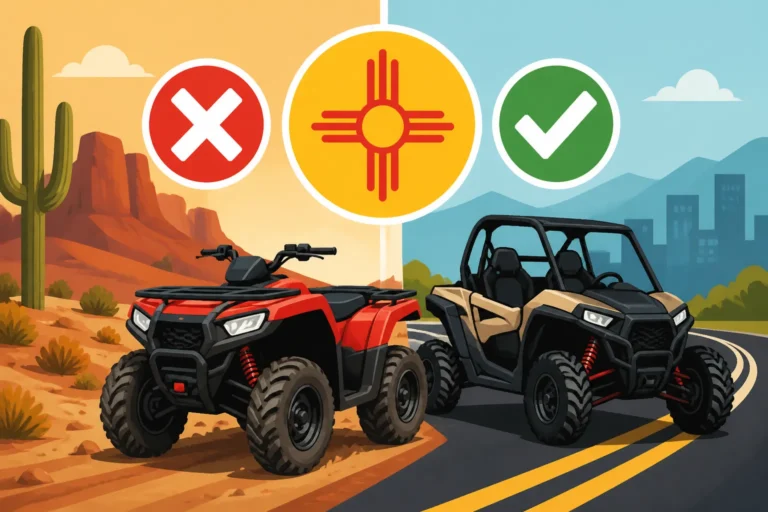
The good news for UTV owners, electric or otherwise, is that New Mexico does offer a pathway for road use. Unlike dirt bikes, which are generally restricted to off-highway travel, UTVs (and ATVs) can be made street legal on specific paved roads if they meet certain criteria. This "opt-in" is not automatic; counties and municipalities must pass specific ordinances or resolutions to open their roads to OHVs. So, just because you meet the state-level requirements doesn't mean you can ride everywhere. You need to know which roads are open.
This is a common frustration for riders who travel across county lines. One county might be wide open, while the next maintains strict prohibitions. It pays to do your homework on local ordinances, and always have a backup plan for trailering if you find yourself in an area where your machine isn't permitted on the pavement. You can learn more about this by researching [New Mexico's Paved Street Opt-In].
Essential Requirements for Any Street-Legal OHV
For your electric UTV to legally traverse an open paved road in New Mexico, it needs more than just a charge in its battery. It must meet several critical requirements, identical to a gas-powered UTV:
- Registration and Decals: Your electric UTV must be registered with the New Mexico MVD. Upon successful registration, you'll receive specific decals for your machine. For street use, you'll need the green "on and off-highway" decal. This green decal is your ticket to legally operating on designated paved roads, as opposed to the yellow decal which is strictly for off-highway use. You can dive deeper into this at [New Mexico's Green On and Off-Highway Decal]. This registration ensures the state knows who owns the machine and that it's recognized as a legitimate vehicle.
- Insurance: This is non-negotiable for street use. New Mexico requires OHVs operating on paved public roads to carry liability insurance. This isn't just a suggestion; it's a legal mandate to protect other drivers and yourself in case of an accident. Make sure your policy meets the state's minimum coverage requirements, which typically align with those for regular automobiles. Having your insurance card handy is always a good idea. For more details, check out [New Mexico ATV Insurance Requirement].
- Driver's License: The operator of any OHV on a paved public road in New Mexico must possess a valid driver's license. This means a standard automobile driver's license; an OHV safety certificate alone isn't sufficient for street operation. If you're going to hit the pavement, you need to be a licensed driver. [A Driver's License on a New Mexico Paved Road] provides more information on this.
- Equipment for Road Use: This is where many riders realize their stock UTV needs some upgrades. To be street legal, your electric UTV must be equipped with several safety features:
- Headlights and Taillights: These must be fully functional and meet visibility standards. For headlights, they typically need to be visible from 150 feet, and taillights from 200 feet.
- Brake Lights: These need to illuminate when the brakes are applied.
- Horn: A working horn is required to signal other vehicles or pedestrians.
- Mirrors: At least one rear-view mirror is mandatory, providing a clear view of the road behind you.
- Brakes: Your braking system must be in good working order and capable of safely stopping the vehicle.
- Turn Signals: While not always explicitly listed for OHVs, it's highly recommended and often expected by local ordinances for clear communication with other drivers. Many riders opt to install aftermarket turn signal kits from companies like SuperATV to ensure their machine is fully compliant and safe for road travel.
- Muffler/Spark Arrester (N/A for Electric, but important to note the difference): This is where electric UTVs actually have an advantage! Gas-powered OHVs require a muffler and a spark arrester. Since your electric UTV doesn't have an internal combustion engine, these requirements simply don't apply, saving you a step in compliance. However, it's a good reminder of how specific the regulations can get.
Meeting these equipment standards can sometimes be a project, especially if your UTV is primarily for trail use. But for the peace of mind and legal compliance, these upgrades are essential. You can find more specific requirements about lighting at [New Mexico Headlight and Taillight Rules] and braking at [Mirrors and Brakes for New Mexico Road Use].
Specific Considerations for Electric UTVs on New Mexico Streets
While the general OHV rules apply, there are still a few unique points to consider when your UTV draws its power from batteries rather than gasoline. The spirit of the law remains the same, but the practical application might differ slightly.
No Special Exemptions (Mostly)
The most important takeaway for electric UTV owners is this: your machine generally does not receive special exemptions for street use simply because it's electric. If it's classified as an OHV (which most modern electric UTVs are), then it must abide by all the existing OHV laws for street legality. This means the same registration, the same decals, the same insurance, the same equipment, and the same driver's license requirements as a gas-powered UTV. The state is primarily concerned with vehicle type and safety features, not the power source.
For example, you might think the lack of engine noise from an electric UTV would be beneficial. And it is, certainly for trail etiquette and enjoying nature! However, New Mexico still has sound limits for OHVs on public lands (96 decibels). While an electric UTV is unlikely to exceed this, it's an example of how regulations are broad and cover all OHVs.
Performance and Legal Definitions
Many electric UTVs today boast impressive horsepower and speed, often surpassing 25 mph. This is key because if your electric machine could technically fall into the "golf cart" or "LSV" category due to its appearance or size, its performance capabilities would likely push it back into the OHV classification. If your electric UTV can easily hit speeds well above 25 mph, it's not an LSV in the eyes of the MVD; it's an OHV, and thus subject to all those more stringent requirements. This is a crucial distinction to avoid potential citations.
The good thing is, most manufacturers design electric UTVs for performance, not just slow-speed cruising. This inherently aligns them with the OHV category, making the street-legal process fairly straightforward once you understand it.
The Role of Local Ordinances for All UTVs
Even after you've got your electric UTV fully registered, insured, and equipped for street use at the state level, you're not entirely in the clear. New Mexico's opt-in law relies heavily on local county and city ordinances. A road might be open to OHVs in one county but closed in an adjacent one. Some towns, like Red River, have very specific rules about UTVs on their streets. For instance, Red River allows ROVs on many of its streets, but often with time restrictions or specific exclusion zones. Meanwhile, standard ATVs might be banned entirely. This distinction impacts both electric and gas-powered machines equally.
It's absolutely vital to check the local ordinances for any town or county where you plan to ride your electric UTV on paved roads. What's legal on a county road outside of Truth or Consequences might be strictly prohibited within city limits, regardless of whether your UTV is electric or gas-powered. Looking into resources like [Red River's ROV-Only Streets] and [Red River Ordinance 2000-5] can give you a clear example of how specific these local rules can be. Always err on the side of caution and research before you roll onto unfamiliar pavement.
Navigating the Process and Practicalities
Getting your electric UTV ready for those paved New Mexico roads doesn't have to be a headache. With a clear understanding of the requirements and a bit of planning, you can ensure your machine is compliant and ready for your adventures.
Registration: Your First Step
The journey to street legality starts at the MVD. You'll need to [Registering a UTV in New Mexico] just like any other off-highway vehicle. This involves proving ownership, providing vehicle information (including the VIN), and paying the required fees. Ensure you specify that you intend for "on and off-highway" use when registering to ensure you receive the correct green decal. This decal is the visual proof that your electric UTV has completed the initial step toward street legality. Don't skip this; riding an unregistered OHV on any public land or road, electric or not, is a surefire way to get a citation.
Insurance: Proof of Responsibility
As mentioned, liability insurance is critical for street use. Before you ever hit the pavement, ensure you have an active policy that meets New Mexico's minimum requirements. Many insurance providers offer specific OHV policies, and it's worth checking with your current auto insurance carrier first, as they might offer a multi-policy discount. Always carry proof of insurance with you when riding on roads, as an officer may ask for it during a stop. Review [New Mexico ATV Insurance Requirement] to be certain you're covered appropriately.
Equipping Your Electric UTV for Road Use
This is often the most hands-on part of the process. Your electric UTV likely came with some basic lighting, but you'll need to confirm it meets the specific requirements for brightness and visibility.
Here’s a quick checklist for your electric UTV's road equipment:
| Feature | New Mexico OHV Road Use Requirement | Electric UTV Consideration |
|---|---|---|
| Headlights | Capable of illuminating objects at least 150 feet ahead. | Most modern electric UTVs come with decent headlights, but check their illumination range. Consider brighter aftermarket LED options from brands like SuperATV if your stock lights are dim, ensuring they don't blind oncoming traffic. |
| Taillights | Red in color, visible from 200 feet to the rear. | Similar to headlights, verify visibility. Aftermarket light bars or brighter LEDs can enhance safety. |
| Brake Lights | Must illuminate when the brake is applied. | Essential for signaling stops. Ensure they are fully functional and easily visible. |
| Horn | Audible from at least 200 feet. | A simple, functional horn is required. Many electric UTVs come with one, or it's an easy aftermarket add-on. |
| Mirrors | At least one rear-view mirror providing a clear view of the road behind. | A single handlebar-mounted mirror (if applicable) or a side-view mirror will often suffice. Many riders opt for a full set of side mirrors for better visibility, easily found from accessory providers. |
| Brakes | Fully operational and capable of stopping the vehicle safely. | Regular maintenance is key here. Ensure your electric UTV's brake system is in top condition. |
| Turn Signals | Highly recommended for clear communication; some local ordinances may require them. | While not always explicitly state-mandated for all OHV road use, adding a turn signal kit is a smart safety upgrade, especially for electric UTVs that are quieter and might be less noticeable to other drivers. SuperATV offers various universal and model-specific kits. |
| Spark Arrester | Not applicable for electric UTVs. Required for gas-powered OHVs on public land. | This is where electric UTVs simplify things! You don't need to worry about this requirement. |
| Muffler | Not applicable for electric UTVs. Required for gas-powered OHVs to meet sound limits. | Another benefit of electric! No muffler to worry about, and inherently quieter operation helps you comply with any noise concerns, though OHV sound limits still apply to the overall vehicle noise. |
| Tires | Must be in good condition, suitable for road use. | Aggressive off-road tires can be loud and wear quickly on pavement. Consider a set of DOT-approved tires if you plan extensive road use. |
| Windshield | Not always explicitly required, but highly recommended for safety and comfort, especially with eye protection. | A full or half windshield helps protect against debris, regardless of your power source. Ensure it's clear and doesn't obstruct vision. |
Many companies, like SuperATV, specialize in aftermarket parts that can help you meet these requirements. From universal turn signal kits to DOT-approved windshields and mirrors, you can usually find everything you need to upgrade your electric UTV for safe and legal street operation.
Where You Can and Cannot Ride
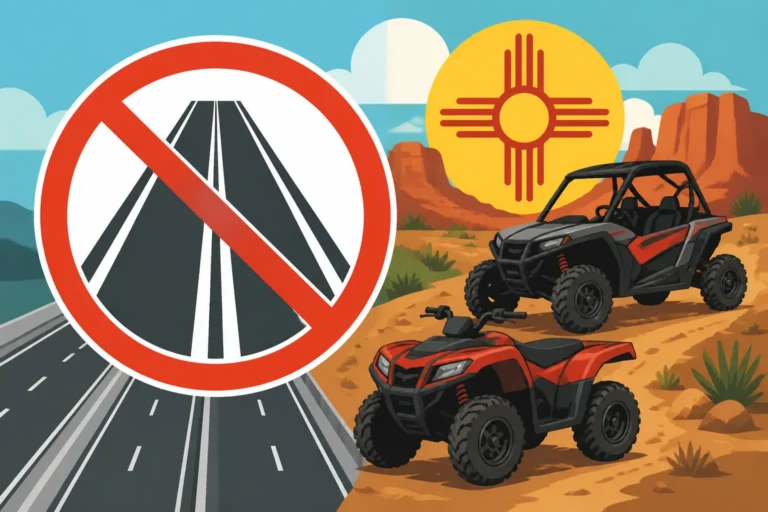
Even with all your ducks in a row, remember that not all paved roads are open to OHVs. State highways and interstates are generally off-limits to all OHVs, electric or otherwise. These high-speed, high-traffic arteries are simply not designed for OHV travel, and attempting to use them can result in serious fines and accidents. You can find more detail on this topic in [Why New Mexico State Highways Are Off Limits].
Your main opportunities for road riding will be on county roads and designated city streets that have explicitly been opened by local ordinances. Always consult local maps and ordinances to understand the legal riding areas. The landscape of what's open can change, so staying informed is crucial for responsible riding.
Riding your electric UTV on New Mexico's roads is absolutely possible, but it requires diligence and adherence to the same comprehensive rules that apply to all OHVs. By understanding these regulations, ensuring your machine is properly equipped, and staying informed about local ordinances, you can enjoy the unique experience of silent cruising on the Land of Enchantment's diverse paved pathways.
Disclaimer
This article is for general informational purposes only and does not constitute professional advice. Laws, prices and regulations vary by location and change over time. Consult a qualified professional for guidance on your specific situation.