New Mexico Low-Speed Vehicle Rules
It’s easy to get tangled up in the various rules for driving different kinds of vehicles on New Mexico’s paved roads. Many folks wonder if their souped-up golf cart, ATV, or UTV can qualify as a "Low-Speed Vehicle" to gain legal street access. This guide is here to untangle that confusion, clearly defining what a Low-Speed Vehicle is in the Land of Enchantment and how its rules differ from those governing off-highway vehicles and standard golf carts.
Understanding New Mexico's Definition of a Low-Speed Vehicle (LSV)
When we talk about Low-Speed Vehicles (LSVs) in New Mexico, we're not just throwing around a casual term for something that goes slow. The state has a very specific legal definition, and understanding it is absolutely crucial before you even think about taking one on public roads. This isn't about how fast your ride can go, but rather how it was manufactured and equipped to begin with.
What Makes a Vehicle "Low-Speed" in the Eyes of the Law?
In New Mexico, a Low-Speed Vehicle is a four-wheeled motor vehicle that has a maximum speed capability of greater than 20 miles per hour but not greater than 25 miles per hour. It’s primarily designed for operation on public streets and highways. Crucially, it must meet all the safety standards set forth in Federal Motor Vehicle Safety Standard 500 (FMVSS 500). This isn't some minor checklist; it's a comprehensive set of requirements that dictate everything from braking performance to crash-test worthiness, albeit for lower speeds.
Think of it this way: an LSV is almost like a miniature car, built from the ground up to be safe enough for slower road use, rather than an off-road machine adapted for the street. These vehicles are typically electric, though not exclusively, and are designed for utility or short-distance personal transportation within communities. They often look like beefed-up golf carts, but the key distinction lies in their manufacturing and compliance with strict federal standards. Without meeting these exact specifications, your vehicle, no matter how slow it goes, simply isn't an LSV in the eyes of the law.
These vehicles aren't typically what you'd find tearing up the trails; their design is fundamentally different from a typical ATV or UTV. The regulations are in place to ensure a basic level of safety when these vehicles share the road with traditional automobiles, even at lower speeds. It’s a distinct category, purposefully created for a specific niche of transportation.
Essential Equipment for Street Legality
For a vehicle to be legally recognized and operated as an LSV in New Mexico, it must be equipped with a comprehensive set of safety features that go far beyond what you’d find on a standard golf cart or even most stock off-highway vehicles. These aren't optional add-ons; they are foundational requirements for its street-legal status. You can't just slap a few lights on and call it a day.
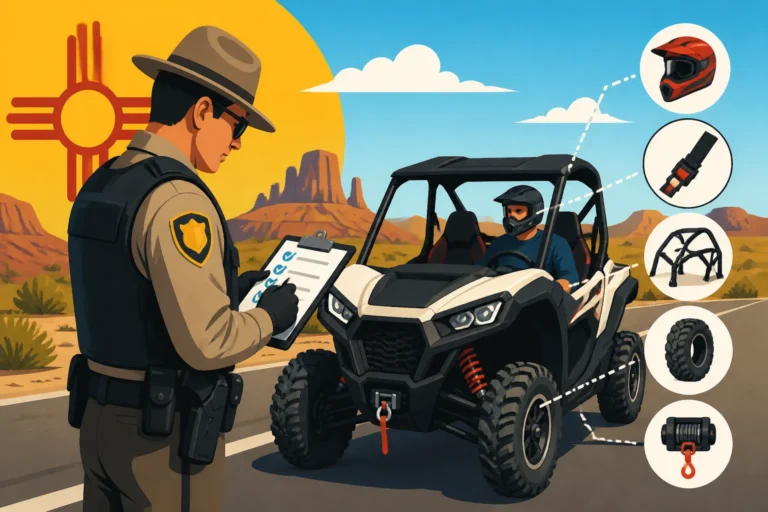
Every Low-Speed Vehicle must have headlamps, tail lamps, stop lamps (brake lights), turn signal lamps, and a horn. It needs a rearview mirror or mirrors to give the driver a clear view of the road behind. A New Mexico-approved windshield is also mandatory, providing protection from debris and the elements. Furthermore, seatbelts are required for all seating positions, emphasizing passenger safety. Lastly, an LSV must bear a Vehicle Identification Number (VIN) that is recognized by the National Highway Traffic Safety Administration (NHTSA), which certifies its compliance with federal safety standards.
This robust list of equipment is what truly distinguishes an LSV. It's about being visible, being able to signal your intentions, and offering a basic level of occupant protection. Without all these elements, even if your vehicle meets the speed criteria, it cannot be legally registered or operated as an LSV on New Mexico's public roads. This level of equipment is what allows it to integrate, even on a limited basis, into the flow of street traffic.
How LSVs Differ from ATVs, UTVs, and Golf Carts in New Mexico
This is where a lot of the confusion comes in for riders in New Mexico. People often lump all smaller, slower-moving vehicles into one category, but legally, an LSV is a very distinct animal from your typical golf cart or off-highway vehicle (OHV). Understanding these differences is absolutely paramount to staying on the right side of the law and avoiding hefty fines.
The Crucial Distinction: LSV vs. Golf Cart
It’s a common misconception that a golf cart, especially a modified one, can simply be considered a Low-Speed Vehicle. In reality, a standard golf cart is almost never an LSV. The primary difference lies in their manufacturing standards and intended purpose. Golf carts are designed for golf courses and private property, not for public roads, and therefore are not built to the strict federal safety standards (FMVSS 500) required for an LSV.
Most golf carts lack the full suite of required safety equipment we discussed – proper headlights, taillights, turn signals, brake lights, a certified windshield, and seatbelts for all occupants. They typically don't have a VIN that certifies federal compliance. While some local ordinances in New Mexico might permit golf cart use on specific, very low-speed community streets, this local allowance is not the same as qualifying as a state-recognized Low-Speed Vehicle. If you're relying on a local golf cart ordinance, be very sure of its exact boundaries and limitations, because venturing outside them can lead to tickets.
So, while your neighbor might drive their golf cart to the community pool, that doesn't mean it's an LSV, and it certainly doesn't mean you can drive it anywhere else a true LSV could go. The burden of proof, in terms of federal compliance and equipment, falls squarely on the vehicle owner. Don't confuse local permission for golf carts with the rigorous requirements for a legitimate Low-Speed Vehicle.
Why Your ATV or UTV Isn't an LSV
This is perhaps the biggest point of confusion for off-road enthusiasts. Many people invest in great aftermarket parts from companies like SuperATV to enhance their UTVs and ATVs, adding features like turn signals, windshields, and even horn kits, hoping to make them street-legal. While these additions are fantastic for making your off-highway vehicle safer and more visible when it is allowed on certain roads, they absolutely do not transform your ATV or UTV into a Low-Speed Vehicle under New Mexico law.
The fundamental reason your ATV or UTV isn't an LSV comes down to its design, speed capabilities, and lack of federal certification as an LSV. Most ATVs and UTVs are designed for much higher speeds than 25 mph and are built for rugged off-road conditions, not the federal safety standards required for street-legal LSVs. They are classified as off-highway vehicles, a completely separate category with its own set of rules for limited road use.
For OHVs, New Mexico has specific provisions for paved road access, such as obtaining a [New Mexico's Green On and Off-Highway Decal] or a [New Mexico's Paved Road Plate]. These allow you to use your OHV on designated county roads or municipality-approved streets under certain conditions, but the vehicle is still an OHV, not an LSV. The rules for [Are ATVs Street Legal in New Mexico?] or [Can You Ride a UTV on a New Mexico Street?] are distinct and separate from LSV regulations. While modifying your UTV with SuperATV components can certainly make it better equipped for the limited paved road use permitted for OHVs, it doesn't change its fundamental classification as an off-highway vehicle, which falls outside the LSV definition.
Operating a Low-Speed Vehicle on New Mexico Roads
Once you're sure your vehicle is a bona fide Low-Speed Vehicle, understanding the specific rules for its operation on New Mexico's public roads is the next critical step. These aren't free-for-all vehicles; they have very clear limitations and requirements to ensure the safety of everyone on the road. Navigating these rules correctly prevents frustration and unwanted attention from law enforcement.
Where You Can (and Can't) Drive an LSV
The beauty of an LSV is its convenience for local trips, but that convenience comes with specific geographical limitations. In New Mexico, Low-Speed Vehicles are generally restricted to roads with a posted speed limit of 35 miles per hour or less. This makes them ideal for cruising through residential neighborhoods, small town streets, or planned communities where speeds are lower.
You absolutely cannot operate an LSV on any road with a posted speed limit exceeding 35 mph. This immediately rules out most main thoroughfares, state highways, and certainly any interstate or limited-access highway. The design and speed capabilities of an LSV make it unsafe for higher-speed traffic, and attempting to operate one on such roads is not only illegal but extremely dangerous.
It's also important to remember that local municipalities can impose further restrictions. While state law defines where an LSV can generally operate, a city or county might have an ordinance that prohibits them on certain streets or within specific zones, even if the speed limit is 35 mph or less. Always check local regulations in addition to state laws. This is a very different system than the [New Mexico's Paved Street Opt-In] process, which allows off-highway vehicles on specific city streets, not LSVs.
Licensing, Registration, and Insurance Requirements
Operating an LSV in New Mexico isn't like tooling around in a non-motorized vehicle; it comes with the same fundamental responsibilities as driving a car. This means you can't just hop in and go without the proper credentials. The state treats these vehicles seriously due to their road-sharing nature.
First and foremost, anyone operating a Low-Speed Vehicle on public roads must possess a valid driver's license. There's no special LSV license; your standard New Mexico driver's license is required. Next, the LSV itself must be properly registered with the New Mexico Motor Vehicle Division (MVD), just like any other motor vehicle. It receives a standard license plate and registration, not an OHV decal. This confirms that the vehicle meets all the necessary legal definitions and equipment standards. You'll register it at MVD, similar to how you handle [New Mexico OHV Registration at MVD] for your off-road machines, but under a different vehicle classification.
Finally, and critically, liability insurance is mandatory. An LSV is subject to [New Mexico's Mandatory Financial Responsibility Act], meaning you must carry proof of financial responsibility, typically in the form of an insurance policy, that meets the state's minimum coverage requirements. Without valid registration, a driver's license, and insurance, you are not legally permitted to operate an LSV on public roads in New Mexico.
To help clarify the differences between common small vehicles, here's a handy comparison:
| Feature | Low-Speed Vehicle (LSV) | OHV (with Green Decal/Paved Road Plate) | Standard Golf Cart (Typical) |
|---|---|---|---|
| Max Speed Capability | 20-25 mph | Varies, often >25 mph | Typically <20 mph |
| Power Source (Common) | Electric | Gasoline or Electric | Electric/Gas |
| Wheels | 4 | Varies (3, 4, 6) | 4 |
| Registration Entity | MVD (as motor vehicle) | MVD (as OHV) | None (mostly) |
| License Required | Driver's License | Driver's License | Varies (local rules) |
| Insurance Required | Mandatory Liability | Mandatory Liability | Optional (mostly) |
| Roads Allowed | <35 mph speed limit; local rules | Designated roads <45 mph (county) / Opt-in streets (city) | Varies greatly (local only) |
| Safety Standard | Federal MVSS 500 | Off-road specific; limited road safety | Basic manufacturer specs |
| VIN Required | Yes, for federal certification | Yes, for registration | Often not certified VIN |
| Street Lights/Signals | Full set required | Required for road use | Often none or basic |
| Windshield | Required | Often optional/aftermarket | Often optional/plastic |
| Seatbelts | Required for all positions | Often not required (OHV specific) | Often none or lap belts |
Practical Considerations for LSV Owners and Enthusiasts
Deciding whether an LSV is the right vehicle for you, or understanding its role in the New Mexico landscape, involves looking at both its advantages and its inherent limitations. It’s also important to manage expectations, especially if you’re thinking about converting another type of vehicle into an LSV. Knowing these practicalities upfront can save you a lot of time, money, and potential legal headaches.
The Benefits and Limitations of Owning an LSV
Owning a Low-Speed Vehicle in New Mexico can offer a unique blend of convenience and responsibility, perfect for certain lifestyles and environments. On the plus side, LSVs are incredibly convenient for short-distance travel within neighborhoods, gated communities, or small towns. They offer an eco-friendly mode of transport, especially if electric, reducing your carbon footprint for those quick errands or visits to nearby friends. Their smaller size often means easier parking, and the open-air design can be a lot of fun on a pleasant day.
However, LSVs come with significant limitations. Their top speed of 25 mph means they are unsuitable for most major roads and any road with a speed limit over 35 mph. This restricts their range and utility, making them impractical for commuting over longer distances or where higher speeds are necessary. They offer limited protection from the elements, making them less ideal in New Mexico's diverse weather, from summer monsoons to winter snow. Perhaps most importantly, sharing the road with full-sized vehicles, even at lower speeds, can pose a safety concern, as LSVs are much smaller and less visible. Owners must always prioritize defensive driving and awareness of their surroundings.
Ultimately, an LSV thrives in a specific niche: short, local trips in low-speed environments. It's not a replacement for a car, and it doesn't offer the off-road capabilities of an ATV or UTV. Understanding these inherent pros and cons is key to making an informed decision about whether an LSV fits your transportation needs in New Mexico.
What About Modifying a Golf Cart to Be an LSV?
This is a path fraught with complexity, expense, and often, disappointment. Many golf cart owners, seeing the potential for street use, consider modifying their carts to meet LSV standards. While adding some accessories is easy enough, transforming a standard golf cart into a legal Low-Speed Vehicle is a monumental task that goes far beyond simple bolt-ons.
To qualify as an LSV, a golf cart would need to meet all of the federal safety standards (FMVSS 500) that a purpose-built LSV adheres to. This means not just adding headlights, taillights, turn signals, mirrors, seatbelts, and a DOT-approved windshield, but also ensuring the braking system, chassis integrity, and other components meet rigorous federal specifications. You'd also need to ensure it has a federally recognized VIN, which most standard golf carts do not. This often requires engineering certifications and inspections that are incredibly difficult and costly to obtain for a vehicle not originally manufactured to these standards.
Even with access to high-quality aftermarket parts, like those offered by SuperATV for UTV enhancements, converting a golf cart to a true LSV is rarely practical or cost-effective. The expense of sourcing and installing all the necessary federally compliant components, plus the headache of navigating the certification process, usually far outweighs the cost of simply purchasing a factory-built LSV. In most cases, if you need a street-legal low-speed vehicle, it's almost always easier and safer to buy one that was manufactured to be an LSV from the start, rather than attempting to convert a golf cart. For more on golf cart rules, you can also check out [New Mexico Golf Cart Street Rules].
Disclaimer
This article is for general informational purposes only and does not constitute professional advice. Laws, prices and regulations vary by location and change over time. Consult a qualified professional for guidance on your specific situation.