New Mexico Fines for Illegal Road Riding
Oh, the open road! There’s nothing quite like the dream of cruising along, the wind in your face, on your beloved ATV or UTV. But then reality hits, often in the form of flashing lights in your rearview mirror, and suddenly that dream turns into a knot in your stomach. Many of us have faced the confusing and frustrating situation of navigating New Mexico's road rules for off-highway vehicles, and sometimes, despite our best intentions, we find ourselves on the wrong side of the law, wondering what kind of fine we’re actually looking at. This guide is here to unravel the complexities, shed light on the penalties for illegal road riding, and most importantly, help you understand how to avoid those unwelcome surprises altogether.
The Frustration of Facing Fines for Road Riding in New Mexico
It’s a tale as old as time for OHV owners in New Mexico. You’ve got your quad or side-by-side, perfectly capable of handling all sorts of terrain, and sometimes, just sometimes, the most direct route to the next trail, or even just to grab a quick soda from the corner store, involves a stretch of asphalt. The temptation to just hop on the road, even for a short distance, can be incredibly strong, especially when you feel like your machine is perfectly safe and you’re just trying to get from point A to point B.
The frustration often stems from a lack of clarity, or sometimes, just plain misunderstanding the intricate web of state and local regulations. You might see others doing it, or you might genuinely believe your machine is equipped for it. Then, out of nowhere, you’re pulled over, and suddenly, what seemed like a minor shortcut becomes a significant headache and a potential hit to your wallet. It's not just about the money; it's about the feeling of being caught off guard, of being an outsider in your own state, simply for trying to enjoy your passion.
The Double-Edged Sword of Convenience
Let’s be honest, sometimes convenience is a powerful motivator. You’ve just finished a fantastic ride out on the BLM land near Elephant Butte, and your staging area is just a mile or two down a paved county road. Trailing up, loading the machine, and driving the truck just for that short hop feels like a massive waste of time and effort. It’s in these moments that the idea of just riding the OHV directly starts to look incredibly appealing. The machine is right there, ready to go, and you’re already geared up.
However, this desire for convenience is precisely where many riders unwittingly step into legal gray areas, or sometimes, clearly illegal ones. The regulations in New Mexico are designed to keep everyone safe, but they can often feel like arbitrary barriers when you're just trying to get somewhere. The rules differentiate between a machine that's purely "off-highway" and one that has been specifically modified and registered for limited paved road use. This distinction is lost on many, leading to a quick trip on the pavement turning into a much longer and more expensive interaction with law enforcement. It's a classic case of saving a few minutes potentially costing you much more in the long run.
The "Just This Once" Temptation
Ah, the infamous "just this once." We've all been there, haven't we? It’s the thought that creeps into your mind when you're faced with a minor obstacle, like a short section of paved road separating you from the next dirt track, or maybe your buddy's house is just around the corner, and it feels silly to trailer your side-by-side for such a short distance. You tell yourself, "No one will see me," or "It’s only a block." This is often where riders, especially those new to the New Mexico OHV scene, run into trouble.
The problem with "just this once" is that law enforcement officers patrol these roads consistently. They know the common crossing points, the popular shortcuts, and the areas where riders are most likely to take a chance. What seems like a harmless, quick jaunt can quickly escalate into a citation for illegal road riding. The state of New Mexico takes its road safety seriously, and while it's frustrating to be caught, these laws are in place to prevent accidents involving vehicles that aren't designed or equipped for regular road traffic. That small moment of convenience simply isn't worth the stress and cost of a potential fine.
Understanding New Mexico's Core Road Riding Restrictions
Before we dive into the nitty-gritty of fines, it’s absolutely essential to grasp the fundamental principles that govern OHV use on paved roads in New Mexico. It's not just about what you can’t do; it’s about understanding the framework that allows for limited and specific road use. New Mexico isn't completely closed off to OHVs on pavement, but there are very clear lines drawn in the sand – or rather, on the asphalt.
The state operates with a careful balance, acknowledging the popularity of off-highway riding while prioritizing public safety on shared roadways. This balance is reflected in the regulations that dictate everything from where you can ride to what equipment your machine needs. Getting a handle on these core restrictions is your first line of defense against those unwelcome fines. It's about being informed and making smart choices before you even turn the key. If you are ever in doubt, it is always best to err on the side of caution.
Why State Highways Are Generally Off-Limits
One of the most iron-clad rules in New Mexico regarding OHVs is the prohibition on riding on state highways. Seriously, if there's one thing to commit to memory, it's this. Think of any road with an "NM" prefix, like NM 14 or NM 38, or the major US routes that crisscross the state, and understand that these are generally off-limits to your ATV or UTV. This can be a real head-scratcher for riders who are used to more lenient rules in other states or for those who simply see a wide, open road and think "opportunity." But the state's reasoning is sound.
State highways are designed for high-speed, multi-lane traffic, often including large commercial vehicles. OHVs, by their very nature, are slower, lighter, and less visible than typical automobiles. Putting an ATV or UTV in that environment creates a significant safety hazard, not just for the OHV rider but for everyone else on the road. The speed differentials, the lack of robust crash protection, and the reduced visibility make it a recipe for disaster. While there might be very specific, limited exceptions for crossing, the general rule is clear: [Why New Mexico State Highways Are Off Limits]. Stick to designated OHV trails, county roads where permitted, or your own private property to avoid this particular, and often costly, mistake.
The Critical Distinction Between "Off-Highway" and "Street Legal"
Here's where a lot of confusion often creeps in, and it's a distinction that can directly lead to a fine if you don't get it right. In New Mexico, your ATV or UTV starts its life as an "off-highway vehicle." This means it's built for dirt, rocks, and trails, not for cruising down Main Street. However, New Mexico does provide a pathway for certain OHVs to gain limited "street legal" status through what’s known as the paved road plate program. This isn't about transforming your UTV into a car, but rather equipping it and registering it to allow specific, legal use on certain paved roads.
Many riders mistakenly believe that simply having a registration decal for off-highway use, like the yellow decal, means they can ride on pavement. Not so! That yellow decal signifies your machine is registered for off-highway riding. To legally access paved roads (where allowed), you generally need to meet additional equipment requirements and obtain a special [New Mexico's Paved Road Plate]. This plate, along with specific equipment like headlights, taillights, mirrors, and a horn, is what truly bridges the gap between off-highway and limited street-legal use. Without that plate and the necessary gear, any jaunt onto a paved road that isn't explicitly open to all OHVs is considered illegal.
Common Violations Leading to Fines for OHV Road Use
So, you’ve got a basic understanding of the rules. Now, let’s get down to the brass tacks: what are the actual actions that will likely get you a ticket when it comes to riding your OHV on New Mexico’s paved roads? It's often not just one thing, but a combination of factors that compound the issue. Think of it as a checklist of things you absolutely must have or must not do if you want to avoid those flashing lights and the inevitable conversation with a law enforcement officer.
These violations generally fall into a few key categories: not having the right paperwork (registration, license), not having the right equipment on your machine, or simply being in the wrong place at the wrong time (i.e., on a prohibited road). Understanding these common pitfalls can help you preemptively address any shortcomings and ensure your rides are always within the bounds of the law, keeping your wallet heavier and your stress levels lower.
Riding an Unpermitted OHV on Pavement
This is probably the most frequent reason riders get pulled over for illegal road use. As we discussed, an OHV registered only for off-highway use (with the standard yellow decal) is generally not permitted on paved public roads. If you take that machine onto a county road or city street that hasn't been specifically opened to OHVs, you're looking at a violation. It doesn't matter if it's just for a quarter-mile to connect to a trail, or if you're trying to reach a gas station.
The state has a specific process for allowing limited paved road use, which involves obtaining the special paved road plate and ensuring your machine meets certain [New Mexico Equipment Rules for Road Use]. Without this, your off-highway registered machine is just that – an off-highway vehicle. An officer seeing an OHV on a paved road without the proper plate and decals will immediately know something is amiss. This violation often carries a significant fine because it speaks to a fundamental disregard for the regulations designed to separate off-road recreation from public road safety. It's a clear-cut case, and unfortunately, it's often the hardest one to argue your way out of.
Ignoring Equipment Requirements for Road Use
Let's say you've done your homework and you know about the paved road plate. That's a great start! But simply having the plate isn't enough. New Mexico has specific [New Mexico Equipment Rules for Road Use] that your OHV must meet to be considered legal for paved road use. This isn't just about safety; it's about making your OHV visible and controllable in a way that's consistent with other road vehicles. Missing even one of these critical components can still lead to a fine, even if you have the plate.
Think about it: you need working headlights and taillights that are visible at specific distances, turn signals, at least one rear-view mirror, a horn, and proper brakes. Your exhaust system also has to meet a [New Mexico's 96 Decibel Ceiling]. Many stock ATVs and UTVs might have some of these, but often not all, or not to the required specifications. This is where aftermarket parts come in handy. Companies like SuperATV offer a wide range of accessories, from turn signal kits to mirrors, that can help bring your machine into compliance. Trying to skirt these requirements, perhaps thinking a hand signal is enough for a turn, is a risky gamble. An officer observing your machine lacking any of these components can issue a citation for each missing item, quickly adding up to a hefty sum.
Operating Without Proper Licensing or Age Restrictions
Just like driving a car, operating an OHV on a paved public road in New Mexico comes with specific licensing and age requirements. It's not a free-for-all, especially when you're interacting with regular traffic. Many riders, particularly younger ones or those new to the state, might overlook these crucial details, leading to fines not just for the machine, but for the operator themselves.
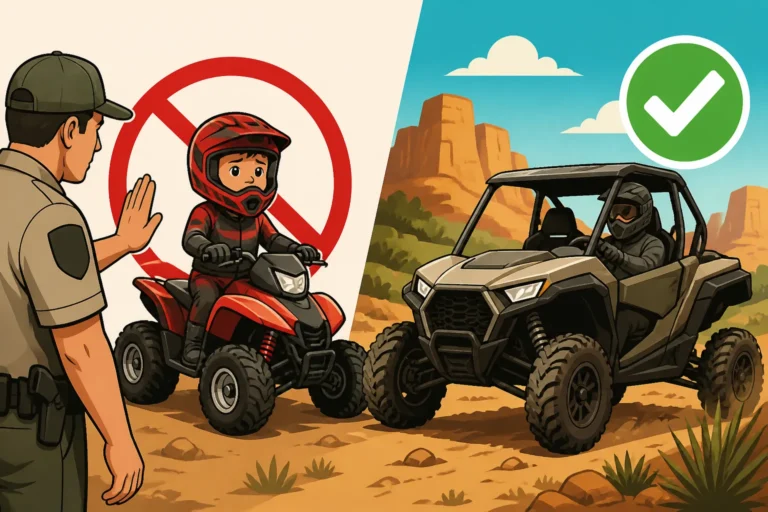
If you’re riding an OHV that has been equipped and registered for limited paved road use, you are essentially driving on a public thoroughfare. This means the operator generally needs a valid driver's license. [New Mexico Driver's License Rules for OHVs] are pretty clear on this. Furthermore, there are strict [New Mexico Rules for Riders Under 18] and minimum age requirements for operating OHVs on public land, and these rules often extend to paved road crossings or designated paved road use. For instance, children under a certain age are typically prohibited from operating OHVs on public land, and those under 18 might need to wear a helmet and eye protection even if adults don't in that specific scenario. Ignoring these rules puts young riders at risk and their parents on the hook for potential penalties.
Here's a quick summary of common violations:
| Violation Type | Description | Potential Consequences |
|---|---|---|
| Unregistered/Unplated Road Use | Riding an OHV on a paved public road without the required New Mexico paved road plate and current off-highway registration decals. | Fines for unregistered vehicle, illegal road use. |
| Missing Required Equipment | Operating a plated OHV on a paved road without necessary safety equipment (headlights, taillights, turn signals, mirrors, horn, proper muffler). | Fines for each missing or non-compliant equipment item. |
| Operator License/Age | Riding a plated OHV on a paved road without a valid driver's license (if required) or operating by an underage rider in violation of state laws. | Fines for unlicensed operation, age violations. |
| Prohibited Roadways | Riding any OHV (even plated) on roads explicitly prohibited, such as New Mexico State Highways or specific city streets. | Fines for illegal road use, potentially higher for state highway violations. |
| No Insurance | Operating an OHV on a paved public road without meeting New Mexico's [New Mexico Insurance Requirement] for financial responsibility. | Fines, potential license suspension, vehicle impoundment. |
The Financial Impact: What New Mexico Fines Actually Look Like
Okay, let's talk numbers – or rather, the shape of the numbers, since specific figures can change and vary wildly based on jurisdiction and the discretion of the officer. What you need to understand is that New Mexico takes illegal road riding seriously, and the fines aren't just a slap on the wrist. They are designed to be a deterrent, to make you think twice before taking that shortcut or riding without the proper setup.
The financial impact isn't always just the base fine listed on the ticket, either. There are often administrative fees, court costs if you contest it, and potential increases in insurance premiums. It's a ripple effect that can extend far beyond that initial moment of getting pulled over. Being prepared for these financial realities is just as important as knowing the rules themselves.
Initial Penalties for Basic Infractions
For a first-time offense, or what an officer might deem a "basic infraction," you're typically looking at a set fine amount. This could be for something like riding an unregistered OHV on a paved road, or perhaps missing a required piece of equipment like a mirror or functioning turn signal. While I can't give you exact figures, know that these fines are usually in the hundreds of dollars, not tens. It's enough to make you wince.
Imagine you're cruising down a county road near your home in Sierra County, connecting two pieces of BLM land. You thought, "Hey, Sierra County opened nearly all its roads, so I'm good." But you forgot your machine isn't wearing the proper paved road plate, and you only have your yellow off-highway decal. A sheriff's deputy spots you. That simple oversight could lead to a fine for [New Mexico Fines for an Unregistered OHV]. These initial penalties are meant to educate and deter. They’re a costly lesson, but hopefully, one you only have to learn once.
Escalating Fines for Repeat Offenses or Multiple Violations
Here’s where it gets even more painful for your wallet. New Mexico, like most states, tends to escalate penalties for repeat offenders. If you get caught violating the same rule twice, or if you're cited for multiple violations in a single stop, the costs can skyrocket. This isn't just about one ticket; it can be several tickets at once, each carrying its own base fine, plus additional fees.
Consider a scenario where you're stopped for riding an unplated OHV on a paved road. The officer also notices you don't have working turn signals, your taillight is out, and you're not carrying proof of [New Mexico Insurance Requirement]. That's not just one fine; that's potentially four or more distinct violations. Each one adds to the total, turning a few hundred dollars into potentially a thousand or more. If you've been cited for illegal road riding before, the judge might impose a higher fine, or even more severe penalties, demonstrating that the state expects you to have learned your lesson.
The Hidden Costs Beyond the Ticket
The fine printed on your citation is often just the tip of the iceberg. There are several other "hidden" costs that can accumulate, making an illegal road ride an even more expensive endeavor. One significant factor is court costs and administrative fees if you decide to contest the ticket or if a court appearance is mandatory. These can easily add an extra chunk to the overall cost.
Then there's the time lost. Time spent dealing with the citation, possibly appearing in court, or making arrangements to bring your OHV into compliance. For some, this could mean taking time off work, which is another form of financial loss. And let's not forget potential insurance implications. If your illegal road riding results in an accident, even a minor one, your insurance company might deny coverage if you were operating illegally. This leaves you personally liable for damages, which could be catastrophic. It’s a stark reminder that the true cost of a fine for illegal road riding extends far beyond the number on the ticket.
Beyond the Fine: Other Consequences of Illegal Road Riding
While the financial hit from a fine is certainly painful, it's not the only consequence you might face for illegal road riding in New Mexico. There are other, sometimes more severe, repercussions that can impact your ability to ride, your vehicle, and even your future driving privileges. It’s crucial to understand these potential outcomes so you can make truly informed decisions about where and how you ride your ATV or UTV.
These additional consequences highlight the seriousness with which New Mexico treats road safety and adherence to OHV regulations. They act as further deterrents, ensuring that riders think twice about putting themselves and others at risk by operating outside the law.
Vehicle Impoundment and Recovery Fees
One of the most immediate and distressing consequences beyond a fine is the potential for your OHV to be impounded. If an officer determines you are operating your machine illegally on a public road, especially if it's an egregious violation or if you're a repeat offender, they have the authority to have your ATV or UTV towed and stored. This means your pride and joy could be sitting in an impound lot, inaccessible to you.
Getting your machine back from impound isn't cheap or easy. You'll be responsible for towing fees, daily storage fees, and potentially administrative fees from the impound lot or the police department. These costs accumulate rapidly, sometimes amounting to hundreds of dollars, on top of any fines you received. Furthermore, you’ll typically need to prove ownership and show that the vehicle is now in compliance with state laws before it can be released. This can mean getting the proper registration or equipment installed before you can even retrieve it, adding another layer of hassle and expense. It's a truly frustrating experience that can put your machine out of commission for days or even weeks.
Insurance Implications and Liability Nightmares
This is a big one, and it often gets overlooked until it's too late. New Mexico has the [New Mexico's Mandatory Financial Responsibility Act], which means if you're operating any motor vehicle on a paved public road, including an OHV with a paved road plate, you need to have proper liability insurance. But even if you have a policy, operating your OHV illegally can void your coverage.
Imagine you're riding your unplated UTV on a paved county road and, through no fault of your own, another driver swerves and hits you. Even though it wasn't your fault, because you were operating your OHV illegally on a public road, your insurance company might deny your claim for damages to your machine. Worse, if you were at fault in an accident while riding illegally, your insurance company could refuse to cover the damages or injuries you caused to others. This means you could be personally on the hook for massive medical bills, vehicle repairs, or even lawsuits. A little moment of illegal convenience can turn into a lifetime of financial burden. Always make sure you understand [New Mexico ATV Insurance Requirement] for legal road use.
Potential Impact on Driving Privileges
For some illegal road riding violations, especially those involving more serious infractions or repeat offenses, there's a risk of impacting your regular driving privileges. This isn't about points on your OHV registration (which isn't a thing), but points on your driver's license or even a suspension of your ability to drive any motor vehicle.
For instance, if you’re caught operating an OHV on a paved road without a valid driver's license (where one is required), or if the violation is coupled with other offenses like reckless driving or impairment, the state Motor Vehicle Division (MVD) might take action against your regular driver's license. This could mean a suspension, additional fees to reinstate your license, or mandatory defensive driving courses. Losing your ability to drive your car or truck to work or for daily errands is a far more serious consequence than any fine, truly highlighting the importance of understanding and adhering to [New Mexico Driver's License Rules for OHVs] when considering any paved road use.
How to Avoid Fines: Riding Legally on New Mexico Roads
Okay, enough about the bad stuff! The good news is that most fines for illegal road riding are entirely preventable. New Mexico provides clear pathways and guidelines for legal OHV use, both off-highway and, in specific circumstances, on paved roads. It’s all about being proactive, understanding the regulations, and making sure your machine and your paperwork are in order before you head out.
Avoiding fines isn't about tricking the system; it's about respecting the system and ensuring everyone's safety. By taking the necessary steps, you can enjoy the vast and beautiful riding opportunities New Mexico offers without the stress of an unexpected citation. Let's look at the key steps you can take.
Securing the Proper Registration and Plate
This is your foundational step. Every OHV operating on public land or public roads (where permitted) in New Mexico needs to be registered. For purely off-highway riding, you'll get the standard off-highway decal (often yellow). However, if you have any intention of riding on paved roads that are open to OHVs, you'll need to go a step further.
You must obtain a special [New Mexico's Paved Road Plate]. This plate signifies that your OHV meets the criteria for limited paved road use. It's not just a fancy piece of metal; it's your permit to interact with regular road traffic within the confines of the law. Make sure your off-highway registration is always current, and that your paved road plate is properly displayed according to [New Mexico OHV Decal Placement Rules] and regulations. Without these in place, even a short hop onto a county road that's technically "open" can result in a fine because your vehicle isn't properly authorized for that surface.
Equipping Your OHV for Paved Road Compliance
Having the paved road plate is great, but it's only half the battle. Your OHV must also be physically equipped to meet New Mexico's safety standards for paved road use. This isn't optional; it's a requirement. The state wants to ensure that if you're mixing with cars and trucks, your machine is as visible and controllable as possible.
This means you'll need:
- Headlights and Taillights: Operational and visible at required distances, especially at night or in low-light conditions.
- Brakes: Fully functional and capable of stopping your vehicle safely.
- Turn Signals: Both front and rear, to clearly indicate your intentions to other drivers.
- Rear-view Mirror(s): At least one, allowing you to see traffic behind you.
- Horn: An audible warning device.
- Muffler and Spark Arrester: Meeting noise limits ([New Mexico's 96 Decibel Ceiling]) and spark arrester requirements for public lands.
Many stock machines don't come with all these features. This is where researching aftermarket options becomes essential. Companies like SuperATV specialize in accessories that can help you meet these requirements, from full street-legal kits to individual components like mirrors and signal lights. Investing in these upgrades is a small price to pay compared to the cost of fines, potential accidents, or impoundment.
Understanding Local Ordinances and Open Roads
New Mexico has a patchwork of regulations when it comes to OHV use on paved roads, and it can be confusing. While state highways are generally off-limits, counties and municipalities have the authority to open or close their own paved roads to OHVs. This means a road that's legal to ride in one county might be illegal just across the county line.
Before you venture onto any paved road, do your homework!
- County Roads: Many counties, like Sierra County, have passed ordinances to open most of their county roads to OHVs, often with specific conditions. Always check the specific ordinance for the county you plan to ride in. [New Mexico Rules for Riding a County Road] are crucial here.
- City Streets: Riding on city streets is even more restrictive. Some towns, like Red River, have unique ordinances that allow specific types of OHVs (like ROVs, but often not ATVs) on certain streets, sometimes with curfews and designated zones. [Red River's ROV-Only Streets] is a prime example of a very specific local rule.
- Designated Crossings: Even on state highways that are otherwise off-limits, there are often designated perpendicular crossing points. [New Mexico Rules for Crossing a Highway] allow you to cross straight across a highway to get from one section of trail to another, but you cannot ride along the highway.
Always look for signage, check county and city websites, or call local law enforcement agencies to confirm the rules for the specific area you plan to ride. Ignorance of the law is not an excuse, and assuming a road is open can lead to a ticket.
The Importance of Education and Responsible Riding
Ultimately, avoiding fines for illegal road riding in New Mexico boils down to two key things: education and responsibility. It’s not just about memorizing rules; it’s about understanding the spirit of those rules, which is primarily safety, and then acting as a responsible member of the OHV community. When you ride legally and safely, you not only protect yourself and your wallet, but you also help maintain a positive image for all OHV enthusiasts.
Every time you get on your machine, you're an ambassador for the sport. Operating responsibly helps preserve access to trails and roads for everyone, preventing stricter regulations that could emerge from a pattern of unsafe or illegal riding.
Knowing the Law Before You Ride
This cannot be stressed enough: know the law before you ride. Don't rely on hearsay, outdated information, or what you think might be permissible. New Mexico's OHV laws are extensive, covering everything from registration to safety equipment to where you can and cannot ride. Ignorance of these laws is the most common reason riders face fines.
Take the time to review the official New Mexico OHV regulations, which are usually available through the New Mexico Motor Vehicle Division (MVD) or the Department of Game and Fish. Familiarize yourself with state statutes concerning [What New Mexico Law Says About Road Use]. Understand the distinctions between different types of roads (state highway vs. county road vs. city street) and the specific requirements for each. If you're planning a trip to a new area, research the local ordinances in advance. A few minutes of research before you hit the trail can save you hours of headache and hundreds of dollars in fines.
Setting a Good Example for the OHV Community
When you ride an OHV, you're not just representing yourself; you're representing the entire OHV community. Every illegal act, every instance of reckless behavior, and every fine issued for non-compliance casts a shadow on all riders. This is especially true for road riding, where OHVs often interact with the general public who may already have preconceived notions about off-road vehicles.
By consistently riding legally and responsibly, you contribute positively to the perception of OHV recreation. This means:
- Always being properly registered and equipped.
- Following all traffic laws when on designated paved roads.
- Being courteous to other road users, pedestrians, and property owners.
- Educating fellow riders who might be unaware of the rules.
- Wearing appropriate safety gear, like a helmet ([New Mexico Helmet Law for ATV Riders]) and eye protection, even when not legally mandated for adults.
When you set a good example, you help foster goodwill, which can be critical for maintaining and expanding access to riding areas. It demonstrates that OHV riders are responsible citizens who care about safety and respecting the law. This collective effort is vital for the long-term health and enjoyment of OHV recreation in New Mexico.
Disclaimer
This article is for general informational purposes only and does not constitute professional advice. Laws, prices and regulations vary by location and change over time. Consult a qualified professional for guidance on your specific situation.