The Sixteen States That Need a New Mexico Permit
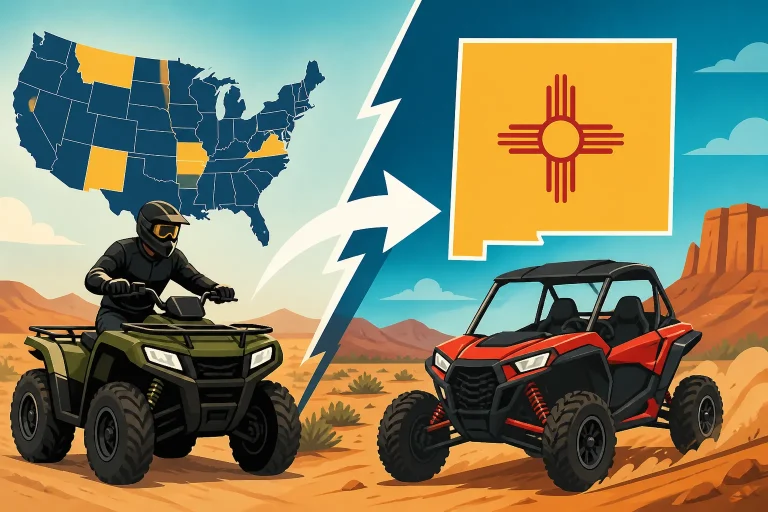
New Mexico’s reciprocity rule can be confusing: many visitors can ride on their home-state registration, but riders from states without an OHV registration program generally need a New Mexico permit. Here’s the sixteen-state list, how to choose the right permit, and what to check before you load up.
The sixteen states whose riders generally need a New Mexico permit
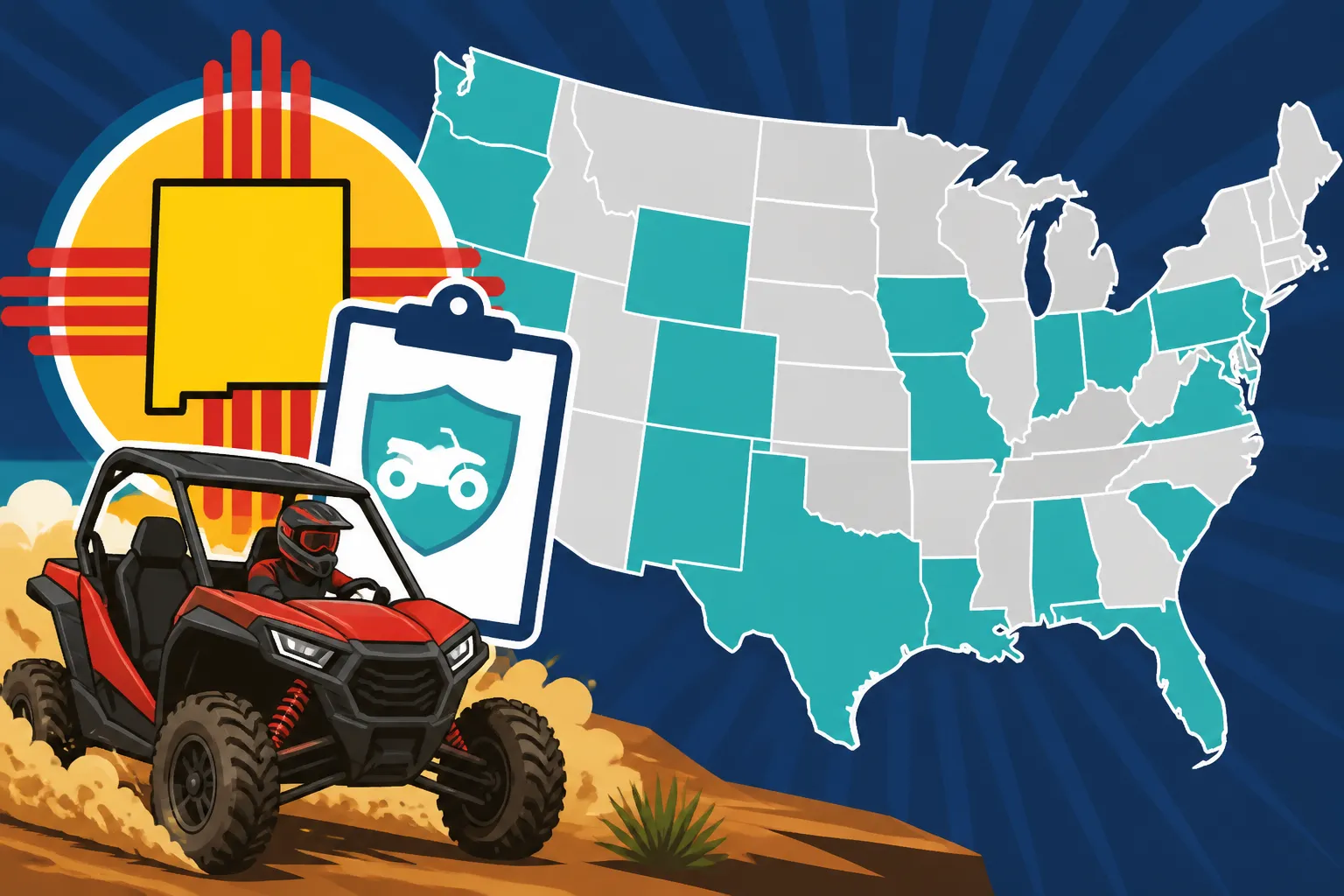
New Mexico generally requires a nonresident OHV permit when the machine is from a state without an OHV registration program. The sixteen states commonly identified for this rule are:
| State | State | State | State |
|---|---|---|---|
| Alabama | Alaska | Connecticut | Delaware |
| Hawaii | Illinois | Indiana | Iowa |
| Kentucky | Maryland | Massachusetts | Mississippi |
| Missouri | New Jersey | Tennessee | West Virginia |
If your ATV, UTV, dirt bike, or other off-highway vehicle is associated with one of these states, plan to get a New Mexico nonresident permit before riding. The list is about a state’s OHV registration system, not simply whether your machine has a license plate, a title, or a document that looks like registration. Confirm the current list and requirements with the New Mexico Department of Wildlife before your trip, especially if your state’s rules or your machine’s paperwork are unusual.
The key distinction is that New Mexico recognizes valid OHV registration from states with qualifying programs. If your home state has no OHV registration program, there may be no equivalent registration for New Mexico to recognize. The nonresident permit fills that gap. For the broader rule, see New Mexico’s Broad OHV Reciprocity and New Mexico’s Nonresident OHV Permit.
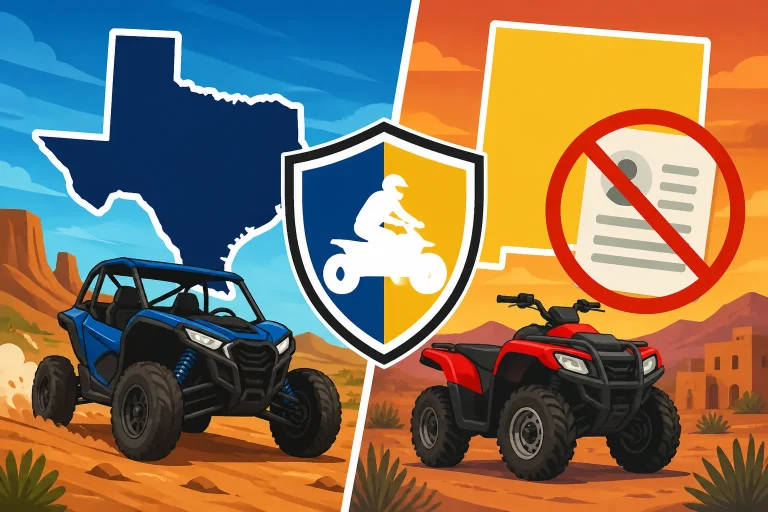
If your home state is not on the list, that does not automatically mean you can ride without paperwork. You may need to carry valid registration from your state. The practical question is not just “Where do I live?” but “What proof does New Mexico recognize for this machine?” Any Valid OHV Registration Counts in New Mexico explains that distinction. Visitors from nearby states can also check the state-specific guidance for Why Arizona Riders Need No New Mexico Permit, Why Colorado Riders Need No New Mexico Permit, and Why Texas Riders Need No New Mexico Permit.
How New Mexico reciprocity works
Reciprocity is a way for New Mexico to recognize an out-of-state OHV registration rather than requiring visitors to register the same machine again. It can save a rider from buying a New Mexico nonresident permit, but it applies only when the machine’s paperwork qualifies.
Think of the rule as two separate paths:
- Your machine has valid registration from a state with an OHV registration program. Carry that registration while riding in New Mexico. It may satisfy the state’s basic nonresident OHV permit requirement.
- Your machine comes from a state without an OHV registration program. Get the applicable New Mexico nonresident permit before riding.
This is why a state list is useful, but it is not the only thing to check. A machine’s paperwork may not match the rider’s current residence. You might have moved recently, bought the vehicle out of state, borrowed it from a friend, or brought a machine that is titled but not registered. In those situations, don’t assume a title, bill of sale, purchase receipt, or vehicle plate is a substitute for OHV registration. Confirm what documents the state accepts for your specific circumstances.
Registration, title, and permit are different things
These terms are easy to mix up:
- Registration generally shows that the machine is recorded under a state’s OHV program and may include a registration card or decal.
- Title is a document showing ownership. A title alone does not necessarily prove that the machine is currently registered for OHV use.
- Nonresident permit is New Mexico’s requirement for certain visitors whose home state does not provide a qualifying OHV registration.
- Paved-road permit or authorization relates to a separate kind of road use. It should not be confused with the basic nonresident OHV permit.
For example, a rider may have a title from a state but no current OHV registration. That does not automatically make the title enough to ride in New Mexico. If you are uncertain what document you have, compare it with the state’s registration requirements and ask the New Mexico agency before leaving home.
The permit is not ownership paperwork, either. Buying one does not establish that you own a machine or resolve a missing-title problem. If you purchased a used vehicle and the ownership documents are incomplete, deal with that issue separately before your trip.
Reciprocity does not replace local riding rules
A permit or accepted registration is only one part of being ready to ride. It does not authorize every road, trail, or parcel of land. New Mexico routes may have different access rules depending on who manages the land, whether the route is designated for motorized use, and whether a closure is in effect.
You may need to check the applicable travel map or land manager’s directions even after your paperwork is in order. For federal land basics, see New Mexico Rules for Riding Federal Land. A permit does not grant access to private property, tribal land, or closed routes.
Choosing the right permit for your trip
New Mexico offers nonresident permit options intended for visitors with different trip lengths. The right choice depends on how long you plan to ride and which permit category applies to you. Permit terms and fees can change, so confirm the current options and details with the official source before paying.
The two nonresident options commonly described are a longer-term permit and a shorter visitor permit. The longer-term option may suit someone planning several visits or a longer stay. A shorter-duration option may be more practical for a brief trip. Compare the valid dates, eligible machine or rider details, and any conditions before choosing. The pages on New Mexico’s $48 Two-Year Permit and New Mexico’s $18 Ninety-Day Permit discuss those options; check the official permit information for current terms and costs.
Do not choose solely by the name of a permit or by something a friend bought on a past trip. Check what the current permit covers, when its validity begins and ends, and whether it must be associated with a particular machine. Keep a copy of the confirmation and any permit number so you can show proof if asked.
Keep the paved-road requirement separate
A nonresident OHV permit is not automatically permission to ride on pavement. New Mexico has separate requirements for certain paved-road use, and road access can depend on the machine, the road, and the local rules. A sticker, plate, or permit intended for one kind of use should not be treated as a substitute for another.
Even where a paved-road option exists, it does not turn every highway or street into an OHV route. State highways, local streets, and county roads can have different restrictions. Before planning a route that uses pavement, check the rules for the specific road and machine. The basic distinction is covered in New Mexico Paved Road Plate Requirements.
If your plan is simply to trailer to an OHV area and ride designated off-highway routes, you may not need to address paved-road use at all. If you expect to ride a short pavement connection, cross a roadway, or travel through a town, investigate those rules separately rather than assuming a nonresident permit covers them.
A youth safety permit is another separate requirement
A New Mexico nonresident OHV permit and a youth safety permit serve different purposes. A minor may need to meet safety-course or supervision requirements even when the machine’s registration or nonresident permit is valid. An adult’s paperwork does not automatically satisfy a young rider’s requirements.
Check the age-specific rules for every young person who will operate a machine, not only the person who owns or registered it. Review New Mexico’s Safety Permit for Under-18 Riders before the trip. Also make sure the planned route, machine size, passenger arrangement, and level of adult supervision are appropriate for the rider’s age and experience.
How to get ready before you leave home
Sorting out paperwork before the trailer is packed is much easier than trying to solve a registration question at a trailhead. Use this sequence to reduce the chance of arriving without the required proof.
- Identify the machine and its home-state paperwork. Write down the state where it is registered, if any, and check whether that state has an OHV registration program.
- Compare your situation with the sixteen-state list. If the machine comes from one of those states, assume you will need the applicable New Mexico nonresident permit unless the official guidance confirms an exception.
- Check the permit options directly with New Mexico. Confirm current requirements, terms, valid dates, and accepted purchase methods.
- Purchase the permit before riding. Do not rely on being able to buy one at the trailhead or after you arrive. If the state provides a particular purchasing channel, follow its instructions and save the confirmation.
- Carry the proof with the machine or rider as directed. Keep any registration document, permit confirmation, and required identification accessible. A phone screenshot can be useful, but do not assume it is the only acceptable proof unless the official rules say so.
- Check other requirements. Consider youth safety rules, insurance where relevant, equipment, land access, and road restrictions.
- Recheck conditions just before the ride. A route can close, a fire restriction can change, or a land manager can update access instructions.
Keep proof easy to find
A permit is most useful when you can produce it quickly. Keep the original or accepted proof in a secure, dry place, and save a backup copy on your phone. If you carry paper, a waterproof document pouch can help protect it from dust, rain, mud, or a damp gear bag. Some riders order a basic pouch through Amazon; a simple outdoor-store sleeve works just as well if it keeps the document readable and secure.
Don’t leave the only copy loose in a trailer, under a seat where it can get wet, or in a vehicle parked far from the riding area. If your permit is digital, take a screenshot or download the confirmation when you have a reliable connection. A remote trailhead may not have cell service, and a web page that will not load is not much help during a roadside check.
A second practical step is to keep the paperwork together. You might use one small folder for the permit, registration card, insurance proof if required, and emergency contact information. A pouch from Amazon can be one option, but the important part is having a consistent place for the documents and checking that they remain legible. Before each trip, confirm you packed the paperwork rather than assuming it is still in the machine from the last ride.
If the website or purchase process is unclear
If you cannot tell which permit applies, do not guess based on a search result, social post, or an old receipt. Start with the New Mexico agency’s current permit instructions. If the issue is whether the machine qualifies for reciprocity, explain the home state, the machine type, and the exact paperwork you hold. That makes it easier to get an answer that fits your case.
Save any written confirmation you receive. If you purchase a permit online or by another approved method, retain the receipt and note the permit number. If the permit is mailed or requires an additional step, allow time for that process before your trip. A purchase confirmation may not be the same thing as the final document you need to carry, so follow the instructions carefully.
If you need an in-person option, check the current list of sellers or offices before driving there. Locations and availability can change. Where to Buy a New Mexico OHV Permit can help you understand the purchase routes, but confirm the current details before making a detour.
Common situations that cause confusion
The state list answers the simplest case: a machine from one of the listed states generally needs a New Mexico permit. Real trips are often less tidy. These examples show how to think through common situations without treating a guess as a legal answer.
You live in a listed state but the machine is registered elsewhere
A rider’s residence and a machine’s valid registration may point to different states. Don’t assume that the rider’s home address alone decides reciprocity. Check the official rule for the machine’s registration and the proof the rider must carry. If the machine is validly registered in a state with a recognized OHV program, that may matter even if the owner now lives elsewhere. If it is not registered, or the registration is expired, ask New Mexico what applies.
You live in a state with a program, but your machine is not registered
The existence of an OHV program in your state does not necessarily mean an unregistered machine has qualifying proof. Reciprocity is not the same as a blanket exemption for every resident of every state. If your state offers registration and you have not completed it, check whether New Mexico requires current registration or allows another form of proof. Do not assume a bill of sale or title will take its place.
You are borrowing a machine
Ask the owner for the current registration or permit documentation before you leave. Confirm that the documents match the machine you will ride, and check whether the proof must be carried by the operator or kept with the vehicle. If the machine comes from one of the sixteen states, the owner’s lack of a state registration program may mean you need to arrange the New Mexico permit. The owner’s verbal assurance that “it’s all registered” is not a substitute for seeing the paperwork.
You are renting an ATV or UTV
Ask the rental company what permit or registration the machine already carries and what the renter must do. A rental machine’s paperwork may differ from the customer’s personal machine, and a rental operator may provide instructions or documentation. Do not assume every rental includes every permit, safety credential, or land-use authorization. Confirm what is included before booking and again at pickup.
If a minor will ride, ask separately about age restrictions, supervision, and safety permits. A rental company’s approval does not necessarily resolve every state requirement. For more on rented machines, see New Mexico Rules for a Rented Machine.
You recently moved to New Mexico
A permit meant for a nonresident visitor may not be the right long-term solution after you become a resident. Moving can affect registration and titling obligations, so check the process for bringing an OHV into New Mexico rather than relying on a visitor permit indefinitely. The questions of residency, ownership, title, and registration are related but not interchangeable.
You have a title but no registration card
A title helps establish ownership, but it may not show current OHV registration. If you cannot find the registration document, first contact the state or agency that issued it to learn whether a replacement or verification is available. Then ask New Mexico what proof it accepts in the meantime. Avoid waiting until the morning of the ride to discover that the document you expected to use is missing.
You are hauling several machines from different states
Check each machine independently. A group may include vehicles with different registrations, different owners, or different types. One person’s valid permit does not necessarily cover everyone else’s machine. Make a simple list with each machine’s identification, home-state paperwork, and permit status. This is especially useful for family trips, club rides, or mixed groups where one person has handled all the planning.
The permit is not a pass for every New Mexico route
Once you have a qualifying registration or nonresident permit, the next job is choosing legal routes. The permit addresses a visitor’s OHV paperwork; it does not override land-management rules, closures, or access restrictions.
New Mexico riding opportunities include areas managed by federal agencies, local governments, and other landowners. Each may use designated routes, seasonal closures, or access conditions. Follow posted signs and current travel maps. A route that appears on an old map, a phone app, or a friend’s saved GPS track may no longer be open to motorized use.
Check the land manager’s route information
Before unloading, identify who manages the land and where motorized travel is allowed. On federal land, use the current travel-management information from the relevant office. On private land, get permission from the landowner. Tribal lands and state trust lands have their own access requirements, so do not treat them as open simply because they appear between public areas on a map.
Also check for temporary closures. Fire restrictions, weather damage, maintenance, wildlife concerns, and seasonal conditions can change access. A permit does not authorize travel around a closure gate, past a closed-route sign, or outside a designated route.
A map or phone app is not necessarily legal proof of access
Digital maps are useful for navigation, but they can lag behind official changes. Use them alongside the current land manager’s route information rather than as the sole authority. Save relevant maps before you lose cell service, and keep enough information to recognize route numbers and boundaries on the ground.
If a route sign conflicts with a saved track, stop and follow the posted closure while you verify the situation. The few minutes spent checking are better than risking a citation, damaging sensitive ground, or getting stranded on a route that is not open.
Carry the documents and equipment the ride requires
At a minimum, know what proof of registration or permit you must carry. Depending on the machine, rider, location, and planned road use, there may also be requirements for helmets, eye protection, lights, sound levels, spark arresters, or insurance. Those rules are separate from the sixteen-state reciprocity question.
Pack for the conditions, too. A New Mexico ride can mean heat, dust, altitude, changing weather, long distances between services, and limited phone reception. Bring water, basic tools, recovery equipment appropriate to your machine, and a way to contact help if you lose coverage. Paperwork keeps the administrative side in order; it does not replace good preparation.
A practical pre-ride checklist for out-of-state riders
Before you set out, work through this checklist for every ATV, UTV, dirt bike, or other OHV in your group.
- State and registration: Identify the machine’s state registration and confirm whether it is current.
- Sixteen-state check: If the machine is from Alabama, Alaska, Connecticut, Delaware, Hawaii, Illinois, Indiana, Iowa, Kentucky, Maryland, Massachusetts, Mississippi, Missouri, New Jersey, Tennessee, or West Virginia, plan on a New Mexico nonresident permit unless official guidance confirms otherwise.
- Permit selection: Compare the current short-duration and longer-term options. Check the period of validity, eligibility, and purchase instructions.
- Proof: Carry the permit or valid registration in the form New Mexico accepts. Save a backup copy.
- Riders under eighteen: Check whether each young operator needs a safety permit, supervision, or other age-specific measures.
- Pavement: If any part of the route uses pavement, check that road’s separate OHV rules. Do not treat the nonresident permit as automatic road authorization.
- Land access: Check current travel maps, signs, closures, and permission requirements for the land you plan to ride.
- Rental or borrowed machine: Confirm which paperwork belongs with the machine and what you, as operator, must carry.
- Trip timing: Verify current permit details and route conditions shortly before departure, not only when you first plan the trip.
- Group responsibility: Make sure each rider knows which machine they are using and where its paperwork is stored.
A simple example helps: a visitor bringing a quad from a listed state should not count on a title or a purchase receipt as the New Mexico permit. They should confirm the current nonresident option, obtain it before riding, carry proof, and then separately check whether the chosen trail system is open. A visitor with valid OHV registration from a state with a recognized program may be able to rely on that registration instead, but should still carry the actual document and confirm it qualifies.
For a family or group, the same process applies machine by machine. The paperwork may be different for a rented side-by-side, a borrowed dirt bike, and an owner’s ATV. Keep a record of what each machine needs, who is responsible for it, and where the proof will be carried. A few minutes of organization at home can prevent a frustrating delay at the trailhead.
The main takeaway is straightforward: riders from the sixteen listed states should expect to need a New Mexico nonresident OHV permit because their home states do not provide the registration program New Mexico recognizes for reciprocity. Riders from other states should carry valid qualifying registration rather than assuming they are exempt. In either case, confirm the current rule with the New Mexico Department of Wildlife, keep the paperwork accessible, and remember that registration or a permit does not replace route access rules.
Disclaimer
This article is for general informational purposes only and does not constitute professional advice. Laws, prices and regulations vary by location and change over time. Consult a qualified professional for guidance on your specific situation.