New Mexico Rules for Riding a Grazing Allotment
A grazing allotment can look like open country, but that does not automatically make every pasture, track or ranch road legal to ride. In New Mexico, the key is to identify who manages the land, check whether motorized use is allowed on your route, and respect livestock operations and closures. Here’s how to check before setting out.
A grazing allotment is not an open riding area
A grazing allotment is land assigned or authorized for livestock grazing. In New Mexico, allotments may cover public land managed by a federal agency, private land, or a patchwork of both. The visible landscape rarely tells you where one type of land ends and another begins.
The important distinction is that grazing permission and motorized recreation permission are separate. A rancher’s authorization to graze livestock does not, by itself, make a road or pasture open to ATV or UTV use. Likewise, seeing cattle, fences, water tanks or a ranch track is not proof that the route is public or open to vehicles.
If part of the allotment is federal public land, riding is generally governed by the managing agency’s motorized-use rules, route designations and closures. An open grazing allotment may contain routes that are open to motor vehicles, closed routes, and areas where cross-country riding is not allowed. If the allotment includes private land, you need the landowner’s permission to ride there unless a specific public access right applies. Tribal land also has its own access rules; do not assume a public-looking road is open to visitors.
A useful starting point is to identify the land manager and then check its current map and notices. New Mexico Rules for Riding Federal Land gives a broader overview, while Designated Routes and Travel Management in New Mexico explains why being on public land does not necessarily mean you can ride wherever you like.
Do not rely only on a phone map, an old trail file, a fence line or a route someone described online. Maps can show property boundaries and designated routes differently, and route status can change. Confirm your planned route with the agency responsible for that land, especially where public and private parcels meet.
Check the land, route and access before riding
Before you load the machine, work out three things: where the route goes, who manages the ground, and whether motorized travel is currently allowed. This is particularly important around ranches, where a track may serve grazing operations but not be open for recreation.
| What you find | What it means for your ride | What to check |
|---|---|---|
| A designated motorized route on public land | Riding may be allowed on that route, subject to current restrictions | The agency’s route map, seasonal closures and vehicle limits |
| A road or trail with no clear route designation | Its appearance does not establish that it is open | Ask the land manager before using it |
| Private land within or beside an allotment | Public land access may not continue across the private parcel | Get permission or choose a route that stays on authorized ground |
| A closed gate, posted restriction or closure notice | Do not treat the route as open just because it appears on a map | Follow the sign and check for an official update |
| A grazing allotment boundary | It identifies a grazing-management area, not an automatic riding route | Check parcel ownership and motorized-use designations separately |
On national forest land, use the applicable forest’s current motor vehicle map and closure information. On Bureau of Land Management land, check that office’s travel-management information. The two agencies may manage adjacent areas under different route systems. [New Mexico Rules for Riding a National Forest] and New Mexico Rules for Riding BLM Land can help you understand those differences.
Plan around the exact route rather than treating the whole allotment as one riding area. Note where your route enters and leaves the allotment, where it crosses a boundary, and whether a private parcel or restricted area interrupts access. If the map is unclear, contact the responsible land office before riding. A quick clarification is better than discovering a boundary issue after you have driven onto a ranch road.
Verify access at boundary crossings
A route that starts on public land can cross private property or pass through land with limited access. Look for signs and posted restrictions, but remember that a lack of signs does not necessarily grant permission. If you are unsure whether a road crosses private land, do not use it until you have confirmed access.
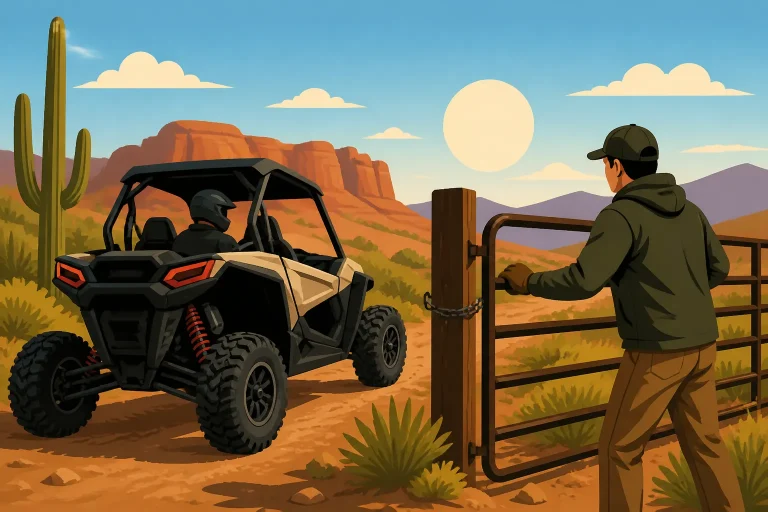
A gate also does not tell you who may pass through it. Some gates are on public routes; others control access to private property, livestock or a closed area. When you have confirmed that the route is open and the gate is meant for through traffic, follow any posted directions and leave it as you found it. Why You Close Every Gate Behind You explains the practical reason this matters to livestock operators.
Never make a new route around a gate, fence or closure. Driving around an obstacle can damage property, disturb livestock and take you onto land where you do not have permission to ride. If a route is blocked, stop and find an authorized alternative.
Ride in a way that protects livestock and the route
Livestock may be spread out across a large area, and animals can appear around a bend or near water with little warning. Slow down when you see cattle, horses, sheep or working vehicles. Give animals room, avoid sudden acceleration, and do not chase, crowd or try to move them with your machine. If a herd blocks the route, wait at a safe distance and allow it to clear rather than driving through the group.
Water sources deserve particular care. Tanks, troughs, springs and stock ponds can be important to livestock and wildlife in dry country. Keep your machine out of the water and away from muddy or sensitive edges. Do not use a watering point as a turnaround or staging area unless you have confirmed that it is an appropriate place to stop.
Stay on the authorized route. Driving across open ground can damage vegetation and soil, create tracks that other riders may follow, and interfere with grazing operations. Avoid cutting corners, widening a trail or making a parallel route around mud. If a route is too rough or wet for your machine, turn around rather than creating a new line.
Dust and noise matter, too. Dust can reduce visibility for other riders, ranch workers and vehicles. Ease off near homes, livestock and work areas. Make sure your machine meets applicable equipment rules for the land and route; the agency may have requirements such as a spark arrester or sound limits. Check the current rules rather than assuming a machine legal for one area is automatically acceptable everywhere.
A few habits make a ride through grazing country safer and less disruptive:
- Reduce speed when approaching livestock, people, gates, water or a blind rise.
- Keep enough distance to let animals move without being pressured.
- Do not stop in a way that blocks a ranch road or access to a water facility.
- Pack out trash and avoid leaving food that can attract animals.
- Do not touch, move or damage fences, livestock equipment or water infrastructure.
- Turn around if you cannot confirm that a route is open.
These are good practices even where a rule does not spell out every situation. Responsible riding helps maintain access and reduces the chance that a land manager or ranch operator will need to restrict a route.
Check permits and carry the information you need
Land access and rider paperwork are separate questions. A permit or registration does not give you permission to cross private land or ride a closed route. But you may still need the right registration or permit for the machine and the kind of riding you plan to do.
New Mexico residents should check the state’s registration requirements for their vehicle. Visitors should confirm whether their home-state registration is recognized or whether they need a New Mexico nonresident OHV permit. Reciprocity depends on the state and applicable rules, so do not assume that an out-of-state plate or sticker covers every visitor requirement. New Mexico’s Nonresident OHV Permit and Riding New Mexico With an Out-of-State Registration explain what to check.
Riders under 18 may also have safety-permit requirements. Confirm the rules for the rider’s age and circumstances before the trip; New Mexico’s Safety Permit for Under-18 Riders covers that topic. For riding on public land, check any additional agency requirements and make sure each rider understands where the group is allowed to travel.
Before leaving, save or carry the route information you used, including the relevant motorized-use map and any closure notices. Cell service may be unreliable in remote areas, so an offline map or paper copy can help you stay on the route. Tell someone where you plan to ride and when you expect to return. If there is a boundary question at the trailhead, contact the land manager rather than treating another rider’s assumption as confirmation.
A practical pre-ride check looks like this:
- Identify the land manager and any private or tribal parcels along the route.
- Confirm that each road or trail is open to your vehicle type.
- Check current seasonal closures, fire restrictions and temporary notices.
- Confirm the machine’s registration or permit requirements and any age-related rules.
- Carry route details and leave gates, fences and livestock facilities undisturbed.
A grazing allotment can include legitimate riding opportunities, but it is not a blanket invitation to use every visible road or open field. The safest approach is to verify access route by route, stay within designated motorized areas, and treat the livestock operation as active working ground.
Disclaimer
This article is for general informational purposes only and does not constitute professional advice. Laws, prices and regulations vary by location and change over time. Consult a qualified professional for guidance on your specific situation.