Riding Near a Pronghorn Herd
Spotting pronghorn while riding in New Mexico can make a trail day feel unforgettable, but the sighting can turn stressful if a machine approaches too fast or blocks the herd’s route. This guide explains how to give pronghorn room, ride responsibly through their habitat, and plan around terrain, land access, and seasonal conditions without treating wildlife encounters as part of the ride.
How to respond when you see pronghorn
Slow down early and give the herd room
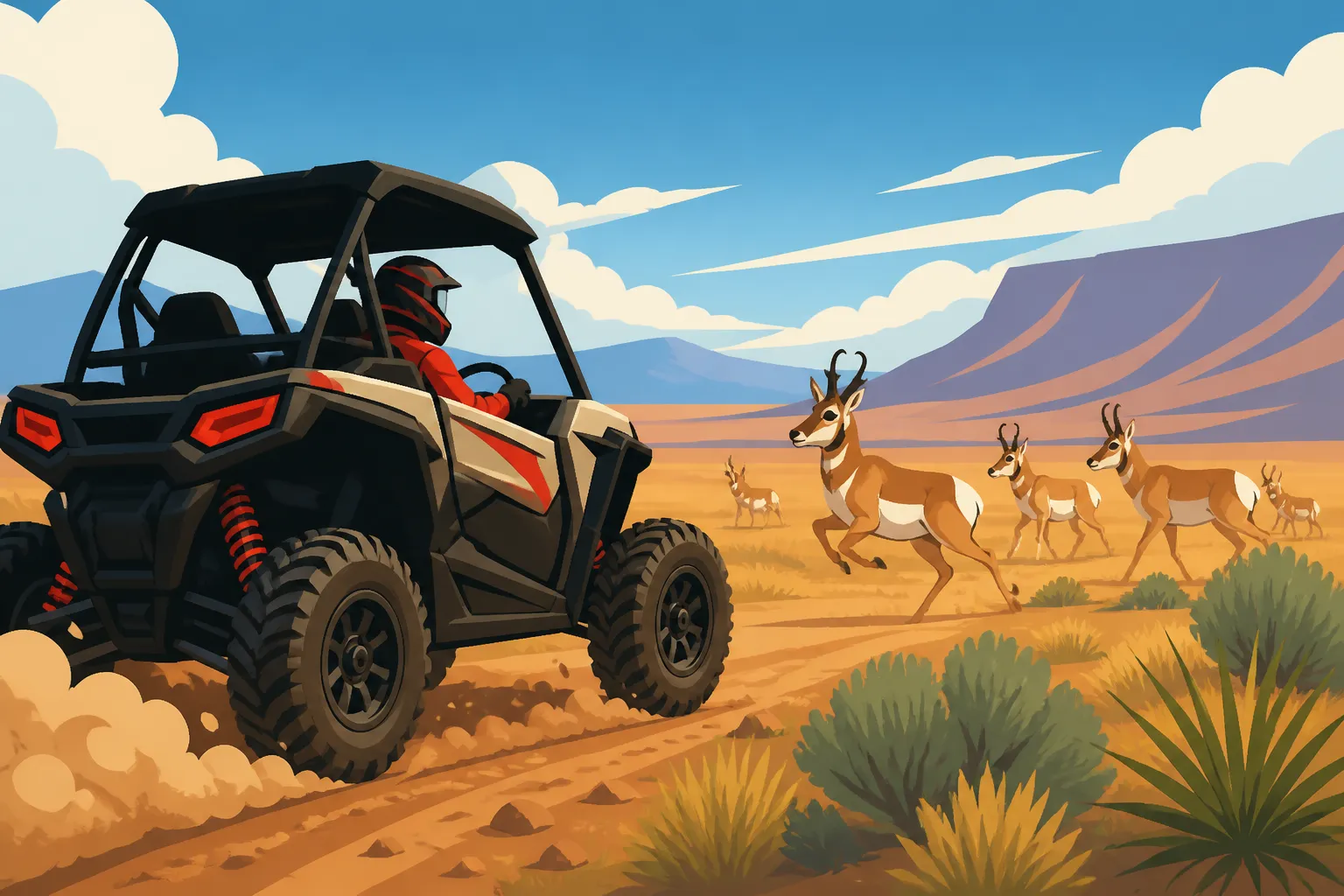
If you see pronghorn ahead, ease off the throttle well before you reach them. Sudden acceleration, engine noise, and a machine appearing quickly over a rise can startle wildlife that may already be watching or listening. If the herd begins moving away, stop and let it continue rather than following to keep it in view.
Give the animals a wide berth, and avoid riding between members of a group. Pronghorn may be spread across open ground, so the closest animal is not necessarily the only one nearby. Look carefully for animals farther out, especially if the group is moving across the trail or through grassland. If you cannot tell where the herd is headed, stay put until it has moved away from your route.
A useful rule is simple: do not make an animal change direction or speed because of your approach. If it has to run, bunch up, or repeatedly look back at you, you are too close or lingering too long. Let the encounter end on the animal’s terms.
Never pursue, surround, or feed them
Do not chase pronghorn for a closer look, a photograph, or a better video. A fast-moving animal may run across uneven ground, toward a road, or into another hazard. Pursuit can also keep it from resting or feeding. Even if the herd runs only a short distance, following it on an ATV or UTV can turn a brief disturbance into a prolonged one.
Avoid circling around a herd or stopping on several sides of it. A vehicle that blocks the animals’ easiest exit can leave them feeling trapped, even if the riders intend to stay still. If you are traveling with a group, let the lead rider signal a stop and keep everyone together at a safe distance. Do not have separate machines approach from different directions.
Food and bait do not belong in a wildlife encounter. Feeding pronghorn can draw them closer to people and vehicles, creating risks for the animals and for future trail users. Keep snacks secured, pack out litter, and give wildlife the same quiet space you would want other riders to give you.
Plan rides through pronghorn habitat responsibly
Expect encounters in open country
Pronghorn are associated with open landscapes, so riders may see them across grassland, broad plains, and sparsely treed country. In New Mexico, open terrain around the eastern plains and areas near Roswell can offer the kind of expansive views where wildlife is visible at a distance. That does not mean pronghorn will be present at a particular trail or on a particular day; sightings are never guaranteed.
The open view can make an encounter seem farther away than it is. Heat shimmer, rolling ground, and the scale of the landscape can distort distance. Slow down near blind rises, trail junctions, and places where the route runs alongside grassland. Scan ahead and to both sides instead of looking only at the track immediately in front of your machine.
Before choosing an area, check what land you will cross and which routes are open. A visible track is not automatically a legal or authorized route. Use official land-manager information for access and closures, and treat mapping apps as planning aids rather than permission to ride. onX Offroad can help you review mapped routes and nearby land boundaries, but confirm route access with the relevant agency or landowner before setting out.
For background on shared-land practices, read New Mexico Trail Etiquette on Shared Ground and [New Mexico Rules for Riding a Grazing Allotment]. Gates, fences, and grazing activity can mark working land or boundaries, so don’t assume that an open gate means every route beyond it is available to ride.
Choose routes and timing with care
If wildlife is a priority, choose a route that lets you ride at a measured pace and stop safely without blocking traffic. Avoid racing through open country or treating distant animals as a reason to leave a designated trail. Where the landscape allows, stop in a stable, visible place well away from the herd and keep the engine quiet.
Seasonal conditions matter. Pronghorn may have young in spring and early summer, and a fawn can remain still in vegetation while its mother is elsewhere. A motionless young animal is not necessarily abandoned. Do not approach it, touch it, or wait nearby for the adult to return. Move away calmly and leave the area undisturbed. If an animal appears injured or in immediate danger, contact the appropriate wildlife authority rather than trying to handle it yourself.
Weather and trail conditions also affect how carefully you need to ride. Dust can obscure animals and other riders, while rain can make some routes muddy or vulnerable to damage. Review New Mexico Trail Closures to Check First, Dust and Visibility on a Desert Trail, and New Mexico Riding Seasons by Elevation while planning. For a wider overview of riding conditions and access, Where to Ride an ATV in New Mexico can help you think through the differences among riding areas.
| Situation | Better response | Avoid |
|---|---|---|
| A herd is on or beside the trail | Slow down early, stop at a safe distance, and wait for the animals to move away | Accelerating toward the herd or riding between animals |
| Pronghorn move away from you | Stay put and let them leave the area | Following them to keep them in sight |
| A fawn is lying in grass | Give it space and continue away without touching it | Picking it up or waiting nearby for its mother |
| You are unsure whether a route is open | Check with the land manager or landowner | Treating a mapped line or tire track as authorization |
| Dust or poor visibility limits your view | Reduce speed and increase your following distance | Riding at normal speed when you cannot see ahead |
Ride in a way that protects wildlife and people
Keep to authorized routes and manage noise
Staying on an authorized route helps prevent unnecessary disturbance to wildlife habitat and reduces the chance of crossing onto private, tribal, or otherwise restricted land. Do not widen a track to pass another vehicle, cut across grassland to go around a herd, or create a new path to improve your view. If wildlife is near the route, wait for a safe opportunity to continue or turn around where it is permitted and practical.
Keep your machine in good condition and avoid unnecessary revving. A loud engine can carry across open country, and repeated acceleration may alarm animals well before riders see them. Ride at a pace that leaves time to respond to wildlife, cattle, other trail users, and changing ground. If you ride in a group, agree on a spacing and hand-signal plan before leaving the staging area so a sudden stop does not cause a chain of close approaches.
A map can support planning, but it cannot tell you that wildlife is present or that a route is safe today. onX Offroad may be useful for reviewing a planned route and locating nearby boundaries, but compare what you see in the app with current land-manager notices and posted signs. If there is any doubt about access, stop and verify rather than pushing farther in.
For related riding considerations, New Mexico Riding With Livestock Around offers useful context for sharing working landscapes. Give cattle and other animals room, close gates as directed, and do not assume wildlife is the only reason to slow down.
Prepare for a quiet, safe stop
Stopping to watch wildlife is only responsible if you can do it without creating a hazard. Pull completely off the active route where the terrain and rules allow, keep the machine stable, and make sure other riders can see you. Do not stop on a blind crest, narrow section, or place where another vehicle would have to swerve around you. If there is no safe stopping place, continue at a controlled pace and leave the encounter behind.
Keep the group calm and compact. Riders should not fan out to look for a better angle, and passengers should stay with their machine. Use binoculars or a camera with a zoom if you have one, rather than moving closer. Keep voices low, avoid sudden movements, and do not use a drone or other device to push animals into motion.
Bring enough water for the conditions, especially on exposed routes where shade may be scarce. Tell someone where you plan to ride, carry a way to navigate if you lose cell service, and leave room in your schedule to turn around. New Mexico Trail Maps Worth Carrying and Carrying Water in the Southern Desert are helpful topics to consider while preparing. A wildlife sighting is not worth continuing into heat, low fuel, poor visibility, or a route you cannot confirm is open.
What to do after an encounter
Leave the area without prolonging the sighting
Once the herd has moved away, wait a moment and check that the route is clear before proceeding slowly. Do not follow the animals’ direction of travel or keep stopping to see where they went. If the herd has moved into the path you planned to take, give it time and space; if the route remains blocked, choose a permitted alternative or turn back.
If another riding group is approaching, make your stop brief and clear. Signal that wildlife is nearby without encouraging the other group to approach. A respectful encounter can easily become a crowd if each passing rider stops to watch. Keep the trail moving safely and let the animals return to their routine.
If you notice a fence, gate, or property boundary while turning around, follow posted instructions and avoid crossing onto land you have not been authorized to use. What to Do With a Gate You Find Open is a useful reminder that gates are part of working-land access, not an invitation to explore beyond the route.
Report a genuine concern, not an ordinary sighting
Seeing pronghorn near a trail is not, by itself, a reason to approach or intervene. Contact the appropriate wildlife authority if an animal appears seriously injured, is trapped in fencing, or is in immediate danger, and provide a clear location from a safe distance. Do not try to free, move, feed, or transport it. A well-intentioned rescue attempt can injure the animal or put you at risk.
For a routine sighting, the best follow-up is often simply to continue your ride responsibly. Avoid posting precise location details if doing so could draw people toward a sensitive area or encourage others to approach wildlife. If you share a photo, make sure it was taken without pursuit or disturbance.
Pronghorn encounters are most rewarding when the animals remain in control of the distance. Ride slowly, stay on routes you are allowed to use, and be willing to miss a closer view. That approach protects the herd, makes the trail safer for everyone, and leaves the landscape feeling like a place wildlife can still use on its own terms.
Disclaimer
This article is for general informational purposes only and does not constitute professional advice. Laws, prices and regulations vary by location and change over time. Consult a qualified professional for guidance on your specific situation.