Meeting a Truck on a One-Lane Road
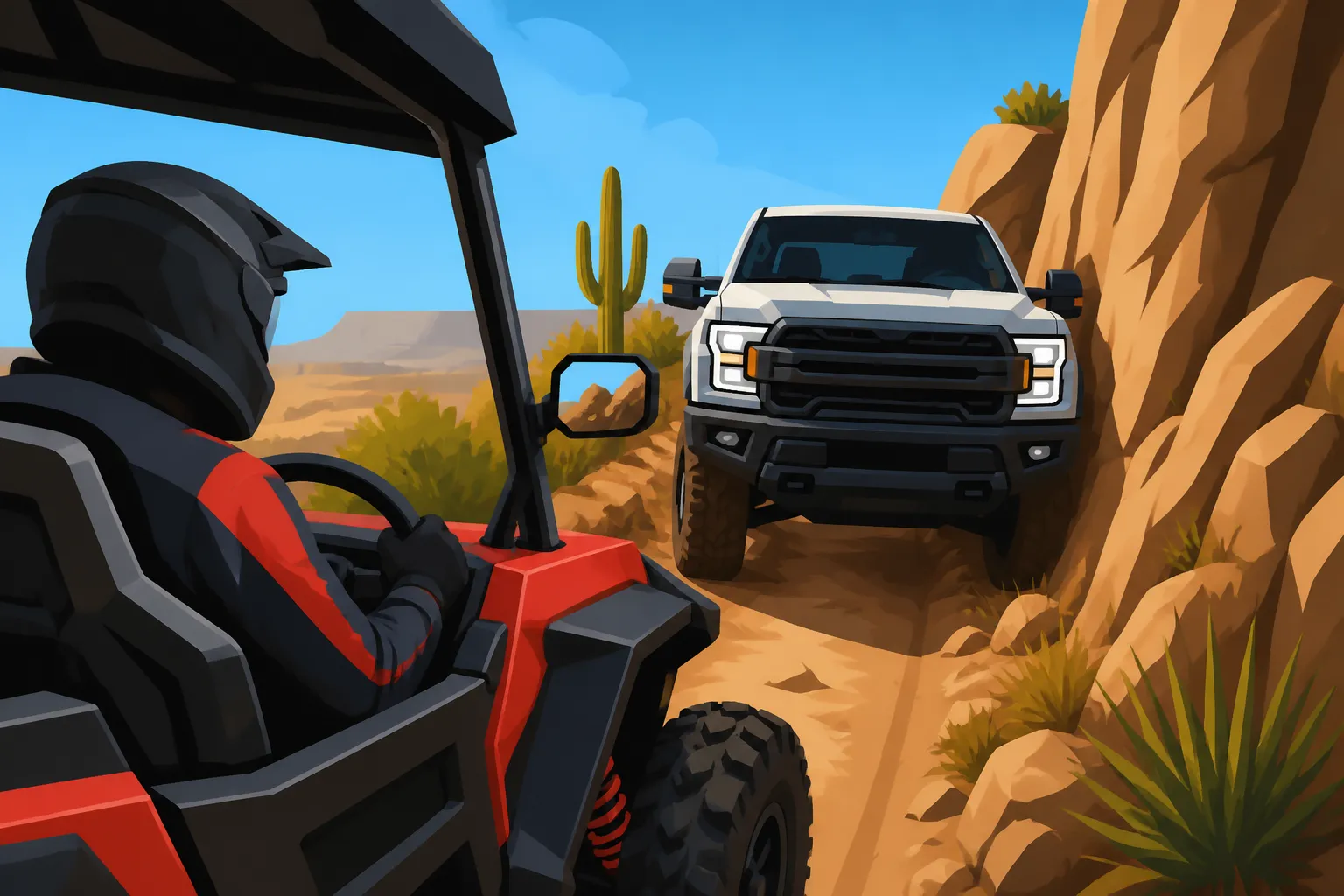
A truck appearing around a blind bend on a narrow New Mexico forest road can leave an ATV or UTV rider with very little room to react. Dust, steep grades, loose shoulders, and limited sightlines make passing stressful. This guide explains how to prepare, communicate, choose a safe place to meet, and avoid turning a close encounter into a rollover or roadside recovery.
Prepare Before You Enter a Narrow Road
Check the route and likely meeting points
A road that looks wide enough on a map may narrow where it climbs through trees, crosses a wash, or follows a shelf above a slope. Before riding, check the route type, terrain, closures, and access rules. A road marked for motorized travel does not necessarily mean every section is wide enough for two vehicles to pass safely.
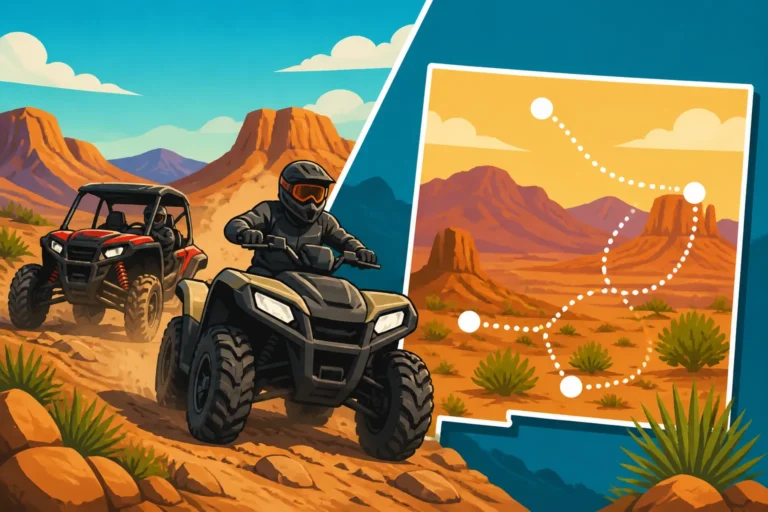
Use a current map and pay attention to junctions, staging areas, and wider stretches that might serve as passing places. Mapping tools such as onX Offroad can help you study a route before you leave, but don’t treat a line on a screen as a guarantee that a road is open, passable, or suitable for your machine. Confirm access and closures through the relevant land manager, especially when riding on national forest or BLM land. For more on access basics, see New Mexico Rules for Riding a Forest Road and [New Mexico Rules for Riding BLM Land].
If you’re riding with a group, agree on how you’ll handle an oncoming vehicle before anyone gets separated. Decide who will signal, whether riders will pull into a turnout together, and how the group will avoid blocking a junction. A brief conversation at the staging area can prevent a confusing scramble when a full-size pickup appears around a bend.
Set up your machine and group for limited visibility
Keep a sensible following distance. If the rider ahead stops suddenly to assess an oncoming vehicle, the person behind needs enough space to brake without bumping them. In dust, that gap may need to be larger than it would be on a clear road. Ride at a pace that gives you time to stop within the distance you can see.
Stay alert for signs that a larger vehicle may be nearby: fresh tire tracks, dust drifting across a slope, engine noise, or a blind bend followed by a wider turnout. A navigation app such as onX Offroad may help you understand where the route bends or joins another road, but your eyes and ears are still essential. Don’t study a screen while moving through a narrow section.
If your group uses radios, agree on a simple, familiar way to call out “vehicle ahead” and identify where it is. Without radios, use hand signals only when you can do so safely and the riders behind can see them. Keep headlights on when conditions call for extra visibility, and avoid riding side by side on a road that may narrow without warning.
What to Do When a Truck Comes Toward You
Slow down, stop, and make your position clear
When you spot an oncoming truck, reduce speed early and look for a safe place to stop. Don’t assume the driver sees you, particularly if dust, brush, glare, or a bend limits visibility. Once stopped, move as far out of the travel path as you safely can, while keeping all tires on stable ground.
Signal your intention if you can do so clearly. A calm wave or other simple gesture can help communicate that you have seen the truck and are yielding room, but don’t rely on a signal as a substitute for a safe position. Avoid sudden movements, and don’t pull off the road onto ground you haven’t assessed. A soft shoulder can give way, and a steep edge or drainage ditch can be more dangerous than waiting in place.
If there is no safe passing space, don’t force one. Stop where both vehicles can see each other and assess the situation. The truck driver may be able to reach a turnout, or you may be able to back carefully to a wider section. Make eye contact only if it’s practical, and keep the ATV or UTV under control while you decide.
Choose a passing spot, not just an open-looking gap
The safest place to pass is generally a broad, stable section with room for both vehicles and a clear view of the road beyond. Avoid trying to squeeze past at a blind corner, on a steep grade, beside a drop-off, or where a ditch, rut, or loose rock could pull a tire off line. A shoulder that looks firm from the seat may be soft, sloped, or undercut.
Look for the whole shape of the space, not just its width. Consider the truck’s mirrors, the width of your machine, the road’s camber, and whether either vehicle would need to reverse. A small turnout may fit an ATV but not a wide side-by-side, or it may provide room for the vehicles to pass only if one stays on unstable ground. If the spot doesn’t feel safe, keep looking for a better one.
Once you’ve chosen a place, make your movements predictable. The truck should be moving slowly, and your machine should be stopped or creeping only as needed. Keep hands, arms, and loose gear inside your vehicle, and don’t stand between vehicles while they pass. On shared roads and trails, courtesy and clear communication matter; New Mexico Trail Etiquette on Shared Ground offers related guidance for keeping encounters calm and considerate.
| Situation | Safer response | Avoid |
|---|---|---|
| You see a truck approaching on a straight section | Slow early, stop in a visible, stable place, and signal if appropriate | Waiting until the last moment to brake |
| The road narrows at a blind bend | Stop before the bend if you can do so safely and listen for traffic | Continuing quickly because the road seems quiet |
| A nearby turnout has a steep or soft edge | Stay on stable ground and look for a safer passing point | Driving onto a shoulder you haven’t checked |
| The truck reaches a narrow section first | Communicate calmly and let the driver assess whether a safe turnout is nearby | Gesturing impatiently or trying to squeeze by |
| Neither vehicle can pass safely | Coordinate a slow, controlled reverse to a wider section | Backing quickly without checking behind you |
When One Vehicle Has to Reverse
Coordinate before either vehicle moves
Backing on a narrow road takes care, especially if the road is steep, uneven, or bordered by a ditch. Before moving, agree on which vehicle will reverse and where it will go. If you can communicate with the truck driver, use clear, simple signals. Don’t assume that waving someone back means the road behind them is clear.
The best vehicle to reverse depends on the actual terrain and available space, not a one-size-fits-all rule. A truck may have a better view, more room to maneuver, or a suitable turnout behind it; in another situation, an ATV may be able to reach a safe wider spot more easily. The uphill or downhill position can affect traction and control, too. Consider the road surface and the skill of the person reversing, and don’t let courtesy pressure you into a maneuver that feels unsafe.
If one of your group members gets out to guide, that person should stand where the driver can see them and where they’re not exposed to a drop-off or trapped between vehicles. The guide should give one instruction at a time and pause if the driver loses sight of them. Never stand directly behind a reversing vehicle, and don’t ask someone to guide from the narrow space between the truck and your ATV or UTV.
Reverse slowly and stop if conditions change
Use a walking pace or slower, depending on the surface and grade. Keep your eyes on the route you’re backing along, check mirrors and blind spots, and use a spotter when available and safe. On a rocky or rutted road, even a short reverse can be tricky because a tire may drop into a rut or slide toward the edge.
If you’re the one reversing, stop as soon as you lose a clear view or feel uncertain about the surface. Ask for a better signal, reposition the spotter, or consider another safe option. Don’t keep moving just because the maneuver has started. If traction changes, a tire approaches an edge, or another vehicle appears behind you, pause and reassess.
A route-planning app such as onX Offroad can help you identify nearby junctions or wider areas before a ride, which may make it easier to discuss a safe meeting point with your group. It cannot tell you that a particular shoulder is firm under your tires or that a turnout is free of traffic. Make the final decision from what you can see on the ground.
Keep the Encounter Safe for Everyone
Give other road users room and time
A truck on a remote road may be a ranch vehicle, a maintenance crew, a camper, or another recreationist. The driver may not expect to meet a group of OHVs around a bend. Once you’ve passed, wait until the truck has moved clear before accelerating into dust or continuing through a tight section. Leave enough space for riders behind you to pass safely, too.
Keep livestock, pedestrians, cyclists, and other trail users in mind. A road that feels isolated can still be shared, and people may be difficult to see through dust or vegetation. If you encounter a gate, follow the posted directions and leave it as you found it. For guidance on shared access and gates, read Riding a Grazing Allotment Politely and Why You Close Every Gate Behind You.
The route itself matters as well. Stay on roads open to motorized use, follow signs, and don’t pull off onto land simply because it appears empty. Public-land access can vary by route, season, and land manager. Matching a Route Number on a Forest Sign can help riders understand why posted route information deserves attention, while Riding Etiquette on a Narrow Shelf Road covers the extra care needed where the road leaves little room for error.
Know when to turn around or wait
Sometimes the safest choice is to stop and wait for the other driver to reach a wider area. If visibility is poor, the shoulder is unstable, or neither vehicle can reverse without risk, don’t let impatience dictate the next move. A short delay is far better than a damaged machine, an injured rider, or a vehicle stuck near an edge.
Turn around if the road ahead becomes too narrow, steep, or exposed for your group’s experience and equipment. This is particularly sensible when rain has softened the shoulder, recent storms have changed a wash crossing, or dust makes it hard to see. New Mexico terrain can change quickly between desert roads, forest routes, and higher-elevation slopes, so a route that felt manageable earlier may become less forgiving as conditions shift.
After the encounter, take a moment to regroup. Confirm that every rider is present, check for loose gear or damage, and make sure nobody feels pressured to continue at a pace they can’t safely manage. If the meeting exposed a confusing junction, an unsafe turnout, or a route-access concern, note it for future planning and check current land-manager information before returning.
Disclaimer
This article is for general informational purposes only and does not constitute professional advice. Laws, prices and regulations vary by location and change over time. Consult a qualified professional for guidance on your specific situation.