Breaking Down Far From a Road
A broken ATV or UTV can turn a fun New Mexico ride into a stressful wait, especially when the nearest road is miles away and there’s no cell signal. The safest response starts before the machine fails: plan your route, carry the right recovery and communication gear, and know when a repair is too risky to attempt on the trail.
Prepare for a Breakdown Before You Ride
Plan around the route, not just the destination
A trail that looks close on a screen may be slow going in real life. Sand, loose rock, steep climbs, gates, and winding forest roads can make a short distance take much longer than expected. Before leaving, check the route’s surface, elevation, access points, and likely exit options. A useful overview of public riding areas is Where to Ride an ATV in New Mexico, but confirm the rules and conditions for the specific area you intend to visit.
Carry a map you can use without cell service, and download the area before setting out if your mapping app allows it. onX Offroad can help you review routes and save map information for offline use, but do not make a phone app your only navigation plan. A second device, a paper map, or a written route description can help if your phone battery dies or the screen is damaged. See New Mexico Trail Maps Worth Carrying for more ideas about map backups.
Tell someone who is not riding with you where you plan to go, which trailhead you’ll use, and when you expect to check in. Agree on what they should do if you miss that check-in. A vague message like “we’re riding near Farmington” is less useful than a route, a staging area, and a planned return time. If you change plans during the ride, update your contact when you have service.
Carry tools and supplies for common failures
A trail-side kit should match your machine and the places you ride. Before a trip, check the owner’s manual for the tools needed to reach common service points, such as the battery terminals, spark plug, or air filter. A basic kit might include the machine’s required hand tools, a tire repair kit suitable for its tires, a compact air source, spare fuses, electrical tape, zip ties, and work gloves. Carry only what you know how to use safely.
Think about the likely failure, not just the dramatic one. In the southern desert, a slow puncture, loose battery connection, overheated machine, or depleted fuel supply may be more likely to stop your ride than a major engine failure. A planned route should take account of fuel range and available resupply; Fuel Range Between Desert Towns is worth reviewing before a long day away from services. Do not assume a fuel gauge or a stated range will account for soft sand, steep climbs, heavy loads, or repeated stops.
Water, sun protection, and warm layers are part of breakdown preparation, too. If the machine stops moving, you may be outside longer than planned and working in direct sun or changing weather. Pack enough water for the people on the ride, not just the machine, and keep it accessible rather than buried under luggage. Carrying Water in the Southern Desert covers why a ride plan should include more than the tank’s capacity.
Build a communication backup
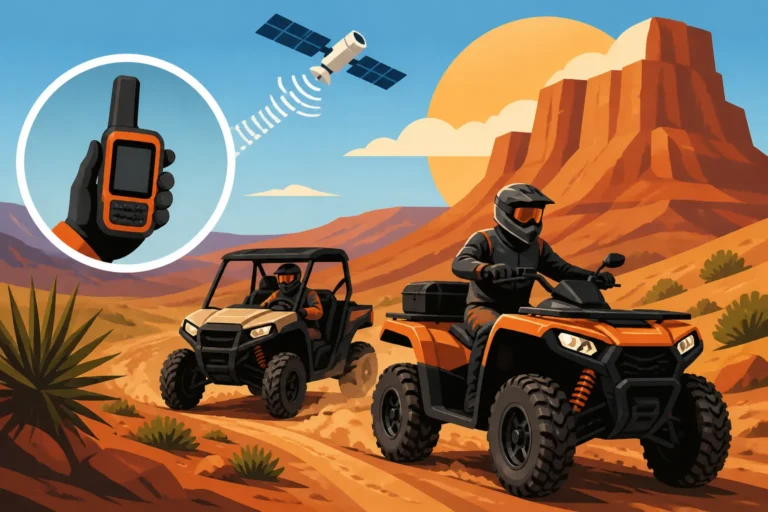
Cell coverage can disappear quickly in remote parts of New Mexico. Don’t assume that a phone showing a map can also place a call from the same spot. A satellite messenger or satellite communication device may offer a way to send a check-in or request help where ordinary cell service is absent. Learn how your device works before the ride, charge it fully, and keep it where you can reach it if the vehicle is disabled.
A satellite device is useful only if someone knows what to do with its message. Share your expected route and check-in schedule with your contact, and make sure they can distinguish a routine update from an emergency signal. Satellite Messengers in the Bootheel offers relevant planning considerations for remote riding.
Before departure, check for closures, fire restrictions, and route changes. A track shown in an app is not permission to ride every connecting road. onX Offroad can be one part of route research, but compare the information with land-management notices and posted signs. A route that is closed, private, or outside an authorized riding area should not become an improvised escape route when something goes wrong. Review New Mexico Trail Closures to Check First and Riding BLM Land in New Mexico as part of your planning.
What to Do When Your ATV or UTV Stops
Stop, assess, and keep the group together
When a machine fails, stop somewhere stable and safe if you can. Avoid blocking a narrow trail or sitting in a blind spot where another rider or vehicle might approach. On a slope, use the parking brake and follow the manufacturer’s instructions for securing the machine. If the vehicle is unstable, leaking, smoking, or in a position where it could roll, prioritize people’s safety over tools or cargo.
Take a moment to check whether anyone is injured, overheated, or otherwise in distress. In desert heat, a rider who feels confused, weak, nauseated, or unusually dizzy needs attention; don’t leave them alone to troubleshoot the vehicle. Move the group to a safer nearby place if the machine itself presents a hazard, while keeping within sight or contact if possible. If there is an immediate threat to life or a serious injury, use your available emergency communication method and request help.
If several machines are traveling together, keep the group organized. One person can remain with the disabled vehicle while another communicates or checks the route ahead, but splitting up should never mean sending someone off without water, navigation, and a clear plan. Don’t assume the closest trail junction leads to a road or that another rider will know where you went. Mark the location on your map or device before moving away.
Diagnose only what you can fix safely
Start with simple checks that do not expose you to avoidable danger: confirm the machine is switched off as directed by its manual, look for an obvious loose connection, inspect a tire, and check whether a fuse or other accessible component appears damaged. Let hot components cool before touching them. Keep hands, clothing, and tools clear of moving parts, and never run the machine in a way that creates an exhaust hazard for people nearby.
Use your machine’s manual rather than guessing at a repair. A repair that seems straightforward in a driveway may be difficult on uneven ground, in windblown dust, or without the correct tools. Do not remove safety-critical components or attempt a repair if you are unsure how to put them back correctly. A temporary fix that fails on a steep descent or remote trail can put the whole group at greater risk.
Here’s a practical way to decide whether to troubleshoot, recover, or call for help:
| Situation | Safer next step |
|---|---|
| Minor issue with a clear, familiar fix | Repair only if the machine is stable and you have the right tools |
| Flat tire and suitable repair equipment | Follow the tire and vehicle manufacturer’s guidance, then reassess before riding |
| Fuel shortage or a problem beyond your skills | Contact your riding group or support person; avoid walking far without a plan |
| Smoke, fire, fuel leak, unstable machine, or serious injury | Move people away from danger and request emergency assistance |
| No reliable route out or worsening weather | Stay together, communicate your location, and avoid an improvised cross-country exit |
A fix is not automatically safe just because the engine starts again. Check for warning lights, unusual sounds, leaks, steering problems, and changes in braking or handling. If you cannot tell whether the machine is safe to ride, do not continue into more remote terrain.
Decide whether to wait or move
The choice between staying put and moving depends on immediate hazards, weather, daylight, communication, and how far a known safe location is. If the breakdown site is stable, people are well, and help can locate you, waiting together is often safer than walking an unfamiliar route. If the location itself is dangerous, move only as far as needed to reach a safer spot, and leave clear information about where you went if doing so is safe.
Do not leave an injured or unwell person alone. If a rider has a serious injury, limit movement unless there is an immediate danger where they are. Contact emergency services using any available method and follow the instructions you receive. If the group has a satellite messenger, use it according to its emergency procedure rather than relying on a delayed check-in message.
As daylight fades, temperatures change, or a storm approaches, reassess your plan. A walk that might seem manageable at noon can become much more dangerous in darkness, heat, cold, or rough terrain. Avoid splitting up to look for a road unless you have a clear route, proper supplies, and a reliable way to stay in contact.
Recover the Machine Without Creating a Bigger Problem
Use a tow or winch cautiously
A tow strap or winch can help with a disabled machine, but recovery can be dangerous if the connection points, terrain, or people’s positions are wrong. Read the vehicle and recovery-gear instructions before using them. Attach only to designated recovery points, keep people clear of a loaded strap or cable, and avoid standing in the line of pull. Never use a hitch ball as a recovery point unless the equipment is specifically designed and approved for that purpose.
A recovery attempt can make a stuck machine less stable. Sand may shift under the tires, and a rocky slope can cause a vehicle to slide or roll when tension is applied. If the machine is at an angle, near an edge, caught in deep mud, or blocking a narrow trail, don’t improvise a high-force pull. Stop and call for experienced help if you cannot manage the recovery with the equipment and knowledge you have.
Keep the group’s roles simple. One person should direct the operation, while everyone else stays clear of the vehicle and recovery line. Agree on a stop signal before applying tension. A shouted instruction can be hard to hear over an engine, wind, or helmet noise, so do not begin until everyone understands how the operator will stop.
Avoid damaging the trail or nearby land
A disabled vehicle is frustrating, but cutting a new route across the landscape can create lasting damage and may violate access rules. Stay on authorized routes and use existing staging or access points when arranging assistance. Do not drive around a closure, cross an unmarked boundary, or take a shortcut across vegetation because it seems like the quickest way out. New Mexico Trail Etiquette on Shared Ground is useful background for handling difficult situations responsibly.
Dust, low visibility, and other riders can add risk while you work. Park where approaching traffic can see you, use appropriate warning signals if you carry them, and keep children and passengers away from the recovery area. On a busy trail, a spotter can help watch for approaching riders while staying out of the path of the machine and recovery gear.
If you need someone to reach you, provide a precise location rather than a broad landmark. Share a map pin or coordinates if your device supports them, along with the route name, nearest junction, machine type, number of people, and any injuries. If phone service is available, keep your phone battery for communication instead of repeatedly trying calls that cannot connect.
Know when not to ride the machine out
A machine that has been pulled free may still be unsafe. Check the tires, steering, brakes, lights, and visible frame or suspension parts before moving. Look for leaking fluid, a hot or damaged electrical area, or anything hanging loose. If the machine handles differently than it did before the breakdown, stop and reassess.
A short ride to a nearby safe staging area may be reasonable after a minor problem is corrected and the vehicle behaves normally. Riding farther into remote country because the machine “seems mostly fine” is a different decision. If the issue returns, you may have fewer daylight hours, less fuel, or a worse location than before.
When arranging recovery, be clear about where the vehicle is and what it needs. A machine may require a trailer or specialized recovery equipment rather than a simple tow. If you staged at a remote trailhead, leave enough room for a recovery vehicle to turn around and load safely. Parking a Trailer at a Desert Trailhead can help you think through access and turnaround space before a trip.
Make the Next Remote Ride Easier to Manage
Review what went wrong
Once you and the machine are safely back, write down what failed, where it happened, and what would have helped. Perhaps the route took longer than expected, the tire kit was missing a part, or the group had no clear check-in plan. Small adjustments—packing a better tool, choosing a shorter loop, or carrying more water—can prevent the same problem from becoming a repeat ordeal.
Check the machine for damage before the next outing. A puncture repair, unusual engine temperature, damaged wiring, or rough handling may need a closer inspection before the vehicle is ridden again. If you are unsure whether a repair is sound, have the machine checked by someone qualified rather than testing it on another remote trip.
Also review your route planning. Did your map show the right access roads? Did you have an offline backup? Did you rely on a route that was closed or unclear? Comparing your planned track with land-management information and posted signs can help you spot weak points. onX Offroad may help organize route research, but verify access independently and carry a backup you can use without the app.
Make a simple breakdown plan for every group
Before starting, agree on what the group will do if a machine stops. Decide who carries the first-aid kit, who has the communication device, how the group will mark its location, and what time someone at home should expect an update. These details may feel unnecessary when the engines are running smoothly, but they reduce confusion when riders are tired, dusty, and worried.
Match the plan to the least-prepared person in the group. A child, a new rider, or someone unfamiliar with the route may need closer supervision and more frequent checks. Keep food, water, and essential supplies in a place everyone can reach without unloading the whole vehicle. A breakdown is much easier to manage when no one has to guess where the basics are packed.
Finally, choose routes that fit your group’s experience, machine, and available daylight. A remote loop can be rewarding, but the best ride is one where you have enough information and supplies to handle an ordinary setback without turning it into an emergency. Preparing for a breakdown is not pessimism; it is what lets you enjoy New Mexico’s trails with more confidence.
Disclaimer
This article is for general informational purposes only and does not constitute professional advice. Laws, prices and regulations vary by location and change over time. Consult a qualified professional for guidance on your specific situation.