Red Sands OHV Area in Southern New Mexico
Red Sands OHV Area can look like an easy desert playground on a map, but loose sand, unmarked tracks, heat and limited services can turn a casual outing into a demanding ride. This guide explains how to plan for Red Sands near US 54, choose suitable routes, prepare your ATV or UTV, and ride responsibly in Southern New Mexico’s desert conditions.
Getting oriented at Red Sands
Where the riding area is
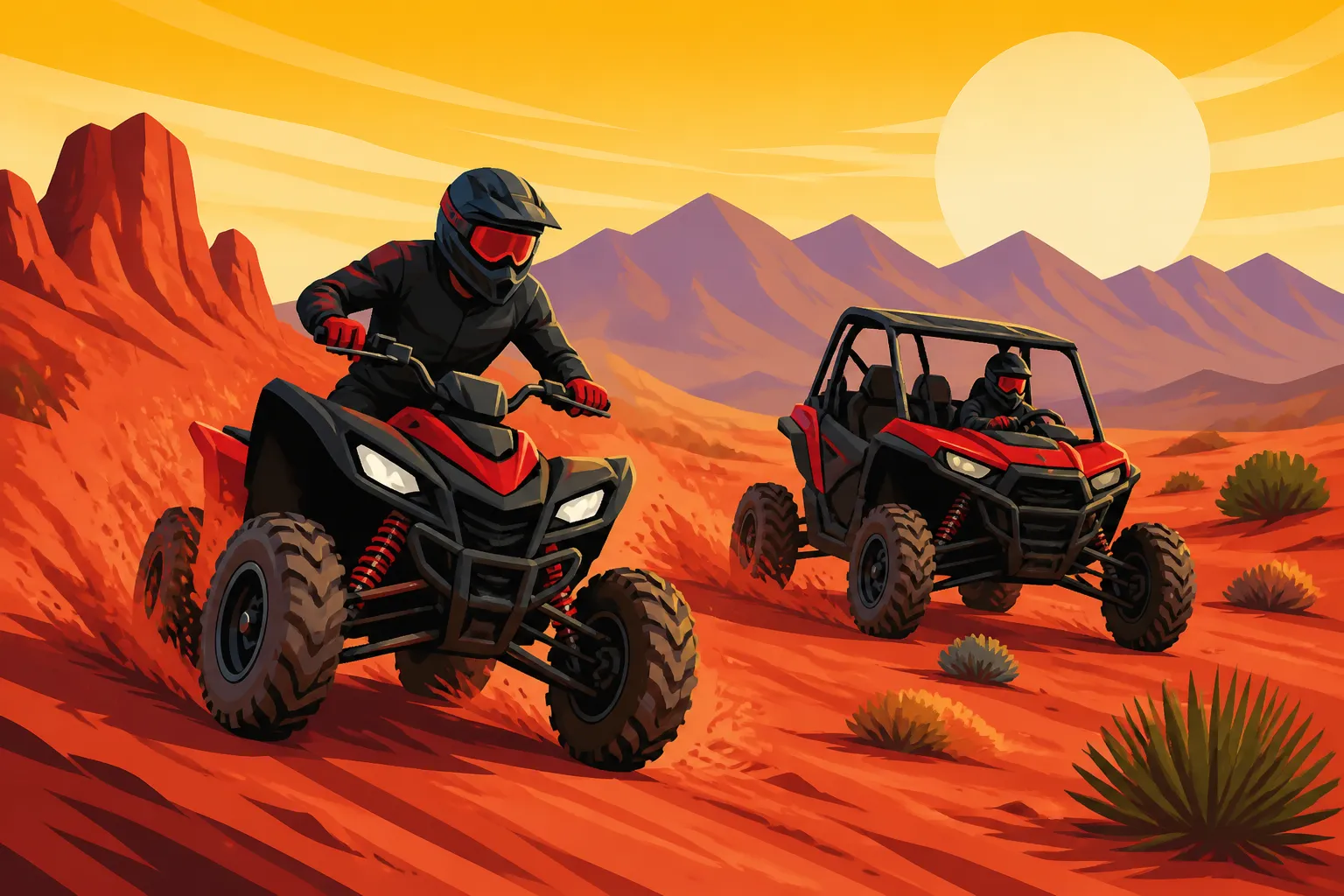
Red Sands is a desert OHV destination in Southern New Mexico, east of El Paso and near US 54 in the Orogrande area. The landscape is open and striking: broad sandy stretches, scattered mesquite, rolling terrain and distant views across the basin. It is close enough to feel reachable from communities along the El Paso–Alamogordo corridor, but the riding environment is still remote.
The change from highway to riding area can feel abrupt. You may leave pavement and quickly find yourself among tracks that lead in different directions, with no obvious trailhead kiosk or staffed visitor center to orient you. Do not assume that a wide track is a signed route, that every visible path is open to motor vehicles, or that another rider’s tracks indicate permission to follow.
For directions and approach planning, see [Getting to Red Sands Off New Mexico's US 54]. Before leaving home, compare your route with current land-management information and a map that shows access roads and boundaries. A mapping app such as onX Offroad can help you understand the surrounding terrain and save offline maps, but treat it as a planning aid—not a substitute for posted signs, official maps or land manager guidance.
What makes Red Sands different
Red Sands is known for its sandy desert terrain and the network of tracks created by repeated use. The riding experience is less like following a single, clearly marked trail from start to finish and more like navigating a broad landscape where route choice, visibility and conditions matter. That freedom can be part of the appeal, but it also means riders need to pay attention to where they are going.
The sand can change from firm and manageable to soft and energy-sapping over a short distance. Mesquite and other desert vegetation can obscure the ground, while small rises may hide riders approaching from the opposite direction. A line that looks simple from the staging area can include soft patches, ruts or a turn that is difficult to see until you are close.
If you are trying to picture the terrain before your first trip, [Red Sands and Its Mesquite Coppice Dunes] offers a useful companion topic. Keep in mind that desert surfaces are not static. Wind, rain, traffic and seasonal conditions can reshape the feel of a route, so descriptions from another day are a starting point rather than a guarantee.
Choosing routes and managing navigation
Think of the area as terrain, not a single trail
At Red Sands, the first useful planning question is not simply “Which trail should we take?” It is “What kind of route can our group handle, and how will we recognize when conditions change?” A newer rider may be comfortable on a broad, firm track but not ready for long stretches of deep sand or a route that requires repeated turns through similar-looking terrain.
Start with a modest loop or out-and-back plan rather than committing to a long exploratory ride. Choose a route that keeps the group oriented toward a known access point, and agree on a turnaround time before you set out. If you reach a section that looks more difficult than expected, turning around is a sound decision—not a failure to make the most of the trip.
Some visible tracks may be informal or user-created, and their presence alone does not establish that they are open for riding. Check the area’s current rules and route information before exploring. The topic [100 Miles of User-Made New Mexico Trails] is a reminder that visible tracks and authorized routes are not always the same thing. Stay on routes and in areas where motorized travel is permitted.
Build a navigation plan before you unload
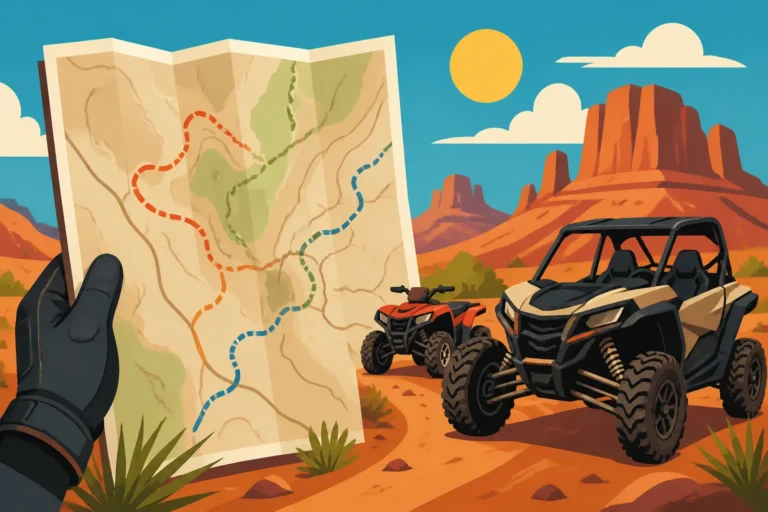
Cell service can be unreliable in remote desert areas. Save your route information before leaving a connected area, carry a paper map or another independent navigation option, and make sure at least two people in your group know how to use the plan. A phone that has a map open is not necessarily useful if its battery is nearly empty or the map has not been downloaded for offline use.
Use a few clear reference points rather than trying to remember every turn. Before riding, identify your starting point, intended route, major junctions and return direction. Mark the location where vehicles are parked and make sure every rider can find it. If your group separates, a shared meeting point is more useful than vague instructions such as “head back toward the highway.”
onX Offroad may help riders review mapped routes and boundaries in advance, especially when an offline map has been saved before the trip. Still, map layers can differ in detail and may not reflect a new closure or a sign encountered on the ground. Compare digital information with official land-manager guidance, obey posted restrictions and do not cross a boundary simply because a screen appears to show a track continuing.
Set group rules that prevent separation
Before starting, decide who leads, who follows and what happens if the group loses sight of one another. The lead rider should travel at a pace that allows the last rider to keep up without pressure. The sweep rider should know the route and help ensure nobody is left behind at a junction or difficult section.
Use a simple stop-and-regroup practice whenever the route turns, visibility drops or the terrain changes. On sandy ground, spacing matters: dust can obscure a following rider’s view, and a sudden stop may be difficult to anticipate. Leave enough room to see the rider ahead and avoid following so closely that dust becomes a constant veil.
For a first visit, make the first ride a short orientation rather than an ambitious all-day exploration. That gives your group a chance to learn how the sand feels, how quickly dust builds and how easy it is to recognize landmarks. You can extend the route once everyone is comfortable, the machines are behaving well and the return plan remains clear.
Preparing your ATV or UTV for desert sand
Check the machine before the trip
A machine that performs well on a packed road may behave differently in soft sand. Before leaving, check the tires for damage, inspect steering and brakes, look for loose fasteners, and confirm that lights and controls work. For a UTV, check the belt and other components according to the owner’s manual, especially if the machine has been sitting or has recently been serviced.
Bring basic tools suited to your machine, along with a tire repair kit and a way to inflate a tire. A small issue can become a long delay when the nearest shop is far away. If you are riding with several machines, agree on who carries tools and recovery equipment rather than assuming another person has everything.
Sand can be hard on equipment because it finds its way into moving parts and can make a machine work harder than expected. Check air filters as recommended by the manufacturer, and clean the machine after the ride. If you notice a new warning light, unusual smell, overheating or loss of power, stop in a safe place and investigate rather than pushing onward in the hope that it will clear.
Set up for traction without guessing
Tire pressure can affect how a machine floats across soft sand, but there is no single pressure that is right for every ATV, UTV, tire, load and riding style. Follow the manufacturer’s guidance and use a reliable gauge. Avoid copying a pressure setting from a different machine or assuming that lower is always better.
Too little pressure can increase the risk of damaging a tire or separating it from the rim, especially when turning or carrying passengers and cargo. Too much pressure may make it harder for a tire to conform to uneven ground. If you adjust pressure for conditions, do so conservatively, make changes in small steps and reassess how the machine handles.
A practical overview of the factors to consider is [Tire Pressure for Soft Sand]. The safest setup is one that stays within the tire and vehicle maker’s recommendations while matching the terrain and load. If you are unsure, ask a qualified mechanic or experienced local riding professional who can assess your exact machine rather than relying on a generic number.
Carry supplies for a remote ride
Pack water for every person, plus extra for delays. Desert temperatures and physical effort can catch people off guard, even when the ride feels easy at first. Carry food, sun protection, a first-aid kit and any required personal medication. A charged phone, backup power and an emergency communication option are sensible additions for a group traveling beyond reliable coverage.
Fuel planning deserves special attention. Do not assume there will be fuel available at the riding area, and do not plan a route that uses nearly all the fuel in your tank. The distance you can travel varies with machine, terrain, passenger load, pace and how much time you spend in soft sand. For regional planning considerations, see [Fuel Range Between Desert Towns].
Tell someone who is not riding where you plan to go and when you expect to return. Share the general route and the vehicle description, not just the name of the riding area. If plans change, let that person know. A delayed group that cannot be reached is much harder to assist when nobody outside the ride knows where to begin looking.
Reading desert conditions and choosing when to ride
Heat, wind and changing visibility
Desert heat can make a ride tiring before anyone recognizes how depleted they are. Start hydrated, drink regularly and take breaks before riders feel worn down. Watch one another for unusual fatigue, confusion, nausea, headache or poor coordination. Those signs are reasons to stop, cool down and get help if symptoms are serious or do not improve.
Wind can reduce visibility by lifting dust and carrying it across open terrain. If you can no longer see the route or the rider ahead clearly, slow down or stop in a safe location. Do not continue at speed just because the next machine is still moving. On a dusty track, the person behind may be operating with much less visibility than the lead rider realizes.
Plan around the day’s conditions rather than treating a calendar date as a guarantee of comfort. A spring morning may be pleasant, while an afternoon later in the season can feel punishing. [Riding Red Sands on a Spring Morning] explores one type of outing, while [Dust and Visibility on a Desert Trail] is useful for thinking through a problem that can arise in many seasons.
Rain, washes and monsoon weather
Rain can change a desert route quickly. A dry-looking wash may carry water after a storm upstream, and a low section that was easy to cross earlier can become soft, slippery or hazardous. Do not enter moving water or ride into a wash when you cannot judge its depth, bottom or exit. If there is doubt, stay out and choose a safer route.
After rain, soft ground can conceal ruts and make a familiar track behave differently. A route may be muddy in one stretch and powdery or deeply rutted in another. Allow more time, ride at a pace that leaves room to react, and be prepared to turn around if the terrain is deteriorating or visibility is poor.
Thunderstorms can bring lightning, sudden downpours and flash flooding. Check weather information before setting out and keep watching the sky. If storms are developing, move away from exposed high points and low-lying drainage areas, and follow appropriate emergency guidance. For seasonal planning, see [New Mexico Riding in Summer Monsoon] and [Red Sands After a Rainstorm].
Match the outing to your group
A strong plan accounts for the least experienced rider, not just the person with the most powerful machine. If one member of the group is new to riding, keep the first route short, avoid pushing into difficult sand and schedule breaks. An experienced rider may enjoy exploring farther, but that does not mean every rider should be expected to keep up.
Families should talk through supervision, passenger needs and fatigue before the ride. Make sure every rider knows how to stop safely, communicate a problem and regroup. Children and newer riders may need frequent breaks, and a route that looks short on a screen can take much longer when the group stops to check directions or work through soft terrain.
A useful rule is to finish with enough daylight, fuel and energy to get back comfortably. If the group is already tired, extending the ride to reach one more landmark can turn a pleasant day into a stressful one. Make the return journey part of the plan, not an afterthought.
Rules, access and responsible riding
Confirm what is open before you ride
Access rules can depend on land ownership, route designations, closures and other restrictions. Do not assume every area that looks empty is open to motorized use. Check current information from the land manager, read signs at access points and follow any closure or route-designation notices you encounter.
Keep your ride within permitted areas and avoid creating new tracks through vegetation. A shortcut can damage fragile desert ground, disturb wildlife or contribute to erosion. If a route is blocked or unclear, turn around and seek a verified alternative instead of going around a barrier.
A digital map is useful for planning, but it is not permission to ride. onX Offroad can help you see terrain and map information in advance, but riders should cross-check routes and boundaries with official sources. If a local sign conflicts with a route displayed on your device, take the sign seriously and confirm access before proceeding.
Understand permits and machine documentation
New Mexico requirements can depend on whether you are a resident or visitor, where you ride, and how your machine is registered or permitted. Do not rely on another rider’s paperwork or assume that a registration from home automatically answers every question about riding in New Mexico. Review [New Mexico OHV Permits Explained] well before departure and carry the documents that apply to your situation.
If your group includes riders under 18, check the safety permit and supervision requirements before the trip. Make sure young riders understand basic trail behavior and can operate their machines safely for the terrain planned. For rental machines, confirm with the rental provider what documentation, equipment and riding restrictions apply; do not assume the machine’s paperwork covers every rider or every location.
Keep proof of applicable registration or permits accessible, and make sure the machine’s identification information is readable. If you are unsure whether a particular route or land area has extra requirements, contact the relevant land manager before riding. A few minutes of checking at home is much easier than discovering a problem after you have unloaded.
Respect the land and other users
Desert vegetation may look sparse, but it can be slow to recover from damage. Stay on permitted routes, avoid driving over plants and do not widen a track to get around a rut. Carry out trash, secure loose items and leave the staging area cleaner than you found it.
Give other riders room, especially on narrow or dusty tracks. Reduce speed near people, parked vehicles and trail junctions, and do not assume another rider has seen you. Be alert for wildlife and avoid chasing or crowding animals. Mesquite, terrain changes and dust can make it difficult to spot people or animals until you are close.
Good etiquette also includes keeping noise reasonable, closing gates if you pass through a gate that is meant to be closed, and yielding thoughtfully when the route is narrow. For a broader discussion of shared-ground practices, see [New Mexico Trail Etiquette on Shared Ground]. Responsible riding helps protect access and keeps the experience welcoming for people who use the area differently.
Camping and making a longer trip work
Plan for limited facilities
Treat Red Sands as a self-supported outing unless you have confirmed otherwise with current local information. Do not count on water, restrooms, shade, fuel or staffed assistance being available where you intend to ride. Bring everything your group needs, and plan how you will handle trash and sanitation.
If you are camping, choose a location where camping is allowed and avoid blocking access roads or established routes. Keep vehicles and trailers out of places where they could obstruct other users or damage vegetation. Secure food and loose gear, and be considerate of noise—especially if other campers are nearby.
Read [Camping at Red Sands Without Facilities] before deciding what to bring. A comfortable camp does not have to be elaborate, but it does need to account for sun exposure, wind, water, waste and the possibility of a delayed return. Keep camping and riding plans flexible enough to adjust if conditions change.
Pack for a day that runs longer than expected
Even a planned day ride can stretch out if a tire needs attention, a route is harder than expected or a machine develops a problem. Bring enough water and food to cover a delay, and keep essential items where they can be reached without unloading the entire vehicle. A compact first-aid kit and repair tools are more useful when riders know exactly where they are stored.
Protect electronics from dust and heat. Keep devices charged, store backup power securely and avoid leaving phones in direct sun. If you rely on a phone for navigation, carry a backup option and make sure the route is available offline before leaving service.
Leave a schedule with someone you trust, including a return time and a point at which that person should take action if you have not checked in. Do not ask them to guess whether you are simply taking a long break. Clear timing and a route outline make the plan more useful.
A practical Red Sands planning checklist
Use this checklist as a final review rather than a substitute for checking current rules and conditions.
| Before you leave | At the riding area | During the ride |
|---|---|---|
| Check current access information and weather | Read signs and confirm the group’s starting point | Keep spacing in dust and regroup at turns |
| Download maps and identify boundaries | Inspect machines and secure loose gear | Watch for heat, fatigue and changing weather |
| Confirm permits and required documents | Agree on leader, sweep and meeting point | Turn back if conditions exceed the group’s ability |
| Tell someone your route and return time | Carry water, food, tools and first aid | Stay on permitted routes and pack out trash |
| Plan fuel with a generous reserve | Review the return route before unloading | Stop safely when visibility becomes poor |
A simple first-visit itinerary
For a first trip, arrive with enough time to check signs, unload carefully and let everyone get oriented before riding. Walk around the staging area, locate the vehicles and identify the direction you will return from. Keep the first loop short so the group can learn how the terrain feels without committing to a long route.
After the first section, stop and check in. Ask whether riders are comfortable, whether anyone is already tired and whether the machines are handling as expected. If the answer is positive, continue modestly. If the group is struggling with dust, sand or navigation, shorten the ride and return while everyone still has energy.
At the end of the day, inspect machines for damage and clean them as needed. Note what worked, what ran short and which route details were confusing. Those observations make the next visit easier to plan—and help prevent the same avoidable surprises.
Common planning mistakes to avoid
One common mistake is treating a map distance as a reliable estimate of riding time. Sand, stops, route-finding and group pace can make a short-looking loop take far longer than expected. Build in generous time for the return and avoid starting a long ride late in the day.
Another is carrying too little water or fuel because the group expects a quick outing. Remote rides rarely become safer when supplies are tight. Plan for delays, carry a reserve and do not count on finding services near the riding area.
Finally, do not follow tracks simply because they look established. Routes can be unauthorized, closed or unsuitable for your vehicle. Confirm access, watch for signs and be ready to turn around. Red Sands is most enjoyable when the group treats it as a real desert environment rather than a place where every visible track is automatically safe or open.
Disclaimer
This article is for general informational purposes only and does not constitute professional advice. Laws, prices and regulations vary by location and change over time. Consult a qualified professional for guidance on your specific situation.