Are ATVs Street Legal in New Mexico?
You've probably wondered, squinting at that highway sign while your side-by-side sits trailered, "Can I really ride this thing on the street here in New Mexico?" It's a question that trips up so many of us, creating a real headache when all you want to do is get from point A to point B without breaking the law. This guide is here to clear up that confusion and walk you through exactly what New Mexico law says about making your ATV or UTV street legal for those precious paved miles.
The Baseline: Off-Road is Off-Road
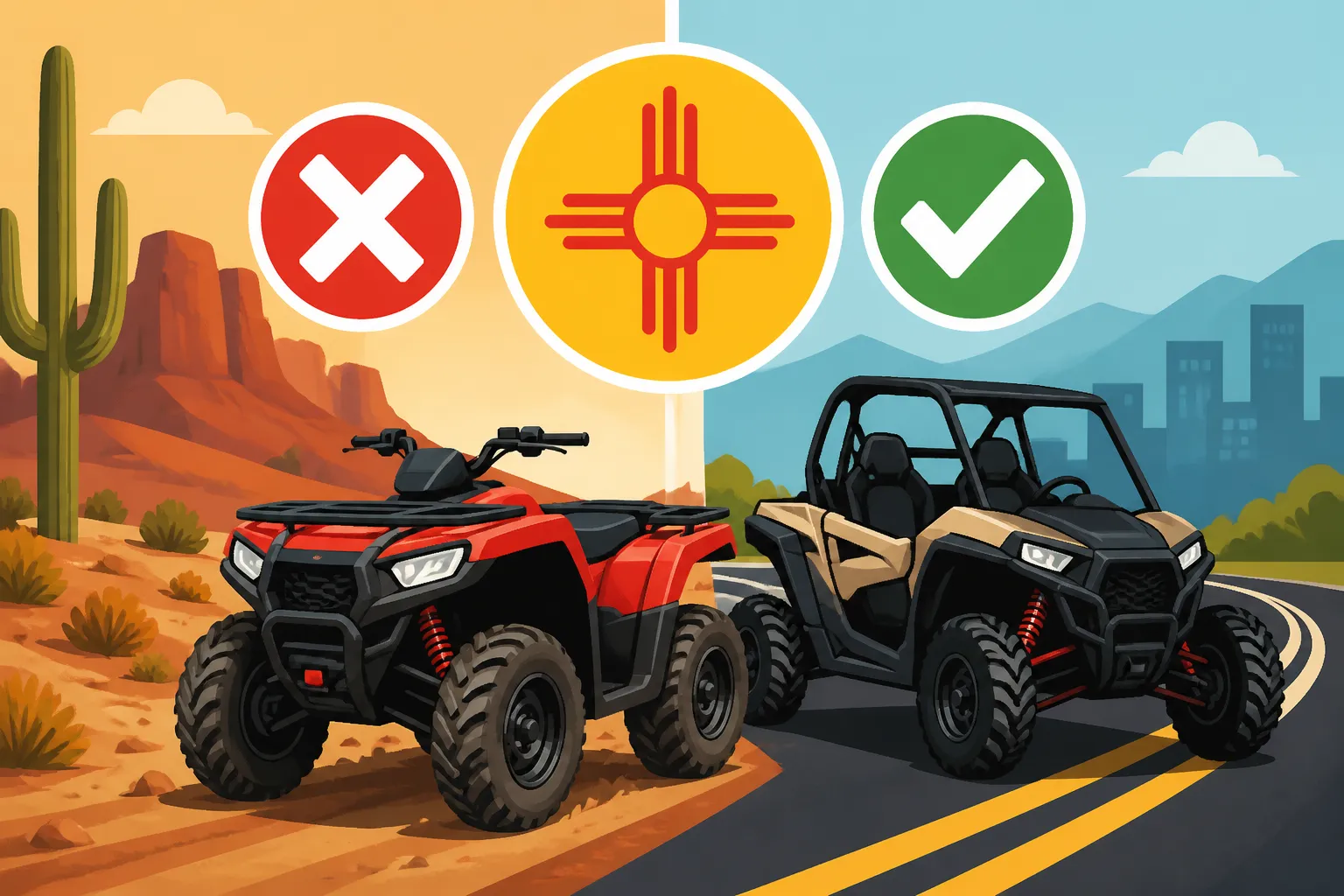
Let's cut right to the chase: In New Mexico, ATVs and UTVs are primarily designed and intended for off-highway use. This means that, by default, they are not street legal. This isn't just a quirky state rule; it's a common understanding across the country. These machines are built for dirt, rocks, and trails, not for sharing asphalt with cars and trucks. Their design, often lacking certain safety features and equipment found on street-legal vehicles, reflects this primary purpose.
Think about it from a common-sense perspective. Your typical quad or side-by-side often doesn't have turn signals, rearview mirrors, a proper horn, or even the same braking systems as a passenger car. They have knobby tires meant to grip loose terrain, not provide smooth, quiet traction on pavement. Their suspension systems are built to absorb big bumps, which can feel a bit wobbly on a paved road at higher speeds. Without specific legal provisions, taking such a machine onto a public road designed for cars poses significant safety and regulatory challenges. This fundamental distinction is where all other rules stem from.
This default "off-road only" status is why you usually see these machines being trailered to trailheads like Red Sands OHV Area or Glade Run. It's the standard, and any deviation from it requires specific permissions and modifications. Without those, attempting to ride on a paved public road can quickly lead to fines and legal trouble. Many riders initially get caught by this, assuming if it has wheels, it can go on a road, but the law has specific definitions for what constitutes a "street legal" vehicle.
New Mexico's "Opt-In" for Paved Road Use
Here's where things get interesting and, frankly, a little confusing for many riders. While your OHV isn't inherently street legal, New Mexico has created an "opt-in" provision that allows certain types of off-highway vehicles to gain limited access to paved public roads. This isn't a free pass to ride anywhere, but it opens up possibilities that didn't exist before, especially for connecting trails or accessing services.
This opt-in isn't for every machine or every road. It's specifically for OHVs that meet certain criteria and are registered for this purpose. The idea is to provide a pathway for responsible riders to use paved roads judiciously, often to link up segments of off-highway trails or reach amenities like gas stations or restaurants without having to trailer their machine for short distances. It acknowledges that the vast landscapes of New Mexico often mean trail systems are separated by short stretches of paved road, and it would be a shame to cut off access entirely.
The rules around this "opt-in" are precise and unforgiving if you don't follow them. It's not enough to simply decide you want to ride on the road; you need to understand the nuances of the law, which roads are permissible, and what equipment your machine must have. Ignoring these details can quickly turn a fun ride into a costly lesson, especially since enforcement officers are well-versed in the specifics of New Mexico's OHV regulations.
Which Roads Are Covered by the Opt-In
Understanding where you can actually ride is paramount. New Mexico's opt-in law doesn't throw open the gates to every paved road in the state. Instead, it carefully delineates which types of roads can be accessed by registered, compliant OHVs. This is a critical distinction that many riders misunderstand, often leading to violations.
Generally, the opt-in primarily allows OHVs on county and municipal roads, provided those specific counties or municipalities have passed an ordinance or resolution opening their roads. This is a crucial local control aspect: a county can decide to open all or some of its paved roads to OHVs, or it can choose to keep them closed. This means what's permissible in Sierra County, for example, might be strictly forbidden just a few miles away in a neighboring jurisdiction that hasn't passed such an ordinance. This patchwork of rules means you must do your homework for the specific area you plan to ride. Towns like Red River have embraced this, allowing ROVs on most streets, while some cities may have strict bans. For instance, [Red River's ROV-Only Streets] outlines specific local regulations.
What's definitely not covered? State highways and interstate freeways. These major arteries are strictly off-limits to OHVs, regardless of whether your machine has met all the opt-in requirements. These roads are designed for high-speed traffic, and an OHV, even a modified one, simply isn't suited for that environment. Attempting to ride on a state highway, even for a short distance, can result in significant fines and jeopardize your safety. There's an exception for perpendicular crossings of state highways, but that's a brief, highly regulated maneuver, not a continuous ride. Also, pay attention to [Why New Mexico State Highways Are Off Limits].
OHV Types Excluded from Paved Road Opt-In
Not all off-highway vehicles are created equal in the eyes of New Mexico law when it comes to paved road access. While side-by-sides (ROVs) and most ATVs can take advantage of the opt-in if they meet the requirements, there's a significant exclusion that often catches dirt bike riders off guard: off-highway motorcycles.
That's right, dirt bikes are generally not eligible for the paved road opt-in in New Mexico. This is a source of frustration for many dual-sport enthusiasts who might argue their bikes are just as capable as some street bikes. However, the law makes a clear distinction. While a dirt bike can be registered as an OHV and ride on designated off-highway trails with a [New Mexico's Yellow Off-Highway Decal], it cannot obtain the [New Mexico's Green On and Off-Highway Decal] or the [New Mexico's Paved Road Plate] that grant paved road privileges. This means if your primary machine is a dirt bike, your only legal option for paved roads is to trailer it. It's important to be aware of [Why a Dirt Bike Cannot Use the Opt-In] before you plan your trip.
The rationale often comes down to design differences and safety considerations, though it can feel arbitrary to riders. The law aims to regulate based on vehicle class, and for the opt-in, off-highway motorcycles simply don't fit the legislative framework that allows ATVs and UTVs onto selected paved roads. This distinction is crucial for dirt bike owners planning rides that might involve connecting via paved roads; you'll need to adjust your route or plan for trailering sections where an ATV or UTV might legally traverse pavement.
Making Your Machine Compliant for Pavement
If your ATV or UTV is eligible and you're planning to ride on a county or municipal road that's been opened to OHVs, you're going to need to make some modifications and ensure you have the right paperwork. This isn't just a suggestion; it's a legal requirement, and ignoring it means you're operating an unregistered, non-compliant vehicle on public roads, which carries significant penalties.
Think of it like getting your machine dressed up for a formal event. It needs specific attire and credentials to be allowed in. These requirements are in place to enhance safety, ensure visibility, and make sure OHVs can integrate, even if minimally, with regular road traffic. Don't skip these steps; an officer checking your machine will be looking for every one of these elements. Many riders find a trusted local mechanic or an OHV accessory shop invaluable in getting these upgrades done correctly. Brands like SuperATV specialize in aftermarket parts that are designed to help you meet these kinds of street-legal requirements, from lighting to mirrors.
Required Equipment for Paved Road Use
To be considered "street legal" for New Mexico's opt-in roads, your OHV needs more than just an engine and wheels. The law specifies a list of essential equipment designed to improve safety and visibility on paved surfaces. This isn't about looking cool; it's about being seen, hearing others, and signaling your intentions to other drivers.
Here's a breakdown of what you'll need, and why each item is important:
- Headlights and Taillights: Your OHV must be equipped with at least one headlight that can illuminate persons and vehicles 150 feet ahead, and at least one taillight visible from 200 feet to the rear. This is crucial for riding at dusk, dawn, or in low-light conditions, and helps prevent rear-end collisions. [New Mexico Headlight and Taillight Rules] covers this in detail.
- Brake Lights: A brake light that illuminates when you apply the brakes is non-negotiable. This immediately signals to drivers behind you that you're slowing down or stopping, preventing accidents.
- Mirrors: You must have at least one rearview mirror. While some states require two, New Mexico allows for one. This mirror provides a view of traffic approaching from the rear, a basic safety feature for any road-going vehicle. When looking for compliant mirrors, checking out options from a supplier like SuperATV can ensure you get durable, functional accessories.
- Horn: A working horn is essential for alerting pedestrians or other drivers to your presence in situations where a warning is needed. It's a fundamental piece of safety equipment.
- Muffler and Spark Arrester: While important for off-road use, on-road rules also apply. Your machine needs a muffler to keep noise within legal limits (typically 96 decibels in New Mexico), and a spark arrester is required for public land use, which includes some roads managed by federal agencies. This keeps noise pollution down and prevents wildfires. See [New Mexico Spark Arrester Requirement].
- Tires: While not always explicitly spelled out for "street legal" conversion, your tires should be appropriate for paved roads. Knobby, aggressive off-road tires wear quickly and can handle poorly on asphalt, especially in wet conditions. While you don't necessarily need street tires, consider the implications of your tire choice for safety and longevity if you plan frequent paved road use.
- Brakes: A properly functioning brake system is a given for any vehicle operating on public roads. Your OHV must have brakes that are effective and well-maintained.
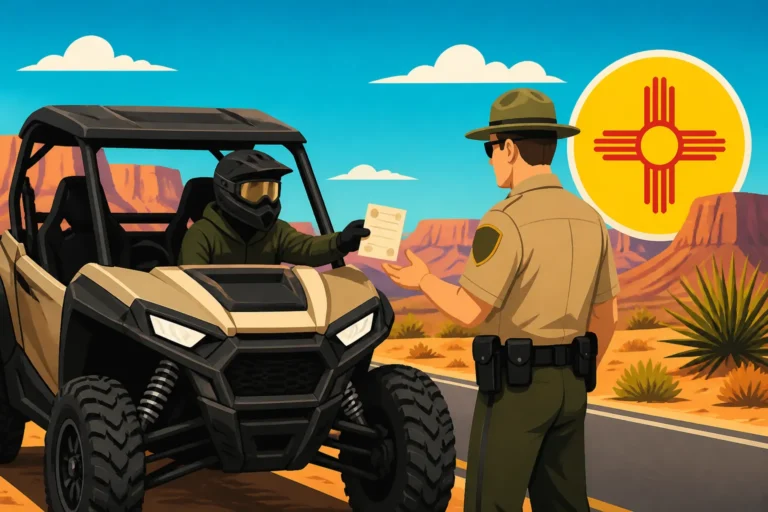
Failing to have any of these items can lead to a citation, even if you have all your paperwork in order. An officer conducting a roadside check will visually inspect your machine for these requirements.
Registration, Decals, and Plates
Beyond the physical equipment, your machine needs to be properly registered and display the correct identification for paved road use in New Mexico. This is a two-tiered system that can sometimes cause confusion, but it's essential to get it right.
First, your OHV needs a basic New Mexico OHV registration, which comes with a [New Mexico's Yellow Off-Highway Decal]. This decal signifies that your machine is legally registered for off-highway use. Every OHV operating on public land or designated trails in New Mexico needs this, regardless of whether you plan to hit pavement. You can obtain this through the New Mexico Motor Vehicle Division (MVD). [Registering an OHV in New Mexico] provides a good overview of this process.
Second, to exercise the paved road opt-in privilege, you need an additional "on-highway" decal or plate. For most ATVs and UTVs, this means acquiring the [New Mexico's Green On and Off-Highway Decal]. This green decal is specifically issued for machines that meet the paved road equipment requirements and indicates you've paid the additional fee and are cleared for the limited on-road use. This decal is usually mounted prominently on the machine, often near the yellow decal, so an officer can easily identify your machine's on-road eligibility. In some cases, depending on how the law is interpreted or historical changes, you might also hear about a "Paved Road Plate," which historically served a similar function. However, the green decal is currently the most common method for marking on-road capability.
You will also need to carry proof of registration and potentially proof of insurance (more on that below) with you whenever you ride, both off-road and on. For those who frequently transition between off-road adventures and paved stretches, a convenient storage solution like a SuperATV cargo box or dash bag can keep all your critical documents secure and easily accessible. Without these decals and documents, even a perfectly equipped machine is considered illegal on New Mexico's public roads.
Driver's License and Insurance Requirements
Operating an OHV on New Mexico's paved roads isn't just about the machine; it's also about the operator. You, as the rider, have specific responsibilities, including possessing the correct licensing and carrying adequate insurance.
For starters, if you're riding your OHV on any public paved road in New Mexico, you must possess a valid driver's license. This isn't the same as just being old enough to ride off-road; it means a state-issued driver's license that permits you to operate a motor vehicle. This is because on a paved road, you are now sharing the space with other licensed drivers in cars and trucks, and the state expects you to meet the same basic qualifications. This is a common point of confusion for younger riders or those who primarily ride off-road where a driver's license isn't always mandated. [New Mexico Driver's License Rules for OHVs] clarifies this further.
Equally important is liability insurance. While not always strictly required for purely off-road use (though always a good idea!), it becomes mandatory once you hit the pavement. New Mexico's Financial Responsibility Act requires all vehicles operating on public roads to carry minimum liability insurance coverage. This protects you and others in case of an accident where you are at fault. Without this insurance, you could face fines, suspension of your driving privileges, and significant financial exposure if you're involved in a collision. Always carry proof of insurance, whether it's a physical card or digital proof, when riding on paved roads. [New Mexico ATV Insurance Requirement] goes into more detail.
It's vital to remember that these requirements apply to you, the operator, in addition to the requirements for your machine. You can have the most tricked-out, street-legal UTV in New Mexico, but if you don't have a valid driver's license and insurance, you're still in violation of the law.
Important Considerations for Street Legal Riding
Getting your machine equipped and yourself licensed and insured is a huge step, but the journey to responsible street-legal OHV riding in New Mexico doesn't end there. There are crucial behavioral and practical considerations you need to keep in mind to ensure your safety and avoid trouble. The spirit of the law is to allow limited, safe use, not to turn every OHV into a daily commuter vehicle.
Riding an OHV on pavement is inherently different from riding off-road. You're dealing with different traction, speed limits, traffic rules, and the expectations of other drivers. Understanding these distinctions and adapting your riding style accordingly is paramount for a safe and enjoyable experience. Many of the frustrations people feel come from not fully appreciating these differences or overlooking the subtle but important regulations that apply to OHVs on public roads. Always remember that even when you're street legal, you're still on an OHV, which has different dynamics than a car or truck.
Riding Etiquette and Speed Limits
When you take your OHV onto a paved road, you're no longer just navigating trails; you're sharing the road with other vehicles. This means adhering to traffic laws and demonstrating proper road etiquette, which is often different from what you might be used to off-road.
First and foremost, you must obey all posted speed limits. While your UTV might be capable of higher speeds, the legal limit for an OHV on a paved road in New Mexico is generally 25 miles per hour, unless a lower speed limit is posted. This 25 mph limit is a critical regulation, as exceeding it is a direct violation, regardless of the road's posted car speed. This speed restriction is in place because OHVs, even when modified, are not designed for high-speed road travel and can be less stable or responsive than traditional vehicles.
Beyond speed, you need to follow all other rules of the road: stop signs, traffic lights, yielding to pedestrians, and maintaining safe distances. Use your turn signals (if equipped, which is highly recommended for street use) or hand signals to communicate your intentions. Be mindful of traffic flow; while you have a right to the road, your lower speed might mean you need to pull over safely to allow faster traffic to pass, especially on two-lane roads. Never block traffic or impede the safe movement of other vehicles.
Remember, you're representing the entire OHV community when you ride on paved roads. Courteous and safe riding helps maintain public support for these opt-in provisions, while reckless behavior could lead to stricter regulations or even the repeal of access in certain areas. [What a New Mexico Officer Checks Roadside] highlights some of these concerns.
Helmet and Eye Protection Rules
Safety gear is always important, but when you're on paved roads, specific rules regarding helmets and eye protection come into play, especially for younger riders. New Mexico law is quite clear on this.
For anyone under the age of 18, wearing an approved safety helmet is mandatory when operating or riding as a passenger on an OHV, both off-road and on. This is a non-negotiable rule designed to protect vulnerable young riders. The helmet must be properly fitted and DOT-compliant. Parents and guardians should take this rule very seriously, as they can face penalties if a minor under their supervision is found riding without a helmet. For a deeper dive, check out [New Mexico Helmet Law for ATV Riders] and [New Mexico Helmet Law for Riders Under 18].
While adults (18 and over) are not legally required to wear a helmet when operating an OHV on pavement, it is highly recommended. The risk of head injury in a collision or rollover is significant, regardless of age. Many experienced riders will tell you a helmet is cheap insurance. However, for all riders, regardless of age, eye protection is required when operating an OHV on a paved road. This means goggles, a face shield on a helmet, or shatter-resistant glasses. This protects your eyes from dust, debris, insects, and other hazards that can impair your vision and lead to an accident. Losing vision for even a second on a paved road can have disastrous consequences. [New Mexico Eye Protection Requirement] spells this out.
These rules exist for your safety. Don't view them as inconveniences but as essential safeguards that can prevent serious injury. Always prioritize safety gear, especially when riding on roads with other traffic.
Specific Local Ordinances and Restrictions
One of the biggest pitfalls for riders trying to go "street legal" in New Mexico is the variability of local ordinances. While the state provides the framework for the opt-in, it largely leaves the decision to open or close roads to individual counties and municipalities. This means that what's legal in one town might be illegal just a few miles down the road.
Before you plan any paved road riding, you absolutely must research the specific county and city ordinances for the area you'll be in. A general understanding of state law isn't enough. For example, [Red River Ordinance 2000-5] specifies unique rules for riding in that popular OHV destination. Some counties, like Sierra County, have adopted broad ordinances opening most of their county roads, while others might be much more restrictive, or have no enabling ordinance at all, meaning all their roads remain closed to OHVs.
This can be a complex and frustrating aspect of OHV riding in New Mexico. There isn't a single, statewide map of open OHV-friendly paved roads. You might need to check county websites, city council minutes, or even call local law enforcement agencies to confirm the current rules. Don't rely on assumptions or what you heard from a friend. Ignorance of the local law is not a valid defense if you're pulled over and cited. It's truly a situation where due diligence is your best friend. A good practice is to look for official signage or check with local tourism offices, which often have up-to-date information for visitors.
| Feature | Off-Highway Use (Yellow Decal) | Paved Road Use (Green Decal/Plate Opt-In) |
|---|---|---|
| Primary Purpose | Trails, unimproved roads, open areas | Connecting trails, accessing services |
| Road Access | Dirt roads, trails, unpaved areas | County/municipal paved roads (by ordinance) |
| State Highways | Prohibited | Prohibited (except perpendicular crossings) |
| Required Decal | Yellow | Yellow AND Green |
| Driver's License | Not always required for adults* | Mandatory |
| Liability Insurance | Recommended | Mandatory |
| Headlights | Recommended for low light | Required (150 ft visibility) |
| Taillights | Recommended for low light | Required (200 ft visibility) |
| Brake Lights | Recommended | Required |
| Mirrors | Optional | Required (at least one rearview) |
| Horn | Optional | Required |
| Muffler | Required (96 dB limit) | Required (96 dB limit) |
| Spark Arrester | Required on public land | Required on public land |
| Speed Limit | Varies by trail/area | 25 mph (unless lower posted) |
| Helmet (Under 18) | Mandatory | Mandatory |
| Eye Protection | Recommended | Mandatory (all ages on pavement) |
| Vehicle Type | ATV, UTV, Dirt Bike | ATV, UTV (Dirt Bikes generally excluded) |
Note: A safety permit is required for riders under 18, and a driver's license is required if you are operating an OHV on a road where a conventional vehicle driver's license is needed, even if unpaved.
Disclaimer
This article is for general informational purposes only and does not constitute professional advice. Laws, prices and regulations vary by location and change over time. Consult a qualified professional for guidance on your specific situation.