New Mexico Spark Arrester Rules
A spark arrester can look like a small part of an ATV or UTV’s exhaust, but it matters when you ride New Mexico public land. Riders are often unsure whether a stock machine already has one, how to check it, or whether the rule applies on every trail. The practical approach is to use an intact, compliant arrester and confirm the rules for your route.
When New Mexico riders need a spark arrester
For a ride on public land in New Mexico, plan to have a compliant spark arrester installed and in working condition. National forests and Bureau of Land Management areas are common destinations for OHV riders, and their land managers can impose equipment requirements as well as route restrictions. The specific rules can vary by area, so check the current requirements for the place you plan to ride.
A spark arrester helps stop hot particles from leaving the exhaust and potentially starting a fire. That makes it especially important during dry conditions, when a spark or hot fragment can have serious consequences. The device needs to be part of the exhaust system and functioning as intended; carrying a loose screen or a spare part does not make an unequipped machine compliant.
The rule is about the machine’s equipment, not just the rider’s behavior. If you ride a dirt bike, ATV, or UTV, check its exhaust before setting out. A stock exhaust may have a spark arrester, but do not assume it does simply because the machine is new, quiet, or has a muffler. Modifications and replacement exhaust parts can change what is installed.
| Riding location or situation | Practical approach |
|---|---|
| National forest or BLM land | Use an intact, compliant spark arrester and check the land manager’s current requirements. |
| A public trail or road with local rules | Confirm both equipment rules and whether the route is open to your machine. |
| Private land | Ask the landowner and check any applicable local requirements; public-land rules may not settle the question. |
| Modified or replacement exhaust | Verify that the spark arrester is present, suitable, and not altered or removed. |
| Dry or restricted conditions | Check for fire-related closures and restrictions before traveling. |
A permit or registration is a separate issue. Having the paperwork to ride does not replace required equipment, and an arrester does not authorize travel on a closed route. For broader requirements that apply to public-land riding, see New Mexico Rules for Riding Federal Land, New Mexico Rules on National Forest Land, and [New Mexico Rules on BLM Land].
How to check your ATV or UTV
Start with the owner’s manual and the exhaust manufacturer’s information. Look for a statement that the exhaust system includes a spark arrester and is suitable for the land where you plan to ride. If you have the original exhaust, the manual or parts documentation may identify the arrester. If the machine has an aftermarket exhaust, check the documentation for that specific model rather than relying on the machine’s brand or year.
A visible screen or plate may be part of the system, but appearance alone does not establish that it meets the applicable standard. Some arresters are internal, so you may not be able to confirm their presence just by looking at the exhaust outlet. If the documentation is unclear, ask the manufacturer, dealer, or land manager what identification or proof they accept. The dedicated overview at New Mexico Spark Arrester Requirement is also a useful place to start.
Before a ride, inspect the exhaust while the machine is cool. Check for obvious damage, missing fasteners, loose parts, heavy buildup, or signs that someone has removed or altered the arrester. Follow the manufacturer’s instructions for inspection and cleaning; the right procedure depends on the design. Do not reach into a hot exhaust, and do not remove parts unless the manual calls for it and you can reinstall them correctly.
A clogged arrester can affect performance, while a damaged or missing one can leave the machine out of compliance. Cleaning is not the same as modifying. Keep the original components and hardware together, use the specified replacement parts, and do not enlarge openings, cut away a screen, or bypass the device to improve exhaust flow. If you are uncertain about its condition, have a qualified service shop inspect it before heading onto public land.
Aftermarket parts deserve particular attention. A replacement muffler may be quieter or marketed for off-road use without necessarily including a compliant arrester. If you shop for a replacement through a retailer such as Amazon, match the part to your exact machine and verify the manufacturer’s documentation before buying. A product description or customer review is not a reliable substitute for confirmation that the arrester meets the requirements for your riding area.
For a step-by-step pre-ride check, see Checking Your Spark Arrester Before Public Land. If the exhaust has been modified and you cannot identify what is inside it, treat that as an unresolved equipment issue, not as proof that the system is compliant.
Spark arresters, mufflers, and other rules
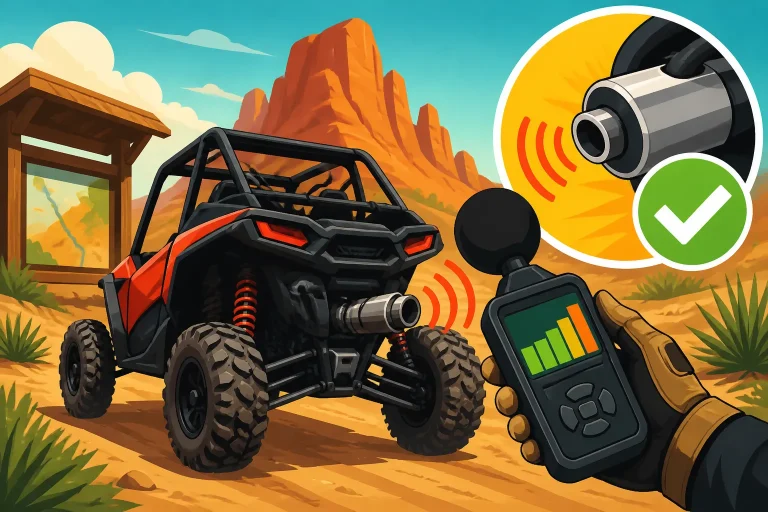
A spark arrester and a muffler do different jobs. The muffler reduces exhaust noise. The arrester is designed to limit the escape of hot particles. A muffler does not automatically count as a spark arrester, and a spark arrester does not automatically make an exhaust quiet enough to meet a sound rule.
This distinction matters because public-land riding may involve more than one equipment requirement. New Mexico OHV riders should check sound limits as well as spark-arrester requirements. An exhaust could have an arrester and still be too loud, or it could meet a noise limit while lacking a working arrester. See New Mexico Sound Limit for ATVs for information about the separate sound issue.
The rules also do not grant permission to ride anywhere a machine can physically travel. Public lands often use designated routes, and a trail may close seasonally or because of weather, fire danger, maintenance, or another management decision. Follow posted signs and current travel-management information. Riding beyond an open route can create a separate violation even when your machine has all required equipment. Check New Mexico Trail Closures to Check First and New Mexico Rules for Riding a Closed Road before choosing a route.
Local conditions can change quickly. Fire restrictions may limit access or activities even when a route was open recently. A spark arrester is one practical safeguard, not a guarantee that riding is permitted during a restriction or that a fire cannot start. Avoid parking or stopping where hot exhaust components could contact dry grass, and follow any instructions from land managers or emergency personnel.
A practical pre-ride checklist
Use this short checklist before loading the machine:
- Identify the riding area. Confirm whether the route is on national forest, BLM, state, tribal, or private land. Different land managers and owners may set different requirements.
- Check the route status. Make sure the trail or road is open to your type of machine, and review any current fire or seasonal restrictions.
- Verify the exhaust. Use the manual or manufacturer’s documentation to confirm the arrester is installed and appropriate for the machine.
- Inspect the parts. Look for damage, missing hardware, blockage, or unauthorized changes. Clean or service the system only as directed by the manufacturer.
- Check other equipment rules. A working arrester does not replace sound, safety, registration, permit, or route requirements.
- Resolve doubts before departure. Contact the land manager or a qualified service shop if you cannot confirm what is installed or whether it meets the local rule.
If you discover that the arrester is missing or damaged at the staging area, do not treat a short ride as an exception. Repair or replace it before riding where it is required. The same goes for an exhaust system that has been altered in a way that may defeat the arrester. A straightforward check at home is safer and usually easier than trying to sort out the equipment question at a trailhead.
For a machine used on both private property and public land, set it up to meet the stricter requirements you expect to encounter, then confirm those requirements for each destination. That approach avoids assuming that a machine acceptable on one parcel is automatically acceptable on a forest road or BLM route. Keep the owner’s manual and relevant parts information available, especially if the exhaust is not original.
Disclaimer
This article is for general informational purposes only and does not constitute professional advice. Laws, prices and regulations vary by location and change over time. Consult a qualified professional for guidance on your specific situation.