Does New Mexico Honor Arizona OHV Registration?
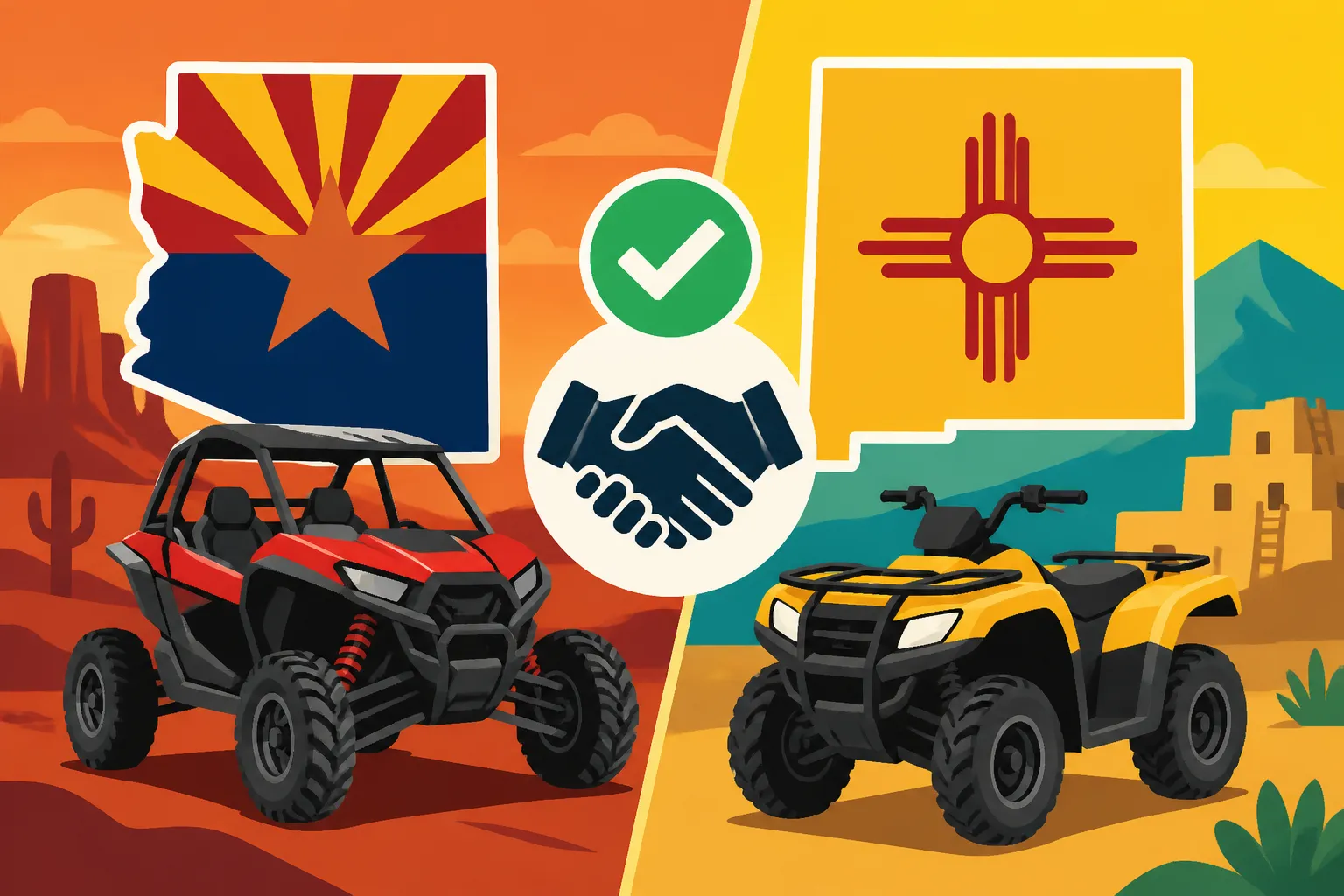
If you’re bringing an ATV or UTV from Arizona to ride in New Mexico, you may be wondering whether you need another state’s permit. In general, New Mexico honors valid Arizona OHV registration, so you do not need to buy a New Mexico nonresident OHV permit just because you crossed the state line. You still need proof of registration and must follow New Mexico’s riding rules.
Yes, New Mexico Generally Honors Arizona OHV Registration
New Mexico recognizes valid OHV registration from Arizona for visiting riders. If your machine is properly registered for off-highway use in Arizona, that registration generally satisfies New Mexico’s nonresident registration requirement. You do not have to obtain a New Mexico nonresident permit solely to ride on that basis.
This is part of New Mexico’s reciprocity approach: a rider whose home state has an OHV registration program can generally use valid home-state registration in New Mexico. Arizona is among the states whose OHV registration New Mexico recognizes. The details are covered in New Mexico OHV Reciprocity Rules and Why Arizona Riders Need No New Mexico Permit.
That does not mean every Arizona document proves the machine is registered as an OHV. Make sure the paperwork and any required decal apply to the machine’s off-highway use. A vehicle’s ordinary license plate or road registration may not, by itself, establish that its OHV registration is current. If you are unsure which Arizona document applies to your machine, check with the relevant Arizona agency before traveling.
The practical distinction is simple:
| Your situation | What to plan for in New Mexico |
|---|---|
| Your machine has valid Arizona OHV registration | Carry proof of that registration; a New Mexico nonresident OHV permit is generally not required |
| Your Arizona registration has expired or does not apply to the machine | Resolve the registration issue before riding, or check whether a New Mexico nonresident permit is required |
| Your machine is registered in a state without an OHV registration program | Check New Mexico’s nonresident permit requirement |
| You want to use an OHV on a paved road | Check the separate road-use rules; reciprocity alone does not authorize pavement riding |
The central answer is yes, but reciprocity is not a blanket approval for every vehicle, road or riding area. Registration must be valid, and the location must allow the kind of riding you plan to do.
What to Carry as Proof
A roadside check or land manager may ask you to show that the machine is properly registered. Carry the Arizona registration document or other official proof that applies to your OHV. Keep the document with the vehicle or in a place where the rider can readily produce it, rather than relying on someone back home to send a photo if questions come up.
A useful pre-trip check is to compare the machine’s identifying information on the registration paperwork with the machine itself. Check the VIN, registration period and any identifying number associated with the Arizona registration. If a number is hard to read, or the paperwork lists a different machine, contact the Arizona registration provider before leaving.
It is sensible to carry both a paper copy and a usable digital copy when available. A phone can lose power, get wet or have no signal, so a digital image should not be your only plan. Keep paper documents protected from dust and water; a small waterproof document pouch, including one available through retailers such as Amazon, can help keep them legible. Avoid putting original paperwork somewhere that is difficult to reach during a roadside stop.
Before the trip, use this checklist:
- Confirm the Arizona OHV registration is current for the planned ride.
- Check that the registration applies to the specific ATV or UTV you are taking.
- Compare the VIN or other machine identifier on the paperwork with the machine.
- Pack proof where the operator can access it.
- Check any separate youth safety requirements, land-access rules and road-use restrictions.
If you recently bought the machine, do not assume the previous owner’s paperwork automatically settles the question. Confirm that the registration has been transferred or renewed as required in Arizona and that the documents match the machine. For help sorting out registration paperwork for a machine arriving from another state, see Registering an Out-of-State Machine in New Mexico.
What Reciprocity Does Not Allow
Arizona registration helps satisfy New Mexico’s nonresident OHV registration requirement. It does not make the machine street legal, give you permission to ride on private or restricted land, or exempt you from New Mexico’s safety rules.
It does not authorize riding on every road
Most roads are not automatically open to ATVs and UTVs. New Mexico has specific rules for pavement, highway crossings, county roads and local streets. A machine that is properly registered in Arizona can still be prohibited from a road in New Mexico.
Before planning a route that uses pavement, determine whether the road is open to OHVs and whether a separate paved-road opt-in or plate is required for that use. Do not assume an Arizona plate or sticker substitutes for New Mexico’s road-use requirements. The distinctions are explained in New Mexico’s Paved Street Opt-In and New Mexico Paved Road Plate Requirements.
A highway crossing is different from riding along a road. Crossings have their own conditions, and a route that appears to connect two trails may still be unlawful. Review New Mexico Rules for Crossing a Highway before relying on a road crossing to reach a trail.
It does not replace local access permission
Registration is not a trail pass. Public land managers may limit OHVs to designated routes, close roads seasonally or impose other access conditions. Private land requires permission, and tribal lands have their own access rules. State trust land also has separate requirements.
Check the rules for the specific riding area before unloading. A trail map, sign or travel-management map may indicate which routes are open, but closures and conditions can change. For federal land, review New Mexico Rules for Riding Federal Land and Designated Routes and Travel Management in New Mexico. If your plan includes trust land, consult The Permit You Need for New Mexico Trust Land.
It does not waive New Mexico safety requirements
Visitors are still expected to follow New Mexico’s requirements for riders and equipment. Rules can depend on the rider’s age, the type of machine and where it is being operated. In particular, confirm the safety-permit and supervision requirements if anyone under 18 will ride. Arizona registration does not take the place of any New Mexico safety permit that applies to a young rider.
Helmet and eye-protection requirements, passenger restrictions and equipment rules may also matter. Review the current rules for your group rather than assuming that compliance at home automatically means compliance in New Mexico. The relevant topics include [New Mexico OHV Safety Permit Requirements], New Mexico Helmet Law for Riders Under 18 and New Mexico Rules for Carrying a Passenger.
A Practical Pre-Trip Decision
For most Arizona riders with current, applicable OHV registration, the registration question has a straightforward answer: bring proof and you generally do not need to purchase a New Mexico nonresident OHV permit. The remaining work is to confirm that your machine is actually covered, then check the rules for the route, land and riders in your party.
Use this short decision process before departure:
- Verify the Arizona registration. Confirm it is current and applies to the machine’s off-highway use. If the machine is newly purchased or the paperwork is unclear, resolve that with the Arizona registration authority.
- Pack proof. Carry official documentation that matches the machine, with a backup copy if practical.
- Check the riding location. Confirm the trail or road is open to your machine and that you have any area-specific permission or permit.
- Check road plans separately. If the route includes pavement, determine whether the road is open to OHVs and what additional requirements apply.
- Review rider-specific rules. Check requirements for minors, helmets, eye protection, passengers and equipment before the ride.
If the Arizona registration is expired, missing or not clearly tied to your machine, do not rely on reciprocity as a substitute for valid proof. Check whether you need to renew or correct the Arizona registration, or whether New Mexico requires a nonresident permit in your circumstances. New Mexico’s permit options and eligibility are summarized in New Mexico’s Nonresident OHV Permit.
When details are uncertain, check with the relevant state agency or land manager before traveling. A quick confirmation can prevent a registration issue from disrupting a trip, but it cannot replace checking current trail closures and local access rules.
Disclaimer
This article is for general informational purposes only and does not constitute professional advice. Laws, prices and regulations vary by location and change over time. Consult a qualified professional for guidance on your specific situation.