New Mexico Rules for Carrying Fuel
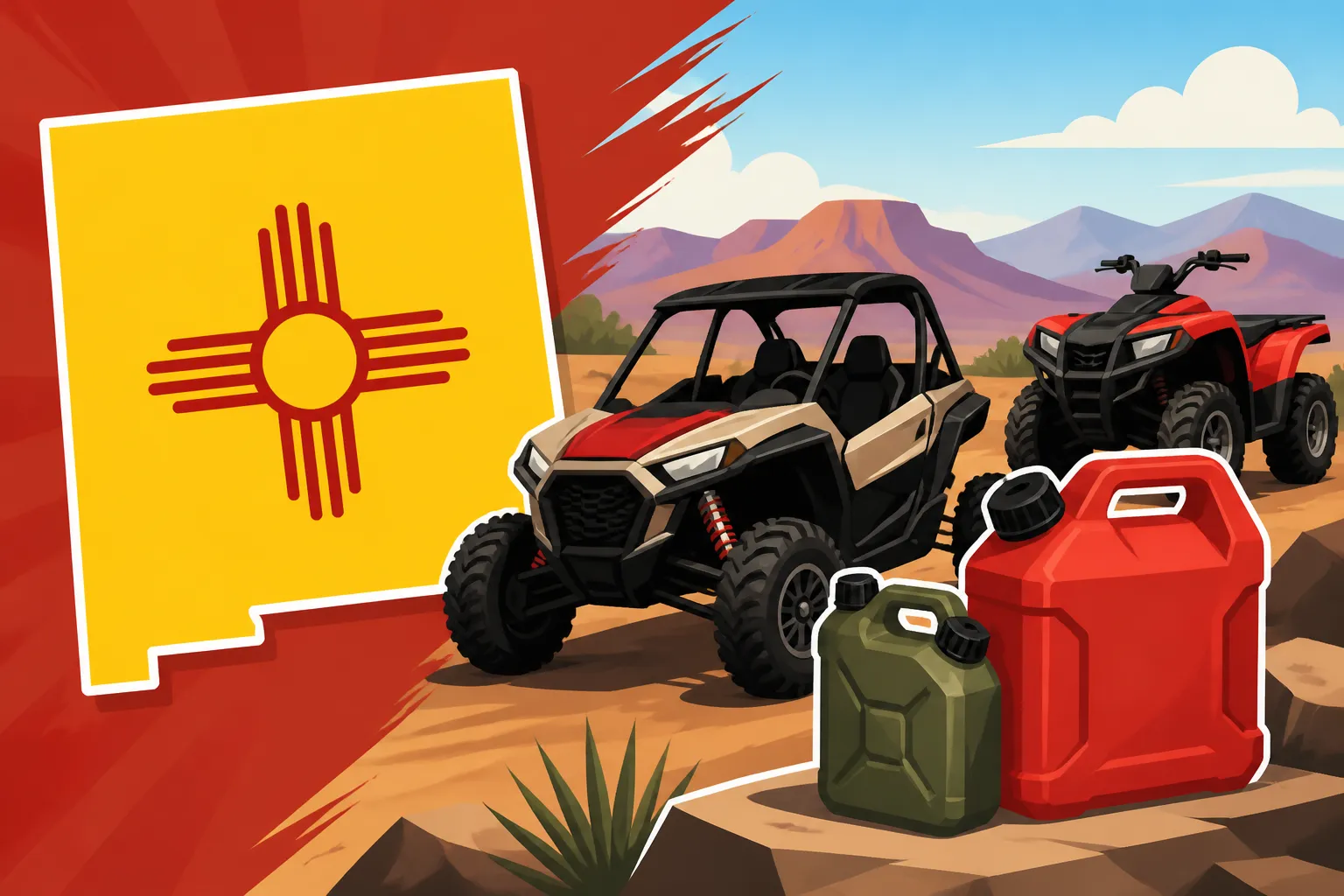
Carrying spare fuel can make a remote New Mexico ride more practical, but a loose or leaking can creates a serious fire and spill risk. The safest plan is to check the route’s land rules first, choose a suitable fuel container, secure it away from heat, and refuel well clear of ignition sources.
Check the rules for your route before packing fuel
There is no one simple rule that answers every question about carrying spare gasoline across New Mexico riding areas. Rules and restrictions can depend on the land manager, the route, current fire conditions, and how you are transporting the fuel. A container that is acceptable on a private trailer may not be acceptable at a particular staging area or during a temporary fire restriction.
Before leaving, identify who manages the trail or road. National forests, Bureau of Land Management (BLM) areas, state trust land, tribal land, and private property do not necessarily share the same access rules. Start with the land manager’s current notices and contact the appropriate office if its instructions do not clearly address your situation. For background on access requirements, see [New Mexico Rules for Riding a National Forest], New Mexico Rules for Riding BLM Land, and Riding State Trust Land With a Permit.
Pay special attention to temporary fire restrictions. They can prohibit activities beyond campfires and may affect vehicle use, equipment, or where fuel can be handled. The terms of the current order matter; do not assume that a restriction applies only to people building a fire. Check New Mexico Rules for Riding During Fire Season and New Mexico Rules for Campfires at a Trailhead, then confirm any active order with the land manager before your trip.
A useful distinction is the difference between carrying fuel as ordinary riding equipment and fueling a machine at the trailhead. A restriction, closure, or site rule may affect one activity differently from another. Read the actual notice rather than relying on a general statement that “the area is open.” An open route does not automatically mean every activity or every staging location is allowed.
| Before you go | What to confirm |
|---|---|
| Route and land ownership | Which agency or property owner manages the route and staging area |
| Fire status | Whether current restrictions limit fuel handling, vehicle use, or access |
| Container rules | Whether the site has requirements or prohibitions for portable fuel containers |
| Machine compatibility | Whether the fuel is correct for your ATV or UTV |
| Transport method | Whether the container can be secured upright and kept away from heat |
| Emergency options | Where you can stop, and how to contact help if a leak or breakdown occurs |
If your ride crosses more than one type of land, check each section rather than treating the entire route as one jurisdiction. A trail may connect public routes, private access roads, or land with separate permission requirements. For tribal land, do not assume a public road or trail is open just because it appears on a map; see New Mexico Rules for Riding Tribal Land.
Also confirm that the vehicle itself is allowed on the planned route. A fuel plan cannot make a closed or unauthorized route legal. If you are visiting from another state, check the separate permit rules as well: carrying fuel does not replace any required riding permit or proof of registration. New Mexico’s Nonresident OHV Permit explains a different requirement from permission to carry fuel.
Choose a container and secure it properly
Use a purpose-made container intended for gasoline, in good condition, with a cap and closure that seal reliably. Follow the container manufacturer’s instructions for the fuel type, filling level, orientation, temperature, and transport. A container intended for water, household chemicals, or another liquid is not a safe substitute. Do not use a damaged, swollen, cracked, or badly worn container, even for a short trip.
Choose a size and shape that your machine or trailer can carry without interfering with the rider, passenger, controls, suspension, or cargo. A large container may hold more reserve fuel, but it also adds weight and can shift the machine’s balance. That trade-off matters on rocky climbs, loose sand, narrow trails, and uneven roads. If a suitable place to mount the container is not available, carrying less fuel or using a support vehicle may be the safer choice.
Secure the container so it cannot slide, bounce, tip, or fall off. Use a proper mount or tie-down arrangement that holds it firmly during normal movement, and check that the closure remains accessible for inspection. Keep it upright if the container’s instructions require that position. Do not rely on a bungee cord, an unsecured cargo rack, or a loose strap as the only restraint on rough terrain.
Keep spare fuel away from hot exhaust parts, exposed electrical connections, sharp edges, and areas where branches or rocks could strike it. Avoid placing a container where it could be crushed in a rollover or block a quick exit from the machine. Never carry it in a way that obstructs the driver’s view, interferes with steering, or crowds a passenger’s seating area. A secure load still needs to be a load that the machine can handle.
An ATV or UTV may have limited storage and little protection from weather or impact. If you cannot position a fuel container safely, do not force it into an awkward spot just to gain extra range. Consider refueling before leaving town, shortening the ride, choosing a route with a realistic fuel plan, or transporting fuel in a properly equipped tow vehicle instead.
If you shop for a container through Amazon or another retailer, check the manufacturer’s specifications rather than relying only on a product photo or listing title. Confirm that it is intended for gasoline, that it suits your transport setup, and that its mounting system is compatible with your machine. A container sold as “off-road” equipment is not automatically appropriate for every ATV, UTV, route, or fire-restriction condition.
Do not improvise a fuel transfer system with loose tubing, an unsecured funnel, or an open container. Keep any spout or transfer equipment clean and protected from dirt. Dust and debris can enter an open fuel container during a desert ride, and contamination can create problems for the machine far from a repair shop.
Refuel carefully at the trailhead or on the route
Refueling is a moment when a small mistake can have serious consequences. Stop in a stable, well-ventilated place away from traffic, dry grass, brush, and other combustible material. Turn the engine off and allow hot parts to cool before opening a fuel container or the machine’s tank. Do not smoke or use a flame, and keep other riders from starting engines nearby while fuel is exposed.
Use a stable position for both the machine and the container. Do not refuel on a steep slope where fuel could spill or the machine could roll. Pour slowly, avoid overfilling, and stop if the container or tank shifts. Keep the opening clear of grit. If the machine has a manufacturer’s refueling instructions, follow them; do not guess at a safe fill level or force fuel into a tank that is already full.
A basic field refueling routine helps reduce spills:
- Stop in a clear, stable spot and shut off the engine.
- Move away from dry vegetation and other ignition sources.
- Let hot parts cool and make sure the machine cannot roll.
- Inspect the container and cap for damage or leakage.
- Transfer fuel slowly, keeping the container and tank stable.
- Close both openings securely and wipe up any small residue before restarting.
- Check for leaks and make sure the container is secured again before riding.
If fuel spills, stop the transfer and keep people and ignition sources away. Do not start the machine or ride through the spill. Follow the land manager’s instructions for reporting or handling a spill, especially if fuel reaches soil, water, or vegetation. Do not try to wash it away with water; that can spread contamination.
Never refuel inside an enclosed trailer, vehicle, or small shelter. Vapors can build up in enclosed spaces and may ignite. Keep containers closed when not in use and follow their instructions for ventilation and storage. Do not leave fuel in direct sun longer than necessary, and do not store it beside hot equipment.
For a group ride, decide in advance who is carrying fuel and where stops will happen. Make sure each rider knows not to pass a fuel container around while engines are running or while machines are hot. A group leader should also know how to contact the land manager or emergency services if a spill, fire, or breakdown occurs. See [New Mexico Rules for a Group Ride] for broader planning considerations.
Plan range without overloading the machine
The right amount of spare fuel depends on the machine, route, riding style, terrain, weather, and the availability of fuel before and after the ride. Sand, steep climbs, high elevation, a heavy load, and frequent stopping can all change consumption. A route estimate made for a short paved trip may not predict a day of slow off-road riding.
Build a conservative plan rather than aiming to arrive with the tank nearly empty. Check the machine’s fuel level before departure, identify the last reliable refueling point, and plan a turnaround point that leaves a reserve. Do not rely on a map symbol alone to assume a station is open or sells the fuel your machine needs. In remote areas, the next opportunity may be farther away than expected.
Test your machine’s typical consumption under similar conditions before depending on a range estimate in a remote area. Keep notes about the ride distance, terrain, load, and fuel used. This will not guarantee the same result on a different day, but it gives you a more useful estimate than the advertised range or a guess based on easy riding close to home.
Carrying more fuel is not always safer. Extra weight can affect handling, braking, and stability, and an additional container is another potential leak or impact point. Compare the benefit of added range with the risk of carrying it. If the route is too remote for the machine’s practical range, consider a shorter route, a support vehicle, or a different starting point instead of loading fuel in an unsafe location.
Fuel also does not solve every kind of remote-area problem. A machine can break down, a route can close, or weather can make a crossing unsafe. Carry water, basic repair supplies, communication equipment suited to the area, and a plan for telling someone where you are going. Check New Mexico Trail Closures to Check First and Carrying Proof on a Desert Ride as part of trip preparation.
A simple pre-ride check can catch problems before you leave:
- Confirm the route is open and the relevant land manager permits your planned activity.
- Check current fire restrictions and any staging-area notices.
- Inspect the fuel container, cap, mount, and tie-downs.
- Verify that the fuel is suitable for the machine.
- Make sure the load does not affect controls, seating, visibility, or stability.
- Estimate the trip conservatively and identify a safe turnaround point.
- Tell someone your route and expected return time.
If any part of the fuel setup feels insecure, change the plan before setting out. A shorter ride with a stable machine is preferable to a longer ride with a loose container or an uncertain fire-risk situation.
Disclaimer
This article is for general informational purposes only and does not constitute professional advice. Laws, prices and regulations vary by location and change over time. Consult a qualified professional for guidance on your specific situation.