Approved Courses for a New Mexico Permit
Approved Courses for a New Mexico Permit
If a rider under 18 needs a New Mexico OHV safety permit, the important question is not simply whether they have taken an ATV course. The course must be accepted for New Mexico’s permit requirement. Here’s how to identify an approved course, complete it, and make sure the rider has the right proof before heading out.
What an approved course means in New Mexico
New Mexico requires many OHV riders under 18 to complete an approved safety course and obtain a safety permit before riding on public land. The course is meant to teach safe operation and responsible riding; the permit is proof that the rider has met the state’s training requirement. It is separate from the machine’s registration or any nonresident permit.
The word “approved” matters. An ATV safety certificate from a school, dealer, employer, another state, or a general online training site does not automatically satisfy New Mexico’s requirement. The course needs to be recognized by the New Mexico authority that administers the OHV safety program. If the course provider does not identify New Mexico’s permit requirement or show that its course is accepted for that purpose, check before enrolling.
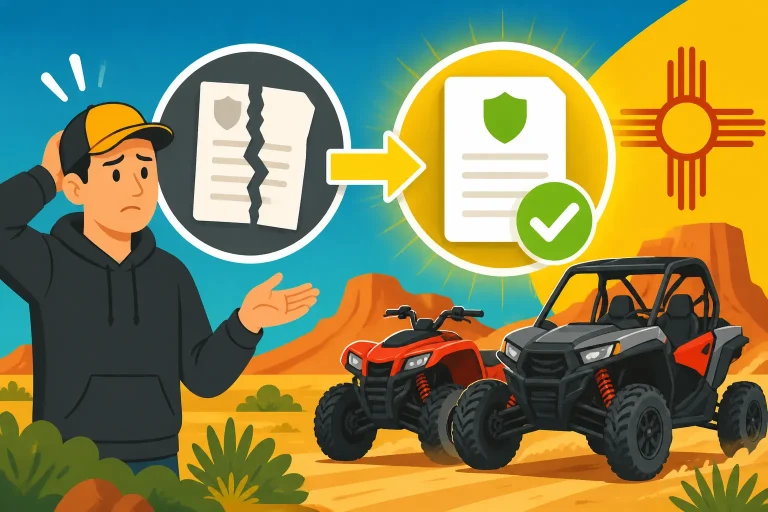
This distinction can prevent a frustrating problem: a teen finishes a course and receives a certificate, but the certificate is not the New Mexico safety permit or is not accepted to obtain one. A course completion document and a state permit may be separate items. Confirm what the course issues, what the state requires afterward, and what the rider must carry.
The safety permit is also not the same as a New Mexico registration decal or permit for a nonresident machine. Those address different requirements:
| Requirement | What it addresses | Who may need it |
|---|---|---|
| OHV safety course and safety permit | Rider training and proof of completing the requirement | Many riders under 18 |
| OHV registration or nonresident permit | The machine’s authority to be used on public land | Depends on the machine and the rider’s home-state registration |
| Road-use requirements | Whether and how an OHV may use certain paved roads | Depends on the road, local rules, and machine |
For details about the youth requirement, see [New Mexico OHV Safety Permit Requirements]. For the broader permit rules that apply to visitors, see New Mexico’s Nonresident OHV Permit. Do not assume that completing the safety course replaces a machine’s registration, or that a valid registration replaces the rider’s safety permit.
The course requirement focuses on the rider, not the machine’s size, value, or ownership. A child riding a family ATV may still need to meet the applicable training requirement. The same issue can arise when a youth rides a borrowed or rented machine. Before the trip, check both the operator’s requirements and the machine’s paperwork.
How to identify a course New Mexico accepts
Start with the state’s official OHV safety permit information, rather than a general internet search for “ATV safety course.” Look for the course or provider that the state identifies as accepted for earning its permit. If the information directs riders to a particular course platform or enrollment page, use that route instead of assuming that a similar course elsewhere will count.
Course availability and delivery options can change. An approved option may be online, in person, or offered through another arrangement, depending on the program. The key is not the format. It is whether the state recognizes that specific course for its safety permit.
Before registering, check these points:
- The course is explicitly connected to New Mexico’s OHV safety permit. A statement that a course teaches ATV safety is not enough on its own.
- The rider is eligible to enroll. Check any age, account, or guardian requirements before beginning.
- The course meets the relevant training requirement. A general motorcycle class, driver education course, or training from another activity may not substitute.
- The completion record can be used to obtain or document the New Mexico permit. Find out whether the provider issues the permit, reports completion to the state, or gives the rider a certificate to submit.
- The rider knows what proof to carry. A screen showing a completed lesson may not be the required proof during a ride.
If the official instructions are unclear, contact the state program or the course provider before paying or investing time. Ask a direct question: “Will completing this course satisfy New Mexico’s OHV safety permit requirement for this rider?” Also ask what the rider receives at the end and whether an additional step is needed to get the permit.
A course title by itself is not a reliable test. “ATV safety,” “off-road vehicle safety,” or “youth rider training” can describe useful instruction without establishing that New Mexico accepts it. Conversely, a course may satisfy the requirement even if its title differs from the phrase used in state materials. Verify recognition through the official program rather than judging by the course name.
Be cautious with third-party sites that appear in search results. Some provide general safety education, some offer training for other states, and some may be designed for workplace or recreational use rather than a state permit. A certificate can be worthwhile for learning and still fail to meet this specific requirement. That is why it helps to confirm acceptance before starting.
Completing the course and getting the permit
The process is easiest when the rider and parent or guardian treat course completion and permit possession as two separate checkpoints. The course teaches the material; the permit is the proof required for riding. Follow the current official instructions for the specific approved course, since enrollment, completion, and permit delivery steps can differ.
A practical sequence is:
- Check whether the rider needs the permit. Review the current rules for the rider’s age and circumstances. The requirement can include exceptions, so do not rely only on a general statement that every minor follows the same route.
- Locate the state-recognized course. Use the official OHV safety permit information or contact the administering program if the accepted course is not clear.
- Confirm how the course leads to the permit. Determine whether the course provider issues the permit, sends completion information to the state, or provides documentation for a separate application step.
- Enroll using the rider’s correct information. Enter names and details carefully. A mismatch between a course record and permit paperwork can complicate proof of completion.
- Complete the required material and assessment. The course may include instruction, questions, or a final assessment. Follow the course’s own rules and make sure the rider personally understands the material.
- Finish every required administrative step. Do not stop at a “course complete” screen if the official instructions require an additional permit request or confirmation.
- Save the permit and completion records. Keep a durable copy, and retain any confirmation or certificate that shows the course was completed.
- Review what must be carried on the ride. Follow the current rule on whether the permit must be carried physically or whether another form of proof is accepted.
Parents can help with registration and recordkeeping, but the training should be meaningful to the rider. A youth who clicks through without understanding the content may have a document but not the knowledge needed to make safe decisions. Review the material together, especially if the rider is new to throttle control, braking, terrain changes, or riding around other people.
Keep the course completion record even after the permit is issued. It can help resolve a lost permit, a question about a name or date, or an uncertainty about which course was completed. Store it somewhere accessible, and take a photo or digital copy if the program permits that form of recordkeeping. Do not assume a phone image alone is an acceptable substitute for the required permit; check the official carrying instructions.
If the course is online, plan for a reliable connection and enough uninterrupted time to finish. Some platforms may allow a rider to pause and return; others may have different session rules. Check the provider’s instructions before starting, particularly if the rider is using a shared device or a parent’s account.
For a young rider, it can also help to treat the course as preparation for the first ride rather than a box to check. After completion, talk through how the rider will handle a stop, a hill, an unexpected obstacle, or a change in trail conditions. A permit verifies the required training step; it does not establish that a rider is ready for every machine or route.
Exceptions, supervision, and other riding requirements
A course may not be the only route for every minor in every circumstance. New Mexico’s rules can include exceptions or different treatment for a young person with a qualifying license or credential. The exact conditions matter, so confirm the rule for the particular rider rather than assuming that a driver’s license, learner’s permit, or motorcycle credential automatically satisfies the OHV requirement.
If a rider believes an exception applies, check what credential qualifies and whether the rider must carry it while operating. Do not rely on a parent’s interpretation or an informal statement from a seller. The state’s published requirements or program staff are the right place to verify it. Related questions are covered in Can a 13-Year-Old With a Motorcycle License Ride? and Can a 15-Year-Old Driver Skip the Safety Permit?.
The safety permit does not cancel supervision rules. A trained minor may still have to ride under the supervision required for their age and circumstances. Nor does a safety permit make every route legal. Riders still need permission to access the land, must follow route designations, and must comply with rules for the machine and the place where they ride. For those separate issues, see [New Mexico Supervision Rules for Young Riders] and [New Mexico Rules for Riding a Designated Route].
The same separation applies to registration. A youth’s safety permit does not register the family’s ATV, and registering the ATV does not satisfy the youth’s training requirement. If the machine is from out of state, check whether its home registration is recognized or whether a New Mexico nonresident permit is needed. Any Valid OHV Registration Counts in New Mexico explains the reciprocity issue.
A rental or borrowed machine adds another layer. Ask the rental company or owner what paperwork comes with the machine, but verify the youth’s personal requirement separately. A company’s rental agreement or a machine’s permit should not be treated as proof that a young rider has completed New Mexico’s safety training. If a teen will ride a rental, see New Mexico Rules for a Rented Machine and Riding a Rented Quad on New Mexico Public Land.
Before leaving, check the full set of applicable requirements:
- The rider has the required safety permit or meets a verified exception.
- The rider has any required supervision for their age.
- The machine has the appropriate registration or permit.
- The route is open to the type of OHV being used.
- The rider and machine meet any separate equipment or road-use rules.
- Required documents are available in the form the rules accept.
This checklist is especially useful for families traveling from another state. A course or permit from home may be relevant, but do not assume that every state’s program transfers automatically. Check New Mexico’s current reciprocity and safety permit guidance before the trip. Information about permits for riders from states without an OHV program is available at Riders From States Without Registration.
Common mistakes to avoid
The most common mistake is choosing a course because it looks credible, then checking too late whether New Mexico accepts it. A polished website, a completion badge, or a certificate with “ATV safety” in the title does not prove that it meets the state requirement. Confirm recognition first.
Another mistake is treating the course certificate as the permit. They may be linked, but they are not necessarily the same document. Read the last step of the official process and make sure the rider has the required permit, not just evidence that lessons were completed.
Families also sometimes assume a child is exempt because the family owns the machine, the ride is short, or the rider has used an ATV before. Ownership and experience do not by themselves establish an exception. Check the rule based on the rider’s age, credentials, and riding location.
A few other errors are easy to prevent:
- Using a course from another state without checking acceptance. Training can be useful without being recognized for the New Mexico permit.
- Waiting until the day of the ride. Course access, account setup, completion, or permit delivery may take more time than expected.
- Leaving the permit at home. Completing the requirement does not help roadside if the required proof is unavailable.
- Assuming an adult’s paperwork covers the child. The safety permit requirement applies to the rider, while registration and nonresident permits concern the machine or its use.
- Relying on old instructions. Course providers and agency processes may change. Confirm current directions before enrolling or traveling.
- Confusing public-land riding with paved-road use. A safety permit does not grant permission to ride on a public street or highway. Road access has separate rules.
If a permit is misplaced, use the course or state program’s replacement instructions. Keep the rider’s identifying details and original completion record available, but avoid sending sensitive information to a site that is not clearly connected to the approved program.
A good approach is to verify the course, complete it early, save proof, and then check the rest of the ride requirements independently. That prevents a training document from being mistaken for blanket permission to operate an OHV anywhere in New Mexico.
Frequently Asked Questions
Does any ATV safety course count for a New Mexico permit?
No. The course must be accepted for New Mexico’s OHV safety permit requirement. Confirm that the state recognizes the specific course before enrolling.
Is a course certificate the same as a safety permit?
Not necessarily. The course certificate may show completion, while a separate step may be needed to obtain the permit. Follow the official instructions and carry the required proof.
Does a New Mexico safety permit register the ATV?
No. The safety permit concerns the rider’s training. Machine registration or a nonresident permit is a separate requirement.
Can an out-of-state safety course satisfy the requirement?
Do not assume so. Check with New Mexico’s OHV safety program to confirm whether that course or credential is accepted for the rider’s situation.
Does completing the course mean a minor can ride without an adult?
Not necessarily. Supervision rules are separate from the training requirement. Check the applicable rule for the rider’s age and circumstances.
Disclaimer
This article is for general informational purposes only and does not constitute professional advice. Laws, prices and regulations vary by location and change over time. Consult a qualified professional for guidance on your specific situation.