New Mexico’s First OHV Registration
So, you've just brought home a shiny new (or new-to-you) off-highway vehicle, maybe an ATV, a UTV, or a dirt bike, and you're itching to hit the incredible trails New Mexico has to offer. That excitement is totally understandable! But before you can kick up dust legally, there's that little hurdle of getting it properly registered for the very first time. It can feel like a maze of paperwork, fees, and rules, especially if you're new to the OHV scene or even new to the state. This guide is here to cut through the confusion and walk you, step-by-step, through everything you need to know to get your off-highway machine officially registered in New Mexico, ensuring your first ride is legal and worry-free.
Understanding the Basics of OHV Registration in New Mexico
Getting your OHV registered in New Mexico isn't just about putting a sticker on it; it's about making sure you're a responsible and legal rider. Many folks come from states where OHV registration is handled differently, or perhaps they've only ever ridden on private land before. That transition to public land riding, and the responsibilities that come with it, can feel a bit daunting at first, but it's totally manageable.
Why Registration Matters for Your New Mexico Adventures
You might be thinking, "It's just a sticker, what's the big deal?" But believe me, that little decal on your machine is your ticket to legal adventure and peace of mind here in New Mexico. Without it, you could be facing some serious headaches and expenses that nobody wants when they're out trying to enjoy the stunning landscapes. It's a fundamental part of being a legal rider in the Land of Enchantment.
First off, registration is about legality. Riding an unregistered OHV on public land in New Mexico is a direct violation of state law. This isn't just a slap on the wrist kind of offense; you could be looking at fines that definitely put a damper on your riding budget. Imagine getting pulled over by a Game and Fish officer or a BLM ranger miles from anywhere, only to find out your machine isn't compliant. It's a frustrating situation that’s entirely avoidable. Proper registration means you're operating within the legal framework, which is always the best starting point for any outdoor recreation.
Secondly, registration grants you access to New Mexico's vast and diverse trail systems. Our state boasts an incredible array of public lands, from national forests to Bureau of Land Management (BLM) areas, many of which welcome OHV riders. However, accessing these designated trails and riding areas almost universally requires your machine to be currently registered. Think of it as your pass to explore; without it, many gates, figuratively speaking, will remain closed. This applies whether you're planning a trip to the dunes of Mescalero Sands or the high-country trails in the Carson National Forest.
Finally, and this is a point many riders might not immediately consider, your registration fees play a crucial role in maintaining and improving the very trails you love to ride. A portion of the money collected through OHV registrations goes directly into programs that support trail development, maintenance, and educational initiatives. When you register your machine, you're contributing to the infrastructure that makes New Mexico such a fantastic place for off-highway vehicle enthusiasts. It’s a direct investment in the future of our sport, ensuring there are well-maintained and accessible places for everyone to enjoy. If you're curious about exactly where those dollars go, you can learn more by checking out [Where New Mexico OHV Fees Go].
The Role of the MVD in First-Time OHV Registration
When it comes to getting your OHV registered in New Mexico, the central player you'll be dealing with is the Motor Vehicle Division, or MVD. This is often a point of confusion for new residents or those familiar with other states where wildlife or parks departments handle OHV matters. But here in New Mexico, the MVD is the authority.
The MVD is the primary state agency responsible for processing all aspects of OHV registration. This means they're the ones who will handle your initial application, verify your ownership documents, issue your registration card, and provide those all-important decals that signify your machine is legal to operate. They oversee the entire process, from verifying your vehicle identification number (VIN) to collecting the necessary fees. It's a comprehensive service aimed at streamlining vehicle regulation, whether it's for a car, truck, or an off-highway machine.
One of the common questions people have is why the MVD, and not say, the New Mexico Department of Game and Fish, handles OHV registration. In many states, it’s a wildlife agency that manages these permits. However, New Mexico made the decision to centralize all vehicle registrations under the MVD to create a more unified and accessible system. This means whether you're registering a car, a motorcycle, or an ATV, you generally go through the same state agency. This approach aims to simplify the process for residents and ensure consistency across different vehicle types. For a deeper dive into this specific structure, you might find [Why MVD Registers New Mexico OHVs] helpful.
So, when you're planning your first registration, remember that your destination will be a New Mexico MVD office, not a Game and Fish department. They are equipped to guide you through the specific forms and requirements for off-highway vehicles, ensuring you get the correct registration and decals for your intended riding.
Differentiating Between Registration and Titling
Before we dive too deep, it's really important to understand that there are two distinct, though often intertwined, processes you'll go through when you get a new OHV: titling and registration. People often use these terms interchangeably, but they mean very different things in the eyes of the law, and mixing them up can definitely cause delays at the MVD counter.
Registration is essentially your permission to operate the vehicle on public lands. Think of it like a temporary license for your machine. It proves that you've paid the necessary fees and are compliant with state regulations for a specific period. In New Mexico, OHV registration is not permanent; it needs to be renewed. For most machines, this means a biennial renewal, happening every two years. When you register, you receive a registration card and the all-important decals that you'll affix to your OHV. This process is about active permission to ride and typically comes with an expiration date.
Titling, on the other hand, is all about proving ownership. The title document is essentially the legal document that states who the rightful owner of the OHV is. It's a one-time process for each machine (unless it's transferred to a new owner), and it doesn't expire. The title document includes key information about the vehicle, such as its VIN, make, model, and year, along with the owner's name. This document is critical for buying, selling, or transferring ownership of your OHV. It's the ultimate proof that the machine belongs to you, free and clear.
So, while you might hear people talk about "getting your OHV registered," what they often mean is that they're going through both the titling and registration process. Generally, you need to establish legal ownership (get the title in your name) before you can get permission to operate it (register it). The MVD typically handles both of these concurrently or in sequence during your first visit for a new machine. Understanding this distinction is key to gathering the correct documents and understanding what's happening at each step. If you're looking for more details specifically on the ownership side, [Titling an Off-Highway Vehicle in New Mexico] is a great resource.
Essential Documents for Your First New Mexico OHV Registration
Getting all your ducks in a row before you head to the MVD is probably the single most important piece of advice I can give you. Nothing is more frustrating than waiting in line, finally getting to the counter, only to find out you’re missing a critical piece of paper and have to start all over again. Trust me, I've been there! A little preparation goes a long way to making your first registration a smooth experience.
Proof of Ownership: The Foundation of Your Registration
When you walk into the MVD, the very first thing they need to establish is that you are the legitimate owner of the OHV you're trying to register. Without solid proof of ownership, they simply cannot proceed. This is the cornerstone of the entire process, whether you're buying a brand-new machine off the showroom floor or picking up a used gem from a private seller.
For a brand-new machine purchased from a dealership, your proof of ownership will typically be a Manufacturer's Statement of Origin (MSO) or a Manufacturer's Certificate of Origin (MCO). This document is issued by the manufacturer and indicates that the vehicle is new and has not been previously titled. It's essentially the birth certificate of your OHV. The dealership should provide this to you, often filled out with your name as the initial owner. It's a critical piece of paper, so keep it safe! Without an MSO, a new machine cannot be titled or registered.
If you're buying a used OHV, whether from a dealership or a private party, the proof of ownership will be the previously issued title. This title needs to be properly signed over to you by the previous owner, indicating the transfer of ownership. It should be clear and free of any alterations. Always ensure the seller provides you with this original document, as a copy usually isn't sufficient for MVD purposes. This is where many private sales can get tricky, so absolute clarity on the title transfer is paramount.
Now, what if there's no title? This is where things can get complicated, and it's a common frustration, especially when buying older used machines or ones that have changed hands many times. In New Mexico, it's generally required to have a title for an OHV. If you purchase a used ATV or UTV without a title, or if the seller has misplaced it, you might be looking at a much more involved process, possibly requiring a bonded title or other affidavits to prove ownership before you can even think about registration. This is definitely a "buyer beware" situation. For a comprehensive look at the title requirements, you'll want to read [Do You Need a Title for an ATV in New Mexico?]. It outlines the challenges and potential solutions for machines in this situation.
The New Mexico Bill of Sale: A Critical Piece of Paperwork
While the title (or MSO) establishes ownership, a bill of sale provides crucial details about the transaction itself. It's an often-underestimated document that can save you a world of hurt, especially in private sales. The New Mexico MVD absolutely recognizes the importance of a well-crafted bill of sale, particularly when a machine is coming from a private party or if there are questions about the purchase price for tax purposes.
For private sales, a bill of sale acts as a detailed record of the transfer. It should clearly identify both the buyer and the seller, including their full names, addresses, and contact information. Crucially, it must accurately describe the OHV being sold, including its make, model, year, and its unique Vehicle Identification Number (VIN). Without the VIN, the bill of sale can't be conclusively linked to the specific machine. The date of sale and the agreed-upon purchase price are also vital elements, as these are used for calculating any applicable sales taxes or fees. Both parties should sign and date the document, and it's always a good idea to have it notarized if possible, though not always strictly required by the MVD for all transactions.
Imagine you've bought a used quad, and the seller just hands you the title, maybe even an old registration, but no bill of sale. A few months later, the MVD has a question about the sale price, or perhaps there's a dispute about the condition of the machine at the time of purchase. Without a clear bill of sale, you have very little to back up your claims. This document clarifies the terms of the transaction and protects both the buyer and the seller, ensuring there’s no ambiguity about what was exchanged and for how much.
If you’re wondering how to create a proper bill of sale, especially for a private transaction, resources like LawDepot can be incredibly helpful. They offer templates that ensure you include all the necessary legal language and information the MVD will look for. Using a standardized, reliable template can prevent common errors that lead to rejection at the counter. Having a robust bill of sale on hand will make the MVD process significantly smoother and provide you with a solid record of your purchase. For more details on what needs to be on this important document, refer to [A New Mexico Bill of Sale for an ATV].
Identification and Residency Proof
Beyond proving that the OHV belongs to you, you also need to prove who you are and, if you're a New Mexico resident, that you actually live here. This might seem obvious, but failing to bring the right forms of personal identification can halt your registration process just as quickly as missing a title. The MVD needs to verify your identity to ensure the registration is issued to the correct person.
First and foremost, you'll need a valid form of photo identification. This typically means your current driver's license or a state-issued identification card. Make sure it's current and clearly shows your photo and signature. If your driver's license is from another state but you're now a New Mexico resident, you'll likely need to update your license before completing the OHV registration, or at least provide additional proof of residency. The MVD is strict about ensuring the identity of the person registering the vehicle.
If you are a new resident of New Mexico, or if your identification doesn't clearly show a New Mexico address, you'll also need to provide proof of residency. This is crucial for distinguishing between resident and non-resident registration requirements. Acceptable documents often include recent utility bills (electricity, water, gas), a current lease agreement or mortgage statement, a bank statement, or other official documents that clearly show your name and a physical New Mexico address. A P.O. Box alone won't suffice, as they need proof of a physical domicile.
For those who are not New Mexico residents but plan to ride here, the requirements differ. New Mexico does offer options for out-of-state riders, including various permit options, but these are separate from a full New Mexico registration. If you're planning to register an OHV in New Mexico as a non-resident, the MVD will have specific guidelines, and you might not need to provide proof of New Mexico residency in the same way. However, you will still need valid identification from your home state. To understand the specific rules for visitors, you'll want to explore [New Mexico OHV Registration for a Nonresident]. Always double-check the MVD's latest requirements to ensure you have all the necessary personal identification and residency verification documents before your visit.
The Step-by-Step Process for Initial Registration at MVD
Alright, you've got your OHV, you understand the difference between titling and registration, and you've started mentally ticking off your document checklist. Now comes the actual process of getting it all done. While it might sound like a bureaucracy nightmare, breaking it down into manageable steps makes it a lot less intimidating. Think of it like navigating a new trail – a good map (this guide!) and knowing what's around the next bend makes all the difference.
Gathering Your Documents Before You Go
This step cannot be overstressed. Gathering everything you need before you leave the house is the ultimate time-saver and stress-reducer. I’ve seen countless people (and been one myself!) get turned away from the MVD counter because they forgot one tiny but critical piece of paper. It’s a frustrating experience that can lead to multiple trips and wasted hours. A complete and organized set of documents ensures a smooth process.
Start by creating a physical checklist based on the requirements we’ve already discussed and any specific MVD forms you might need. For a brand-new machine, this would include your Manufacturer’s Statement of Origin (MSO), the bill of sale from the dealership, and your personal ID. If you’re registering a used OHV, you’ll need the properly signed-over title from the previous owner, a comprehensive bill of sale (perhaps one you drafted using LawDepot), and your ID. If you're a new resident, have those utility bills or lease agreements ready. Don't forget proof of any sales tax paid (if applicable) or a receipt for that.
It's absolutely critical to bring original documents whenever possible, especially for titles and MSOs. While some agencies might accept copies for certain things, the MVD generally prefers or requires originals for proof of ownership. Make sure everything is legible and complete – no missing signatures, dates, or VINs. Any discrepancy or blank field can trigger a rejection. Imagine going through all the trouble, only for a missing date on your bill of sale to send you back home.
Think of it this way: the MVD clerk's job is to ensure everything is perfect according to state law. If anything is amiss, they can't proceed. So, meticulously going through your documents at home, perhaps even making a photocopy of your completed stack for your own records, will save you immense hassle. For a detailed rundown of all potential forms and documentation, the article [New Mexico OHV Registration Paperwork] is an excellent checklist to consult before your MVD visit.
Visiting Your Local New Mexico MVD Office
With all your documents neatly organized, the next step is a trip to your local New Mexico MVD office. This can sometimes feel like going to the DMV – a universal experience that comes with its own set of expectations. However, knowing what to anticipate can make it much smoother.
First, consider whether you need an appointment or if walk-ins are accepted. In many MVD offices across New Mexico, particularly in larger cities, appointments are highly recommended or even required for certain services to manage wait times. Checking the specific MVD office's website or giving them a call beforehand can save you hours of waiting. There’s nothing worse than showing up bright and early, only to find a sign saying appointments are mandatory and the next available slot is weeks away. Smaller, rural MVD offices might be more amenable to walk-ins, but it's always best to verify.
Once you arrive, be prepared for a VIN inspection. This is a standard procedure for many vehicle registrations, especially initial ones, to verify that the Vehicle Identification Number on your documents matches the physical VIN on your OHV. Depending on the office, this might involve an MVD employee coming out to the parking lot to visually inspect your machine, or you might be asked to bring the OHV to a specific inspection area. This step is crucial for preventing theft and ensuring accurate record-keeping. Make sure your OHV is accessible and the VIN is easily readable, typically stamped on the frame.
Finally, you'll get to the counter. This is where the MVD representative will meticulously review all your paperwork. Be ready to fill out any necessary application forms on site, such as the application for title and registration. They'll ask questions to clarify information, so be prepared to answer accurately and patiently. The key here is to remain calm and cooperative; the clerk is just doing their job to ensure everything is compliant with state regulations. They’ll likely check off each document from their own internal checklist, verifying signatures, dates, and numbers.
Fees, Payments, and What You Receive
Once your documents have been reviewed and approved by the MVD, you’re almost at the finish line! The next step is to pay the required fees. It's important to understand what these fees cover and why the initial registration often has a higher cost than subsequent renewals.
For a first-time OHV registration in New Mexico, you'll generally encounter a few distinct fees. There's the title fee, which is a one-time charge for issuing your Certificate of Title, officially putting the OHV in your name. Then there's the actual registration fee, which covers the cost of registering your vehicle for a specific period. Currently, New Mexico OHV registrations are valid for two years, making it a biennial renewal. You might also have a small fee for the issuance of your decals. If you've just purchased the OHV, there may also be sales tax (gross receipts tax) due on the purchase price if you haven't already paid it to a dealer.
You might notice that the initial registration fee is a bit higher than what you'll pay for renewals down the line. This is typically because the first registration includes the titling process, which is a one-time administrative cost associated with establishing initial legal ownership. Subsequent renewals only cover the registration itself. For a clear explanation of this cost difference, [Why a First Registration Costs More Than a Renewal] offers great insight. Always check the current fee schedule with the MVD or on their website, as these amounts can change.
When it comes to payment, New Mexico MVD offices generally accept various methods, including cash, checks, and major credit/debit cards. It’s always a good idea to confirm accepted payment types with your specific MVD office beforehand, or simply bring a few options to be safe. You don't want to get stuck without a way to pay after all that waiting!
Once the fees are paid, you'll walk away with several important items. You’ll receive a temporary registration permit on the spot, which allows you to legally operate your OHV while your official documents are being processed. Soon after, you'll get your permanent registration card, your Certificate of Title (if not issued immediately), and most importantly, your OHV decals. These decals are critical, as they must be affixed to your machine to prove it’s registered. Keep your registration card with you when you ride, as it's proof of compliance.
Understanding New Mexico OHV Decals and Their Placement
Those colorful decals aren't just for show; they're the visible proof that your OHV is properly registered in New Mexico. But it's not a "one size fits all" situation. New Mexico has a system of different colored decals that signify different things, and how you place them on your machine is just as important as having them in the first place. This can be a point of confusion for new riders, but once you understand the system, it's pretty straightforward.
The Significance of Yellow and Green Decals
In New Mexico, you'll primarily encounter two colors of OHV decals: yellow and green. Each color signifies a different level of riding privilege, specifically regarding access to paved roads. Understanding the distinction is absolutely crucial to avoiding fines and riding legally, especially if you plan to use your OHV for more than just dirt trails.
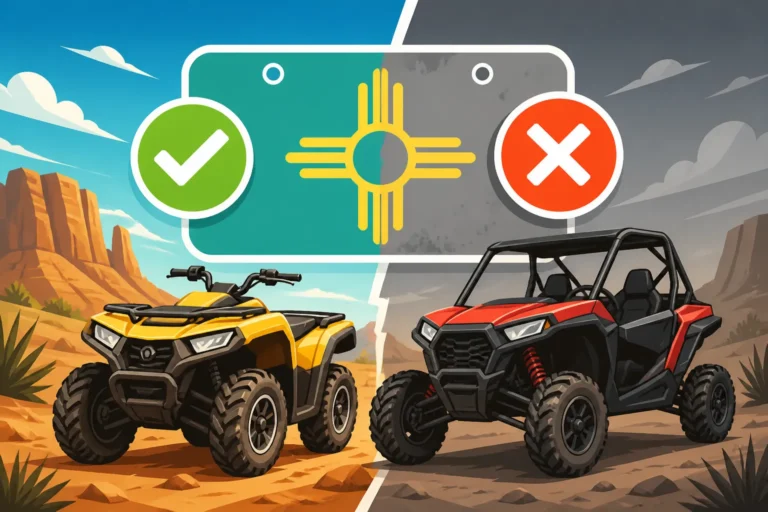
The yellow decal is what you'll get if you intend to use your OHV exclusively for off-highway riding. This means public lands, designated trails, and unpaved county roads where OHVs are permitted. If your adventures are purely dirt-based, this is the decal for you. It signifies that your machine is registered for off-highway use only and is not equipped or permitted for paved public street or highway travel. It's the standard OHV registration for the vast majority of riders who stick to the trails and the wilder side of New Mexico. For a deeper dive into these specific requirements, check out [New Mexico's Yellow Off-Highway Decal].
The green decal, on the other hand, grants you expanded privileges. This decal signifies that your OHV is registered for both on-highway and off-highway use. It’s specifically designed for those who want to use their OHV on paved public roads where permitted by local ordinance, such as crossing a highway to get to a trailhead or riding on open county roads. To qualify for a green decal, your OHV must meet additional equipment requirements, such as headlights, taillights, mirrors, and sometimes insurance. This decal is directly linked to New Mexico's "paved road plate" program's evolution, allowing compliant OHVs greater access. If your vision of OHV use involves any paved road travel, even short distances, this is the decal you need. You can find more comprehensive information on this decal at [New Mexico's Green On and Off-Highway Decal].
It's also worth noting that in some cases, particularly if you have an older machine that was part of the previous "paved road sticker" program, or if you plan to frequently transition between off-road and permitted paved roads, you might have or be required to carry both decals. This is because New Mexico law explicitly differentiates between the two types of use and has specific reasons for wanting both decals for pavement access, which you can read more about in [Why New Mexico Wants Both Decals for Pavement]. The key takeaway is to choose the decal that matches your riding intentions and ensure your OHV meets all associated requirements.
Correct Decal Placement by Vehicle Type
Having the right decal is only half the battle; knowing where to put it is equally important. New Mexico law is pretty specific about decal placement, and for good reason. It ensures that law enforcement officers, park rangers, and BLM agents can easily verify your OHV's registration status without having to stop you and physically inspect your machine. Incorrect placement can lead to unnecessary stops and even fines, so it's a detail you don't want to overlook.
For ATVs, the rules are quite clear. Your OHV decal (whether yellow or green) should be affixed to the left rear fender. It needs to be placed in a position where it is clearly visible from both the rear and the side of the machine. The goal is easy visibility without obstruction from cargo racks, bags, or rider posture. This standard placement ensures uniformity and ease of inspection across all ATVs operating in the state. If you’re unsure about the exact spot, visualize where an officer would naturally look to check for compliance. More specifics can be found in [Where a Quad's Decal Goes].
When it comes to UTVs or side-by-sides (ROVs), the placement differs slightly due to their different body styles. For these machines, the decal should be placed on the left rear quarter panel. Similar to ATVs, the key is clear visibility from the rear and side. The quarter panel often provides a flat, unobstructed surface ideal for the decal. Ensure it’s not hidden by aftermarket accessories, mudflaps, or cargo. The intention is for the decal to be easily identifiable at a glance. You can review precise requirements for UTVs at [Where a Side-by-Side's Decal Goes].
For off-highway motorcycles, or dirt bikes, the placement shifts again. The decal is generally required to be affixed to the left fork leg. This ensures visibility from the front and side of the motorcycle. It needs to be placed high enough to be seen easily but low enough not to interfere with suspension travel or other components. Make sure the surface is clean and dry before applying to ensure good adhesion. This specific spot is chosen because it’s a relatively universal, visible location on most dirt bikes. For dirt bike-specific instructions, consult [Where a Dirt Bike's Decal Goes]. Regardless of your machine type, take your time with placement to ensure it’s secure and compliant from day one.
What Happens If Your Decal is Lost, Damaged, or Placed Incorrectly
Life happens, and sometimes, despite your best efforts, things go wrong with your OHV decal. Whether it’s peeled off from sun exposure and mud, damaged in a minor fender bender, or perhaps you just realized you stuck it in the wrong spot, it’s important to know the implications and how to fix it. Operating with an improperly displayed or missing decal is essentially the same as riding with an unregistered machine in the eyes of the law.
The consequences of incorrect placement or a missing decal can range from being pulled over for a verbal warning to receiving a substantial fine. Law enforcement officers, whether it's the New Mexico State Police, county sheriffs, or federal land management rangers (like the BLM or Forest Service), are trained to look for these decals. If they can't easily see and verify your registration status, they have every right to stop you and investigate. This can disrupt your ride, cause delays, and lead to penalties you'd rather avoid. They might also issue a citation, potentially leading to fines and requiring a court appearance, all because a sticker wasn't where it should be.
If your decal becomes lost, damaged, or simply unreadable, you are required to obtain a replacement. It’s not something you can just ignore and hope for the best. The process for replacing a lost or damaged decal is handled through the MVD. You'll typically need to fill out a specific form, provide your OHV's registration information, and pay a small replacement fee. It's usually a much quicker process than initial registration, but it still requires a trip to the MVD or utilizing their online services if available. For detailed instructions on how to get a new decal, definitely check out [Replacing a Lost New Mexico Decal].
Ultimately, the importance of keeping your registration current and your decal clearly and correctly displayed cannot be overstated. It's not just a formality; it's a fundamental part of legal and responsible OHV operation in New Mexico. Take the extra five minutes to ensure your decal is properly affixed and visible, and routinely check its condition. This small effort can save you a lot of hassle down the road and keep your focus on the joy of riding.
Special Considerations for Different Scenarios
The world of OHV ownership isn't always straightforward. Sometimes, you're not buying a brand-new machine from a dealer, or perhaps you've just moved to the Land of Enchantment. These situations come with their own unique set of challenges and specific requirements for a first-time registration. Understanding these nuances upfront can help you navigate the process without hitting unexpected roadblocks.
Registering a Used OHV Purchased Privately
Buying a used OHV can be a fantastic way to get into the sport without the hefty price tag of a new machine. However, when you purchase from a private seller, the registration process involves a few extra steps and a lot more vigilance on your part compared to buying from a licensed dealer. The burden of ensuring everything is correct often falls squarely on the buyer.
The absolute most critical step when buying privately is ensuring a clean title transfer. The seller must provide you with the original Certificate of Title, properly signed and dated, indicating the transfer of ownership to you. Without this, you will not be able to title and register the OHV in your name at the MVD. Always verify that the VIN on the title matches the physical VIN on the machine – don't just take their word for it. This is where many problems arise, as some sellers may have lost the title or never had one themselves. If you find yourself in a situation where the seller has misplaced the title, [Buying From a Seller Who Misplaced the Title] offers essential advice on how to proceed.
Secondly, a robust and complete bill of sale becomes even more vital in a private transaction. While the signed title transfers ownership, a detailed bill of sale clarifies the terms of the sale, the purchase price, and the condition of the OHV at the time of sale. This protects both parties and provides the MVD with the necessary information for tax purposes. As mentioned earlier, using a reliable template, perhaps from LawDepot, can ensure all critical information is captured, reducing the chances of rejection at the MVD counter. It’s your best defense if any disputes arise later.
Finally, be prepared for a VIN inspection at the MVD. For privately sold used vehicles, especially if they are coming from out of state or have a potentially murky ownership history, the MVD will almost certainly want to visually inspect the VIN on the OHV itself to ensure it matches the title and to verify that the vehicle is not stolen. This is a common and necessary step to maintain vehicle integrity records. Always bring the OHV with you to the MVD if possible, or confirm their policy on mobile VIN inspections if your machine isn't street-legal for the drive.
Registering a Machine Without a Traditional Title (e.g., Homebuilt, Antique)
This is perhaps one of the trickiest scenarios for first-time registration, and it definitely requires extra patience and diligence. While most OHVs come with a Manufacturer's Statement of Origin (MSO) or a previously issued title, some machines – particularly older models, custom-built buggies, or those that have simply fallen out of the titling system over time – may not have these traditional ownership documents. New Mexico MVD has processes for these situations, but they are more involved.
If you have a very old OHV, sometimes referred to as an antique, it might predate titling requirements for off-highway vehicles in New Mexico or its state of origin. In such cases, the MVD may accept an Affidavit of Ownership, along with a comprehensive bill of sale, and potentially other supporting documents like old registrations or repair receipts. The key here is to build a compelling case that you are indeed the rightful owner and have a legitimate chain of custody. The MVD will review these cases on an individual basis, often with a greater level of scrutiny.
For homebuilt machines, such as sand rails or custom buggies that don't have a manufacturer's VIN, the process is even more specialized. You'll likely need to provide receipts for major components, an affidavit detailing the construction, and potentially even have a VIN assigned by the MVD after a thorough inspection. This ensures that even custom vehicles can be tracked and legally operated. It’s a process designed for safety and traceability, not just bureaucracy.
The best approach if you're in one of these non-traditional situations is to contact the New Mexico MVD directly before you even start gathering documents. Explain your specific situation to them. They can guide you on the exact forms, affidavits, and supporting evidence they will require. It might involve a special VIN inspection, additional sworn statements, or even a bonded title process, where you purchase a surety bond to protect against claims of prior ownership. While more complicated, it is possible to get these unique machines titled and registered, but it requires thorough preparation and understanding of the MVD's specific procedures for non-titled vehicles.
Registering After Moving to New Mexico
Welcome to New Mexico! Moving to a new state brings a whole host of administrative tasks, and if you've brought your OHV with you, getting it properly registered is definitely one of them. The process for out-of-state machines has some similarities to a first-time registration, but also some key differences you need to be aware of.
First, you'll need to establish your New Mexico residency. This means providing the MVD with proof that you now live here, such as a New Mexico driver's license (which you'll typically need to get within a certain timeframe after moving), utility bills, or a lease agreement. Once your residency is established, your OHV will be subject to New Mexico's registration and titling laws. For a helpful guide on the overall process of making the move official for your vehicles, check out [Registering After Moving to New Mexico].
If your OHV was previously titled and registered in another state, you will need to present that out-of-state title to the New Mexico MVD. They will process a title transfer, issuing you a new New Mexico title in your name. Along with the title, you'll generally need your bill of sale or other proof of purchase, as well as your valid identification. Just like with privately purchased used machines, an MVD VIN inspection is almost always required for vehicles coming from out of state to verify its identity. This prevents fraud and ensures the machine matches its documentation.
It’s important to understand New Mexico's reciprocity rules. While New Mexico generally honors valid OHV registrations from other states for visitors, once you become a resident, you are expected to register your machine in New Mexico. You can't simply keep your old state's registration indefinitely. The idea is that residents contribute to the New Mexico OHV program through their registration fees. So, while you might be able to ride for a short period upon arrival with your out-of-state registration, the clock is ticking to get your New Mexico paperwork in order. For detailed information on what New Mexico expects from OHVs brought in from other states, [Registering an Out-of-State Machine in New Mexico] is an essential read. Don't delay this process, as riding with an expired out-of-state registration as a New Mexico resident can lead to fines.
Beyond Registration: What Every New Mexico OHV Owner Needs to Know
Getting your OHV registered for the first time is a huge accomplishment, but it's not the end of your responsibilities as a New Mexico OHV owner. There are ongoing requirements and important considerations that extend beyond that initial visit to the MVD. Staying on top of these ensures continuous legal compliance and, most importantly, keeps you safe on the trails and roads.
The Biennial Renewal Cycle and What to Expect
Once you've successfully completed your first OHV registration in New Mexico, you'll quickly become familiar with the biennial renewal cycle. "Biennial" simply means every two years, so your registration, along with those essential decals, will need to be renewed to remain current and legal. This two-year cycle is pretty standard for OHVs in the state.
The good news is that renewing your registration is usually much simpler and quicker than the initial registration process. You won't typically need to bring the OHV in for another VIN inspection, nor will you need to re-title it (unless there's been a change in ownership, of course). The MVD will generally send you a renewal notice as your expiration date approaches, reminding you that it's time to re-up. This notice usually includes your registration information and instructions on how to renew. For specifics on how long your initial registration is valid, you'll find [How Long a New Mexico OHV Registration Lasts] to be a helpful resource.
When it comes time to renew, New Mexico MVD offers several convenient options. Many people choose to renew online, which is often the fastest and easiest method. You'll simply need your current registration information, and a credit or debit card for payment. You can also renew by mail, sending in your renewal notice and a check or money order. Or, if you prefer the personal touch or have questions, you can always visit an MVD office in person. Regardless of the method, you'll pay a renewal fee, which is typically less than the initial registration fee since the titling portion is already complete. You can see a breakdown of these ongoing costs by checking out [What a New Mexico Renewal Costs]. Once renewed, new decals will be issued to replace your expired ones, ensuring your OHV remains visibly compliant.
Insurance Requirements for On-Highway Use
This is a really important point that can trip up even experienced riders. While basic liability insurance isn't always mandated for purely off-highway riding in New Mexico, it becomes an absolute requirement the moment you take your OHV onto any paved public road or highway where permitted. This distinction is critical, and operating on pavement without the proper insurance can lead to severe penalties.
If you have a green decal and plan to use your OHV on any public street, road, or highway (even just to cross one), New Mexico law mandates that you carry proof of financial responsibility. This almost universally means having a current liability insurance policy for your OHV. This isn't just a suggestion; it's a legal obligation aimed at protecting other drivers and property in case you're involved in an accident on a paved surface. The minimum coverage amounts for this liability insurance are set by the state and are generally similar to what's required for automobiles.
What exactly does this mean for you? It means that before you even think about putting a tire on designated paved roads, you need to contact your insurance provider and ensure your OHV is covered. Your standard auto policy likely won't extend to an OHV, so you'll probably need a separate off-road vehicle policy. Make sure it meets New Mexico's minimum liability requirements. When you're riding on pavement, you absolutely must carry proof of this insurance with you, such as your insurance card. Just like with a car, an officer can ask for it during a stop. To get all the specifics on what kind of coverage you need, refer to [New Mexico ATV Insurance Requirement]. It's a small investment for huge peace of mind and legal compliance. Ignoring this can lead to fines, impoundment of your machine, and even suspension of your driver's license. [New Mexico Registration and Insurance Proof] also sheds light on what you need to show at the counter.
Safety Permits and Training for Younger Riders
New Mexico is committed to safety, especially when it comes to our younger OHV enthusiasts. If you have riders under the age of 18 in your family who will be operating an OHV on public lands, there's an additional, crucial requirement: a New Mexico OHV Safety Permit. This isn't just a suggestion; it's a legal mandate designed to ensure that young riders have the fundamental knowledge and skills to operate these machines safely.
The safety permit requires riders under 18 to complete an approved OHV safety course. These courses cover essential topics such as safe riding practices, understanding terrain, vehicle maintenance basics, and responsible trail etiquette. The goal is to equip young riders with the critical decision-making skills and operational proficiency needed to minimize risks while enjoying their time outdoors. This helps to prevent accidents and promotes a culture of safety within the OHV community. For a full breakdown of who needs this permit and what it entails, [New Mexico's OHV Safety Permit] is an indispensable guide.
So, if your teenager or child plans to ride an ATV or UTV on public lands, enrolling them in an approved safety course should be a top priority. Many courses are available online or through certified instructors across the state. Once they successfully complete the course, they'll receive a safety permit card. Just like your registration card and insurance proof, this permit must be carried by the young rider whenever they are operating an OHV on public land. An officer can ask to see it during a roadside check.
Beyond the legal requirement, investing in safety training for young riders is simply good practice. OHVs are powerful machines, and proper instruction can make a world of difference in preventing injuries. It instills confidence, teaches respect for the machine and the environment, and helps foster a lifelong love for responsible off-roading. Make sure your young riders are not only legal but also well-prepared for the adventures ahead.
Common Pitfalls and How to Avoid Them
Even with the best intentions and a detailed guide, it's easy to stumble into common traps when registering an OHV for the first time. Many of these pitfalls lead to wasted time, frustration, and sometimes even fines. Learning from the experiences of others (and from my own past mistakes!) can help you sidestep these common issues and ensure your first registration is as smooth as possible.
Incomplete or Incorrect Paperwork
This is, hands down, the most frequent reason why people get turned away from the MVD counter. It’s a frustrating scenario that stems from the MVD’s strict adherence to legal requirements for titling and registration. Even a small error can cause a big delay.
Imagine you've meticulously gathered your MSO, bill of sale, and ID. You wait your turn, only for the MVD clerk to point out that the VIN on your bill of sale doesn't exactly match the VIN on the MSO, or that a required signature is missing. Perhaps the date of sale is ambiguous, or the purchase price is left blank. Each of these seemingly minor omissions can be a deal-breaker. The MVD cannot process incomplete or inconsistent information because their records need to be precise for legal ownership and enforcement purposes. They simply can’t make assumptions or accept incomplete documents.
To avoid this headache, double-check every single detail on every single document before you leave for the MVD. Verify that all Vehicle Identification Numbers (VINs) match across the title, bill of sale, and any other relevant forms. Ensure all names are spelled correctly and consistently. Make sure every required signature line is filled, and all dates are accurate. It also helps to cross-reference the information on your bill of sale with the title to ensure there are no discrepancies.
This is where utilizing a structured template for documents like a bill of sale can be incredibly helpful. Services like LawDepot provide forms that prompt you for all the necessary information, minimizing the chance of overlooking a critical field. Taking an extra 15-20 minutes at home to thoroughly review your paperwork can save you hours of frustration and an extra trip to the MVD.
Not Understanding Decal Requirements
Another common pitfall stems from confusion about New Mexico’s specific OHV decal requirements. Many riders assume a single "off-road sticker" covers everything, or they might improperly place the decal, unknowingly putting themselves at risk of a citation.
The biggest misunderstanding often revolves around the yellow versus green decal distinction. Some riders might register for a standard yellow off-highway decal, intending only to ride trails, but then decide to cross a short stretch of paved county road to get to another trail. If they don't have the green decal (and meet the associated equipment and insurance requirements), they are technically operating illegally on that paved road. Conversely, some might get a green decal but fail to equip their OHV with the necessary mirrors, lights, and insurance, meaning they haven't fulfilled the full requirements for paved road use, even with the correct sticker.
Improper placement is also a frequent issue. As we discussed, each OHV type has a specific location for its decal. Sticking it somewhere else "because it looks better" or "it's out of the way" can lead to problems. If an officer cannot easily see and verify your decal, they may assume your machine is unregistered and pull you over. This can lead to delays, questioning, and potentially a citation for improper display, even if your registration is otherwise valid.
To avoid these issues, take the time to truly understand the purpose of each decal color and the specific placement rules for your type of OHV. If you plan any paved road travel, ensure you apply for the green decal and equip your OHV accordingly with lights, mirrors, and insurance. Double-check the MVD’s guidelines (and this guide!) for decal placement before you permanently affix it. If you're ever unsure, err on the side of caution and ask an MVD representative for clarification. It's much better to clarify upfront than to face a fine out on the trail.
Delaying Registration After Purchase
Finally, one of the most tempting, yet ultimately problematic, pitfalls is delaying the registration process after you've purchased your OHV. It's easy to get excited, throw the machine on a trailer, and head straight for the trails. But riding an unregistered OHV, even for "just one trip," is a gamble that rarely pays off.
The immediate consequence of delaying registration is the potential for fines. New Mexico law requires OHVs to be registered to operate on public lands. If you're caught riding an unregistered machine by an officer from Game and Fish, BLM, Forest Service, or any local law enforcement, you can face significant penalties. These fines can quickly outweigh the cost of registration itself, making that initial delay a very expensive mistake. The article [New Mexico Fines for an Unregistered OHV] spells out the financial consequences you're trying to avoid.
Beyond fines, there's the broader issue of legal compliance and responsibility. An unregistered OHV lacks official documentation linking it to you, which can become a major headache in case of an accident, theft, or even just a simple roadside check. It can complicate insurance claims (if you have insurance but no registration), make it harder to report a stolen machine, and simply puts you in a legally vulnerable position.
The best practice is to prioritize registration immediately after purchase. Schedule your MVD appointment, gather your documents, and complete the process as soon as possible. While you might be eager to ride, the peace of mind that comes with knowing your OHV is fully legal and compliant is invaluable. It allows you to focus solely on the joy of the ride, knowing you've done everything right. Don't let the excitement of a new machine overshadow the importance of getting it legally ready for the trails.
Disclaimer
This article is for general informational purposes only and does not constitute professional advice. Laws, prices and regulations vary by location and change over time. Consult a qualified professional for guidance on your specific situation.