Hazards in New Mexico’s Old Mining Country
New Mexico’s old mining country can turn a scenic ATV or UTV ride into a serious emergency when an unmarked shaft, collapsing ground, or hidden debris sits just beyond the trail. This guide explains how to recognize mining-related hazards, choose safer routes, respond to warning signs, and prepare for a breakdown without treating historic mine sites as places to explore.
Why old mining country is risky for ATV and UTV riders
The danger may be hidden beside an otherwise ordinary trail
Mining landscapes around places such as Mogollon, Kingston, Hillsboro, Magdalena, and Silver City carry layers of industrial history. That history is part of what makes these areas distinctive, but it can also leave behind hazards that are easy to miss while riding. A route may pass through open desert or forest, then approach old workings, discarded equipment, tailings, or unstable ground with little visual warning.
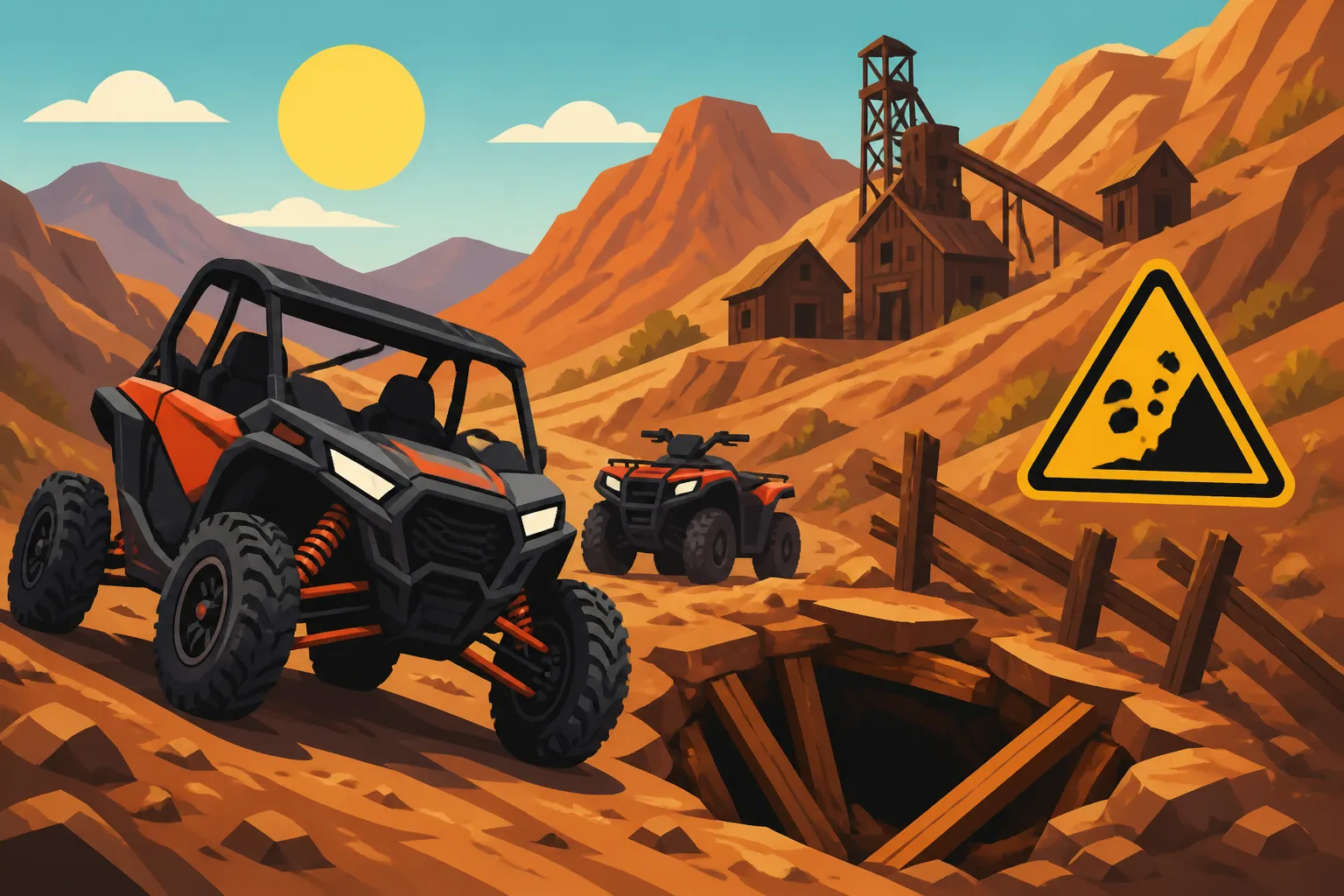
The most obvious danger is an uncovered or poorly marked mine opening. A shaft can be obscured by brush, rocks, or shadow, and an adit may look like a shallow recess from a distance. Other openings may be hidden beneath a weak crust of soil or debris. The edge of a shaft can crumble under a tire, and a UTV’s size and weight do not make it any less vulnerable to a collapse.
Not every hazard looks like a deep hole. Old excavations can leave steep drop-offs, loose spoil piles, uneven ground, and voids below the surface. A rider following a friend’s tracks may assume the ground is firm because it held the previous machine. That is not a safe assumption: the surface can shift, especially near disturbed soil or after rain.
Keep your eyes on the route ahead, but don’t ride so close to an interesting structure that you have no room to stop or turn around. A safe rule is simple: if you cannot clearly see stable ground and a legal, open route, don’t approach.
Old mine sites can involve more than physical hazards
Abandoned mining areas may contain rusted metal, broken timbers, cables, machinery, glass, and other debris. These can puncture tires, snag clothing, or injure someone who steps off the trail. Tailings and waste rock may also contain materials that should not be handled or disturbed. Avoid digging, collecting objects, walking through mine waste, or letting children play around old equipment or structures.
Water deserves caution, too. A pool or seep near a mine may look inviting on a hot ride, but its depth, footing, and water quality can be uncertain. Don’t enter mine openings or underground workings to reach water, take photographs, or look for a way through. A headlamp, phone light, or camera flash cannot make an unstable underground area safe.
Land status adds another layer. An old mining road shown on a map may cross private property, a restricted area, or land with specific access rules. A route’s historical use does not automatically mean it is open to motorized travel today. For general guidance on choosing permitted ground, read Riding BLM Land in New Mexico and [New Mexico Rules for Riding Federal Land]. The land manager’s current route information and signs on the ground should guide your decision.
Treat every mine opening as dangerous, even if it looks stable
A mine entrance can appear solid while its roof, walls, or surrounding slope are failing. Do not ride up to an opening for a closer look, drive into it, or send someone ahead on foot to check the interior. Stay back, keep passengers together, and turn around using the same stable route you arrived on if that route remains safe.
If you see an opening near a trail, don’t assume it is safe simply because there is no fence or sign. Barriers can be damaged, signs can be missing, and an unmarked opening is still a hazard. Never climb over a barrier or move rocks, boards, or fencing to get through.
A cautious rider also avoids stopping where another machine may approach without warning. Pull over only on firm, wide ground, well away from an opening or steep slope. If you need to discuss what you see, keep the group in a safe staging spot rather than gathering beside the hazard.
How to plan a safer ride near historic mining areas
Confirm the route, land status, and closures before leaving
Planning matters because a line on a screen can create a false sense of certainty. A trail may be closed, may not be a legal motorized route, or may cross land with access restrictions. Before setting out, check the route with the responsible land manager and review local signs or notices. Don’t assume that a route is open because it appears on a recreational map or because another rider has posted a track.
Mapping tools, including onX Offroad, can help riders review route options and orient themselves. Use them as planning aids, not as proof that a road is open or that a mine site is safe. Compare the digital map with current agency information, posted closures, and what you see on the ground. If map details disagree with a sign or closure notice, follow the restriction and choose another route.
A printed or offline map is useful when cell coverage disappears. New Mexico Trail Maps Worth Carrying offers another angle on carrying route information, while New Mexico Trail Closures to Check First is a useful reminder to verify access before making a long drive to a staging area. Save the information you need before leaving town; a map that will not load without a signal is not much help in a remote canyon or forest.
| What you are checking | Why it matters | Safer approach |
|---|---|---|
| Route is open to motorized travel | A visible road or old mine track may be closed or unauthorized | Confirm with the responsible land manager and obey signs |
| Land ownership and access | Historic roads can cross private or restricted land | Verify access rather than relying on a map line alone |
| Mine openings and disturbed ground | Openings and unstable soil may sit close to a route | Stay on the designated route and give suspicious ground a wide berth |
| Weather and drainage | Rain can soften slopes, wash out tracks, or create flash-flood danger | Check conditions and avoid washes during storms or runoff |
| Group and emergency plan | A remote incident can become harder to manage when riders are scattered | Set a turnaround point, keep the group together, and share the route plan |
Ride at a pace that gives you time to react
In open terrain, riders can be tempted to increase speed because the route seems clear. Near mining history, a slower pace gives you more time to spot changes in the ground, barriers, debris, and unexpected turns. Reduce speed before blind corners, narrow ledges, wash crossings, and any place where brush or shadows limit your view.
Keep enough distance between machines to avoid eating dust while still allowing the rider behind to see your signals. Don’t follow so closely that the lead rider’s sudden stop forces a hard brake or a sharp turn near unstable ground. For groups, agree on simple hand signals and a routine for stopping at junctions so nobody has to guess which way the group went.
Stay on established, legal routes rather than cutting across a slope to get a better view of old structures. The alternate line may run over fragile ground, private land, or an unmarked opening. Responsible travel also means avoiding damage to the surrounding landscape; New Mexico Trail Etiquette on Shared Ground is relevant when a route is used by other riders, land users, or wildlife.
Make a turnaround plan before the tempting detour appears
A group is more likely to make a poor decision when someone says, “Let’s just look a little closer.” Decide before the ride that mine openings, fenced areas, and questionable ground are not destinations. Pick a clear point where you will turn back if the route becomes uncertain, and make sure every rider knows the plan.
Use onX Offroad or another navigation tool to help the group follow its planned route, but don’t let a track line override a closure or warning sign. If the route looks blocked, the ground is deteriorating, or the map and the terrain no longer match, stop in a safe place and reassess. Backtracking is often the sensible option, even when it means giving up a viewpoint or shortening the day.
That decision can be frustrating, especially after a long trailer drive or when the group has planned the ride for weeks. But turning around early is far better than putting a machine, passenger, or rescuer at risk for a closer look at a mine site.
What to do if you spot a mine hazard or have an incident
If you find an opening, keep people and machines back
Stop only when you have firm, open ground beneath you. Keep every rider away from the edge and do not walk around the opening to inspect it from another angle. Ask passengers and children to stay with the group, and prevent anyone from approaching to take a photo or retrieve an object.
If a barrier or warning sign is present, do not cross it, move it, or use it as a convenient parking point. Note the location from a safe distance if you can do so without leaving the route. A map pin or description can help you report the concern to the relevant land manager, but don’t put yourself in danger to get a more precise location.
If the hazard is immediately threatening other trail users, contact the appropriate emergency service or land-management office when you have a safe way to do so. Don’t try to block an opening with your machine or improvise a cover. A person who falls into a mine opening may need a trained rescue response; untrained attempts to enter can create additional victims.
If a machine breaks down near a mine site, move away carefully
A flat tire, dead battery, or overheating problem can leave a group stopped longer than expected. If the machine is still operable and it is safe to do so, move it to a broad, stable area away from the opening, slope, or loose debris. Don’t attempt a recovery that requires driving toward a shaft or pulling a vehicle across questionable ground.
Keep the group together and decide who will stay with the disabled machine and who, if anyone, will seek help. Don’t leave a rider alone without a clear plan, especially if weather is worsening or daylight is fading. A phone may have no signal, so consider how your group will communicate before the ride. For additional preparation, see Breaking Down Far From a Road.
If a rider is injured or has fallen into an opening, call emergency services as soon as possible and provide the clearest location information you can. Do not enter the mine or descend into an opening to reach them. Wait for trained responders and follow their instructions. A spontaneous rescue attempt can cause the surrounding ground to collapse or expose rescuers to unstable structures, poor air, or other unseen hazards.
Report the hazard without returning to investigate it
After everyone is safe, report a dangerous opening or damaged barrier to the land manager responsible for that area. Share a location, route name, nearby landmark, and a brief description if you have them. Avoid posting directions that invite others to visit a hazardous site, and don’t return to mark the opening yourself.
If a ranger or other official contacts your group, explain what you observed and where you were riding. Keep the description factual: what the opening looked like, whether a sign or barrier was present, and whether anyone was injured. For an idea of what a roadside or trailhead conversation may involve, see What a Ranger Asks for First.
Respecting closures and reporting hazards helps protect the next person who comes through. It also keeps riders from turning a manageable concern into a more dangerous incident by trying to explore, repair, or mark an old mine site themselves.
A practical safety checklist for mining-country rides
Before you leave
Confirm that your intended route is open to motorized use and check access rules for the land it crosses. Look for current closures and weather concerns, particularly where storms could affect washes, slopes, or unpaved roads. Download maps or carry a paper backup, and share your route and expected return plan with someone who is not on the ride.
Talk through the group’s turnaround rule before you unload. Agree that nobody rides toward an opening, crosses a barrier, or leaves the legal route to inspect old workings. Bring the basic supplies your group needs for a delayed return, including water, appropriate clothing, first-aid supplies, and a way to communicate when cell service is unreliable.
On the trail
Stay on the route and scan ahead for signs of disturbed ground, loose debris, barriers, and sudden changes in terrain. Slow down where visibility is limited and leave space between machines. Do not enter mine openings, walk onto unstable spoil, or approach a structure just because it appears abandoned.
Use onX Offroad or another mapping tool to stay oriented, but keep checking signs and conditions on the ground. If you are uncertain whether a route remains open, stop somewhere safe and choose a known legal alternative. A navigation app can help answer “Where am I?” It cannot answer every question about current access or whether soil beside a trail will hold a vehicle.
If conditions feel wrong
Stop in a stable, open place. Keep the group together, identify the safest route back, and resist pressure to continue simply because the destination is close. If someone is injured or a machine is stranded near a mine hazard, prioritize distance from the opening and contact appropriate help rather than attempting a risky recovery.
Historic mining country rewards patience and respect. The safest ride is not the one that gets closest to every old structure; it is the one that follows permitted routes, leaves dangerous sites alone, and brings everyone back without an avoidable emergency.
Disclaimer
This article is for general informational purposes only and does not constitute professional advice. Laws, prices and regulations vary by location and change over time. Consult a qualified professional for guidance on your specific situation.