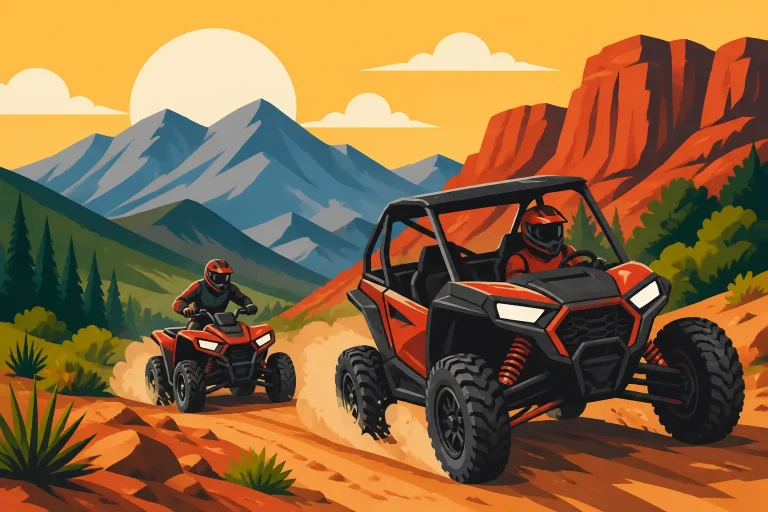
Enchanted Off-Road’s Multi-Day Rentals in New Mexico
A multi-day ATV or UTV rental can turn a New Mexico weekend into a real backcountry trip, but the booking is only one part of the plan. Before arranging an Enchanted Off-Road rental, confirm where the machine may go, what support is available away from the shop, and which costs and requirements apply to your route.
Confirm the Rental Details Before You Plan a Route
A multi-day rental is not simply a day rental stretched over a longer itinerary. The machine may be available for several days, while its permitted travel area, pickup and return arrangements, and support rules still shape what you can do. Start by confirming the current offer directly with Enchanted Off-Road. Do not rely on an old listing, a search snippet, or a general description of the company’s services to establish what is available now.
Ask for clear answers in writing before you make nonrefundable travel plans. If you find a listing through a booking platform such as Viator, compare its terms with the operator’s terms. A marketplace description may summarize an experience, but the rental agreement and the operator’s instructions are what you need to understand.
Questions to ask the operator
Get the basics straight before you choose lodging or sketch out a route:
- Which dates and rental duration are available? Confirm the pickup time, return deadline, and whether the rental period includes full riding days or is measured from pickup to drop-off.
- Where does the rental begin and end? Ask whether you must collect and return the machine at one location, or whether delivery, drop-off, or a trailer is part of the arrangement.
- Where may you ride? Request the names of approved areas, roads, trails, or route systems. Ask whether you can ride directly from the pickup point or must transport the machine to a staging area.
- What machine is included? Confirm the make or class, seating capacity, and whether the reservation guarantees a particular model or only a comparable machine.
- What is included? Ask about helmets, other protective equipment, maps, navigation devices, fuel, and any required safety briefing.
- What happens if the machine breaks down? Find out who to call, what information they need, and whether recovery is available where you intend to ride.
- What are the total charges and holds? Ask what you pay, what may be held on your payment card, and which charges could be added after the ride.
- What can change or cancel the trip? Clarify the rules for weather, road closures, fire restrictions, mechanical problems, and a late return.
These questions are especially important when you are coordinating flights, lodging, a group, or a route far from the rental location. A reservation does not by itself guarantee that a preferred trail is open or that you can reach it on the rental machine.
| Detail to confirm | Why it matters | What to request |
|---|---|---|
| Rental dates and handover times | A partial pickup day can leave less riding time than expected | Exact pickup, riding, and return schedule |
| Approved riding area | A machine may be restricted to certain roads or routes | Named areas and route limits |
| Transportation to the trail | You may not be allowed to ride from the shop to public land | Trailer, delivery, or staging instructions |
| Included equipment | Missing gear can delay a group or create a safety problem | Itemized list of equipment and supplies |
| Fuel and range | Long routes may not have a convenient fuel stop | Fuel policy, tank capacity, and practical range guidance |
| Breakdown and recovery | A remote failure can affect the entire group | Emergency contact and recovery procedure |
| Damage and cleaning terms | Return condition can affect the final bill | Current agreement and damage schedule |
| Closures and cancellation | Weather or land restrictions can disrupt the plan | Written policy for closures and changes |
If the provider cannot identify where a machine is allowed to go, treat that as a reason to pause. “New Mexico” is too broad to function as a riding plan. Public land, private property, tribal land, county roads, and town streets can all have different access rules. A route shown on a map is not automatically open to an ATV or UTV.
For a broader overview of planning a longer booking, see New Mexico Rentals for Several Days. If you are comparing a self-guided rental with a guided outing, New Mexico Tours With a Guide can help you think through the difference in route support and responsibility.
Build a Route Around Legal Access, Not Just Distance
New Mexico offers varied riding landscapes, but that variety makes route research essential. Desert tracks, forest roads, dunes, and open areas may look equally inviting on a map while following very different access rules. A multi-day booking gives you more time to travel, not more permission to ride.
Ask the operator which specific routes or areas it approves for its machines. Then verify access with the relevant land manager or local authority before you go. Check for seasonal closures, fire restrictions, construction, and temporary notices close to your riding dates. Rules can change, and a route that was open on a previous visit may not be available now.
Know what kind of land you are entering
On National Forest or Bureau of Land Management ground, riding is generally tied to designated routes and the applicable travel-management rules. A trail that appears on a general map may not be open to motorized use, and leaving a designated route can be prohibited. The rules can differ by district, route, vehicle, or season.
Use current land-manager maps and signs, not just a phone app or an old downloaded track. A route line is useful for navigation, but it is not proof of legal access. Review [New Mexico Rules for Riding a National Forest] and New Mexico Rules for Riding BLM Land as starting points, then verify the exact area you plan to visit.
Other land requires separate care:
- Private property: Do not assume a gate, dirt road, or existing tire track means public access. Get permission from the landowner.
- Tribal land: Access rules are distinct from those on federal or county land. Do not enter without the required permission.
- State Trust Land: A recreational access permit may be required, and a permit does not mean every road or parcel is open to motorized travel.
- County roads and town streets: Local rules determine whether an OHV may use a particular road. A rental company’s permission cannot replace a public authority’s restrictions.
- State parks and developed recreation areas: Check the area’s own rules rather than assuming an OHV is allowed because another public-land unit nearby permits riding.
The rental itself also has boundaries. A provider may prohibit certain roads, areas, or types of use even when they are legally open to other riders. The applicable plan is the overlap between what the land manager allows and what the rental agreement allows. If either one says no, choose another route. See New Mexico Rentals and Where You Cannot Go before building a trip around a particular destination.
Allow for conditions and closures
A multi-day itinerary should include a fallback. Monsoon storms can create dangerous runoff in arroyos and dry washes, and afternoon lightning can make exposed ridges a poor place to linger. Heat, dust, snow, fire restrictions, and road closures can also change what is practical. A route that is technically open may still be a poor choice for a particular machine, group, or day.
Before each ride, check current notices for the land you intend to enter and pay attention to posted signs at the trailhead. If the plan includes forest roads, check whether seasonal restrictions apply. If it includes desert terrain, have an alternate route that avoids washes when storms are possible. For general route preparation, New Mexico Trail Maps Worth Carrying is a useful companion topic.
Do not let a prepaid rental or a tightly scheduled itinerary pressure you into riding through a closure. Ask the operator how it handles a closure that affects the agreed route. If the only alternative is an area the machine is not approved for, the trip needs a different plan.
Choose a Machine and Itinerary That Fit the Group
The right machine is not always the largest or fastest option. It is the one that fits the riders, passengers, route, terrain, and rental rules. For a multi-day trip, comfort and dependable operation matter because small frustrations can build over several days.
Match the vehicle to the route
An ATV usually gives one rider a compact, open machine to control. A UTV or side-by-side offers a seat and steering wheel and may carry more than one person, depending on its configuration. These differences affect how a group travels, but they do not establish where either vehicle may ride. A wide machine may not fit a narrow trail, and a passenger seat does not make every route appropriate for a family.
Before choosing, confirm:
- Seating and passenger rules: Verify the approved passenger count and whether every passenger has a properly fitted helmet and seat belt where applicable.
- Width and route compatibility: Ask whether the planned route has width limits, tight turns, or terrain that may not suit the machine.
- Rider experience: Be honest about who has operated an ATV or UTV before. A challenging route can be unsuitable for a new rider even if the vehicle is capable of climbing it.
- Group pace: A mixed group may need a route that works for its least experienced rider, not just its most confident one.
- Cargo capacity: Ask how much gear can be carried safely and whether additional equipment can be secured without interfering with controls or visibility.
- Machine substitution: Find out what happens if the reserved model is unavailable and whether a substitute has different seating or capability.
If your group has children, older riders, or people who are uneasy with exposure or rough terrain, say so when you book. Ask the operator to describe the expected riding conditions in plain terms. “Beginner friendly” can mean different things to different businesses, so seek a concrete explanation: surface, steepness, exposure, traffic, and typical ride duration.
Plan daily mileage conservatively
A multi-day rental can tempt riders to cover as much ground as possible. That is often the wrong measure of a successful trip. Trail speed can be slow, navigation can take time, and stops for water, photographs, fuel, or mechanical checks add up. A short distance on a rough or unfamiliar route can take much longer than expected.
Build each day around a realistic turnaround point. Identify where you can stop, where fuel might be available, and which sections would be difficult to reverse if conditions worsen. Leave daylight for the return leg. Do not treat a route line on a screen as a reliable estimate of riding time.
A practical itinerary can use a simple structure:
- Choose a primary route that the rental company approves and the land manager allows.
- Mark a shorter alternative for fatigue, changing weather, or a slower-than-expected pace.
- Set a turnaround time that leaves a safe margin before the machine is due back or the group loses daylight.
- Identify fuel and water needs based on the route, not on assumptions about services.
- Share the plan with someone who is not on the ride, including the route area and expected return time.
- Recheck conditions before setting out each day, and change the plan if access or weather has changed.
When comparing rentals for multiple days, ask whether you keep the same machine throughout the booking. A consistent vehicle can make controls and handling familiar. If the operator may substitute a machine, request a briefing on its controls and operation before the group leaves.
Decide whether a guide makes sense
A self-guided rental offers flexibility, but the group takes responsibility for navigation, route choices, and responding to problems. A guided ride can provide local route direction and a planned pace, though the experience may be less flexible and may follow a set itinerary. Neither option removes the need to follow land rules or listen to current safety instructions.
A guide may suit a group that is new to the area, has limited navigation experience, or wants help choosing a route. A self-guided plan may fit riders who are comfortable with maps, know how to manage changing conditions, and have clear written access instructions. Ask what support is actually included rather than assuming a rental company provides route assistance throughout a multi-day trip.
Understand Equipment, Fuel, Damage, and Other Costs
The advertised rental charge is only one part of a multi-day budget. Depending on the arrangement, the total may also involve a deposit or card hold, required equipment, fuel, cleaning, damage, delivery, late return, or recovery. Named providers do not all use the same terms, and those terms can change. Ask for the current agreement and review it before paying.
Check the rental agreement line by line
Make sure you understand the difference between a charge, a refundable deposit, and a temporary authorization on a payment card. Ask when any hold is released and what can delay its return. Do not assume a “damage waiver” removes every responsibility. Read what it covers, what it excludes, and how the agreement treats damage to tires, underbody components, or other parts exposed to rough terrain.
Ask how damage is assessed and documented. Photograph the vehicle at pickup and return, including existing marks, tires, lights, body panels, and any supplied equipment. Report a problem promptly rather than waiting until drop-off. If a machine develops a fault during the rental, contact the operator before attempting a repair unless the agreement or an immediate safety need clearly directs otherwise.
Cleaning expectations deserve the same attention. A dusty ride is normal in many areas, but caked mud, wet equipment, or unusual contamination may be treated differently. Ask what condition the machine should be in when returned and whether cleaning charges can apply. The same goes for late returns: a delay caused by a route issue may still have consequences under the agreement. Review New Mexico Rental Damage Charges and New Mexico Rental Cancellation Policies when evaluating those risks.
Make a realistic fuel and supply plan
Do not assume fuel is included or that a machine will arrive with a full tank. Confirm the pickup fuel level, return expectation, and how the provider handles fuel if the machine comes back below the required level. Ask for practical range guidance for the route you intend to ride. Published tank capacity alone does not tell you how far a machine will travel in sand, climbs, slow technical terrain, or a heavily loaded configuration.
Fuel access can be limited in remote areas. Check where a route intersects a reliable fuel source and whether the rental agreement permits transporting extra fuel. If you plan to carry fuel, use appropriate approved containers and secure them away from occupants and hot components. Do not improvise a storage solution inside a passenger area.
Bring enough water, food, sun protection, and basic personal supplies for the conditions, plus a margin for an unexpected delay. Confirm whether the rental includes a first-aid kit, tool kit, spare tire equipment, or other recovery gear. If it does not, ask what you are allowed or expected to bring. A phone may not have reliable service in remote terrain, so plan communication accordingly.
For permit questions, distinguish the rental machine’s requirements from the rider’s requirements. Some visitors may need a New Mexico nonresident OHV permit depending on their home-state registration and circumstances. Riders under 18 may also have separate safety-permit rules. Ask the operator what it provides, then verify your situation through New Mexico OHV Permits Explained and New Mexico’s Nonresident OHV Permit. Do not assume that the permit attached to a rental automatically covers every rider, route, or use.
Get the safety and breakdown plan before departure
The handover is the time to learn the machine, not the moment to rush out of the parking area. Ask for a walkthrough of starting and stopping, shifting, four-wheel drive, parking, fuel, lights, seat belts, and any model-specific controls. Make sure every person who will operate the machine receives an appropriate briefing.
Ask what to do if:
- The engine overheats, stalls, or will not restart.
- A tire goes flat or the machine becomes stuck.
- The group separates or loses the route.
- Weather makes a crossing or exposed section unsafe.
- A rider is injured or the machine cannot be returned on schedule.
- Phone service is unavailable.
Know the designated contact method and whether the operator expects you to call, text, or use another device. Save the contact details before leaving. Do not count on a recovery service reaching every location or arriving quickly; ask what areas are covered and what circumstances may create an additional charge.
A rental company’s briefing is not a substitute for safe judgment. Wear the equipment required for the ride, keep within your skill level, and leave extra room between machines in dust. If the route becomes unsafe, turn around or stop in a safe place and contact the operator. The fact that the rental is for multiple days does not make a difficult section worth forcing.
Frequently Asked Questions
Does Enchanted Off-Road offer multi-day rentals?
Confirm current availability, machine choices, dates, and pickup arrangements directly with Enchanted Off-Road. Rental options and terms can change, so do not assume a listing or previous booking description reflects the current offer.
Can I ride any trail in New Mexico with a rental ATV or UTV?
No. Access depends on the land manager’s rules, local restrictions, closures, and the rental agreement. Get approved route information from the operator and check current rules for the specific land you plan to enter.
Is fuel usually included in a multi-day rental?
Fuel terms vary. Ask whether the machine is supplied with fuel, what level it must have on return, and whether a refueling charge may apply. Also confirm the machine’s practical range for your intended terrain.
Should I choose a guided trip or a self-guided rental?
Choose a guided trip if route support and a set plan are important to your group. A self-guided rental offers more independence but requires you to manage navigation, access rules, timing, and changing conditions. Confirm exactly what support either option includes.
What should I do if a rental machine breaks down?
Follow the operator’s breakdown instructions and use the contact information supplied at pickup. Ask in advance what recovery is available, which areas are covered, and whether recovery or delays can result in additional charges.
Disclaimer
This article is for general informational purposes only and does not constitute professional advice. Laws, prices and regulations vary by location and change over time. Consult a qualified professional for guidance on your specific situation.