Checking Your Spark Arrester Before Public Land
A spark arrester can look like a small part, but riding without a suitable one can put a New Mexico public-land trip out of compliance. The challenge is knowing what to inspect, what a damaged or missing part means, and whether a replacement is actually approved. Use this practical pre-ride check to assess your ATV or UTV and decide what to do before heading out.
What New Mexico requires
New Mexico requires off-highway motor vehicles to have a spark arrester approved by the United States Forest Service. The Motor Vehicle Division NM states this requirement, and the New Mexico Department of Wildlife also says all OHVs must be equipped with a Forest Service-approved spark arrestor.
The wording matters: a part that looks like a screen or is described as a spark arrester is not automatically approved. You need equipment suitable for your particular machine and approved for the required use. If you are not sure what is installed, check the owner’s manual, the exhaust manufacturer’s documentation, or ask a qualified repair professional to identify it. The New Mexico Spark Arrester Requirement article can help explain the rule in more detail.
A spark arrester is part of the exhaust system. Its purpose is to reduce the chance that hot particles escaping from the exhaust will start a fire. It is separate from a muffler, which reduces exhaust noise. A muffler, quiet exhaust, or internal-looking exhaust component should not be assumed to meet the spark-arrester requirement unless its documentation confirms that it does.
This check is especially important before public-land riding. The New Mexico Department of Wildlife says a person operating an OHV on public land must register the vehicle or obtain a permit. That access requirement does not replace equipment rules: having valid registration or a permit does not make an unequipped machine compliant. For the access rules that apply to different kinds of public ground, see New Mexico Rules for Riding Federal Land, New Mexico Rules on National Forest Land, and [New Mexico Rules on BLM Land].
How to inspect the arrester before a ride
A useful check starts with identification, then moves to condition and fit. Do it while the machine is cool, and follow the manufacturer’s instructions. Do not take apart a hot exhaust system or force a component that is stuck.
Confirm what is installed
Look for documentation that identifies the spark arrester and confirms its approval. This may be in the owner’s manual, in information for the exhaust system, or in paperwork supplied with a replacement part. If the machine has an aftermarket exhaust, do not assume that the original equipment’s approval applies to the changed system. Confirm that the installed configuration has an approved arrester.
If the paperwork is missing or the part is difficult to identify, ask a dealer, mechanic, or the exhaust-system manufacturer for help using the machine’s make, model, and exhaust details. Avoid relying on appearance alone. A mesh-like insert may look plausible without proving that it is approved or intended for that particular exhaust.
Check that it is present and seated
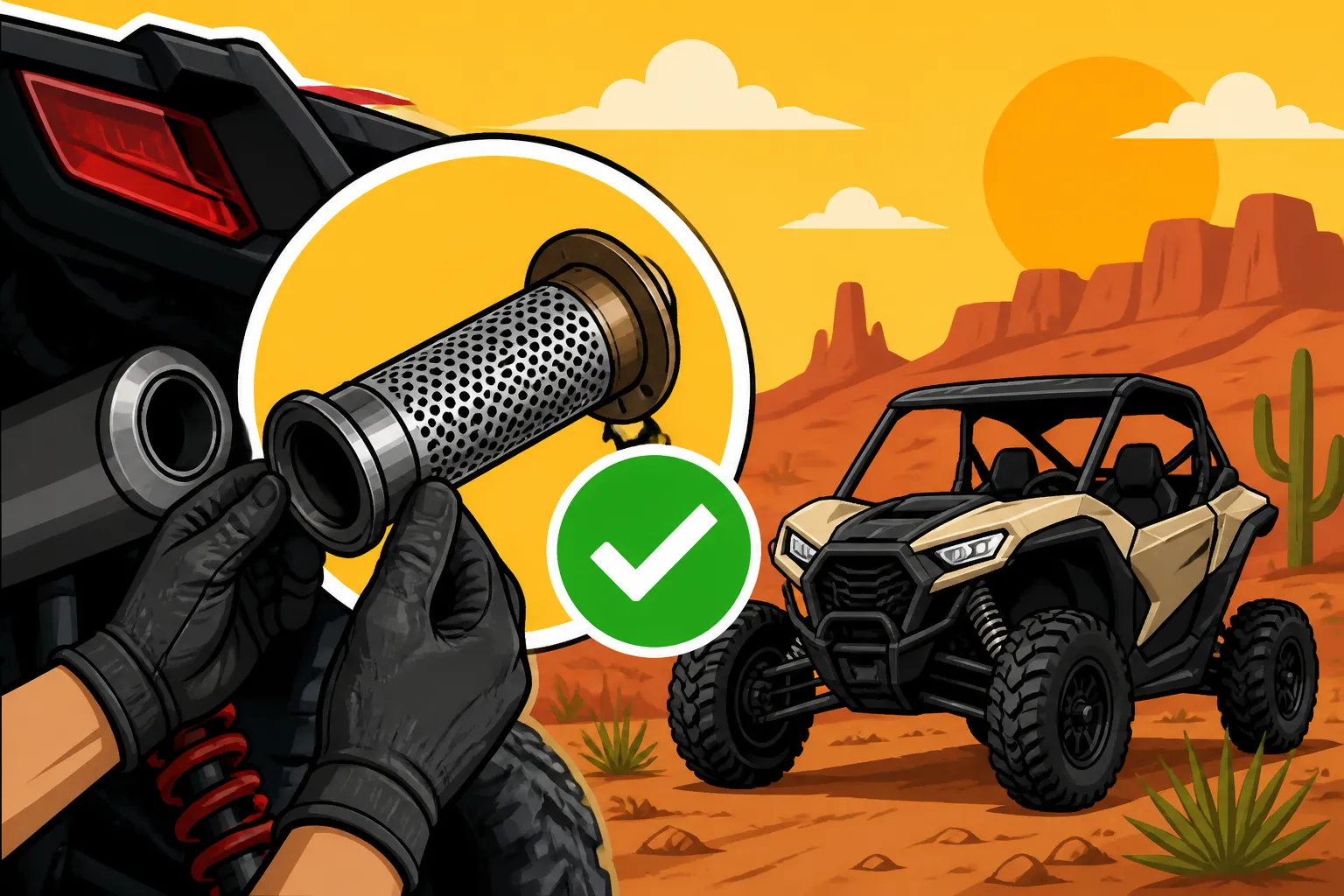
With the exhaust cool, follow the manufacturer’s directions to inspect the area where the arrester is installed. Check that the expected part is present, properly seated, and secured as designed. Look for signs that it has shifted, loosened, or been removed. If a fastener is absent or the insert does not fit correctly, do not improvise a repair that could leave the component unsecured.
A missing or loose arrester is a reason to stop and resolve the problem before riding public land. Avoid trying to substitute an unrelated screen, mesh, or other material. A makeshift part may not be approved, may not fit safely, and may not perform as intended.
Look for damage or blockage
Check the arrester and surrounding exhaust components for visible cracks, deformation, corrosion, or other damage. Look for accumulated debris or deposits that could obstruct the part. Do not scrape, drill, cut, or alter an arrester to clear it unless the manufacturer’s instructions specifically call for that procedure. If cleaning is allowed, follow the supplied directions and use a method that will not damage the part.
A part that is visibly damaged, badly blocked, or impossible to identify should be assessed before the next ride. If you cannot tell whether the arrester is intact and correctly installed, have it checked rather than treating uncertainty as proof that it is fine.
| What you find | Practical next step |
|---|---|
| The arrester is present, identified, undamaged, and secured | Follow the manufacturer’s maintenance instructions and recheck it before future rides |
| The part is missing, loose, damaged, or visibly obstructed | Do not ride on public land until it is corrected |
| Approval or fit is unclear | Confirm the part and exhaust configuration with the manufacturer or a qualified professional |
| The exhaust has been modified | Verify that the installed arrester is approved for the modified setup |
This inspection is not a substitute for maintenance instructions or a professional assessment. It is a way to catch obvious problems before loading the machine or reaching a trailhead.
Replacing or repairing a questionable part
If an arrester is missing or damaged, the safest course is to identify a suitable replacement for the exact machine and exhaust setup. Use the manufacturer’s documentation to check compatibility and approval. A product description that simply says “spark arrestor” is not enough to establish that the part meets New Mexico’s requirement.
Online shopping can make it easy to compare components, but a marketplace listing is not proof of approval. If you look on Amazon or another retailer, check the manufacturer and model details, confirm that the part fits the installed exhaust, and look for documentation of Forest Service approval. When those details are absent or unclear, contact the manufacturer or a qualified shop before buying. A cheap or convenient insert is a poor substitute for verified fit and approval.
Do not remove an arrester to make the machine louder or change exhaust flow, and do not ride on the assumption that an arrester can be reinstalled later. If cleaning or replacement requires exhaust work beyond the manufacturer’s instructions, have a qualified professional handle it. Incorrect assembly can create a separate mechanical or safety problem.
A spark arrester is not the only equipment rule worth checking. The Motor Vehicle Division NM says OHVs must not produce noise exceeding 96 decibels. A compliant arrester does not by itself prove that the exhaust meets the sound limit, and a quiet exhaust does not prove that an approved arrester is installed. See New Mexico Sound Limit for ATVs for more on that separate requirement.
Likewise, registration and permits are separate from equipment compliance. The Motor Vehicle Division NM says OHVs are issued staggered two-year registration stickers, which must be displayed on the rear of the vehicle where visible. The New Mexico Department of Wildlife says public-land users must register the vehicle or obtain a permit. Check the requirements that apply to your situation before the trip; New Mexico OHV Permits Explained covers the permit side.
A practical pre-ride routine
Make the arrester check part of preparing the machine, not a last-minute guess at the trailhead. A consistent routine helps you notice when something has changed between rides.
- Let the exhaust cool. Follow the owner’s manual before touching or opening any exhaust component.
- Identify the installed part. Confirm that the arrester is present and that its approval and fit are supported by documentation.
- Inspect its condition. Look for looseness, damage, blockage, or signs that the part has been removed or altered.
- Use the correct maintenance procedure. Clean or service the component only as directed by the manufacturer.
- Resolve uncertainty before departure. If the part’s identity, approval, or condition is unclear, contact a qualified shop or the manufacturer.
- Check the rest of the trip requirements. Confirm access permission, registration or permit status, and any route closures that could affect the ride. New Mexico Trail Closures to Check First is useful when planning where to ride.
A quick visual check cannot certify an exhaust system, but it can catch a missing or obviously damaged part. The key is not to confuse “looks installed” with “verified approved.” Keep the documentation with the machine’s maintenance records so you can refer to it if the exhaust is serviced or changed.
If you ride in dry or fire-sensitive country, take the inspection seriously even when the machine ran normally on the last trip. An arrester can become loose, clogged, damaged, or removed during service. Recheck it after exhaust work and before heading onto public land again.
The bottom line is straightforward: New Mexico requires a Forest Service-approved spark arrester on OHVs, so verify the part rather than relying on its appearance or a product label alone. When it is missing, damaged, or uncertain, resolve the issue before riding.
Sources
- Motor Vehicle Division NM — Chapter 16 – Off-Highway Motor Vehicles | Motor Vehicle Division NM (checked November 3, 2026)
- New Mexico Taxation and Revenue Department Motor Vehicle Division — New Mexico Residents | Ride New Mexico (checked November 3, 2026)
Disclaimer
This article is for general informational purposes only and does not constitute professional advice. Laws, prices and regulations vary by location and change over time. Consult a qualified professional for guidance on your specific situation.