What a Ranger Asks for First
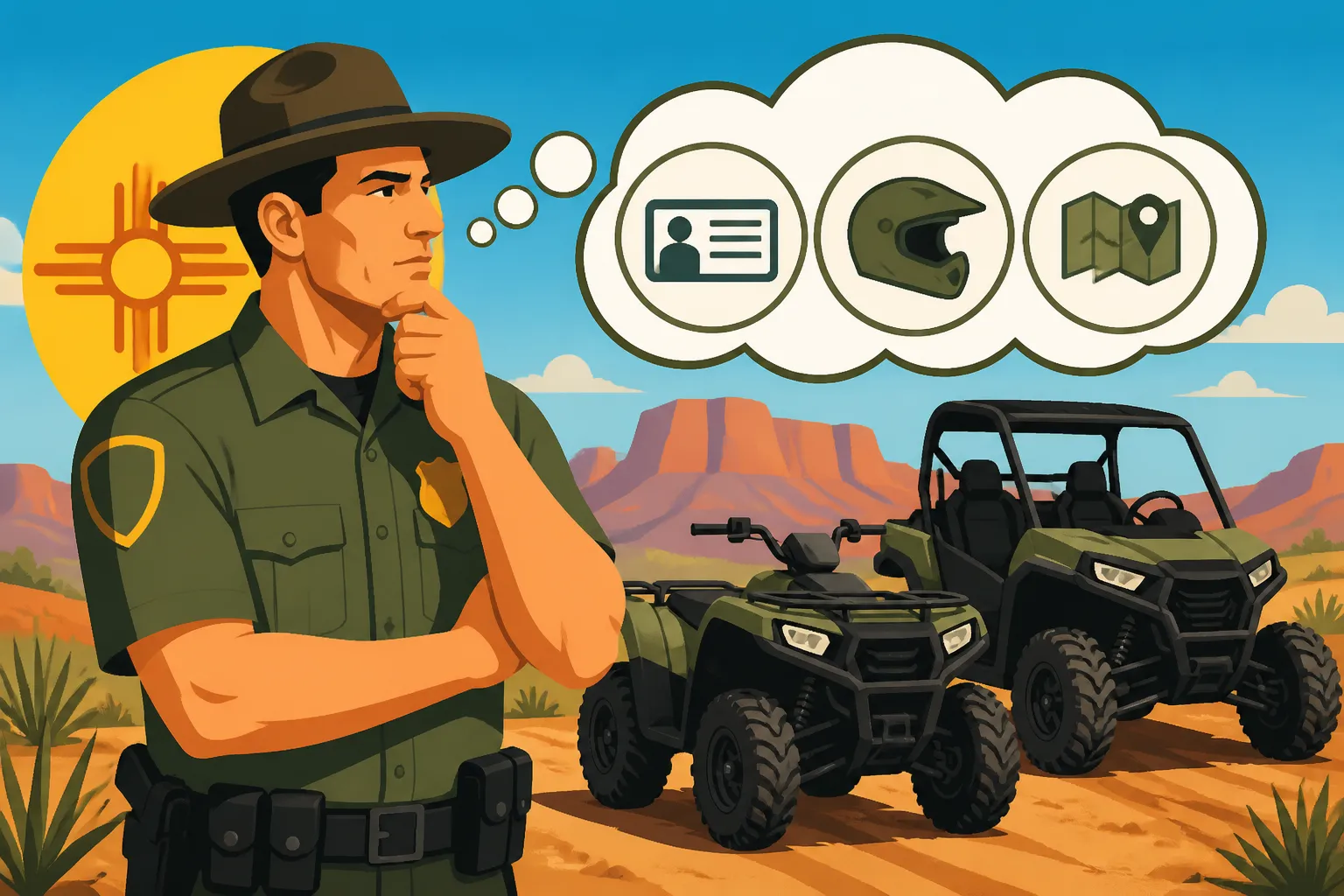
You're out enjoying a beautiful day on the trails, maybe exploring some of the stunning terrain near Red River or cruising through the Mescalero Sands, when suddenly you see a uniform, a badge, or flashing lights. Your heart might skip a beat, and a million questions race through your mind: "Did I do something wrong? What are they going to ask for?" This guide is here to cut through that uncertainty, detailing exactly what a New Mexico ranger or law enforcement officer is most likely to ask for first during an OHV stop, helping you stay calm, prepared, and informed for your next adventure.
Understanding Who's Stopping You: The Different Hats of Authority
When you're out riding your ATV or UTV in New Mexico, whether it's on a designated trail, a county road, or federal land, you might encounter various types of law enforcement. It's not always a state police officer or a sheriff's deputy. Depending on where you're riding, it could be a U.S. Forest Service Ranger, a Bureau of Land Management (BLM) Ranger, a New Mexico State Parks officer, or even local municipal police if you're on a city street where OHVs are permitted. The important thing to remember is that while their uniforms and jurisdictions might differ, they are all generally enforcing the same New Mexico Off-Highway Vehicle Act and associated local ordinances.
Different Hats, Same Rules (Mostly)
Imagine you're tearing it up on a forest road in the Carson National Forest, enjoying the crisp mountain air. If a U.S. Forest Service Ranger pulls you over, they have full authority to enforce state OHV laws, federal regulations specific to forest land, and even issue citations. Similarly, if you're exploring the vast desert landscapes managed by the BLM, a BLM Ranger will be looking for compliance with both state statutes and federal land use rules. A New Mexico State Police officer or a county sheriff's deputy, on the other hand, might stop you on any public road or land within their jurisdiction, whether it's a dirt county road or a designated OHV area. They all share the common goal of ensuring rider safety, protecting public lands, and upholding the law.
It’s easy to get flustered when you see an official vehicle, but understanding that these officers are trained professionals tasked with keeping everyone safe can help. They're not just looking to issue tickets; often, they're performing routine checks to educate riders and ensure compliance, especially in popular riding areas.
Jurisdiction Matters
While the core New Mexico OHV laws apply statewide, the specific rules about where you can ride can vary significantly based on the land management agency. For instance, the U.S. Forest Service and BLM have their own travel management plans, designating specific routes for OHV use. Riding off these designated routes on federal land is a big no-no and something a ranger would definitely be checking for. On the flip side, some New Mexico counties have opened many of their dirt roads to OHV use, but city streets within those counties might still be off-limits unless specifically designated.
This patchwork of regulations means that while a BLM Ranger might be focused on spark arresters and proper decals on a federal trail, a city police officer might be more concerned with speed limits, driver's licenses, and proper lighting on an approved paved street. Regardless of who stops you, the first things they'll ask for are usually universal. Being prepared for these initial requests can make the entire interaction smoother and quicker.
The Immediate Ask: Essential Documentation and Equipment
When an officer makes an OHV stop in New Mexico, their primary goal is to verify that you and your machine are legally permitted to be where you are and that you're operating it safely. This almost always begins with a request for specific documents and a quick visual check of your machine. Having everything readily accessible and in order will demonstrate your responsibility and help the interaction proceed efficiently. This is often the point where an officer performs [What a New Mexico Officer Checks Roadside].
Your Proof of Legitimacy: Registration and Permits
The very first thing an officer will likely ask for is proof of your machine's New Mexico registration. For most residents, this means the current yellow or green decal affixed to your OHV. The yellow decal indicates your machine is registered for off-highway use only, while the green decal signifies it's good for both off-highway and paved road use, assuming you meet other street-legal requirements. They'll want to see this decal prominently displayed.
- New Mexico Residents: If you're a New Mexico resident, you'll need a valid [New Mexico's Yellow Off-Highway Decal] or [New Mexico's Green On and Off-Highway Decal]. The officer will check that the decal is current and properly affixed in the designated location for your specific machine type (e.g., left rear fender for an ATV, quarter panel for a side-by-side, or fork leg for a dirt bike). They may also ask for the physical registration card that matches your decal's number and your machine's Vehicle Identification Number (VIN).
- Non-Residents: If you're visiting New Mexico from out of state, the rules are a bit different. New Mexico honors valid OHV registrations from many other states. However, if your home state doesn't have an OHV registration program, or isn't one of the states with reciprocity, you'll need to purchase a New Mexico Nonresident OHV Permit. An officer will ask to see this permit, which can be a two-year or a ninety-day option. It’s crucial to carry proof of your home-state registration if you have one, or your New Mexico permit if you needed to purchase it. This [New Mexico's Nonresident OHV Permit] is critical for out-of-state riders.
- Safety Permits for Minors: For riders under 18 years old, New Mexico requires an OHV Safety Permit. This permit demonstrates that the rider has completed an approved safety course. An officer will absolutely ask to see this if a minor is operating a machine. It's a key component of [New Mexico OHV Safety Permit Requirements] and ensures young riders have received proper training. This is a point where some confusion can arise, especially if a minor holds a driver's license. While a driver's license allows operation of a passenger vehicle, it doesn't automatically waive the OHV safety permit for minors on public lands.
Carrying all these documents in a waterproof bag, perhaps tucked safely under your seat or in a glove box, ensures they remain legible and protected from the elements. Nobody wants to fumble through a muddy wallet to find soggy paperwork.
Personal Identification and Operating Credentials
Beyond machine-specific documents, the officer will always ask for your personal identification. This typically means a valid driver's license or a state-issued identification card. Even if you're only riding off-road where a driver's license isn't technically required for the act of riding itself, an officer needs to identify you.
If you are operating your OHV on a paved road, even a designated county road or a specific city street where OHVs are permitted, then a valid driver's license becomes mandatory. Additionally, for paved road use, New Mexico requires proof of financial responsibility, meaning you'll need to provide [Carrying an Insurance Card on Pavement]. This is a critical detail that sometimes gets overlooked by riders transitioning from trails to roads. An officer will want to see your [A Driver's License on a New Mexico Paved Road] alongside your proof of insurance.
Safety Gear and Machine Compliance
After checking your paperwork, an officer will usually conduct a quick visual inspection of your machine and yourself, focusing on key safety and compliance elements.
- Helmets and Eye Protection: For any rider under 18 years old, wearing a helmet is mandatory when operating an OHV on public land or public roads in New Mexico. The officer will verify that any minor rider is wearing an approved helmet. Even for adult riders, while a helmet isn't legally required on all public lands, eye protection is always a smart move and can be mandatory on paved roads. For a thorough review, check out the [New Mexico Helmet Law for ATV Riders] and [New Mexico Eye Protection Requirement]. Many riders opt for aftermarket accessories from companies like SuperATV to ensure their machines meet these requirements, especially when it comes to durable mirrors or compliant exhaust systems.
- Spark Arresters and Sound Limits: New Mexico, like many states, has strict rules about spark arresters for any OHV operating on public land. An officer will be looking for a U.S. Forest Service-approved spark arrester on your exhaust system. If your machine doesn't have one, or if it's been modified, you could face a citation. This is directly addressed in the [New Mexico Spark Arrester Requirement]. They might also assess your machine's sound level. New Mexico has a 96-decibel limit, which is another common checkpoint, particularly in sensitive areas or if an officer hears an excessively loud machine approaching. Ensuring your machine has a U.S. Forest Service-approved spark arrester, perhaps an aftermarket one from SuperATV, is non-negotiable for public land riding.
- Basic Equipment for Paved Roads: If you're riding on a paved road, the officer will check for additional equipment required for street-legal operation. This includes working headlights and taillights, [New Mexico Headlight and Taillight Rules], a rearview mirror, and functional brakes. Your UTV or ATV needs to have proper turn signals, horn, and reflective material to comply. These elements are detailed in [Mirrors and Brakes for New Mexico Road Use].
Having everything in order—registration, identification, and proper safety gear—shows respect for the laws and for the officers enforcing them. It usually leads to a much quicker and more pleasant interaction, allowing you to get back to enjoying your ride.
Why the Stop? Beyond Routine Checks
While many stops are simply routine checks to ensure compliance with New Mexico's OHV laws, sometimes an officer might have a more specific reason for pulling you over. Understanding these common scenarios can help you prepare and react appropriately, whether it's a quick chat or a more detailed inspection.
Common Reasons for a Pull-Over
It's not always just a random check. Officers are observant, and certain behaviors or conditions can draw their attention, prompting a stop.
- Visible Violations: This is perhaps the most straightforward reason. If your OHV clearly lacks a current registration decal, if a minor isn't wearing a helmet, or if your machine is excessively loud, an officer has a clear reason to pull you over. They're often on patrol specifically looking for these types of easily observable infractions. Imagine you've just bought a used quad, and the previous owner's decal has expired. An officer spots that faded, out-of-date sticker, and that's your cue to pull over. This could also include things like riding in a clearly marked "closed" area or on private property without permission.
- Suspicious Riding or Behavior: Reckless operation is a major concern for all law enforcement. This could include excessive speed in a posted area, riding off-trail in areas not designated for OHVs, performing stunts near other users, or operating erratically. Officers are trained to spot unsafe riding practices that could endanger the rider, other trail users, or the environment. If you're seen cutting switchbacks on a forest road, or dangerously close to hikers, a ranger will certainly intervene. They're there to maintain order and safety for everyone sharing the public lands.
- General Checkpoints or Patrols: In popular OHV areas, especially during peak riding seasons or on holiday weekends, officers might set up temporary checkpoints at trailheads or main access points. These are often for public safety and education, offering an opportunity to quickly verify compliance and answer questions. It's not necessarily that you've done anything wrong, but rather that you've simply ridden past a designated check-in point. In these situations, they'll usually ask for the same core documents and perform a quick visual inspection. If you're upgrading your UTV for trail riding, checking out robust components from brands like SuperATV can give you peace of mind that your machine can handle tough trails, and pass a quick visual inspection.
Specific Equipment Inspections
While the initial check covers the basics, an officer might also have reason to delve into specific equipment details, especially if your riding environment or timing dictates it.
- Lighting Requirements: If you're riding near dusk, at night, or in low-visibility conditions, an officer will pay close attention to your OHV's lighting. They'll want to ensure your headlights and taillights are functional and meet the minimum visibility requirements. This is crucial for safety, as proper lighting prevents accidents with other vehicles or obstacles. If your lights aren't working, or are inadequate for the conditions, you'll be stopped. For those riding on designated paved roads, this becomes even more critical, as street-legal requirements often include specific headlight intensity and taillight visibility.
- Sound and Emissions (Spark Arresters): In addition to the basic check for a spark arrester, an officer might specifically stop you if your machine sounds excessively loud. They may carry a decibel meter to test your exhaust if there's a suspicion it exceeds the 96-decibel limit. This is particularly common in National Forests and BLM lands where noise pollution can disturb wildlife and other visitors. Compliance with spark arrester regulations is also often checked in greater detail in fire-prone areas to prevent wildfires caused by hot exhaust particles.
- Width Restrictions: On some trails, particularly in National Forests, there might be width restrictions for OHVs. If your side-by-side or UTV appears to be wider than the posted limit for a specific trail, an officer might stop you to verify its dimensions. Riding a machine that's too wide for a designated trail can cause significant trail damage and create safety hazards. Aftermarket modifications, even useful ones from brands like SuperATV, can sometimes unintentionally push a machine over these limits, so it's always good to be aware of your machine's true width.
Remember, officers are enforcing laws designed to protect riders, the public, and the environment. Cooperating, being polite, and having your documentation ready goes a long way in making these interactions positive and brief.
Consequences of Non-Compliance
Nobody wants to deal with the repercussions of an OHV stop that results in a citation or worse. Understanding what might happen if you don't have the necessary documentation, safety gear, or if your machine isn't compliant is crucial for responsible riding in New Mexico. The impacts can range from a minor inconvenience to significant financial penalties and legal headaches.
The Immediate Impact
If you're stopped and found to be in violation of New Mexico OHV laws, the immediate consequences can vary depending on the severity of the offense and the officer's discretion.
- Warnings and Education: For minor infractions, especially if you're generally cooperative and it's your first offense, an officer might issue a verbal or written warning. They might take the opportunity to educate you on the specific rules you've violated and how to correct the issue. For example, if your decal is just barely expired, but you have proof of a recent renewal application, they might give you a pass with a stern reminder. While a warning is certainly better than a ticket, it still means taking time out of your ride and signals that you need to be more diligent.
- Citations and Fines: This is the most common outcome for violations. An officer can issue a citation, much like a traffic ticket, for offenses such as riding an unregistered OHV, lacking the required safety permit for a minor, not having a spark arrester, or operating on a closed trail. The fines for these infractions can vary widely. For instance, [New Mexico Fines for an Unregistered OHV] can be substantial, and these costs can quickly add up if there are multiple violations. You'll be given a court date or instructions on how to pay the fine, which can often be done online or by mail.
- Impoundment of Your OHV: In more serious cases, particularly for repeated offenses, severe reckless operation, or operating under the influence, an officer has the authority to impound your OHV. This means your machine will be towed and stored at an impound lot, and you'll be responsible for all towing and storage fees, in addition to any fines. Recovering an impounded OHV can be an expensive and time-consuming ordeal, requiring proof of ownership, payment of all fees, and often resolving the underlying legal issues first. Imagine being miles out on a trail when your machine is taken away—it's a massive disruption to your day and can leave you stranded.
- Immediate Trail Closure or Restriction: If you're found riding in a prohibited area, especially a sensitive ecological zone or a recently closed fire area, the officer might not just fine you but also order you to leave the area immediately. This can mean turning around and finding an alternative route, or even having your machine escorted off the public lands.
| Violation Type | Potential Immediate Action | Severity Level |
|---|---|---|
| Unregistered OHV | Citation, warning, potential impoundment | High |
| No Minor Safety Permit (under 18) | Citation, warning, rider may be required to stop operation | Medium |
| No Helmet (under 18) | Citation, warning, rider may be required to stop operation | Medium |
| No Spark Arrester | Citation, warning, may be ordered off public land | Medium |
| Riding in Prohibited Area | Citation, ordered to leave, potential impoundment | High |
| No Driver's License (on paved road) | Citation, ordered to stop operation | Medium |
| No Insurance (on paved road) | Citation, ordered to stop operation | Medium |
Long-Term Repercussions
Beyond the immediate headaches, non-compliance can have longer-lasting effects.
- Increased Fines for Repeat Offenses: New Mexico laws often stipulate higher fines for subsequent violations. What might be a $100 fine for a first offense could easily double or triple if you're caught for the same infraction again. This acts as a strong deterrent to ensure riders learn from their mistakes.
- Court Appearances: If you receive a citation, you may be required to appear in court. This means taking time off work or other commitments, traveling to the courthouse, and potentially hiring legal counsel, all of which add to the overall cost and stress of the situation. Some fines can be paid without a court appearance, but more serious offenses might mandate your presence.
- Loss of Riding Privileges: While not always an immediate consequence, severe or repeated violations, especially those involving reckless endangerment or environmental damage, could potentially lead to a suspension of your OHV riding privileges on public lands in New Mexico. This is rare for minor infractions but is a possibility for egregious behavior.
- Impact on Public Land Access: Enforcement of OHV laws is critical for maintaining access to riding areas. When riders consistently violate rules, it can lead to public outcry and stricter regulations, or even permanent closures of trails and areas. Responsible riding helps ensure that these incredible natural resources remain open for everyone to enjoy for years to come.
Being prepared with your documents, ensuring your machine is compliant, and riding responsibly not only keeps you safe but also protects your wallet and preserves your access to New Mexico's spectacular OHV trails and roads.
Disclaimer
This article is for general informational purposes only and does not constitute professional advice. Laws, prices and regulations vary by location and change over time. Consult a qualified professional for guidance on your specific situation.