What to Do With a Gate You Find Open
There's nothing quite like hitting the trails on your ATV or UTV in New Mexico, feeling the dust under your tires and the wide-open sky above. But inevitably, on those winding ranch roads or through public grazing allotments, you're going to encounter a fence line with a gate. The big question often isn't whether to open it, but what to do when you find one already open. This guide will walk you through the proper etiquette and decision-making process for handling open gates, ensuring you ride responsibly and maintain good relationships with landowners and land managers across the Land of Enchantment.
Why Gates Exist on New Mexico's OHV Trails and Backroads
It can be a little confusing when you're out exploring and come across a gate. Sometimes it feels like it's just in the way, right? But these gates, whether they're on private ranch land that allows public access, or across federal and state lands, serve incredibly important purposes. Understanding why they're there is the first step in knowing how to treat them with respect.
Protecting Livestock and Property Boundaries
New Mexico has a rich history of ranching, and much of the land, both public and private, is used for grazing livestock. When you see a gate, especially on what looks like open range, chances are it's there to keep cattle, horses, or other animals contained within their pastures. Imagine finding a gate open and not closing it – those animals could wander off, get lost, or even end up on a busy highway, creating a serious hazard for drivers and a massive headache for ranchers. For many landowners, their livelihood depends on keeping their herds safe and where they belong. A gate clearly marks where one parcel of land ends and another begins, or delineates a grazing allotment boundary. Ignoring these boundaries, even unintentionally by leaving a gate open, can have significant financial consequences for ranchers.
Moreover, gates also protect private property. Even if a trail crosses private land with an easement for public passage, the gate itself is a clear indicator of private ownership. Respecting that boundary by correctly handling the gate helps maintain that access for everyone. [New Mexico Rules for Riding Private Land] often emphasize the importance of adhering to these landowner expectations.
Managing Resources and Preserving Natural Habitats
Beyond livestock, gates are crucial tools for land managers – think the Bureau of Land Management (BLM), Forest Service, or even state parks, though [Why New Mexico State Parks Ban OHVs] for riding. These agencies use gates to control access, protect sensitive habitats, or direct traffic to designated routes. For example, a gate might be closed during critical wildlife breeding seasons to prevent disturbance, or during periods of high fire danger to limit vehicle access and potential sparks.
Sometimes, gates are part of a larger travel management plan designed to reduce erosion, protect fragile ecosystems, or prevent illegal dumping. They ensure that riders stick to [New Mexico Rules for Riding a Designated Route] and don't venture into areas where their machines could cause environmental damage. When a gate is found open, and it's intended to be closed, it can inadvertently invite riders into restricted areas, leading to compliance issues and potential damage to the very landscapes we love to explore. This kind of careful management is vital for keeping our beautiful desert and mountain trails open for future generations.
The Golden Rule: Close What You Open, Leave Closed What You Find Closed
This phrase is practically gospel in the OHV community, and for very good reason. It's the bedrock of responsible trail riding, especially when you're navigating lands that are shared with ranchers, wildlife, and other users. But what happens when you arrive at a gate that's already swinging wide open? This scenario often throws riders for a loop, and it's where a little extra thought goes a long way.
Interpreting an Already Open Gate
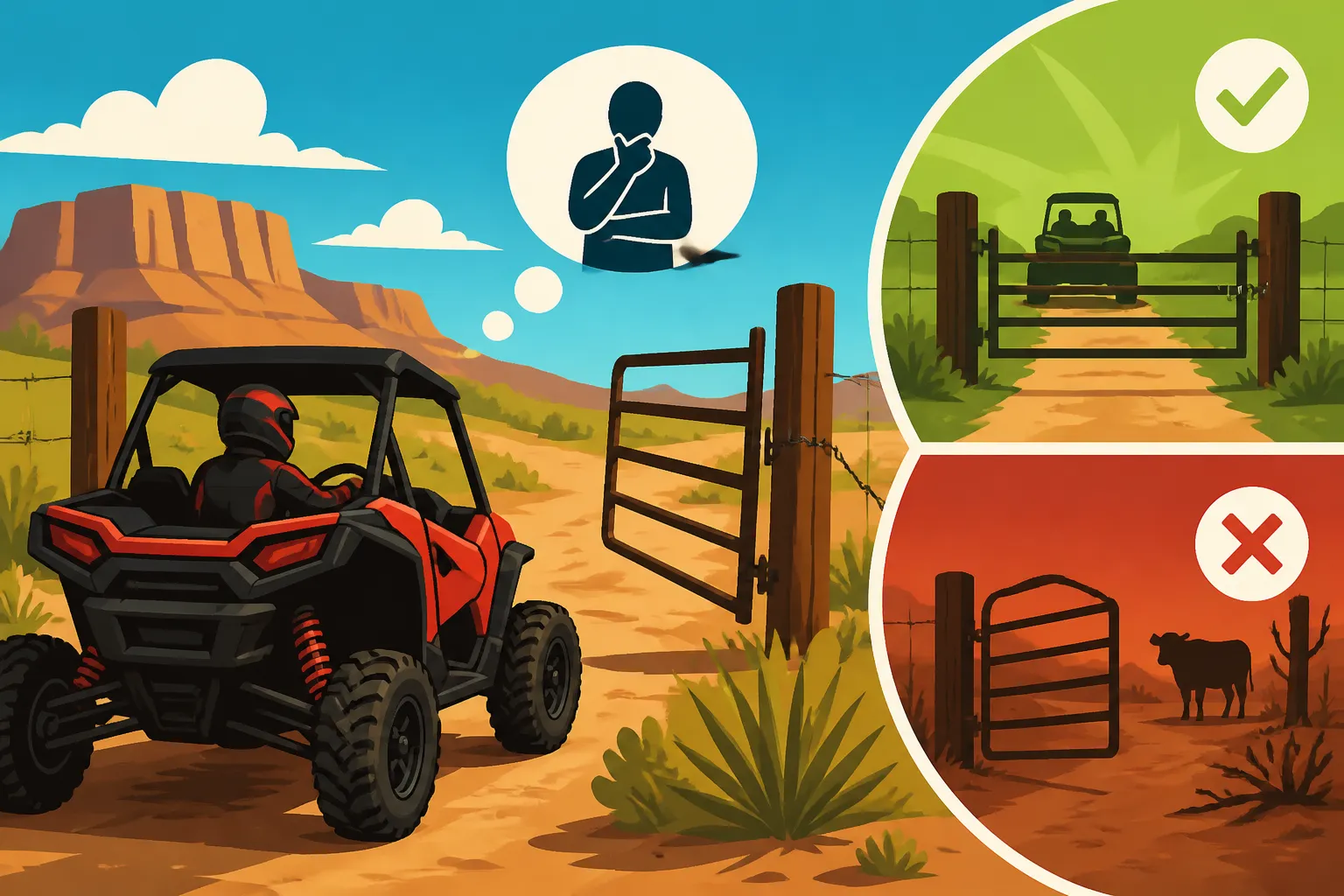
When you roll up to an open gate, the immediate thought might be, "Great, less work for me!" But hold on a moment. An open gate doesn't always mean it should be open. It could mean someone ahead of you forgot to close it, or perhaps a rancher or land manager just passed through and hasn't had a chance to return yet. The key is to assess the situation and look for clues.
Consider the context: Are you deep in a grazing pasture where stray cattle would be a major problem? Is it an area known for wildlife migration? Is there a designated [New Mexico Rules for Riding a Grazing Allotment]? If the area clearly benefits from gates being closed, then an open gate should raise a flag. On the other hand, if you're on a main arterial dirt road, and the gate leads to a lesser-used track, it might be intentionally left open. However, this is rarer than you might think. A good rule of thumb is that if a gate exists, there's a reason for it. Often, that reason implies it should be closed.
When to Close an Open Gate
So, you've found an open gate. When should you definitely close it? The answer, more often than not, is almost always. If there are no obvious signs indicating the gate must remain open (like a permanent "leave open" sign, which is incredibly rare), then you should proceed with caution and assume it needs to be closed.
Here's a mental checklist:
- Is there livestock present or evidence of livestock (e.g., fresh tracks, droppings)? If yes, close the gate immediately after passing through. [New Mexico Rules for Riding Near Livestock] dictate a level of respect for these animals and their caretakers.
- Are you on a ranch road or entering/leaving a specific pasture? If so, it's highly probable the gate should be closed. Ranchers depend on these gates to manage their herds and prevent them from wandering off.
- Is it a designated public land route where gates are typically closed for resource management? Many BLM and Forest Service roads will have gates that are routinely closed to prevent vehicles from entering sensitive areas or to protect new growth.
- Are there any signs suggesting the gate's status? Look for small, handwritten notes, or official land management signs. If none, defaulting to closed is usually the safest bet.
When you decide to close an open gate, make sure you secure it properly. Latch it, chain it, or whatever mechanism is in place, as if you were the one opening it in the first place. You don't want to be the reason for an escape!
The Rare Exceptions: When an Open Gate Stays Open
While the "close what you open" rule is paramount, there are a few very specific, rare situations where an open gate should remain open. These are usually indicated by clear, unmistakable signage or context.
- Explicit Signage: The most definitive exception is a sign specifically stating, "Leave Gate Open" or "Do Not Close Gate." If you see this, trust the sign. These are often placed by land managers during periods of heavy use, construction, or when a specific area is designated for continuous access that doesn't conflict with other land uses.
- Active Work Crews: If you see heavy equipment, utility vehicles, or fencing crews actively working nearby, and they've left a gate open for continuous passage, it might be best to leave it open. However, use common sense. If they're a mile down the road and the gate leads into a critical grazing area, it’s still probably better to close it. You can always ask if you see them.
- Damaged or Non-Functional Gates: Occasionally, you'll encounter a gate that is clearly broken, lying on the ground, or simply cannot be closed or latched properly. In these cases, you can't close what's broken. However, it's a good idea to report such a gate to the relevant land management agency (BLM, Forest Service, state land office) or, if it appears to be private property, a local rancher if you can safely make contact. This helps ensure it gets repaired and doesn't become a continuous problem. Sometimes SuperATV might have heavy-duty gate components or repair kits that could even be useful for trail maintenance groups, but for the individual rider, reporting is the best action.
When in doubt, always default to closing the gate. It shows respect for the land, the wildlife, and the people who work and live there. It's about being a responsible steward of the trails and ensuring continued access for all.
How Your Actions Impact Trail Access and Relationships
Every time we ride, we're ambassadors for the OHV community. The way we treat the land, the trails, and especially things like gates, directly influences how we're perceived by landowners, land managers, and other users. Leaving a gate open that should have been closed isn't just a minor oversight; it can have significant ripple effects that impact everyone's ability to enjoy New Mexico's beautiful backcountry.
The Consequences of Leaving a Gate Open
Imagine the scenario: a rancher relies on a series of gates to keep their cattle rotating through different pastures. You, or someone ahead of you, finds a gate open and, thinking nothing of it, leaves it that way. What could happen?
- Stray Livestock and Property Damage: The most immediate and often costly consequence is livestock escaping. Cattle can wander onto roads, causing accidents that put drivers and animals at severe risk. They can enter crops, pastures they shouldn't be in, or even travel miles away, requiring immense effort and expense for the rancher to round them up. This isn't just an inconvenience; it can be a significant financial hit, especially if animals are injured or lost. This is why [New Mexico Rules for Opening a Gate] exist and should always be observed carefully.
- Erosion of Trust: Each incident of a gate left open erodes the trust between the OHV community and landowners or land management agencies. Ranchers might, understandably, become frustrated and begin to lobby for restricting or even closing off access to their lands. If this happens repeatedly across different areas, it can lead to widespread closures, impacting all of us. No one wants to see a "No Trespassing" sign go up on a favorite route because of a few careless actions.
- Increased Management Burden: Land management agencies have limited resources. If they constantly have to send staff out to close gates or deal with issues caused by improper gate management, it diverts funds and personnel from trail maintenance, mapping, or other projects that benefit riders. This can lead to less support for OHV recreation overall.
- Legal Implications: In some cases, intentionally leaving a gate open or failing to close one could be considered trespassing or property damage, particularly if it leads to direct losses for a landowner. While it might be an honest mistake, the impact can still be severe, and penalties could follow. [New Mexico Fines for an Unregistered OHV] are one thing, but fines related to property damage or trespassing can be far more complex.
Building Positive Relationships Through Responsible Actions
Conversely, when you consistently act responsibly, you help build a positive reputation for the entire OHV community. Every time you stop, assess an open gate, and make the correct decision to close it, you're contributing to this goodwill.
- Maintaining Access: By demonstrating respect for land rules and ranching operations, we help ensure that current access agreements remain in place and perhaps even encourage more opportunities for responsible riding. When landowners see that riders are careful and considerate, they are more likely to keep their gates open to recreational users.
- Community Respect: Being a responsible rider means being a good neighbor. It shows respect for the livelihoods of ranchers, the efforts of land managers, and the experience of other trail users. This fosters a more harmonious environment where everyone can enjoy the land.
- Setting an Example: If you're riding with a group, your actions set an example. Newer riders or those less familiar with gate etiquette will learn from your responsible behavior. This "pass it on" mentality is crucial for perpetuating good practices throughout the community. Many riders will even outfit their machines with practical accessories like those from SuperATV that can make it easier to dismount and secure gates, showing they're prepared for whatever the trail throws at them.
Remember, every single gate is an opportunity to reinforce positive perceptions of OHV recreation. It's a small action that carries a lot of weight in the larger picture of trail access and land use in New Mexico.
Practical Steps for Handling Any Gate Scenario
You've got the "why" and the "golden rule." Now let's talk about the practical, boots-on-the-ground steps you can take every time you encounter a gate, whether it's open or closed. Being methodical helps prevent mistakes and reinforces good habits.
Approaching and Assessing the Gate
The moment you see a gate, slow down. Don't just blast through because it's open. Take a moment to observe the surroundings.
- Reduce Speed and Stop Safely: Pull your ATV or UTV completely off to the side of the trail or road, ensuring you're not blocking passage for others and that your machine is stable. If you're riding with a group, make sure everyone behind you knows to stop as well.
- Look for Signage: This is crucial. Check the gate itself, fence posts, and nearby trees for any signs. You're looking for instructions like "Please Close Gate," "Leave Open," "Private Property," or specific land management rules. Sometimes these signs are small and easy to miss, so scan carefully. A sign indicating "No Trespassing" means turn around immediately; don't even think about entering.
- Observe the Environment:
- Livestock: Are there cattle, sheep, or horses visible in the pasture? Even fresh droppings or tracks can indicate their presence. If livestock are around, the gate is almost certainly meant to be closed. [What a Cattle Guard Marks on a Ranch Boundary] can give you clues about where livestock roam versus where roads are designed to prevent their crossing without a gate.
- Trail Condition: Does the trail beyond the gate look like an active road, or does it quickly disappear into overgrown brush, suggesting it's less traveled or perhaps leads to a restricted area?
- Recent Activity: Look for signs of recent human or vehicle activity. Fresh tire tracks, recent fence repairs, or equipment nearby might suggest a work crew just passed through.
Making the Decision: Close It or Leave It?
After your assessment, it's time to decide.
- Default to Closing: If there's no explicit sign telling you to leave it open, and especially if there's livestock or it's a ranching area, your default action should be to close the gate. It's always better to err on the side of caution and responsibility. This goes for both gates you open yourself and gates you find open.
- If a Sign Says "Leave Open": Respect the sign and pass through, leaving the gate as you found it (open). These signs are rare but exist for specific reasons, usually related to active management or continuous public access that doesn't interfere with other land uses.
- If the Gate is Broken: If a gate is completely non-functional or lying on the ground, you can't close it. Make a mental note of the location (GPS coordinates if possible) and the condition. Report this to the appropriate land management agency (e.g., BLM, Forest Service, New Mexico State Land Office) or a local rancher if you have contact information. This helps ensure repairs can be made promptly.
Executing the Gate Passage Safely
Once you've made your decision, execute the passage carefully.
- One Rider at a Time: If you're riding in a group, only one person should dismount to handle the gate. The rest of the group should wait patiently until the gate is clear.
- Dismount Safely: Always dismount your machine before handling a gate. Don't try to stretch or reach from your seat, as this can be unstable and dangerous. A good pair of boots and a clear path are all you need. Accessories like durable SuperATV grab handles can make getting in and out of your UTV easier and quicker when you're frequently stopping for gates.
- Pass Through and Close Securely: Once the gate is open (or was already open and you're now closing it), ride your machine through to the other side. Stop, and then get back off to close and secure the gate. Make sure all latches, chains, or wires are properly fastened, just as you would expect them to be.
- Confirm the Group is Through: If you're with others, wait until everyone has passed through before you close the gate. Once everyone is on the other side, then you can secure it.
| Scenario | Gate Condition | Recommended Action | Why? |
|---|---|---|---|
| Common Ranch/Grazing Land | Found Open | Close securely after passing. | Prevents livestock escape, respects rancher's property. |
| Common Ranch/Grazing Land | Found Closed | Open, pass through, then close securely. | Maintains integrity of pasture, follows the golden rule. |
| Public Land (BLM/Forest) | Found Open | Close securely after passing, unless clear signage states otherwise. | Prevents unauthorized access, protects sensitive areas, upholds land management rules. |
| Public Land (BLM/Forest) | Found Closed | Open, pass through, then close securely. | Ensures continued proper use of designated routes. |
| "Leave Open" Sign Present | Found Open | Leave open. | Respects explicit instructions from land managers. |
| "Leave Open" Sign Present | Found Closed | Open, pass through, then leave open. | Respects explicit instructions; someone likely forgot to leave it open. |
| Gate is Clearly Broken | Found Open/Closed | If unsafe to close/open, or unable to be secured, leave as is. Report location to authorities. | Prioritizes safety, informs land managers of needed repairs. |
| Active Work Crew Nearby | Found Open | Use judgment. If crew is actively using the gate, leave open. Otherwise, close. Communicate if possible. | Avoids interfering with work, but still prioritizes land management rules if crew is distant. |
By following these steps, you'll not only navigate New Mexico's trails safely but also demonstrate the highest level of respect and responsibility, helping to preserve OHV access for everyone.
Disclaimer
This article is for general informational purposes only and does not constitute professional advice. Laws, prices and regulations vary by location and change over time. Consult a qualified professional for guidance on your specific situation.