Why a Dirt Bike Cannot Use the Opt-In
It's incredibly frustrating when you see fellow off-highway vehicle (OHV) riders cruising down a paved road on their side-by-sides or ATVs, and you're left on the sidelines, wondering why your trusty dirt bike can't join in. Many New Mexico dirt bike enthusiasts assume there's a simple "opt-in" process, much like for other OHVs, but the reality is a bit more nuanced. This guide will clarify why dirt bikes face unique challenges in becoming street legal in New Mexico and what your actual options are.
Understanding New Mexico's "Opt-In" for OHVs
When we talk about New Mexico's "opt-in" for OHVs, we're primarily referring to the provisions that allow certain off-highway vehicles, like ATVs and UTVs, to gain limited access to public paved roads and highways. This isn't a blanket permission slip for every machine that rolls off-road; it comes with very specific legal and equipment requirements. For many ATV and UTV owners, this has been a game-changer, opening up new possibilities for riding directly from their campsite to a trailhead or even accessing certain town streets.
What the Opt-In Allows for ATVs and UTVs
For ATVs and UTVs, the opt-in provides a pathway to obtain a special "on-highway" decal or plate, often referred to as the [New Mexico's Green On and Off-Highway Decal]. This decal, combined with meeting certain equipment standards and carrying liability insurance, grants these machines permission to operate on designated paved roads, city streets, and county roads that have been opened to OHV use by local ordinance or resolution. It means you can often avoid trailering your machine long distances just to get to a different section of trail, offering a convenience that many riders deeply appreciate. This ability to legally transition between dirt and asphalt is a key reason why ATVs and UTVs have become so popular for exploring the diverse landscapes of New Mexico, from the sandy arroyos to the mountain passes.
The Core Problem: Dirt Bikes Don't Fit the Mold
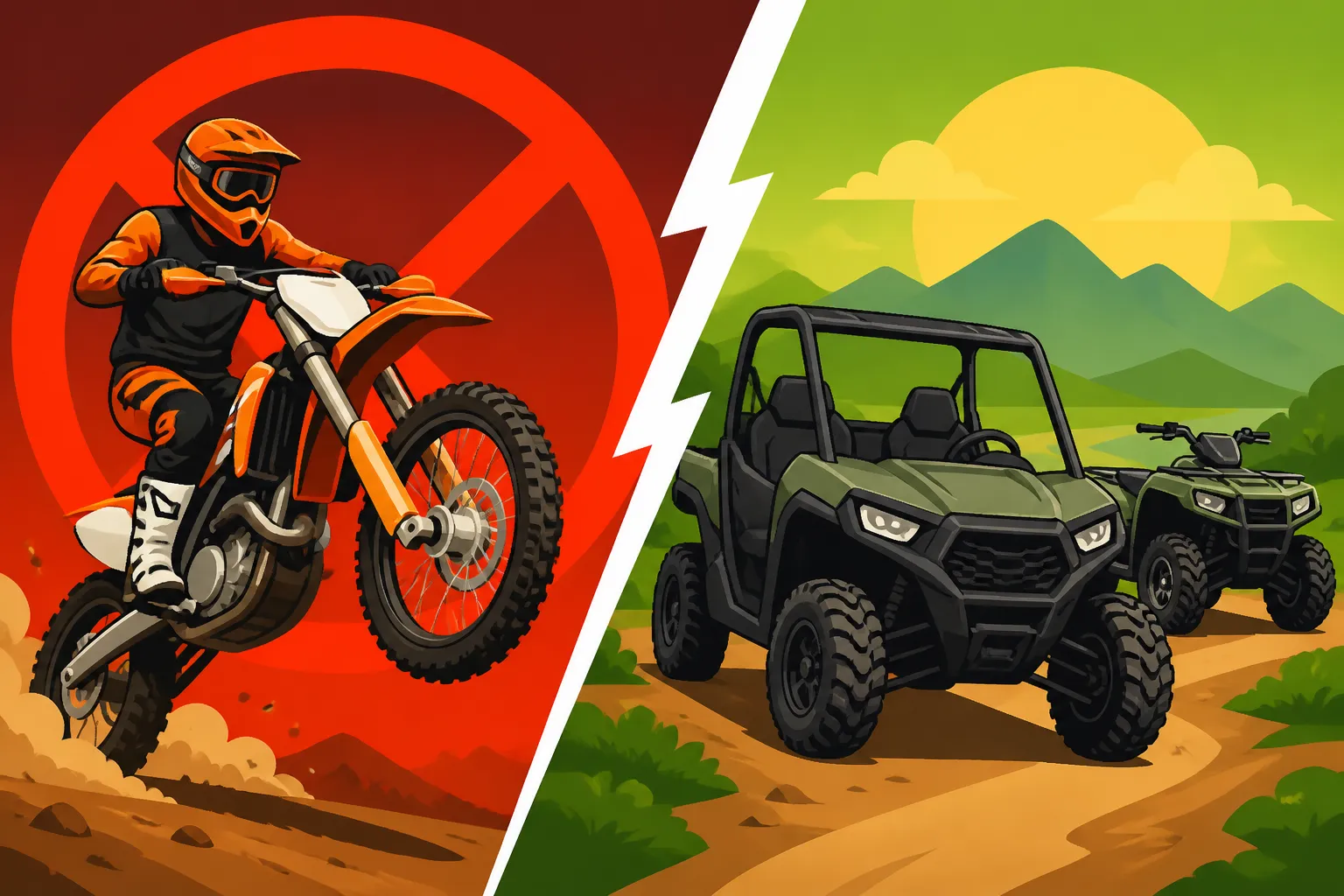
Here's where the frustration often begins for dirt bike riders. While the law outlines a path for ATVs and UTVs to gain paved road access, dirt bikes, which are technically "off-highway motorcycles" in the eyes of the law, are fundamentally excluded from this "opt-in" provision. It's not about what you want to do with your dirt bike; it's about how the law categorizes it and the inherent design differences that prevent it from meeting the same criteria. The legislative intent behind the opt-in focused on machines that could more readily be adapted to road safety standards and integrate with typical road traffic without extensive, often compromising, modifications. This distinction is crucial because it means that no matter how many modifications you might consider, the legal framework itself does not provide an "opt-in" for off-highway motorcycles to gain general paved road access.
Why Dirt Bikes Are Different in New Mexico Law
The legal distinctions for OHVs in New Mexico are rooted in their design, primary intended use, and the safety considerations for operating them alongside traditional motor vehicles on paved surfaces. While all OHVs are designed for off-road adventure, dirt bikes present unique challenges when it comes to meeting street-legal requirements, both practically and legally. It’s not simply a matter of adding a headlight; it’s about a fundamental difference in classification and engineering.
Design and Legal Classification of Dirt Bikes
In New Mexico, a dirt bike is officially classified as an "off-highway motorcycle." This distinction is critical because laws are often written with specific vehicle types in mind. Dirt bikes are built for agility, lightweight performance, and rugged off-road conditions. Their suspensions are designed for absorbing huge impacts, their tires are knobby for maximum grip in loose terrain, and their overall footprint is narrow to weave through tight trails. These characteristics, while perfect for the backcountry, often conflict with the requirements for safe and predictable operation on paved roads. For instance, the very design that makes a dirt bike excellent on trails—minimalist lighting, lack of mirrors, aggressive knobby tires—is what makes it unsuitable for road use in the eyes of the law.
Specific Equipment Requirements Dirt Bikes Lack
New Mexico law mandates a comprehensive list of equipment for any OHV seeking paved road access, many of which dirt bikes simply do not possess, nor are they easily or practically adaptable to include. These requirements are in place to ensure rider safety and the safety of other motorists. Here's a breakdown of some key areas where dirt bikes typically fall short:
- Headlights and Taillights: While most dirt bikes have some form of headlight and taillight, they often don't meet the brightness, visibility, or mounting standards required for road use, such as the [New Mexico Headlight and Taillight Rules]. A road-legal headlight needs to illuminate the road ahead for a specified distance, and a taillight must be visible from a significant distance behind. Dirt bike lights are often designed for rudimentary trail illumination, not road-going visibility.
- Brake Lights: A functioning brake light that activates when either the front or rear brake is applied is mandatory. Many older or race-oriented dirt bikes might only have a constant taillight, lacking a pressure-activated brake light switch.
- Turn Signals: One of the most significant omissions is the lack of turn signals. For a vehicle to operate safely in traffic, clear indication of turns is essential. Adding robust, road-legal turn signals to a dirt bike often requires significant wiring changes and can be prone to damage in off-road environments.
- Mirrors: At least one rearview mirror, typically on the left side, is required to maintain situational awareness in traffic. Dirt bikes are rarely equipped with mirrors from the factory, and aftermarket options can be flimsy or poorly positioned for road use. [New Mexico Mirror Requirements for Road Use] specify what's needed.
- Horn: A functional horn is necessary for alerting other drivers to your presence. While some dirt bikes have a small horn, it might not meet the decibel level required for a road-legal vehicle.
- Tires: Knobby off-road tires, while superb for dirt, are notoriously poor on pavement, offering limited grip, accelerating wear, and affecting handling. Road-legal machines require DOT-approved tires designed for paved surfaces. Switching back and forth is impractical for a rider who wants to do both, and running street tires off-road significantly compromises performance and safety.
- Muffler and Spark Arrestor: While spark arresters are critical for preventing wildfires on public land, and most dirt bikes have them, the muffler system also needs to adhere to sound limits, specifically the [New Mexico's 96 Decibel Ceiling]. Many performance-oriented dirt bike exhausts exceed this limit.
- Width Restrictions: Although more pertinent to UTVs, the underlying intent of road-legal OHV laws often considers the width of the vehicle in relation to traffic lanes. Dirt bikes, being much narrower, face a different problem: their compact size makes them less visible and less stable in a mixed traffic environment.
These combined requirements highlight why dirt bikes don't easily translate to street-legal status. It’s not just an oversight in the law; it’s a recognition of the inherent design philosophy of these machines.
The Mechanical and Practical Hurdles for Dirt Bikes
Beyond the legal definitions, there are very real mechanical and practical challenges that make street-legal conversion for a dirt bike in New Mexico a complex, expensive, and often self-defeating endeavor. These aren't just minor modifications; they often involve fundamentally altering the machine's intended purpose and characteristics.
Impracticality of Extensive Modifications
Imagine trying to take your lightweight, high-performance dirt bike and add all the necessary street-legal components. You'd be looking at a significant overhaul:
- Wiring Harness Overhaul: To support turn signals, proper headlights, taillights, brake lights, and a horn, you'd likely need to replace or heavily modify the existing electrical system. Dirt bikes are designed for minimal electrical load. Adding a robust charging system capable of handling continuous road lighting and accessories can be a major undertaking.
- Mounting Points: Where do you securely mount mirrors and turn signals that won't snap off the first time you hit a tree branch on the trail? The plastic bodywork and minimalist frame of a dirt bike aren't designed for these additions. Even if you manage to install them, they are often bulky, susceptible to damage, and can hinder the bike's off-road maneuverability.
- Tire Compromise: If you put DOT street tires on your dirt bike to make it road legal, you immediately compromise its off-road capability. Those aggressive knobbies are what give you traction in mud, sand, and loose rock. Street tires will be slippery and dangerous in those conditions. Conversely, riding knobby tires on pavement wears them out incredibly fast, reduces grip significantly, and makes for a very uncomfortable, unstable ride at road speeds. There's no good compromise here for a true dual-sport experience within the dirt bike category.
- Suspension and Ergonomics: Dirt bike suspension is tuned for high-speed bumps and jumps, not smooth asphalt. Riding on the street, this can feel overly soft and bouncy, or conversely, too stiff depending on the specific setup. The ergonomics – the seating position, handlebar height, and footpeg placement – are all optimized for aggressive off-road riding, which can be fatiguing and awkward for extended paved road use.
These modifications often lead to a "jack of all trades, master of none" scenario, where your dirt bike becomes less capable off-road and still not truly ideal or legally permissible on pavement.
The Contrast with UTV Conversions and SuperATV
When we discuss street-legal conversions for OHVs, the conversation almost always leans heavily towards UTVs (Utility Terrain Vehicles) and sometimes ATVs. This is where companies like SuperATV truly shine, offering an extensive range of conversion kits. They provide windshields, mirrors, turn signal kits, horns, and even DOT-approved tires and full cabs that transform a UTV into a road-ready machine, often meeting or exceeding the [New Mexico Equipment Rules for Road Use].
The reason this works so well for UTVs is that their fundamental design is much closer to that of a small car or utility vehicle. They have a wider stance, often come with more robust electrical systems, and have more readily available mounting points for road-specific accessories. Their cabin design, even if open-air, lends itself to the addition of safety features like windshields and wipers. Many UTVs already have features like independent suspension and more stable handling characteristics that make them adaptable for paved road use.
Dirt bikes, on the other hand, are a different animal. Their lean, agile design, open frame, and emphasis on minimal weight mean that the solutions SuperATV offers for UTVs simply aren't applicable. There isn't a widely available, legally compliant, and practical "dirt bike street legal kit" in the same way, because the starting platform is so fundamentally different. This stark contrast further underscores why the New Mexico "opt-in" applies to the larger, more car-like OHVs and not to off-highway motorcycles.
What Are a Dirt Bike Rider's Options in New Mexico?
So, if your dirt bike can't use the New Mexico "opt-in" for general paved road access, what can you do? The good news is that New Mexico is an incredible state for off-road riding, and there are plenty of legal ways to enjoy your dirt bike, even if you have to leave the long paved stretches to other types of OHVs.
Legal Places to Ride Your Dirt Bike
New Mexico boasts a vast amount of public land managed by agencies like the Bureau of Land Management (BLM) and the U.S. Forest Service, which offer incredible opportunities for dirt biking. These areas are your primary playgrounds:
- Designated OHV Areas: Places like Red Sands OHV Area near Alamogordo, Glade Run Recreation Area near Farmington, and Haystack Mountain OHV Area offer miles of designated trails and open riding areas perfectly suited for dirt bikes. Many of these areas are specifically managed for OHV recreation and provide varied terrain for all skill levels.
- National Forests and BLM Land: Large portions of New Mexico's National Forests, such as the Carson National Forest near Red River, and vast tracts of BLM land across the state, offer extensive trail systems and forest roads. Riders can explore these areas, but it's crucial to stick to designated routes and obey all posted signs and seasonal closures. Always check with the local land management office for specific rules and current conditions before heading out. For more on this, check out [New Mexico Rules for Riding a Forest Road] and [New Mexico Rules for Riding BLM Land].
- Private Land with Permission: If you have access to private land and the owner's explicit permission, you can ride your dirt bike there. This is often the case for ranch hands or those with private property suitable for riding.
- County Roads (Unpaved): While you can't generally ride on paved county roads, many counties have extensive networks of unpaved, dirt, or gravel roads. These are often open to OHV use, but you must confirm local ordinances. Always assume a road is closed unless explicitly signed or stated as open for OHVs.
The key takeaway here is that while the open road might be off-limits, the wide-open spaces of New Mexico are absolutely not. You just need to plan your route and mode of transport to these areas.
Trailering to Your Riding Destination
Since your dirt bike cannot legally use paved roads for general travel, trailering becomes your essential mode of transport to and from designated riding areas. This is the common practice for most dirt bike enthusiasts, ensuring you get your machine to where it can be ridden legally and safely.
- Safety and Convenience: Loading your dirt bike onto a trailer or a truck bed is the safest and most convenient way to transport it. It keeps your machine off public roads where it's not permitted and allows you to carry all your gear, fuel, and supplies.
- Accessing Remote Areas: Many of the best dirt biking spots in New Mexico are in remote locations, accessible only by paved roads that are off-limits to your bike. Trailering allows you to reach these hidden gems and unload directly at a trailhead or staging area, ready for adventure.
- Avoiding Fines: Riding an unregistered or non-street-legal dirt bike on a paved road can lead to significant fines and even impoundment. Trailering eliminates this risk entirely, giving you peace of mind.
Limited Paved Road Crossing and What It Means
There is one very specific, limited instance where an off-highway vehicle, including a dirt bike, may interact with a paved road in New Mexico: for a perpendicular crossing.
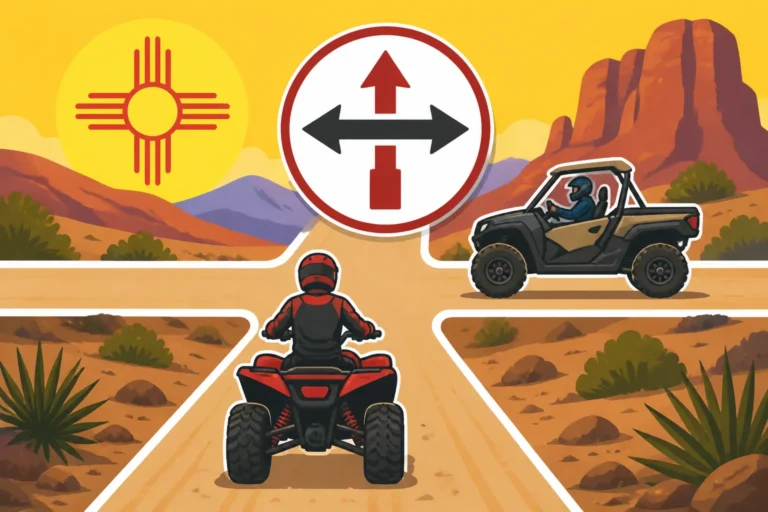
- The Perpendicular Crossing Rule: New Mexico law allows an OHV to cross a paved public road or highway at a right angle (perpendicularly) if you are moving from one off-road area to another. This isn't permission to ride down the road, but merely to get across it.
- Safety First: Even for a perpendicular crossing, you must yield to all oncoming traffic, come to a complete stop before entering the roadway, and make the crossing as quickly and safely as possible. [New Mexico Rules for Crossing a Highway] detail these requirements. You still need to ensure your machine is registered with the state (even if just for off-highway use) and that you're wearing appropriate safety gear. This rule is designed for situations where an existing trail is bisected by a road, not as a loophole for general road use.
- No Green Decal for Dirt Bikes: While ATVs and UTVs might get a green decal allowing them to travel on paved roads in certain open areas, dirt bikes do not have this option. The [Why the Yellow Decal Keeps You Off Pavement] rule for dirt bikes means they are strictly for off-highway use, with the exception of the quick perpendicular crossing.
Ultimately, while the desire to ride your dirt bike on paved roads in New Mexico is understandable, the state's laws and the inherent design of off-highway motorcycles create clear boundaries. Embracing the extensive trail systems and off-road parks by trailering your machine remains the best and only legal way to experience the thrill of dirt biking in the Land of Enchantment.
| Feature / Requirement | Typical ATV / UTV (Street Legal Opt-In) | Typical Dirt Bike (Off-Highway Motorcycle) |
|---|---|---|
| Legal Classification | Off-highway vehicle, can 'opt-in' for limited street access | Off-highway motorcycle, no 'opt-in' for general street access |
| Primary Use | Recreation, utility, adaptable for limited road travel | High-performance off-road racing/recreation |
| Headlights | Full-size, often dual, meeting road visibility standards | Minimalist, single, for basic trail illumination |
| Taillights & Brake Lights | Distinct taillight & brake light, visible from distance | Often integrated, minimal brightness, brake light may be absent |
| Turn Signals | Required, often integrated into conversion kits | Absent, significant wiring and mounting issues for adding |
| Mirrors | Required (at least one left-side), robustly mounted | Absent, aftermarket options often flimsy or impractical |
| Horn | Required, audible over traffic | Often small or absent, may not meet decibel standards |
| Tires | DOT-approved street tires or versatile hybrid tires | Aggressive knobby tires, poor traction/wear on pavement |
| Width | Generally 50+ inches, offering stability in traffic | Typically 30-38 inches, less stable, less visible in traffic |
| Suspension | Tuned for mixed terrain, more stable for varied speeds | Tuned for rough terrain, jumps; less comfortable/stable on pavement |
| Paved Road Access | Yes, with specific decal/plate, insurance, and equipment | No, only perpendicular crossing of roads permitted |
Disclaimer
This article is for general informational purposes only and does not constitute professional advice. Laws, prices and regulations vary by location and change over time. Consult a qualified professional for guidance on your specific situation.